Neurodermatitis: Breaking the Itch-Scratch Cycle

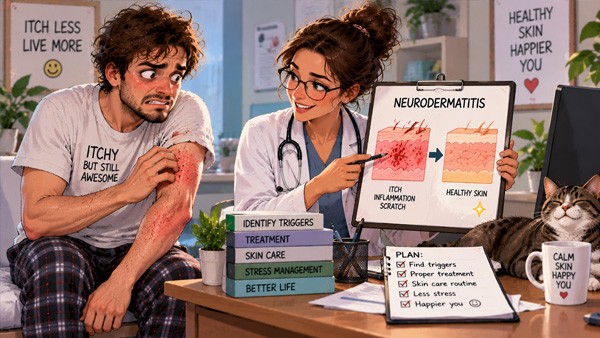

The word covers two related things, and separating them at the start makes everything else clearer.
Localised neurodermatitis is one or a few thickened, leathery, intensely itchy patches produced by years of rubbing and scratching the same spot. Diffuse neurodermatitis is what most of the world now calls atopic dermatitis or eczema — a widespread, relapsing condition usually beginning in childhood and often accompanied by asthma or hay fever.
They share a mechanism, and it is that mechanism rather than the label that determines what works.
🔁 Scratching is not a response to the problem. It is the engine of it. Scratching relieves itch for a few seconds because it activates pain pathways that temporarily suppress the itch signal. What it also does is damage the skin barrier, release inflammatory mediators from the damaged cells, and thicken the skin — all of which make the next itch stronger and easier to trigger. Over months this becomes self-sustaining, so that the patch continues to itch even after whatever originally started it has long gone. Breaking that loop is the treatment, and everything below serves it.
🧱 The barrier that leaks
Healthy skin is a sealed wall — cells packed in a lipid mortar, holding water in and keeping irritants, allergens and bacteria out.
In eczema-prone skin that wall is faulty. A substantial proportion of people with atopic dermatitis carry a variation in the gene for filaggrin, a protein essential to building the barrier and to producing the skin’s own natural moisturising factors. Less filaggrin means a leakier barrier.
Two consequences follow directly. Water escapes, so the skin is chronically dry — not from lack of drinking but from failing to retain what it has. And irritants, allergens and bacteria get in, provoking immune responses that would not otherwise occur.
This explains why moisturising is treatment rather than cosmetic. Restoring the barrier is not a supportive measure alongside the real treatment; in eczema it is a substantial part of the real treatment.
It also explains the sequence known as the atopic march: a leaky barrier in infancy allows allergens through the skin, which appears to prime allergic responses, so eczema is often followed by food allergy, asthma and hay fever in that order.
🔍 What it looks like
| Localised | Diffuse, atopic | |
|---|---|---|
| Extent | One or a few well-defined patches | Widespread, poorly defined |
| Appearance | Thickened, leathery, exaggerated skin lines, often darker than surrounding skin | Red, dry, scaly; weeping and crusting when acute |
| Typical sites | Nape of the neck, ankles, wrists, shins, genital and anal skin | Inner elbows and behind the knees in children and adults; face and outer limbs in infants |
| Onset | Any age, often adults | Usually childhood |
| Associations | Stress, habit, sometimes an original trigger long resolved | Asthma, hay fever, food allergy, family history |
| Course | Persists as long as the scratching does | Relapsing and remitting over years |
Itch dominates both, and in both it is characteristically worse at night. Partly the distractions of the day are gone; partly skin temperature and blood flow rise in the evening; and partly a great deal of the scratching happens during sleep, unconsciously, so people wake to fresh damage they have no memory of causing.
🎯 What sets it off
Soap and detergents are the most frequent and most correctable trigger. They strip the lipids the barrier depends on, so ordinary soap, bubble bath and shower gel actively worsen the condition. A soap substitute is a genuine intervention, not a refinement.
Heat and sweat, including overheated rooms, heavy bedding and hot showers.
Rough fabric, wool in particular. Cotton next to the skin, and washing new clothes before wearing.
Dry air, especially in winter with indoor heating.
Stress, which genuinely worsens it through immune and behavioural routes both — scratching increases under stress, often without awareness.
House dust mite in a proportion of people, and pets.
Infection, which frequently causes what looks like an unexplained severe flare.
🧴 Emollients, and the quantity almost nobody uses
This is the foundation, it is boring, and it is the single most under-done part of treatment.
How much. The quantities recommended for widespread eczema are far larger than people expect — for an adult, in the region of half a kilogram a week. Most people use a small fraction of that and conclude moisturising does not help. A tub that lasts a month is not being used at treatment quantities.
How often. At least twice daily, and more on dry skin. Always within a few minutes of bathing, while the skin is still damp, which is when it holds water best.
How. Smoothed on in the direction hair grows rather than rubbed in vigorously, which irritates and can block follicles.
Which. Greasier preparations hold water better and are less cosmetically pleasant, which is the trade-off. The best emollient is the one that will actually be applied often enough — many people use an ointment at night and a lighter cream during the day.
Instead of soap, not alongside it. A leave-on emollient or a dedicated soap substitute used for washing. Note that some older aqueous preparations sold as moisturisers contain a detergent and are irritating when left on the skin — they are wash products, not leave-on ones.
Keep it up between flares. Emollients prevent flares as well as treating them, and the commonest pattern is diligent use while the skin is bad and abandonment as soon as it improves.
💊 Topical steroids, and the fear of them
Steroid creams and ointments reduce the inflammation driving the itch, and used properly they are effective, fast and safe. They are also the treatment people are most afraid of.
⚠️ Undertreated eczema does more harm than appropriately used steroids. Concern about skin thinning is widespread and it is largely a fear of the wrong scenario. Thinning comes from prolonged, continuous use of potent steroids on thin skin — the face, eyelids, skin folds — not from short courses of appropriate strength on the right site. Meanwhile the person applying a fraction of what was prescribed, for half as long as directed, ends up with months of unrelieved itch, sleepless nights, broken skin, infections and scarring from scratching. Using enough for long enough to actually clear the skin is safer than the alternative.
Strength depends on site. The skin of the face, eyelids and folds is thin and absorbs readily, so only mild preparations belong there. The trunk and limbs tolerate moderate to potent. The palms, soles and thickened lichenified patches are almost impermeable and need potent preparations to have any effect at all.
How much to apply is measured in fingertip units — the amount squeezed from the tube along the last segment of an adult index finger, which covers about the area of two adult palms. It is more than most people apply.
Apply to inflamed skin, not everywhere. Emollient goes on everything; steroid goes on the affected areas.
Continue until the skin is genuinely clear, not until it looks slightly better. Stopping at the first improvement is the commonest reason for a flare a week later.
Consider continuing twice weekly afterwards. Applying steroid on two days a week to sites that habitually flare, once they have cleared, substantially reduces relapse. This is well supported and rarely offered.
🧪 About combined steroid and antibiotic preparations
Some products combine a topical steroid with an antibiotic, and they have a specific and limited place worth understanding.
They suit short courses on thickened, inflamed patches that are also infected or likely to be — typically weeping, crusted or broken skin on the body, and the lichenified plaques of localised neurodermatitis on the trunk or limbs, which need a potent steroid to respond at all.
Their limits are equally specific.
- Short courses only. Prolonged topical antibiotic use promotes resistance, and the antibiotic component is a recognised cause of contact allergy that then complicates the picture it was meant to help
- Not for the face, eyelids or skin folds, where a potent steroid does not belong
- Not for ongoing maintenance. Once the infection is dealt with, a plain steroid of appropriate strength is the right continuation
- Not a substitute for emollients, which continue throughout
Where infection is widespread or the person is systemically unwell, oral antibiotics rather than a cream are what is needed.
🦠 When it becomes infected
Eczematous skin is colonised by bacteria far more heavily than normal skin, and infection is a common cause of a flare that appears to come from nowhere.
Signs of bacterial infection: weeping, golden or honey-coloured crusting, pustules, increasing pain, sudden worsening despite treatment, and sometimes fever.
🔴 One infection is an emergency and needs recognising immediately. When the cold sore virus infects eczematous skin it spreads rapidly and can be serious. The signs are clusters of small uniform blisters or punched-out round erosions, all looking the same as each other, spreading over hours to days, with skin that is painful rather than itchy, alongside fever and feeling unwell. It requires urgent assessment and antiviral treatment, not a stronger steroid cream — steroids alone make it worse. Near the eyes it can threaten sight. Anyone with eczema who develops a rapidly spreading painful blistering rash should be seen the same day.
😴 Where antihistamines actually help
This is worth correcting because antihistamines are so often the first thing offered.
In eczema, histamine is not the main chemical driving the itch. It is one of several, and not the dominant one. Consequently the modern non-drowsy antihistamines — excellent for hay fever and hives, where histamine is the driver — do very little for eczema itch, and trials bear that out.
The older sedating antihistamines do have a role, and it is not the one people assume. They help by aiding sleep, which matters enormously when itch is causing repeated waking and unconscious night-time scratching. Breaking several nights of that cycle can produce real improvement in the skin.
So they are worth using for short periods where sleep is disrupted, understood as a sleep intervention rather than a skin treatment. They are not a substitute for emollients and topical treatment, and they do not treat the inflammation.
🍽️ About diet
Food is where the most avoidable harm happens in this condition.
Food allergy is genuinely relevant in a minority — principally infants and young children with severe eczema that is not controlling on proper topical treatment. In that group, formal assessment is appropriate.
In everyone else, elimination diets do harm. Removing major food groups from a child without a confirmed allergy causes nutritional deficiency and poor growth, and there is a further problem that is not widely known: avoiding a food a child previously tolerated can cause a true allergy to develop, so that reintroduction later provokes a reaction that would never have occurred. Several severe reactions have arisen exactly this way.
The practical position: do not remove foods on suspicion. If food is genuinely suspected, get it assessed properly first. And optimise the topical treatment before concluding that diet must be the answer, because inadequate emollient and undertreated inflammation explain far more failures than food does.
🔎 When it is not eczema
Several conditions are mistaken for it, and two of them are made distinctly worse by steroid creams.
| Condition | Clue |
|---|---|
| Scabies | Intense itch worse at night, other household members itching, involvement of finger webs, wrists, waistband and genitals. Steroids reduce the appearance while the infestation continues and spreads |
| Fungal infection | Often one-sided, with a raised advancing scaly edge and clearer centre. A steroid makes it spread while suppressing the redness, producing an atypical rash that is then very hard to recognise |
| Psoriasis | Well-demarcated plaques with thick silvery scale, favouring elbows, knees and scalp, and less itchy |
| Contact dermatitis | Confined to sites of contact, often with a shape suggesting the cause. Worth suspecting where eczema has changed pattern or stopped responding |
| Persistent single patch in an adult | An area that never fully clears despite adequate treatment warrants examination and sometimes a biopsy, since a small number of rarer skin conditions present this way |
The contact dermatitis possibility is worth taking seriously in anyone whose long-standing eczema changes character — including allergy developing to an ingredient in a cream that has been applied for years. The article on contact dermatitis covers that.
✋ Breaking the habit
For localised neurodermatitis in particular, scratching becomes automatic and continues independently of any remaining cause. Addressing that directly works.
Notice it. Most scratching happens without awareness. Simply counting episodes for a few days, or asking someone else to point it out, produces a surprising reduction on its own.
Substitute something. Pressing firmly on the patch, pinching adjacent skin, or clenching a fist for thirty seconds relieves the urge without causing damage.
Cover the area. A dressing or bandage over a lichenified patch prevents scratching, keeps treatment in contact with the skin, and breaks the cycle mechanically. This is one of the more effective simple measures.
Cut nails short, and consider cotton gloves at night, particularly for children.
Cool the skin. A cold compress, or emollient kept in the fridge, relieves itch immediately and does no damage.
Keep the bedroom cool, with light bedding and cotton nightwear.
🧗 When topical treatment is not enough
Where properly used emollients and topical steroids fail to control widespread disease, further options exist and are worth asking about rather than enduring.
Calcineurin inhibitor ointments suppress inflammation without steroid effects, which makes them particularly useful on the face, eyelids and folds and for long-term maintenance. A burning sensation on the first few applications is common and settles.
Phototherapy under supervision.
Tablet treatments that suppress the immune system, used for severe disease.
Newer targeted treatments — injected biological drugs and a class of tablets developed specifically for this condition — have changed outcomes for severe eczema substantially in recent years.
Referral for these is not a last resort in the sense of admitting defeat. Severe eczema wrecks sleep, education, work and mental health, and enduring it when effective options exist is not stoicism worth practising.
📋 The routine that works
Emollient at least twice daily, in genuine quantity, everywhere, always after washing, and continued when the skin is clear.
Soap substitute instead of soap, shower gel and bubble bath, for everyone in the household who shares a bath.
Short lukewarm baths or showers, and emollient within minutes of getting out.
Topical steroid of the right strength for the site, in adequate amount, continued until the skin is genuinely clear rather than merely better.
Consider twice-weekly application afterwards to sites that habitually flare.
Treat infection promptly, and recognise the one that is an emergency.
Cover lichenified patches to break the scratching.
Remove the correctable triggers — soap, wool, overheating, hot showers.
Deal with sleep, which is both a consequence and a driver.
Escalate if it is not controlled, rather than accepting it.
🩺 When to seek advice
- A rapidly spreading painful blistering rash with fever — same day, and urgently if near the eyes
- Weeping, golden crusting or pustules, or a sudden severe flare
- Not clearing despite proper emollient and topical steroid use
- Itch preventing sleep over more than a few nights
- Eczema affecting a child’s growth, schooling or behaviour
- A single patch that never resolves, particularly in an adult
- Other household members itching — consider scabies
- A rash that changed character or stopped responding to something that used to work
- Around the eyes, where potent steroids must not be used unsupervised
- Before removing foods from a child’s diet — always, rather than afterwards
Treatment is stocked in the skincare category, including Diprogenta (betamethasone with gentamicin) for short courses on thickened or infected patches on the body, and Bactroban (mupirocin) for localised bacterial infection. Sedating antihistamines such as Periactin (cyproheptadine) help sleep where itch is causing repeated waking, without treating the skin itself.
Scratching during sleep is often the hardest part of the itch-scratch cycle to break. A sedating antihistamine taken in the evening, such as Atarise (hydroxyzine), reduces the urge to scratch at night.
❓ Frequently asked questions
Why does scratching make it worse when it feels better?
Scratching relieves itch for a few seconds by activating pain pathways that temporarily suppress the itch signal. It simultaneously damages the barrier, releases inflammatory mediators from the damaged cells and thickens the skin, all of which make the next itch stronger and easier to trigger. Over months the loop becomes self-sustaining, so the patch keeps itching long after whatever started it has gone.
How much moisturiser should I actually be using?
Far more than most people do — for an adult with widespread eczema, in the region of half a kilogram a week. A tub lasting a month is not being used at treatment quantities. Apply at least twice daily and always within a few minutes of bathing while the skin is damp, smoothing it on in the direction hair grows rather than rubbing it in.
Will steroid creams thin my skin?
Thinning comes from prolonged continuous use of potent steroids on thin skin — face, eyelids, skin folds — not from adequate courses of appropriate strength on the right site. The more common outcome is the opposite problem: someone applying a fraction of what was prescribed for half as long, and living with months of itch, sleeplessness, broken skin and infection. Undertreatment does more harm.
How much steroid cream do I put on?
Measured in fingertip units — the amount squeezed along the last segment of an adult index finger, which covers roughly the area of two adult palms. It is more than most people apply. Put it on the inflamed areas only, while emollient goes everywhere, and continue until the skin is genuinely clear rather than stopping at the first improvement, which is the commonest reason for a flare a week later.
Why do antihistamines not help my eczema?
Because histamine is not the main chemical driving eczema itch — it is one of several and not the dominant one. That is why the modern non-drowsy antihistamines, which work well for hay fever and hives, do very little here. The older sedating ones do help, but by aiding sleep rather than by treating the skin, which matters when itch is causing repeated waking and unconscious night-time scratching.
When is a combined steroid and antibiotic cream appropriate?
For short courses on thickened, inflamed patches on the body that are also infected or likely to be — weeping, crusted or broken skin, and lichenified plaques needing a potent steroid to respond at all. Not for the face, eyelids or folds, not for ongoing maintenance, and not long-term, since prolonged topical antibiotic use promotes resistance and the antibiotic component itself commonly causes contact allergy.
What does an infected flare look like?
Weeping, golden or honey-coloured crusting, pustules, increasing pain, sudden worsening despite treatment, sometimes fever. Eczematous skin carries far more bacteria than normal skin, and infection is a common cause of a flare that seems to come from nowhere. Widespread infection or feeling unwell needs oral antibiotics rather than a cream.
Which rash is an emergency?
When the cold sore virus infects eczematous skin. The signs are clusters of small uniform blisters or punched-out round erosions all looking the same as each other, spreading over hours to days, with skin that is painful rather than itchy, alongside fever and feeling unwell. It needs urgent assessment and antiviral treatment, not a stronger steroid, which makes it worse. Near the eyes it can threaten sight.
Should I cut foods out of my child's diet?
Not on suspicion. Food allergy matters in a minority — mainly infants with severe eczema not controlling on proper topical treatment — and that group needs formal assessment. Otherwise elimination causes nutritional deficiency, and avoiding a food a child previously tolerated can cause a true allergy to develop, so reintroduction later provokes a reaction that would never have happened. Optimise the topical treatment first.
What else looks like this?
Scabies above all — intense night-time itch, other household members itching, finger webs and wrists involved — and steroids reduce the appearance while the infestation continues. Fungal infection is often one-sided with a raised advancing edge, and a steroid makes it spread while masking the redness. Also psoriasis, contact dermatitis, and in adults a single patch that never clears, which warrants examination.
How do I stop scratching in my sleep?
Cover the area, which is one of the more effective simple measures — a dressing over a thickened patch prevents scratching, keeps treatment against the skin and breaks the cycle mechanically. Also cut nails short, use cotton gloves at night particularly for children, keep the bedroom cool with light bedding, and treat the sleep disruption itself, since broken sleep both results from and drives the itch.
Nothing topical is working. What now?
First check the basics honestly — emollient in real quantity, soap substitute, adequate steroid strength for the site, continued long enough. If those are genuinely covered, further options exist: calcineurin inhibitor ointments for face and folds, phototherapy, immune-suppressing tablets, and newer targeted injected and oral treatments that have changed outcomes in severe disease substantially. Enduring it is not the only option.
📑 Sources and editorial
- NICE guidance on atopic eczema in children and on topical corticosteroid use
- American Academy of Dermatology guidelines for the management of atopic dermatitis
- Research on filaggrin loss-of-function variants and skin barrier dysfunction
- Literature on the itch-scratch cycle and lichenification in lichen simplex chronicus
- Studies of topical corticosteroid phobia and its effect on treatment adherence and outcomes
- Trials of proactive twice-weekly topical corticosteroid therapy for relapse prevention
- Cochrane review of oral antihistamines as add-on therapy for atopic eczema
- Evidence on food elimination diets in eczema and the risk of inducing IgE-mediated allergy
- Literature on eczema herpeticum recognition and management
- Guidance on topical antibiotic resistance and contact sensitisation with aminoglycosides
- Related reading: contact dermatitis, skin conditions overview
- Related products: skincare category
- RXshop Editorial Team — reviewed by Emily Chen, MD, MPH, Internal Medicine
Medical Disclaimer: The information in this article is for educational and informational purposes only and is not a substitute for professional medical advice, diagnosis, or treatment. Always seek guidance from a qualified healthcare provider with any questions you may have regarding a medical condition, and before starting, stopping or changing any medication.