Fainting in Children and Teens: When It Is Harmless and When the Heart Needs Checking

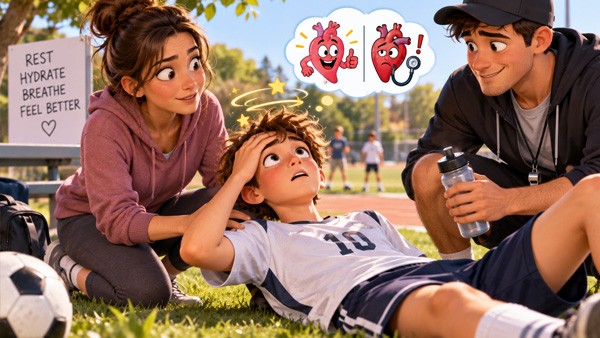

Few things frighten a parent more than watching their child go white and drop to the floor. The good news comes first: most fainting in children and teenagers is harmless. Up to one in five young people faint at least once before adulthood, most often in the teenage years, and nearly all of them are completely healthy.
The harder news is that a small number of faints are the first sign of a heart rhythm problem that can be dangerous. Those faints usually look different, and knowing the difference is the most useful thing a parent, teacher or coach can learn.
This guide explains why children faint, what to do in the moment, how to tell a faint from a seizure, the red flags that call for a heart check, and how recurring faints are prevented.
🧠 What happens in a faint
The brain needs a steady supply of blood. If blood pressure drops for a few seconds, the supply falls short and consciousness switches off. Falling flat is actually the body's rescue: once the head is level with the heart, blood reaches the brain easily again and the child wakes up, usually within a minute.
In most children the drop in blood pressure comes from a reflex. A trigger, such as standing for a long time, heat, pain or the sight of blood, sets off a nerve response that slows the heart and widens the blood vessels at the same moment. Doctors call this vasovagal syncope, or reflex fainting. It accounts for the great majority of faints in young people.
📋 The common, harmless kinds
| Type | Typical picture |
|---|---|
| Reflex (vasovagal) faint | Teenager standing in a hot assembly, at a blood test or after getting up quickly. Feels warm, sweaty, sick and lightheaded, vision greys out, then falls. Awake within a minute, tired afterwards |
| Standing-up faint | Lightheaded or faints on standing quickly, especially when dehydrated, unwell, hot, or after a growth spurt |
| Situational faint | Triggered by a specific act: hair brushing, coughing fits, passing urine, stretching, swallowing very cold drinks |
| Breath-holding spell | Toddler between about six months and six years cries hard or gets a sudden fright, holds the breath, turns blue or pale and goes limp for a few seconds. Frightening, harmless, and outgrown |
Breath-holding spells deserve a special mention because they are so often mistaken for seizures. They are linked to iron deficiency in some children, and treating low iron can make them less frequent.
⚠️ Warning signs before a faint
A reflex faint almost always gives notice, sometimes only seconds, sometimes a minute or more. Teaching a child to recognise these signs is the single best prevention:
- 😵 Lightheadedness or a floating feeling
- 🌡️ Feeling hot, then cold and clammy
- 🤢 Nausea or a sinking feeling in the stomach
- 👁️ Vision greying, narrowing or going black
- 👂 Sounds becoming distant or muffled
- 👻 Turning very pale — often the first thing others notice
🚑 What to do in the moment
📋 If a child feels faint: get them to lie down immediately, wherever they are, with legs raised on a bag or a chair. Lying down stops most faints before they happen. Sitting with the head between the knees works less well.
If a child has fainted: keep them lying flat with legs raised and loosen tight clothing. If they are not awake within about a minute, or they vomit, turn them onto their side into the recovery position. Do not sit them up quickly or make them stand. Give nothing to drink until they are fully alert. Then sit them up slowly, and let them rest before standing.
🔴 Call emergency services if the child:
- fainted during exercise or while swimming
- does not wake up within about a minute, or stays confused
- had chest pain or a racing heartbeat just before
- injured themselves badly in the fall
- is breathing abnormally or has no pulse — start CPR and use a defibrillator if one is available
🫀 Red flags: when the heart needs checking
Heart-related faints are rare in children, but they matter, because the underlying conditions can cause sudden cardiac arrest. They are usually caused by an inherited rhythm disorder, such as long QT syndrome, or by a structural heart problem such as a thickened heart muscle.
| Red flag | Why it matters |
|---|---|
| Fainting during exercise, especially mid-effort or in the water | The most important warning sign of a heart cause. A faint after stopping exercise is more often reflex |
| Fainting from a sudden loud noise or startle, such as an alarm clock | Typical of one form of long QT syndrome |
| Fainting while lying down | A reflex faint needs the child to be upright |
| No warning at all, with injury from the fall | Rhythm faints come on instantly |
| Palpitations or chest pain just before | Suggests the heart is the source |
| Family history of sudden unexplained death before 50, drowning, unexplained car accidents, or a known inherited heart condition | Many rhythm disorders run in families |
| Known heart disease or previous heart surgery | Raises the chance of rhythm problems |
| Deafness from birth together with fainting | Linked to a rare inherited long QT syndrome |
Any of these means the child should be seen by a doctor promptly, and not return to competitive sport until a heart cause has been ruled out.
⚖️ Faint or seizure?
A few jerking movements are common during an ordinary faint. They happen because the brain is briefly short of blood, and they do not mean epilepsy. That alone leads to many unnecessary seizure referrals. These differences help:
| Faint | Seizure | |
|---|---|---|
| Before | Warmth, sweating, nausea, greying vision | Often no warning, or a specific odd sensation |
| Colour | Very pale | May go blue or red |
| Movements | A few brief jerks, if any, lasting seconds | Rhythmic jerking often lasting a minute or more |
| Duration | Usually under a minute | Often longer |
| Afterwards | Quickly clear-headed, though tired | Confused and drowsy for many minutes |
| Tongue biting | Rare, and at the tip if at all | More common, on the side of the tongue |
A phone video of an episode is enormously helpful to the doctor, if someone can take one safely.
🔬 What the doctor will check
For a first faint, the most important tool is the story: what the child was doing, how they felt before, what witnesses saw, how quickly they recovered. The rest is usually simple.
- Heart and blood pressure examination, including readings lying down and standing
- An ECG (electrical heart tracing), recommended for essentially every child who has fainted. It is quick and painless and picks up many inherited rhythm problems
- Blood sugar and blood count when the story suggests fasting or anaemia
- Heart ultrasound, exercise test or a longer heart rhythm recording — only when there are red flags or an abnormal ECG
- Tilt table test — occasionally for frequent unexplained faints
Brain scans and EEGs are rarely needed for a typical faint.
👧 Fainting in teenagers
The teenage years are the peak time for fainting, particularly in girls. Rapid growth, skipped breakfasts, low fluid intake, long periods standing, hot rooms, heavy periods and late nights all play a part.
Some teenagers develop a pattern where standing makes the heart race and brings on lightheadedness, exhaustion and brain fog, sometimes with fainting. When the heart rate rises by 40 beats or more within ten minutes of standing, doctors call it postural orthostatic tachycardia syndrome, or POTS. It often follows a viral illness, and most teenagers improve over months to a few years with the same measures used for fainting.
Two other causes deserve attention in this age group. Restrictive eating lowers blood pressure and heart rate and causes fainting. It should never be put down to growing up without asking. Our guide to anorexia and the medical risks of under-eating explains why. Heavy periods can cause iron deficiency and anaemia, which make fainting more likely.
💧 Preventing repeat faints
For reflex fainting, the effective measures are practical ones.
- Drink more
- Teenagers often drink far less than they need. Around two litres a day, more in heat or with sport, makes a noticeable difference. Keeping a water bottle at school helps.
- A little more salt, if the doctor agrees
- Salt helps the body hold on to fluid. This is only advised after a check that blood pressure and kidneys are normal.
- Never skip breakfast
- Morning faints at school often follow an empty stomach.
- Counter-pressure moves
- At the first warning sign: cross the legs and squeeze the thigh and buttock muscles, clench the fists, or squat down. These push blood back towards the heart and can stop a faint in progress.
- Lie down at the first warning
- Children should know it is fine to lie on the floor in class or in a queue. Teachers should know this too.
- Plan for known triggers
- For injections and blood tests, lie down beforehand. Stand up slowly in the morning. Avoid standing still in heat for long periods.
💊 When medicine is considered
Most children never need medicine for fainting. For a small group of teenagers with frequent faints that continue despite fluids, salt and counter-pressure moves, a specialist may try one of two medicines:
| Medicine | How it helps | Things to watch |
|---|---|---|
| Fludrocortisone | Helps the kidneys retain salt and water, increasing blood volume | Low potassium, raised blood pressure, headache, fluid retention; blood tests are needed |
| Midodrine | Tightens blood vessels so blood pressure holds up when standing | Taken during the day only, never before lying down; can cause tingling of the scalp and goosebumps |
Both work modestly, and both are prescription medicines that need monitoring. In our catalogue they are available as Florinef (Fludrocortisone) and Gutron (Midodrine). Beta-blockers, once widely used, have not proved helpful for reflex fainting in trials.
🏫 At school, in sport and behind the wheel
It helps if the school knows about recurrent faints. That way staff understand that lying down is the right response, allow a water bottle in class, and have a plan for exams and assemblies. A child with a simple reflex faint can play sport normally. A child with any red flag should not, until a heart cause has been excluded.
Older teenagers learning to drive should discuss fainting with their doctor. Rules vary by country, and a faint with no warning signs is treated very differently from a typical reflex faint.
💭 When episodes do not fit the pattern
Occasionally, a young person has frequent episodes that look like fainting but last longer, happen with the eyes closed and are not accompanied by any drop in blood pressure. These episodes are real and not faked. They are a way the nervous system reacts to stress, and they respond well to understanding and psychological support. Dismissing them causes harm. So does endless testing once the heart has been checked.
📞 When to see a doctor
- Any first faint — a check-up and an ECG are worthwhile
- Any red flag from the table above — promptly, and no competitive sport meanwhile
- Faints becoming more frequent
- Lightheadedness most days on standing, with exhaustion
- Weight loss or restrictive eating
- Pale, tired child who may be anaemic
- Toddler with breath-holding spells — for reassurance and an iron check
❓ Frequently asked questions
Is it normal for a child to faint?
It is common, especially in teenagers, and most faints are harmless reflex faints triggered by standing, heat, pain or the sight of blood. A first faint is still worth a check-up with an ECG, and some features, such as fainting during exercise, always need prompt assessment.
What should I do when my child faints?
Keep them lying flat with legs raised and loosen tight clothing. If they are not awake within about a minute or they vomit, turn them onto their side. Do not sit them up quickly, and give nothing to drink until they are fully alert. Call emergency services if they fainted during exercise or do not wake quickly.
When is fainting in a child dangerous?
When it happens during exercise or swimming, while lying down, after a loud noise or startle, without any warning, with chest pain or palpitations beforehand, or when there is a family history of sudden unexplained death. These can signal a heart rhythm problem and need prompt assessment.
My child jerked during a faint. Is it a seizure?
Not necessarily. A few brief jerks are common in ordinary faints because the brain is briefly short of blood. A faint usually has warning signs, the child goes pale and recovers within a minute. A seizure tends to involve longer rhythmic jerking and confusion afterwards.
Why does my teenager keep fainting?
Most often because of low fluid intake, skipped meals, long periods standing, heat, rapid growth or heavy periods. Some teenagers have POTS, where standing makes the heart race. Restrictive eating is an important cause that should always be considered.
What are breath-holding spells?
Episodes in young children, usually between six months and six years, where crying or a sudden fright leads to holding the breath, turning blue or pale and going limp for a few seconds. They are frightening but harmless and are outgrown. Iron deficiency makes them more frequent in some children.
How can fainting be prevented?
Drinking enough, not skipping breakfast, standing up slowly and avoiding long standing in heat. At the first warning sign, lie down or use counter-pressure moves: cross the legs and tense the muscles, clench the fists or squat. Extra salt only with a doctor's agreement.
Is there a medicine for fainting?
Most children never need one. For teenagers with frequent faints despite fluids, salt and counter-pressure moves, a specialist may prescribe fludrocortisone or midodrine. Both have modest effects and need monitoring for side effects such as low potassium or high blood pressure.
Can a child who faints play sport?
A child with simple reflex faints can usually play normally, drinking plenty and resting when lightheaded. A child who has fainted during exercise, or who has any other red flag, should not play competitive sport until a heart cause has been ruled out.
Why is an ECG done after a faint?
An ECG is a quick, painless heart tracing that picks up many of the inherited rhythm disorders that can cause fainting and, rarely, sudden cardiac arrest. It is recommended for essentially every child who has fainted.
📑 Sources and editorial
- Guidelines on the diagnosis and management of syncope, including recommendations for children and adolescents
- Paediatric cardiology guidance on red flags for cardiac syncope and sudden cardiac death
- Reviews of breath-holding spells and their association with iron deficiency
- Consensus statements on postural orthostatic tachycardia syndrome in adolescents
- Trials of physical counter-pressure manoeuvres, fludrocortisone and midodrine in reflex syncope
- Guidance on distinguishing convulsive syncope from epileptic seizures
- Related reading: anorexia and medical risks of under-eating
- Related products: Florinef (Fludrocortisone), Gutron (Midodrine), cardiovascular category
- RXshop Editorial Team — reviewed by Robert Hayes, MD, Cardiology
Medical Disclaimer: The information in this article is for educational and informational purposes only and is not a substitute for professional medical advice, diagnosis, or treatment. Always seek guidance from a qualified healthcare provider with any questions you may have regarding a medical condition, and before starting, stopping or changing any medication.