Diabetic Kidney Disease: Why It Stays Silent for Years, and the Cheap Urine Test That Finds It Early

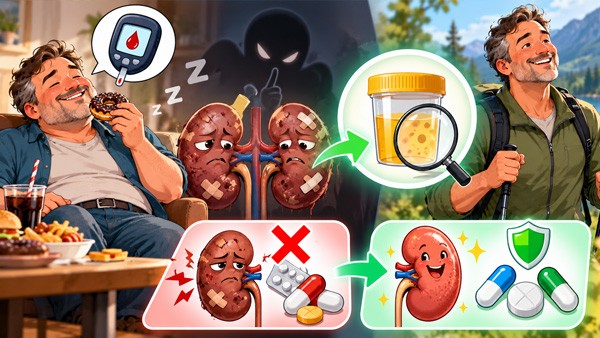

You feel fine. No pain, no swelling, nothing wrong with how you pass urine. Then a routine test comes back abnormal, and the doctor tells you your kidneys have been quietly taking damage for years.
That is how diabetic kidney disease is almost always found, because by the time it produces a symptom the window for stopping it has largely closed. Which makes this one of the few conditions where a cheap test you have never heard of matters more than anything you can feel.
💡 The two things worth taking from this page.
🔹 One urine test finds it years early. The albumin-to-creatinine ratio costs almost nothing, needs no preparation, and is the single most useful test in diabetes after the HbA1c. It should be done every year, and in a lot of people it never is.
🔹 Early damage can be stopped, and the drugs for it changed recently. Protecting the kidney is no longer only about lowering glucose. There is now a class of tablet that slows kidney decline directly, and it is one of the biggest changes in diabetes care in two decades.
🕶️ Why the kidney gives no warning
The kidney is built with enormous spare capacity. You can lose a great deal of filtering function before anything registers — no pain, no change in how much you pass, no change in how urine looks. People donate one kidney and live normally on the other, which tells you how much reserve there is.
Diabetic kidney damage spends that reserve slowly and silently. There are no nerve endings reporting the loss. Blood pressure creeps up, which you cannot feel either. And the filters that fail first are microscopic, so nothing visible changes.
By the time there is swelling in the ankles, foam on the urine, persistent tiredness or breathlessness, a large share of function is already gone and will not come back.
That is the whole argument for screening. Not caution, not thoroughness — simply that this condition has no early symptom to wait for.
🧪 The two numbers that matter
Kidney function in diabetes is tracked with two tests. They measure different things and you need both.
| Test | What it measures | Why it matters |
|---|---|---|
|
uACR urine albumin-to-creatinine ratio |
Protein leaking through the filters into urine | The early warning. Rises years before filtering function falls. This is the one that catches it in time |
|
eGFR estimated glomerular filtration rate |
How much blood the kidneys clear per minute, estimated from a blood creatinine level | The function number. Tells you how much capacity is left. Falls later, once damage is established |
Read them together. A normal eGFR with a raised uACR means early, treatable damage — and this is the commonest pattern at first diagnosis. A falling eGFR means established disease. Each one alone tells half the story, which is why a normal blood test is not reassurance on its own.
📊 What the urine number means
Units differ between laboratories, so both are given here.
| uACR | mg/mmol | mg/g | What it means |
|---|---|---|---|
| Normal | under 3 | under 30 | No detectable leak |
| Moderately increased | 3 to 30 | 30 to 300 | The critical stage. Early damage, often still reversible with treatment. Previously called microalbuminuria |
| Severely increased | above 30 | above 300 | Established disease. Progression can be slowed substantially but not undone. Previously called macroalbuminuria |
📌 Two practical points that cause a lot of confusion.
One abnormal result does not make a diagnosis. Albumin in urine rises temporarily with fever, a urinary infection, heavy exercise in the previous day, very high blood sugar, menstruation and heart failure. Confirmation needs two abnormal samples out of three, taken over three to six months.
Use a first-morning sample where possible. It is more reliable than one taken later in the day.
So if a result comes back abnormal, the next step is a repeat, not alarm.
📉 What the blood number means
eGFR is reported in mL/min per 1.73 m² and sorted into stages. Roughly, it reads as a percentage of normal function.
| Stage | eGFR | What it means in practice |
|---|---|---|
| G1 | 90 and above | Normal filtering. Damage possible if uACR is raised |
| G2 | 60 to 89 | Mildly reduced, common with age and often not disease by itself |
| G3a | 45 to 59 | Mild to moderate reduction. Drug doses start needing review here |
| G3b | 30 to 44 | Moderate to severe reduction. Closer monitoring, more drug restrictions |
| G4 | 15 to 29 | Severely reduced. Specialist kidney care, planning begins |
| G5 | below 15 | Kidney failure. Dialysis or transplant territory |
What matters more than any single value is the direction of travel across several years. A stable eGFR of 55 is a very different situation from one that has fallen from 85 to 55 in three years. Keep your own results, or ask for them, because the trend is the information.
📅 The screening schedule, and who is overdue
This is the part most often skipped, and it is cheap and specific.
- 🧪 uACR and eGFR every year — from the moment of diagnosis in type 2 diabetes, because damage may already be present at diagnosis, and from about five years after diagnosis in type 1
- 👁️ Retinal photography every year. Eye and kidney damage track together closely enough that one raises the suspicion of the other
- 🦶 Foot check every year — pulses and sensation, more often if either is abnormal
- 🩸 Blood pressure at every visit. In kidney disease this is as important as the glucose
- 🧫 Lipids, because cardiovascular disease kills more people with diabetic kidney disease than kidney failure does
- 🧪 HbA1c every three to six months depending on control
- 🧂 Potassium and sodium whenever a kidney-protecting drug is started or its dose changed
If you have had diabetes for years and cannot remember ever giving a urine sample for this, you are probably overdue. It is a reasonable thing to ask for by name: urine albumin-to-creatinine ratio.
🔬 What is actually going wrong
Each kidney contains roughly a million microscopic filters. Each one is a tuft of capillaries that lets water and waste through while holding back protein and blood cells.
High glucose damages these in several ways at once. The small vessels thicken and stiffen. Pressure inside each filter rises, and for a while the kidney compensates by filtering harder than normal — which looks like good function on a blood test while quietly accelerating the injury. Scar tissue accumulates. The filter barrier becomes leaky, which is why albumin appears in urine before function drops.
Two consequences follow from this, and both are practical.
First, a normal or even high eGFR early on can be falsely reassuring, because overworking filters produce good-looking numbers. The urine test sees through that.
Second, pressure inside the filter is a target in its own right. This is why blood pressure drugs that act on that pressure protect kidneys beyond what their effect on blood pressure alone would predict, and why the same principle is now used by a second class of drug.
🚨 The symptoms that mean it is already late
Listed not as a checklist to wait for, but so they are recognised if they appear.
- 🦵 Swelling — ankles and feet first, later around the eyes in the morning, later still the hands
- 🚽 Foam or froth on the urine that persists, which is heavy protein loss
- 😴 Tiredness that does not respond to rest, often with anaemia, which the kidney contributes to
- 🤢 Nausea, loss of appetite, a metallic taste
- 🦵 Itching without a rash
- 😮💨 Breathlessness, from fluid or anaemia
- 🌙 Night cramps and restless legs
- 🛏️ Passing urine more often at night
- 📉 Blood sugars suddenly running lower and insulin or tablet doses needing reduction — the kidney clears several diabetes drugs, so failing kidneys make them stronger. This one is easily mistaken for improvement
💊 The drugs that protect the kidney
Here is the part that has genuinely changed. For a long time protecting the kidney in diabetes meant controlling glucose and blood pressure and little else. There are now drugs that act on kidney decline directly.
| Class | What it does for the kidney |
|---|---|
|
SGLT2 inhibitors dapagliflozin, empagliflozin, canagliflozin |
Slow the fall in filtering function and reduce protein loss, by lowering pressure inside the filter. Benefit is largely independent of how much they lower glucose, and they also reduce heart failure. The main change in this field |
|
ACE inhibitors and ARBs ramipril, lisinopril, losartan, telmisartan |
The long-standing backbone. Reduce albumin leak and slow progression, again beyond their blood pressure effect. Standard whenever uACR is raised, even at normal blood pressure |
|
Non-steroidal mineralocorticoid antagonists finerenone |
Added on top of the above in type 2 diabetes with kidney disease to slow progression further. Needs potassium monitoring |
| GLP-1 receptor agonists | Reduce cardiovascular events and support weight loss, with kidney benefit emerging. Injected, and not stocked here |
| Statins | Do not protect the kidney, but address the risk that actually kills people in this group. See our guide to cholesterol and cardiovascular risk |
| Metformin | Still first line for glucose and safe well into reduced function, but the dose is adjusted by eGFR. Details below |
✅ A sulfonylurea is not on this list, and that distinction is worth understanding.
Glipizide, glimepiride and gliclazide lower blood glucose effectively, and lowering glucose does reduce small-vessel complications over the long term. But they have not been shown to protect the kidney or reduce cardiovascular events directly, and they carry a real risk of hypoglycaemia that rises as kidney function falls, because the kidney clears them.
They remain useful drugs. They are just not what you reach for when the goal is specifically protecting kidneys.
🚫 What harms the kidney, and is avoidable
Rarely discussed and genuinely useful, because most of it is under your control.
- 💊 Anti-inflammatory painkillers — ibuprofen, diclofenac, naproxen. Regular use is one of the commonest avoidable causes of decline. The risk is highest combined with an ACE inhibitor or ARB plus a diuretic, a combination sometimes called the triple whammy. Paracetamol is the safer choice for routine pain
- 💧 Dehydration — particularly with vomiting, diarrhoea, fever or heat, and particularly on an SGLT2 inhibitor or a diuretic
- 📷 Contrast dye for CT scans and angiograms. Tell the radiology department about reduced kidney function and about metformin. Hydration beforehand is often arranged
- 💊 Combining an ACE inhibitor with an ARB. This was once thought better and is now known to be worse, with more kidney injury and high potassium. One or the other, never both
- 💊 Certain antibiotics and antivirals at unadjusted doses. Always mention reduced kidney function when anything new is prescribed
- 💪 High-dose protein supplements and creatine, popular and unhelpful here
- 🚬 Smoking, which accelerates diabetic kidney damage specifically, not just generally
- 🍺 Heavy alcohol, through blood pressure and dehydration
- 🩺 Untreated high blood pressure, the single largest accelerant after glucose. See our guide to arterial hypertension
- 🚽 Repeated urinary infections left untreated, commoner in diabetes
💚 Dapagliflozin: how it works and what to expect
Dapavel (Dapagliflozin) belongs to the class that changed this field. It blocks a transporter in the kidney tubule, so glucose is passed out in urine instead of reabsorbed.
The interesting part is that its kidney benefit is not mainly about the glucose. Blocking that transporter changes the signal reaching each filter and lowers the pressure inside it, which is why the protective effect holds up even in people whose diabetes control is already good, and why the drug is used for chronic kidney disease in its own right.
- 📈 10 mg once daily, with or without food, at any time of day
- 📉 A small fall in eGFR in the first weeks is expected and is not harm. The curve flattens afterwards and ends up better than without the drug. This dip causes unnecessary alarm and sometimes unnecessary stopping
- 🚽 Passing urine more often at first, because glucose draws water with it. This usually settles
- ⚖️ Modest weight loss and a small fall in blood pressure, both generally welcome
- 🧫 Low risk of hypoglycaemia on its own, though the risk rises if combined with insulin or a sulfonylurea, and those doses may need reducing
📌 The side effect that makes people stop, and what to do about it.
Sugar in the urine feeds yeast, so genital thrush is the commonest problem on this class — itching, soreness, discharge, affecting both men and women. It is treatable and it is not a reason to abandon a drug this useful.
What reduces it: washing with water after passing urine, drying properly, and treating the first episode promptly rather than waiting. Recurrent episodes are worth discussing, but most people manage after the first one.
Also report promptly: pain, swelling or redness in the genital or perineal area with fever or feeling unwell. A rare but serious infection of that area is described with this class and needs immediate attention.
⚠️ Sick day rules. This is the most important safety point on the page.
SGLT2 inhibitors can cause ketoacidosis even when blood sugar looks normal, which means the usual warning sign is missing. It is triggered by illness, dehydration, not eating, surgery and very low carbohydrate intake.
Stop the tablet temporarily and seek advice if you are:
🔹 vomiting, or have diarrhoea, or cannot eat and drink normally
🔹 acutely unwell with fever or infection
🔹 due an operation or a procedure requiring fasting — usually stopped a few days before
🔹 severely dehydrated for any reason
Seek urgent care for nausea and vomiting with abdominal pain, deep rapid breathing, unusual drowsiness or a fruity smell on the breath — even if your glucose reading is normal, and say that you take this drug.
Restart once eating and drinking normally again. These rules are simple, they are frequently not explained, and they are the difference between a safe drug and a dangerous one.
🔵 Metformin and the kidney
Glycoheal (Metformin) stays first line for glucose in type 2 diabetes, and it is safer in reduced kidney function than its reputation suggests. It is cleared by the kidney, so the dose follows function rather than being abandoned at the first abnormal result.
| eGFR | What happens to metformin |
|---|---|
| above 60 | Normal dosing |
| 45 to 59 | Continue, monitor kidney function more often |
| 30 to 44 | Reduce the dose and review. Not usually started new at this level |
| below 30 | Stop. Risk of lactic acid accumulation |
Two practical rules with metformin:
- 📷 Hold it around contrast scans — usually on the day and for a couple of days afterwards, restarting once kidney function is confirmed stable
- 💧 Hold it during acute illness with dehydration, vomiting or diarrhoea, for the same reason as above
The common gut side effects — nausea, loose stools, cramping — are usually manageable by taking it with food, building the dose slowly, or switching to the extended-release form. Long-term use also lowers vitamin B12, which is worth checking occasionally, particularly if there is any numbness or tingling, since that overlaps with diabetic neuropathy.
🇽 The other vascular beds, briefly
The kidney is not damaged in isolation. The same process runs everywhere small vessels do heavy work, which is why finding one complication means actively looking for the others.
| Where | What happens | What catches it |
|---|---|---|
| Eyes | Leaking and blocked retinal capillaries, later abnormal new vessels. Leading cause of sight loss in working-age adults | Annual retinal photography. Treatable when found early, irreversible when found late |
| Nerves | Loss of blood supply to the nerves themselves, giving numbness, burning and loss of protective sensation | Annual foot sensation and pulse check |
| Feet | Reduced sensation plus reduced blood flow. A wound that is not felt and does not heal | Daily self-inspection, including between toes and the soles with a mirror |
| Heart and large arteries | Accelerated atherosclerosis. Heart attacks here are more often silent or atypical | Blood pressure, lipids, and taking unusual breathlessness or fatigue seriously |
One point worth carrying away: in diabetic kidney disease, the heart is statistically the bigger threat than the kidney. Far more people in this group die of cardiovascular disease than ever reach dialysis. So treatment that looks like it is about the heart — blood pressure, cholesterol, stopping smoking — is not a distraction from the kidneys. It is the main event.
🥗 What actually moves the numbers
In rough order of how much difference each makes.
- 🩺 Blood pressure — the biggest lever after medication. Around 130/80 or a little below where albumin is raised and it can be reached safely. Home readings are more informative than clinic ones
- 🧂 Salt — cutting it lowers blood pressure and makes ACE inhibitors and ARBs work better. Most of it comes from bread, processed meat, sauces and ready meals, not the salt cellar
- 🧪 Glucose control, with targets individualised. Tight control helps small vessels but matters less once function is well reduced, and the hypoglycaemia risk rises
- 🚭 Stopping smoking, which has a specific effect on this complication
- ⚖️ Weight, which improves blood pressure, glucose and protein leak together
- 🏃 Regular activity — roughly 150 minutes a week of anything that raises your pulse
- 🍖 Moderating protein rather than restricting it hard. Very high protein intake adds load; severe restriction causes malnutrition. This is a conversation with a dietitian, not a thing to improvise
- 🍌 Potassium — usually unrestricted early on, but once function is reduced or you are on drugs that raise it, this needs individual advice. Do not restrict fruit and vegetables on your own initiative
- 💧 Sensible fluid intake. Neither forcing large volumes nor running dry
🔎 What else it could be
Not every kidney problem in a person with diabetes is diabetic kidney disease, and the distinction changes treatment. Features that point elsewhere and deserve a specialist opinion:
- 📉 Kidney function falling unusually fast
- 📈 Heavy protein loss appearing suddenly rather than building over years
- 🩸 Blood visible in the urine, or red cells found repeatedly on testing
- 👁️ Kidney damage with completely normal retinas after years of diabetes — the two usually travel together, so their absence is a clue
- ⏱️ Kidney disease very early in type 1 diabetes, before the usual time course
- 🌡️ Rash, joint pains, fever or weight loss alongside, suggesting a systemic cause
📞 When to seek help
🚨 Urgent, same day: nausea and vomiting with abdominal pain, deep rapid breathing or unusual drowsiness while taking an SGLT2 inhibitor — even with a normal glucose reading. Also: pain, swelling or redness in the genital or perineal area with fever; passing little or no urine; sudden breathlessness or swelling; confusion.
Worth an appointment:
- You have diabetes and cannot recall ever having a urine albumin test — ask for it by name
- An abnormal uACR that was never repeated, since confirmation needs two of three samples
- A raised uACR with no ACE inhibitor or ARB prescribed, which is standard in that situation
- Reduced kidney function and not on an SGLT2 inhibitor — worth asking whether it applies to you
- Taking anti-inflammatory painkillers regularly with diabetes
- Prescribed both an ACE inhibitor and an ARB, which should not be combined
- Swelling, persistent urine froth, or unexplained tiredness
- Blood sugars running lower than usual with no change in diet or dose, which can signal falling kidney function
- A scan with contrast coming up, while on metformin or with reduced function
- Surgery or a procedure with fasting planned while on an SGLT2 inhibitor
- No eye photography or foot check in over a year
- Pregnancy or planning one, since ACE inhibitors and ARBs must be stopped and the whole plan changes
❓ Frequently asked questions
What is the earliest sign of diabetic kidney disease?
Albumin appearing in the urine, detected by the albumin-to-creatinine ratio. It rises years before filtering function falls and before any symptom exists, which is why annual testing matters more than anything you can feel.
Can early diabetic kidney damage be reversed?
At the moderately increased albumin stage it can often be reduced or returned to normal with blood pressure control, an ACE inhibitor or ARB and glucose control. Once filtering function has fallen substantially, progression can be slowed but not undone.
How often should kidney function be checked in diabetes?
Urine albumin-to-creatinine ratio and eGFR at least once a year, starting at diagnosis in type 2 diabetes and about five years after diagnosis in type 1, more often if either result is abnormal.
What does a normal eGFR with raised urine albumin mean?
Early kidney damage with filtering function still intact, which is the most treatable stage. A normal blood test alone is not reassurance, because overworking filters can produce good numbers while damage accumulates.
Does dapagliflozin protect the kidneys?
Yes. It slows the fall in filtering function and reduces protein loss by lowering pressure inside the kidney filters, an effect largely independent of its glucose lowering. It is used for chronic kidney disease in its own right.
Why does eGFR drop when I start a kidney-protecting drug?
A small early fall is expected with both SGLT2 inhibitors and ACE inhibitors or ARBs, because they reduce pressure inside the filters. The decline then flattens and the long-term outcome is better, so this dip is not a reason to stop.
When must an SGLT2 inhibitor be stopped temporarily?
During vomiting, diarrhoea, inability to eat normally, acute illness, severe dehydration, and before surgery or any procedure requiring fasting. These drugs can cause ketoacidosis with a normal glucose reading, so the usual warning sign is absent.
Can I take metformin with reduced kidney function?
Yes, with dose adjustment. Normal dosing above an eGFR of 60, closer monitoring from 45 to 59, dose reduction from 30 to 44, and stopping below 30. It is also held around contrast scans and during dehydrating illness.
Which painkillers are safe for the kidneys?
Paracetamol is the safer routine choice. Regular ibuprofen, diclofenac and naproxen are among the commonest avoidable causes of kidney decline, especially combined with an ACE inhibitor or ARB plus a diuretic.
Should an ACE inhibitor and an ARB be taken together?
No. Combining them was once thought to add protection and is now known to cause more kidney injury and high potassium without benefit. One or the other, never both.
📑 Sources and editorial
- International kidney disease guideline definitions and staging of chronic kidney disease by estimated glomerular filtration rate category and albuminuria category
- Diabetes association standards of care on annual screening for albuminuria and estimated glomerular filtration rate, including timing from diagnosis in type 1 and type 2 diabetes
- Guidance on confirming albuminuria with repeat first-morning samples and on transient causes of false elevation including infection, fever, exercise and hyperglycaemia
- Literature on the pathophysiology of diabetic kidney disease, including glomerular hyperfiltration, basement membrane thickening, mesangial expansion and intraglomerular pressure
- Clinical trial evidence for sodium-glucose co-transporter 2 inhibitors in diabetic and non-diabetic chronic kidney disease, including slowing of estimated glomerular filtration rate decline and reduction in albuminuria
- Evidence for angiotensin converting enzyme inhibitors and angiotensin receptor blockers in diabetic nephropathy, and trial evidence against dual blockade
- Trial evidence for non-steroidal mineralocorticoid receptor antagonist therapy in chronic kidney disease associated with type 2 diabetes
- Prescribing information for dapagliflozin, including dosing, the expected initial decline in estimated glomerular filtration rate, genital mycotic infection, volume depletion, euglycaemic diabetic ketoacidosis and sick day guidance
- Regulatory safety communications on necrotising fasciitis of the perineum reported with sodium-glucose co-transporter 2 inhibitors
- Prescribing information and regulatory guidance for metformin in renal impairment, including dose adjustment thresholds, discontinuation threshold and management around iodinated contrast administration
- Evidence on sulfonylurea efficacy, hypoglycaemia risk in renal impairment, and the absence of demonstrated direct renal or macrovascular protection
- Evidence on nephrotoxicity of non-steroidal anti-inflammatory drugs, including combined renin-angiotensin blockade and diuretic therapy
- Guidance on blood pressure targets, dietary sodium, dietary protein and potassium management in diabetic kidney disease
- Data on cardiovascular mortality exceeding progression to kidney failure as the dominant outcome in diabetic kidney disease
- Guidance on features suggesting non-diabetic kidney disease warranting nephrology referral
- Related reading: type 2 diabetes and metabolic control, diabetic neuropathy, arterial hypertension, high cholesterol
- Related products: Dapavel (Dapagliflozin), Glycoheal (Metformin), diabetes category, blood pressure category, cholesterol category
- RXshop Editorial Team — reviewed by Daniel Kim, MD — Endocrinologist & Diabetes Specialist
Medical Disclaimer: The information in this article is for educational and informational purposes only and is not a substitute for professional medical advice, diagnosis, or treatment. Always seek guidance from a qualified healthcare provider with any questions you may have regarding a medical condition, and before starting, stopping or changing any medication.