Flu or Just a Cold? How to Tell Them Apart, Why the First 48 Hours Matter, and When It Turns Dangerous

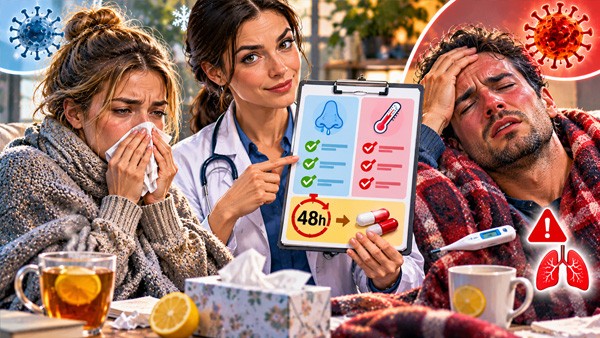

🌡️ Ask someone who has had real influenza when it started and they will usually name an hour, not a day. They were fine at lunch and could not stand up by the evening. Ask someone with a cold and they will say it crept up over the weekend. That difference in onset speed is the most reliable thing you have, and it is free.
📌 What follows is the practical version: how to tell the two apart in the first day, who genuinely benefits from an antiviral and who does not, what to actually take while you wait it out, and the short list of signs that mean you stop managing this at home.
⚡ The onset curve, which does most of the work
📉 Both illnesses eventually produce a blocked nose, a cough and a sore throat, so the symptom list is almost useless for telling them apart. The shape of the first 24 hours is not.
| 🔎 What to compare | 🤒 Influenza | 🤧 Common cold |
|---|---|---|
| ⏱️ Onset | Abrupt. Hours, and you remember when | Gradual over 1 to 3 days |
| 🌡️ Fever | Usual, 38 to 40 C, lasting 3 to 4 days | Uncommon in adults, and low if present |
| 💪 Muscle aches | Prominent, and often the worst part | Mild or absent |
| 😴 Exhaustion | Sudden and severe. People go to bed and stay there | Mild. Most people keep working |
| 🤧 Sneezing and runny nose | Present but secondary | The main event, and usually the first sign |
| 🤕 Headache | Common and intense | Uncommon |
| 😫 Cough | Dry, early, and often severe | Mild, and arrives later in the week |
| 🛏️ Time off your feet | Days in bed is normal | Rarely any |
| ⚠️ Risk of complications | Real: pneumonia, heart and lung flares, hospital admission | Low, mainly ear and sinus problems |
💡 The three-question version, for the first day.
🔹 Did it come on in hours rather than days?
🔹 Is there a real fever with muscle aches, not just a warm forehead?
🔹 Are you unable to carry on with your day, as opposed to irritated by a blocked nose?
Three yes answers point at influenza, and that matters because influenza is the one with a treatment window and a complication list. Three no answers point at a cold, and a cold needs patience rather than a prescription.
🧬 The viruses involved, and which ones change what you do
🔬 Several hundred different viruses produce what people call a cold, and almost none of them change your management. A handful do.
🔹 Influenza A and B. The two that cause real flu. These are the only ones with antivirals worth taking and a vaccine worth having. Influenza A subtypes drift every year, which is why one bout buys you little protection for next season.
🔹 Rhinoviruses. The commonest cause of the ordinary cold, and the usual trigger of an asthma flare in autumn. Treatment is symptom relief only.
🔹 RSV. Mostly known as an infant illness, but it causes severe chest infection in adults over 60 and in anyone with chronic lung disease. Often wheezy rather than feverish.
🔹 Coronaviruses, including the one that causes COVID. Clinically overlapping with flu to the point where guessing is unreliable. A test is the only honest way to separate them.
🔹 Parainfluenza, adenovirus, metapneumovirus. Produce everything from a sore throat to a chest infection. No specific treatment, and no reason to identify them in an otherwise healthy adult.
🗓️ How long each part of it lasts
📅 The single commonest reason people come back worried is that they expected the whole thing to end when the fever did. It does not. The symptoms resolve on completely different schedules, and knowing the schedule prevents a second round of antibiotics that nobody needed.
⏳ The 48-hour window, and why nobody mentions it in time
💊 Influenza is treatable, and almost nobody gets treated, for one unglamorous reason: the drugs only work while the virus is still multiplying. By the time most people decide they are ill enough to ask for help, that phase is finishing.
📊 What the benefit actually amounts to in a healthy adult is modest and worth stating plainly: roughly a day less illness, and a somewhat lower chance of a chest complication. That is not nothing when you have a week of work and a young family, but it is not a cure either. In the high-risk groups the point of treating is different — it is about reducing admissions and complications rather than shortening a miserable week.
⚠️ Two honest caveats about antivirals, because the internet gives both extremes.
🔹 They are specific to influenza. They do nothing for a cold, for RSV, or for COVID. If the illness is not flu, there is no antiviral to miss out on.
🔹 Nausea is common with the oral option, usually settling if taken with food. People stop on day two and conclude it did not work, when in fact they stopped before it could.
🔹 They are prescription-only and worth a same-day request, not a next-week appointment. A phone consultation on day one beats a face-to-face one on day four.
🛡️ Who genuinely needs treating, and who can just go to bed
👥 This list is the part worth keeping. For most healthy adults under 50 the correct plan is rest, fluids and a fever medicine. For the groups below the calculation changes, and a phone call on day one is worth making.
| 🚩 Higher risk | 📝 Why, in one line |
|---|---|
| 👴 Age 65 and over | The single largest risk factor. Most influenza hospital admissions and deaths sit in this group, and a fever may be absent or mild even in serious illness |
| 👶 Children under 5, especially under 2 | Smaller airways, faster deterioration, and dehydration arrives quickly. Never give aspirin to a child or teenager with a viral illness |
| 🤰 Pregnancy, and the first weeks after birth | Pregnancy genuinely raises the risk of severe influenza, particularly later on. Treatment is recommended rather than avoided, and the vaccine also protects the baby |
| 🫁 Asthma and COPD | Influenza is one of the most reliable triggers of a serious flare. See how asthma is actually diagnosed and monitored |
| ❤️ Heart failure and coronary disease | The fever and the inflammatory load strain a weak heart, and heart attacks measurably cluster in the weeks after influenza |
| 🍬 Diabetes | Infection pushes glucose up while appetite falls, so control slips in both directions at once |
| 🛡️ Weakened immunity | Chemotherapy, long-term steroids, immunosuppressants, transplant, poorly controlled HIV. Also stay infectious for much longer |
| 🫀 Chronic kidney or liver disease, and severe obesity | All raise the chance of needing hospital care, and all tend to be left off the list people remember |
| 🏥 Care home residents | Close living plus age plus other conditions. Outbreaks move fast and are managed as a group rather than person by person |
🚫 Why antibiotics do nothing here, and why they are still asked for
💊 Green mucus is not evidence of bacteria — the colour comes from your own white cells, and it appears in ordinary viral infections. The numbers behind the advice are stark enough to quote.
📌 There is a second, less obvious cost. A course of antibiotics taken during flu makes the next real infection harder to treat, and it disturbs the gut for weeks. The decision of when antibiotics genuinely belong in a chest infection is laid out in pneumonia and chest infections: when antibiotics are the right answer.
📈 The second-wave pattern that does mean bacteria
🚩 Secondary bacterial pneumonia after influenza has a recognisable shape, and it is the one thing worth watching for in week two. You get better, and then you get worse again.
🛏️ What to actually do, day by day
💊 Paracetamol or ibuprofen, and when to use which
📊 Both reduce fever and both ease aches. The choice is decided by what else is going on with you, not by which one is stronger.
🟢 Paracetamol (Paracip) first
✅ The default for fever and aches in influenza, and the one with the fewest reasons not to take it
💧 Safe when you are dehydrated or eating badly, which is most of day two
🫀 Fine with stomach ulcers, kidney problems, asthma and blood thinners
⚠️ The one rule: respect the daily maximum. Check cold and flu sachets, because most already contain paracetamol and that is how people double up by accident
🟡 Motrin (Ibuprofen) when aches dominate
✅ Often better for severe muscle pain and headache, and a reasonable choice if paracetamol alone is not touching it
🍽️ Always with food
🚫 Avoid if you are dehydrated or barely drinking, with kidney disease, a history of stomach ulcers, on blood thinners, or if your asthma reacts to anti-inflammatories
📘 Which one suits you is worked through in which painkiller to take and who should avoid anti-inflammatories
🚨 One absolute rule. Aspirin must not be given to children or teenagers with influenza, chickenpox or any viral illness. The combination is linked to Reye syndrome, a rare but devastating liver and brain injury. Paracetamol and, where appropriate, ibuprofen are the options in that age group.
😫 The cough that outstays its welcome
📉 This is the symptom that sends people back to the doctor, and almost always for nothing. The lining of the airway has to regrow, and that takes weeks rather than days.
💧 For the stage where the cough is productive and the mucus is hard to clear, Mucolite (Ambroxol) thins secretions so the cough moves them rather than just rattling. For a dry cough it has nothing to do. What helps and what does not at each stage is in what actually clears phlegm and chest congestion.
🫁 When influenza lands on asthma or COPD
⚠️ For anyone with chronic lung disease this is the week that decides whether they stay at home or end up in hospital, and the deterioration happens faster than the usual flare they are used to.
Peak flow or your usual oximeter reading, written down, not remembered
This is the week it earns its keep, and the week it gets skipped
Needing Ventolin (Albuterol) far more often than usual is a signal, not an inconvenience
If you have one with steroid instructions, this is what it was written for
Breathless at rest, cannot finish a sentence, or reliever not lasting four hours
🚨 The signs that mean stop waiting
🚨 Emergency now
Struggling to breathe, or breathless at rest · chest pain · blue or grey lips · confusion, or unusual drowsiness · a seizure · coughing blood · unable to stay awake · in a child: grunting, ribs pulling in with each breath, a floppy or unresponsive baby, no wet nappies, or a rash that does not fade when pressed
🟡 Same day
Fever settling and then returning after day 5 · new pain on one side of the chest · still feverish beyond day 5 · cannot keep fluids down · barely passing urine · a cough that is clearly worsening in week two · you are in one of the higher-risk groups and getting worse rather than better · day one and you want an antiviral
🟢 Manage at home
High fever and aches on days 1 to 3 that respond to a fever medicine · a dry cough that is slowly settling · a blocked nose for about a week · feeling drained for ten days · green mucus with everything else improving · a lingering cough at two or three weeks that is getting better each week
👶 Children, pregnancy and the over-65s
👥 Three groups where the standard advice needs adjusting, and where the thresholds for calling are deliberately lower.
| 👤 Group | 📝 What changes |
|---|---|
| 👶 Infants and young children | Judge the child, not the thermometer. Drinking, alertness and wet nappies tell you more than the temperature. Vomiting and poor feeding dehydrate a small child within a day, and breathing effort matters more than breathing rate. No aspirin, ever, and no honey under one year |
| 🧒 School-age children | They shed virus for longer than adults, so they stay infectious after they feel better. A cough into week three is still normal. Earache after the fever settles is the commonest complication |
| 🤰 Pregnancy | Treatment is recommended rather than withheld, and the threshold for starting it is lower. Paracetamol is the fever medicine of choice; anti-inflammatories are avoided, particularly in the third trimester. The vaccine is given in pregnancy on purpose, and it also protects the newborn in the first months |
| 👴 Over 65 | The fever may be mild or absent in serious influenza. New confusion, a fall, a loss of appetite or sudden immobility can be the only presenting signs. Any existing heart or lung condition is likely to flare alongside |
💉 The vaccine, described honestly
📊 The vaccine gets oversold by one side and dismissed by the other. Here is what it actually delivers, which is less than full protection and considerably more than nothing.
🧼 How it spreads, and what genuinely reduces that
💨 Influenza travels in the droplets and fine particles of breathing, talking and coughing, and survives for hours on hard surfaces. Which means the useful measures are unglamorous and the popular ones are mostly theatre.
✅ Worth doing: hand washing after being out and before eating · staying home for the first three days, which is when you shed the most · opening a window in a shared room, since ventilation dilutes what is in the air · a mask in a crowded indoor space during a bad season · the vaccine, taken before the season rather than during it.
🚫 Not worth bothering with: antibacterial wipes on every surface, vitamin megadoses started after you are already ill, immune-boosting supplements in general, and avoiding cold air — cold weather spreads flu by moving people indoors together, not by chilling them.
❌ Amantadine, and why it is no longer a flu drug
📜 Symmetrel (Amantadine) appears in older references as an influenza treatment, and it is still a useful medicine — but not for this. Circulating influenza A strains are now almost universally resistant to it, and it never had any activity against influenza B at all. It remains in use in Parkinson disease, which is why it is still on pharmacy shelves and still confuses people reading old advice.
📌 The practical point: if an old article or an old prescription suggests amantadine for flu, it is out of date. The current options are a different class entirely, and they are the ones bound by the 48-hour window.
🧪 Flu, COVID or RSV? The honest answer
🤔 People want a way to tell these apart from symptoms, and the truthful answer is that you mostly cannot. The overlap is close enough that clinicians test rather than guess, which is exactly why combined tests exist. The tendencies below are real but far too weak to decide anything on their own.
| 🔎 Feature | 🤒 Influenza | 🦠 COVID | 🫁 RSV in adults |
|---|---|---|---|
| Onset | Abrupt, within hours | Variable, often over a day or two | Gradual |
| Fever | High and early | Common, often lower | Often mild or absent |
| Aches | Severe | Common | Mild |
| Loss of smell | Rare | More suggestive, though less common than it once was | Rare |
| Wheeze | Only if you already have lung disease | Less typical | Characteristic, and the usual reason it is suspected |
| Who gets hit hardest | Over 65, pregnancy, chronic disease | Older age and chronic disease | Over 60, and anyone with COPD or heart failure |
| Antiviral available | Yes, within 48 hours | Yes, for selected higher-risk patients | No routine antiviral for adults |
| Can you tell without a test? | No, not reliably. If the answer would change your treatment, which it does in the higher-risk groups, the test is worth having in the first two days | ||
🍋 What does not work, despite the confidence behind it
| 💭 The claim | ✔️ What the evidence actually shows |
|---|---|
| "Vitamin C will stop it." | Regular long-term supplementation may shave a few hours off a cold. Starting it once you are already ill does nothing measurable, and it has no effect on influenza |
| "Antibiotics will shorten it." | No effect on any virus. You get the side effects, the gut disruption and the resistance with none of the benefit |
| "Sweat it out under blankets." | Raises your temperature and dehydrates you faster. Comfortable warmth and plenty to drink is the actual advice |
| "Steam inhalation clears the chest." | No measurable benefit, and a genuine scald risk with children in the room. A warm shower is as good and safer |
| "Green mucus means I need antibiotics." | The colour comes from your own white cells. It appears in ordinary viral infections and tells you nothing about bacteria |
| "Echinacea and immune boosters help." | Trial results are inconsistent and the effect, if any, is small. Not something to rely on, and not a reason to delay an antiviral |
| "Flu is just a bad cold." | The reason this page exists. Influenza admits people to hospital, triggers heart attacks and kills, which a rhinovirus does not |
| "The vaccine gave me flu last year." | The injected vaccine contains no live virus. A day of feeling off is the immune system responding, and catching a different virus in the two weeks before it takes effect is common |
📋 What to tell the doctor, and what to ask
🗣️ Four things worth saying unprompted, because they change the answer:
🔹 The exact hour or half-day the symptoms began. This is what decides whether an antiviral is still worth starting
🔹 Whether you are in a higher-risk group — pregnancy, a lung or heart condition, diabetes, immunosuppression, age. People routinely leave this out
🔹 Whether the fever settled and came back, with the dates. That one sentence is what separates recovery from a complication
🔹 Everything you have already taken, including cold and flu sachets, so nobody doubles up your paracetamol
❓ And one question worth asking: am I in a group where this should be treated rather than waited out?
❓ Frequently asked questions
How do I tell flu from a cold?
Onset speed. Flu arrives within hours with fever, severe aches and exhaustion that puts you in bed. A cold builds over two or three days, starts with sneezing and a sore throat, and rarely stops you working.
How long does flu last?
Fever and aches for three to five days, a blocked nose for about a week, fatigue for up to two weeks, and the cough for two to three weeks. The cough outlasting everything else is normal recovery.
Do I need an antiviral for the flu?
Most healthy adults do not. They are worth requesting on day one if you are over 65, pregnant, have lung, heart, kidney or liver disease, diabetes, or weakened immunity, where they reduce complications.
Is it too late to start an antiviral?
After 48 hours from the first symptom the benefit falls away sharply, and it is greatest within the first 12 hours. Hospital patients and the severely immunosuppressed are treated later regardless.
Will antibiotics help my flu?
No. Influenza is a virus and antibiotics have no effect on it. They are needed only if a bacterial complication develops, which usually announces itself as a second fever after day five.
Paracetamol or ibuprofen for flu?
Paracetamol first, because it is safe when you are dehydrated or eating poorly. Ibuprofen is a reasonable alternative for severe aches, with food, if your kidneys, stomach and asthma allow it.
My fever came back on day six. Why?
Getting better then clearly worse again is the classic pattern of a secondary bacterial chest infection. With new chest pain or breathlessness alongside it, this needs assessing the same day.
How long am I contagious?
From about a day before symptoms until five to seven days after they start, with the peak on days one to three. Children shed for up to ten days, and longer with weakened immunity.
Can the flu vaccine give me flu?
The injected vaccine contains no live virus, so no. A day of feeling off is the immune response. It takes about two weeks to work, so an infection caught in that gap is a coincidence.
Can I give my child aspirin for fever?
No. Aspirin in children and teenagers with a viral illness is linked to Reye syndrome, a rare but serious liver and brain injury. Use paracetamol, and ibuprofen where appropriate.
📑 Sources and editorial
- 📘 National and international clinical guidance on the diagnosis and management of seasonal influenza in adults and children, including criteria for antiviral treatment and the definition of higher-risk groups
- ⏱️ Trial and meta-analytic evidence on neuraminidase inhibitor treatment of influenza, including the magnitude of symptom reduction, the dependence of benefit on time from symptom onset, and effects on complications in higher-risk patients
- ❌ Surveillance data on adamantane resistance in circulating influenza A strains, and the resulting recommendation against amantadine and rimantadine for influenza treatment or prophylaxis
- 📉 Studies on the natural history and symptom duration of influenza and of the common cold, including the duration of post-infectious cough and the proportion of patients still coughing at two, three and four weeks
- 🧬 Epidemiological reviews of the viral causes of acute upper and lower respiratory tract infection, including the share attributable to rhinovirus, influenza, RSV, parainfluenza, adenovirus, metapneumovirus and coronaviruses
- 🚫 Systematic reviews of antibiotic treatment in acute bronchitis, the common cold, acute sinusitis and sore throat, including the proportion of cases that are bacterial and the absence of benefit in viral illness
- 📈 Clinical literature on secondary bacterial pneumonia complicating influenza, including the typical biphasic fever pattern, the organisms involved and the indications for urgent assessment
- ❤️ Studies on the increased incidence of acute myocardial infarction and heart failure decompensation in the weeks following laboratory-confirmed influenza
- 🤰 Guidance on influenza in pregnancy, including the raised risk of severe disease, the recommendation to treat, the preference for paracetamol over anti-inflammatory analgesics, and maternal vaccination for infant protection
- 👶 Paediatric guidance on assessing the febrile child, on recognition of dehydration and respiratory distress, and on the contraindication of aspirin in children and adolescents with viral illness because of Reye syndrome
- 👴 Literature on atypical presentation of influenza in older adults, including blunted fever response and presentation as confusion, falls or functional decline
- 🫁 Reviews of RSV in adults aged 60 and over, including its contribution to hospital admission and exacerbations of COPD and heart failure
- 🧪 Comparative studies on the clinical distinction between influenza and COVID-19, concluding that symptoms alone do not reliably separate them and supporting combined testing where management would change
- 💉 Annual estimates of seasonal influenza vaccine effectiveness against medically attended illness, hospital admission and intensive care admission, in well-matched and poorly matched seasons, and the rationale for annual reformulation from antigenic drift
- 🧼 Evidence on influenza transmission and on non-pharmaceutical interventions including hand hygiene, masks, ventilation and the timing of infectiousness relative to symptom onset
- 🍋 Systematic reviews of vitamin C, zinc and echinacea for the prevention and treatment of respiratory infection, and of steam inhalation and nasal saline for symptom relief
- 💊 Prescribing information for paracetamol and ibuprofen, including maximum daily dose, the risk of inadvertent paracetamol overdose from combination cold remedies, and cautions for anti-inflammatory use in dehydration, renal impairment, peptic ulcer disease, anticoagulation and aspirin-sensitive asthma
- 💧 Evidence on mucolytic therapy including ambroxol for productive cough with viscous secretions
- 📖 Related reading: pneumonia and chest infections: when antibiotics are the right answer, what actually clears phlegm and chest congestion, allergy or a cold, and what clears a blocked nose, how asthma is actually diagnosed, which painkiller to take
- 🛒 Related products: Paracetamol (Paracip) 500mg, Motrin (Ibuprofen), Mucolite (Ambroxol), Ventolin (Albuterol), Augmentin (Amoxicillin + Clavulanate), Zithromax (Azithromycin), Avelox (Moxifloxacin), pain and fever range, respiratory range
- 👩⚕️ RXshop Editorial Team — reviewed by Emily Chen, MD, MPH — Internal Medicine Specialist
Medical Disclaimer: The information in this article is for educational and informational purposes only and is not a substitute for professional medical advice, diagnosis, or treatment. Always seek guidance from a qualified healthcare provider with any questions you may have regarding a medical condition, and before starting, stopping or changing any medication.