How Asthma Is Actually Diagnosed, and Why About a Third of Adults Told They Have It Really Do Not

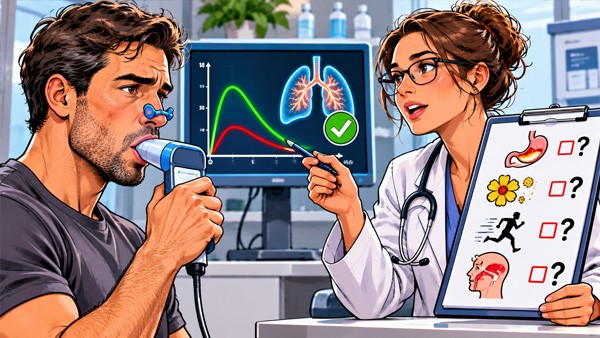

🫁 Breathless climbing stairs, a cough that lingers after every cold, a wheeze at night. Someone listens to your chest, hands over a blue inhaler, and the word asthma enters your records permanently. In a large share of cases no test was ever done — and in a surprising number of those, the diagnosis turns out to be wrong.
📌 That last tile is the reason this is hard. Asthma is variable by definition, so a normal test on a good day proves nothing. A single visit can confirm asthma but cannot rule it out, and almost every mistake in both directions comes from forgetting that.
📊 How often the label is wrong, and why
🤔 Why does this happen so readily? Because wheeze, cough and breathlessness are produced by a dozen conditions, inhalers are cheap and harmless-seeming, and a reliever inhaler makes almost anybody feel slightly better for a few minutes, which gets read as confirmation. The test for asthma is not whether the blue inhaler helps.
🫁 What asthma actually is, and the pattern that points to it
🔬 Two things define it. The airways are inflamed, and they narrow more than they should in response to triggers. The narrowing is at least partly reversible, which is what separates asthma from the fixed obstruction of long-standing smoking damage.
📅 The giveaway is therefore not any single symptom but the pattern: it varies. Worse at some times, absent at others, with identifiable triggers.
| ✅ Points toward asthma | 📝 Why it matters diagnostically |
|---|---|
| 🌙 Worse at night or in the early morning | The single most useful feature. Waking at three or four in the morning coughing or wheezing is close to characteristic |
| 🍃 Clear triggers — cold air, exercise, dust, pets, pollen, smoke, strong smells, laughing | Variability with exposure is the essence of it. A list of triggers is worth writing down before the appointment |
| 🤧 A cold that goes to the chest every time and takes weeks to clear | Common history in adults who are eventually confirmed |
| 🏃 Breathless out of proportion on exertion, with a tight chest afterwards | Symptoms that build after exercise stops, rather than during, are typical |
| 👶 Childhood eczema, hay fever, or a family history | Raises the likelihood considerably, though it does not confirm anything |
| 🔄 Symptom-free stretches of weeks or months | Variability again. Steady, unchanging breathlessness points elsewhere |
| 🚫 What does not point to asthma | Breathlessness that never varies · a cough that produces a lot of sputum every day · symptoms strictly on exertion and relieved by stopping within two minutes · weight loss · dizziness or tingling fingers with the attacks |
🧪 The tests, in the order they are usually done
📈 Spirometry, and the number that confirms it
💨 You blow as hard and as long as you can into a machine, which measures how much air comes out in the first second. Then you take a reliever inhaler, wait a quarter of an hour, and blow again. If the first-second volume improves enough, the obstruction is reversible, and that is asthma.
⚠️ Why a negative result does not clear you, and what to check before the test.
🔹 On a symptom-free day the airways are not narrowed, so there is nothing to reverse. Normal spirometry between attacks is the expected finding in mild asthma, not evidence against it.
🔹 Taking your reliever or preventer beforehand hides the result. Ask how long to hold off — usually several hours for a reliever and longer for a long-acting inhaler. A great many inconclusive tests are caused by this alone.
🔹 Technique matters enormously. A weak or short blow looks like obstruction. A good operator will make you repeat it until three attempts agree.
🔹 If it is negative and the story still fits, the next step is the peak flow diary or a challenge test — not abandoning the question.
💨 The FeNO breath test, and what it can and cannot say
🔬 You breathe out slowly and steadily into a handheld device, which measures nitric oxide in the breath. Raised levels reflect a particular type of airway inflammation — the type that responds well to inhaled steroids. It takes five minutes and needs no effort.
📒 The peak flow diary, which settles more cases than any machine
📊 A small plastic tube, two readings a day for two weeks, written down. It costs almost nothing and it captures the one thing a clinic visit cannot: how much your airways change between morning and evening. That variability is the signature of asthma.
🏃 Two situations with their own tests
🎽 Symptoms only with exercise
⏱️ The pattern is distinctive: fine during the effort, worst 5 to 15 minutes after stopping, settling within an hour.
🧪 Tested with an exercise challenge — spirometry before and repeatedly after a hard run, looking for a drop in the first-second volume.
💡 Cold dry air makes it far worse, which is why swimmers are affected less than winter runners.
💔 If the breathlessness comes on during exertion and stops within two minutes of resting, that is a heart pattern, not an asthma one.
🏭 Symptoms that follow your work
📅 Better at weekends and on holiday, worse by midweek — and often worse in the evening after a shift rather than during it.
🔧 Known causes: flour, isocyanates in spray paint, wood dust, soldering flux, latex, enzymes, hairdressing chemicals, cleaning products.
📋 Tested with peak flow readings four times daily across working and non-working periods.
⚠️ Worth pursuing properly, because this is one of the few forms that can resolve completely if the exposure stops early — and becomes permanent if it does not.
🎭 What it turns out to be instead
| 🔎 The other diagnosis | 📝 What gives it away |
|---|---|
| 🚬 COPD | Over 40, a smoking history, breathlessness that is steady rather than variable, daily sputum. Obstruction that does not reverse. See living with COPD and spotting a flare-up early. The two can coexist, which complicates it further |
| 🗣️ Vocal cord dysfunction | The commonest asthma impostor and the most missed. Noise on breathing in rather than out, felt at the throat rather than the chest, starting and stopping abruptly, with no response to inhalers. Treated by speech therapy, not drugs |
| 😮💨 Breathing pattern disorder | Air hunger with tingling fingers or lips, dizziness, sighing, a need to yawn. Peak flow and spirometry normal. Responds to breathing retraining |
| 🫁 Heart failure | Breathless lying flat, waking gasping, swollen ankles, worse with weight gain over days. The old name was cardiac asthma for a reason |
| 🔥 Reflux | A persistent dry cough and nocturnal symptoms, with heartburn or a sour taste. Can also genuinely worsen real asthma |
| 🤧 Upper airway and post-nasal drip | Chronic throat clearing, blocked nose, a tickly cough. Often improves with nasal treatment — see what actually clears a blocked nose |
| 💊 A medicine you are taking | Blood pressure tablets ending in -pril cause a dry cough in a notable minority. Beta blockers can provoke genuine wheeze. Anti-inflammatory painkillers trigger attacks in some asthmatics |
| ⚖️ Deconditioning and excess weight | Breathless on effort with entirely normal tests. Common, treatable, and frequently given an inhaler instead |
| 🦠 Post-infectious airway twitchiness | Weeks of cough and wheeze after a chest infection that resolves by itself. Genuinely transient, and a common route to a permanent label. See when a cough becomes a long-term signal |
💊 Once it is confirmed: what the treatment actually is
🚫 One point governs everything here, and the old version of this page got it wrong. Asthma is treated with an inhaled anti-inflammatory, not with reliever inhalers and not with oral steroid tablets. Tablets are for a flare-up, in a short burst. Relievers open the airway for a few hours and treat nothing.
| 💊 Medicine | 🎯 Its job, and the practical detail |
|---|---|
| Flovent (Fluticasone), Pulmicort (Budesonide), Ciclohale (Ciclesonide) | The preventer, and the actual treatment. An inhaled steroid that settles the inflammation. Taken every day whether or not you feel unwell, which is the part people stop doing. Rinse your mouth after each dose to avoid thrush and hoarseness |
| Ventolin (Albuterol), Proventil (Albuterol), Asthalin (Albuterol) | The reliever. Opens the airway within minutes and wears off in hours. Needing it more than twice a week means the asthma is not controlled — that is the most useful single question in the whole condition. It is not a treatment and it does not reduce the risk of a severe attack |
| Advair Diskus (Fluticasone and Salmeterol) | A combination preventer with a long-acting bronchodilator alongside the steroid, for when a steroid alone is not enough. The long-acting component is never used without a steroid in asthma |
| Singulair (Montelukast) | A tablet, useful as an add-on, and particularly where exercise-induced symptoms or hay fever sit alongside. Report mood changes, vivid dreams, irritability or low mood — an uncommon but recognised effect, and it is the reason to mention it rather than wonder |
| Budesal Respules (Budesonide and Levosalbutamol) | A nebuliser solution combining both, used where an inhaler is not practical or during a flare under supervision |
| Theo-24 (Theophylline) | An older oral option, occasionally still used as an add-on. Needs blood level monitoring and interacts with a long list of other drugs |
| Deltasone (Prednisolone) | For a flare-up only, as a short course of a few days. Not maintenance treatment for asthma. Needing it more than once or twice a year means the preventer plan needs reviewing, not more tablets |
| 🧴 A spacer | The cheapest improvement available. It roughly doubles how much of the dose reaches the lungs and removes the need for perfect timing. The technique is in why the blue one does not treat asthma |
⏳ How long before a preventer shows anything
🧾 What to bring, so one appointment is enough
| 📋 Bring this | 🎯 What it answers |
|---|---|
| 📒 Two weeks of peak flow readings | The variability question, which is the hardest to answer in a clinic |
| 🍃 A written trigger list | Turns a vague history into a pattern, and may point straight at work or a pet |
| 🌙 How many nights a month it wakes you | Night waking is both diagnostic and the best single marker of control |
| 💨 How often you reach for a reliever | More than twice a week means undertreated, whatever else is said |
| 💊 Every medicine, including eye drops and painkillers | Catches -pril cough, beta blockers, and anti-inflammatory sensitivity |
| 👶 Childhood and family history | Eczema, hay fever and asthma in relatives shift the odds considerably |
| 🧴 Your inhalers, in the bag | So technique can be checked, which changes the result more often than changing the drug |
🚨 When this stops being a diagnostic question
🚨 Ambulance now
Too breathless to finish a sentence · lips or fingers turning blue · the reliever not helping at all, or helping for less than an hour · exhaustion, drowsiness or confusion · a silent chest, where the wheeze disappears as breathing weakens · sitting hunched and unable to lie down
🟡 Same day or next day
Reliever needed more often than every four hours · peak flow below half your usual best · symptoms worsening over days despite treatment · a chest infection on top of asthma · any attack that needed more than one reliever dose to settle
🟢 Book a review
Carrying an asthma label with no test ever done · a preventer that has never been prescribed · using a reliever more than twice a week · waking at night from it · no written action plan · no technique check in the last year · symptoms that follow your working week · mood changes on montelukast
🗿 Four things worth unlearning
| 💭 The belief | ✔️ What is actually the case |
|---|---|
| "My breathing test was normal, so I do not have asthma." | Normal spirometry between attacks is expected. One visit can confirm asthma but cannot rule it out, which is what the peak flow diary is for |
| "The blue inhaler helps, so it must be asthma." | A reliever produces a small short-lived improvement in most people, including those with other conditions. Response to it is not a diagnostic test |
| "I only need the preventer when I am wheezy." | It treats inflammation and takes about four weeks to do most of its work. Used only during a flare it never gets the chance to work at all |
| "Inhaled steroids are the same as steroid tablets." | The inhaled dose is a tiny fraction, delivered to the airway rather than the whole body. The tablets carry the effects people fear; the inhaler is what prevents ever needing them |
❓ Frequently asked questions
How is asthma diagnosed?
By a varying pattern of symptoms plus an objective test: spirometry with reversibility, a FeNO breath test, two weeks of peak flow readings, or a challenge test if those are inconclusive.
Can asthma be diagnosed without any test?
It often is, and that is the problem. About a third of adults carrying the diagnosis show no sign of it on retesting, and many of those never had an objective test at all.
What counts as a positive reversibility test?
The first-second volume must improve by at least 12 percent and at least 200 millilitres after a reliever inhaler. Both conditions have to be met, not just one.
My spirometry was normal. Does that rule asthma out?
No. Asthma varies, so on a symptom-free day there is nothing to reverse. The next step is a two-week peak flow diary or a challenge test, not dropping the question.
What does a FeNO test show?
Nitric oxide in your breath, which reflects a type of airway inflammation. Over 50 parts per billion in an adult supports asthma. A low result does not exclude it.
What is most often mistaken for asthma?
Vocal cord dysfunction, breathing pattern disorders, COPD, heart failure, reflux, post-nasal drip, and the dry cough caused by blood pressure tablets ending in -pril.
How much peak flow variation means asthma?
More than about 10 percent day-to-day variation in an adult supports the diagnosis. The classic pattern is morning readings consistently lower than evening ones.
How do I know if my asthma is controlled?
Needing a reliever more than twice a week, waking at night from it, or any limit on activity all mean it is not. Those three questions are the standard check.
Are steroid tablets a treatment for asthma?
Only as a short course during a flare-up. Day-to-day asthma is treated with an inhaled steroid. Needing tablets more than once or twice a year means the plan needs reviewing.
Should I stop my inhalers before a breathing test?
Ask when you book, because taking them beforehand can hide the result. Relievers are usually held for several hours and long-acting inhalers for longer.
📑 Sources and editorial
- 📘 Global and national guidelines on asthma diagnosis and management, including the requirement for objective confirmation of variable expiratory airflow limitation and the recommended order of testing
- 📊 Published research on the proportion of adults with a physician diagnosis of asthma in whom the diagnosis could not be confirmed on systematic objective testing, and on the proportion who had never undergone objective testing at the time of diagnosis
- 📈 Spirometry standards, including bronchodilator reversibility criteria of at least a 12 percent and 200 millilitre improvement in forced expiratory volume in one second, acceptability and repeatability requirements, and medication withholding periods before testing
- 💨 Guidance on fractional exhaled nitric oxide testing, including adult cut-points, the effect of smoking and inhaled corticosteroid use on results, and its value in predicting corticosteroid response
- 📒 Guidance on peak expiratory flow monitoring, including twice-daily measurement, calculation of diurnal variability and the threshold supporting a diagnosis of asthma in adults
- 🏃 Guidance on exercise challenge testing and exercise-induced bronchoconstriction, including the typical timing of symptoms after exertion and the role of cold dry air
- 🏭 Guidance on occupational asthma, including serial peak flow monitoring across work and rest periods, recognised causative agents, and the importance of early removal from exposure
- 🎭 Reviews of conditions that mimic asthma, including vocal cord dysfunction and inducible laryngeal obstruction, breathing pattern disorders, chronic obstructive pulmonary disease, heart failure, gastro-oesophageal reflux, upper airway disease and medication-induced cough
- 💊 Prescribing information for inhaled fluticasone, budesonide, ciclesonide, albuterol, salmeterol, montelukast, theophylline and prednisolone, including the contraindication on long-acting bronchodilator monotherapy in asthma and neuropsychiatric reporting requirements for montelukast
- ⏳ Evidence on the time course of response to inhaled corticosteroids in asthma, including symptom improvement, plateau of benefit and resolution of airway inflammation
- 🚫 Guidance on the limited role of oral corticosteroids as short courses for exacerbations rather than maintenance therapy, and on short-acting bronchodilator overuse as a marker of poor control and of risk of severe exacerbation
- 🧴 Evidence on spacer devices and inhaler technique and their effect on drug delivery to the lungs
- 🚨 Guidance on the assessment of acute asthma, including inability to complete sentences, cyanosis, a silent chest, exhaustion and peak flow thresholds requiring emergency care
- 📖 Related reading: why a reliever inhaler alone is not a plan, why the blue inhaler does not treat asthma, spotting a COPD flare-up early, living with COPD, when a cough becomes a long-term signal, pneumonia or bronchitis, allergy or a cold
- 🛒 Related products: Flovent (Fluticasone), Pulmicort (Budesonide), Ciclohale (Ciclesonide), Advair Diskus (Fluticasone and Salmeterol), Ventolin (Albuterol), Proventil (Albuterol), Singulair (Montelukast), asthma range
- 👩⚕️ RXshop Editorial Team — reviewed by Emily Chen, MD, MPH — Internal Medicine Specialist
Medical Disclaimer: The information in this article is for educational and informational purposes only and is not a substitute for professional medical advice, diagnosis, or treatment. Always seek guidance from a qualified healthcare provider with any questions you may have regarding a medical condition, and before starting, stopping or changing any medication.