Gout: Why Treating Each Attack Never Ends It, and the Uric Acid Target That Stops Them Completely

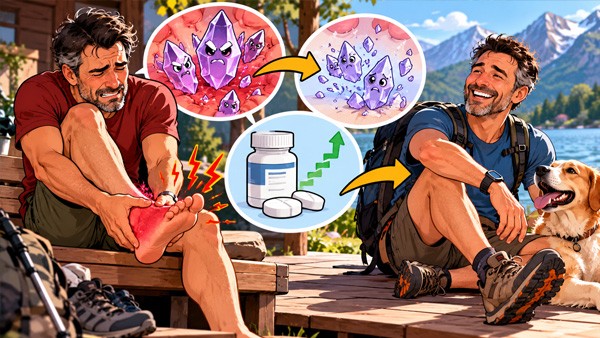

Here is the pattern that costs people their joints.
An attack arrives. It is agonising for a few days, treated with an anti-inflammatory, and gone within two weeks. Six months later another one. Then another. Each is survivable, each gets treated, and everyone involved calls that managing the gout.
Meanwhile the crystals that caused the first attack have never left, and more are forming every month. After ten or fifteen years of this there are visible lumps, permanent joint damage and X-ray erosions — from a condition that is one of the very few in medicine that can be switched off completely.
🎯 The whole of gout treatment reduces to one number. Urate crystals dissolve when the level in the blood falls below roughly 360 micromol per litre, or 6 mg per decilitre. Hold it there and the existing crystals gradually dissolve, the attacks stop, and the lumps shrink.
Treating attacks without lowering that number is treating smoke and leaving the fire. Lowering the number is the actual cure, and it is one tablet a day.
📊 Why a normal result is not good enough
This is the single most useful thing on this page, and it catches patients and doctors alike.
Laboratory reference ranges for uric acid usually run up to about 420 micromol per litre, or 7 mg/dL. So a result of 400 comes back flagged as normal.
But the reference range describes what is common in the population, not what is safe for someone with gout. Crystals form above roughly 360 and dissolve below it. A patient told their uric acid is normal at 400 is being told the wrong thing: that level will keep producing attacks indefinitely.
| Level | What it means if you have gout |
|---|---|
| Below 300 (5 mg/dL) | Target where there are visible lumps or frequent attacks — dissolves crystals faster |
| Below 360 (6 mg/dL) | The standard treatment target. Crystals dissolve at this level |
| 360 to 420 | Reported as normal by most laboratories, and still forming crystals |
| Above 420 | Flagged as high |
So the question to ask is not is my uric acid normal. It is what is my number, and is it under 360.
One more thing that misleads in the other direction: uric acid often falls during an acute attack, sometimes into the normal range. A normal reading taken while the joint is hot proves nothing. It is measured again a few weeks after things settle.
🔥 The attack itself
Gout announces itself distinctively, which is why it is usually diagnosed on the history.
- 🕒 Onset over a few hours, very often waking the person in the early morning
- 🦶 Base of the big toe in more than half of first attacks. Then instep, ankle, knee; later elbows, wrists and fingers
- 🔴 Red, hot, shiny, swollen — and painful enough that the weight of a bedsheet is unbearable
- 📈 Peaks within 12 to 24 hours and settles over one to two weeks even if nothing is done
- 🌀 Usually one joint at first; multiple joints become more common after years
🚨 One thing looks almost identical and is an emergency. A single hot, red, severely painful joint with fever or feeling generally unwell may be infection inside the joint, which destroys cartilage within days.
Nobody should be distinguishing those two at home. A hot swollen joint with fever needs same-day assessment — and the anti-inflammatory that settles gout also masks the fever and pain of infection, which is how a treatable infection becomes a ruined joint.
💊 Treating the attack
Speed matters: starting within the first 24 hours shortens it considerably. Any one of three approaches works, and the choice depends on what else you have.
| Option | How it is used | Avoid when |
|---|---|---|
| Etoricoxib | 120 mg once daily, maximum 8 days — this is the dose and duration licensed specifically for acute gout | Uncontrolled blood pressure, ulcer history, significant kidney or heart disease |
| Naproxen or indomethacin | Full anti-inflammatory dose for the duration of the attack, with food | Same cautions. Add a stomach-protecting tablet over 65 or with ulcer history |
| Prednisolone | Around 30 to 35 mg daily for five days, no taper needed for a course this short | Useful precisely when anti-inflammatories are not an option — kidney disease, ulcers, heart failure. Caution in diabetes |
| Colchicine | Low-dose regimens, started early | We do not currently stock it. Diarrhoea is dose-limiting, and the dose must be reduced in kidney impairment |
Alongside the tablet: rest the joint, keep it elevated, apply ice, and keep fluids up.
⚠️ Do not start allopurinol during an attack, and do not stop it either.
Starting it mid-attack makes the attack worse. But if you are already taking it, keep taking it — stopping during a flare is a common mistake that sets the whole process back and causes another flare on restarting.
💎 Allopurinol: the schedule that works
Zyloprim (Allopurinol) blocks the enzyme that produces uric acid. It does nothing for an attack in progress and everything for the condition.
| How it is done | |
|---|---|
| When to start | After an attack has fully settled, usually two weeks or more |
| Starting dose | 100 mg once daily — or 50 mg where kidney function is reduced |
| Titration | Increase by 100 mg every two to four weeks, with a uric acid test guiding each step |
| Effective dose | Commonly 300 to 600 mg daily. The maximum is 900 mg — and 300 mg is a staging post, not the finish line |
| The endpoint | Uric acid under 360, or under 300 where there are lumps. Not a dose, a number |
| Duration | Lifelong. Stopping returns the level to where it was, and the attacks come back |
That third row is where most treatment fails. Allopurinol is routinely left at 100 or 300 mg and never checked against a blood test, the attacks continue, and the drug gets labelled ineffective. It was not ineffective; it was under-dosed. If you have been on the same dose for years and still get attacks, the question is what your current uric acid level is.
📌 The thing that makes people give up, and it is entirely predictable.
Starting allopurinol triggers attacks. As the blood level falls, existing crystal deposits begin to dissolve and shed crystals into the joint, which sets off inflammation. So the first few months on treatment can be worse than before it.
This is not the drug failing. It is the drug working, and it is why preventive cover is prescribed alongside it for the first three to six months — a low-dose anti-inflammatory or colchicine taken daily through the dissolving phase.
Anyone starting allopurinol without being told this concludes it made their gout worse and stops. Knowing it in advance is the difference between a cure and ten more years of attacks.
⚠️ Allopurinol safety: one rash and one interaction
🚨 Stop immediately and seek medical advice for any rash.
Allopurinol can rarely cause a severe hypersensitivity reaction involving the skin, liver and kidneys, which can be fatal. It almost always begins as a rash in the first weeks to months. A new rash on allopurinol is not something to watch — stop the tablet and get advice the same day, particularly with fever, facial swelling, mouth ulceration or blistering.
The risk is higher with reduced kidney function, with diuretics, and in people of Han Chinese, Thai or Korean ancestry, where a genetic marker raises it and testing is sometimes done first. Starting at 100 mg rather than jumping straight to 300 substantially reduces it — which is the other reason for slow titration.
And one interaction that is potentially fatal: allopurinol blocks the breakdown of azathioprine and mercaptopurine, causing those drugs to accumulate and shut down the bone marrow. Anyone on either of them — usually for inflammatory bowel disease, transplant or autoimmune conditions — must not be given allopurinol without specialist supervision and a drastically reduced dose.
The rest, briefly: warfarin and theophylline levels can rise; nausea and headache occur early and usually settle; and monitoring during titration covers uric acid, kidney function, liver enzymes and a blood count.
💊 The medicines that cause gout, and the two that help
This is the quickest win available and it is checked far too rarely.
Raise uric acid:
- 💧 Thiazide and loop diuretics — much the commonest culprit. Someone on a water tablet for blood pressure who develops gout has a likely cause sitting in the dosette box
- 💊 Low-dose aspirin — taken by huge numbers of people for the heart, and rarely connected
- 🧪 Ciclosporin and tacrolimus
Lower uric acid:
- ✅ Losartan, among the blood pressure drugs, has a mild urate-lowering effect
- ✅ Amlodipine likewise, and atorvastatin and fenofibrate modestly
So for a person with both high blood pressure and gout, swapping a thiazide for losartan or amlodipine treats both problems with one change. That conversation is worth having explicitly, and it does not happen unless the patient raises it. Nobody should stop a blood pressure tablet on their own — but asking whether the choice could be reconsidered is entirely reasonable.
🍺 Diet: what it does and what it cannot do
Here is the honest arithmetic that most gout advice avoids. Dietary change lowers uric acid by roughly 10 to 15 percent. For someone at 480 that brings them to around 420 — a real improvement, and still above the threshold where crystals form.
So diet helps and diet alone will not get most people to target. Anyone told to sort their eating out instead of being offered treatment has been given advice that cannot work.
That said, the specific items do matter, and the list is narrower than the folklore:
| Worth reducing | Not the problem |
|---|---|
| Beer — the worst of all, because it carries both alcohol and purines | Purine-rich vegetables — peas, beans, spinach, mushrooms. They do not raise gout risk |
| Spirits | Coffee — associated with lower risk, possibly protective |
| Fructose-sweetened drinks — soft drinks and fruit juice. Frequently the largest single contributor and almost never suspected | Low-fat dairy — associated with lower risk |
| Red meat and organ meats | Wine in moderation — less implicated than beer or spirits |
| Shellfish and oily fish in quantity | Cherries have modest supportive evidence and are harmless |
| Dehydration, and crash dieting or fasting — both raise urate sharply and can precipitate an attack | — |
Weight loss does lower urate meaningfully, and it should be gradual — rapid loss and fasting push it up in the short term.
❤️ Gout is not only a joint problem
Worth knowing because it changes what else should be checked.
Gout travels with high blood pressure, chronic kidney disease, obesity, type 2 diabetes and cardiovascular disease, and the association is strong enough that a new diagnosis of gout is a reasonable prompt to look at all of them. The kidney link runs both ways: reduced kidney function raises urate, and prolonged high urate is associated with declining kidney function.
So at diagnosis it is worth having blood pressure, kidney function, glucose or HbA1c, and a lipid profile checked. Our guides to blood pressure, cholesterol and type 2 diabetes cover those.
🦴 What untreated gout eventually does
The reason any of this matters, stated plainly.
Crystals that keep accumulating form tophi — firm, chalky lumps under the skin, classically over the elbows, the backs of the fingers, the Achilles tendon and the rim of the ear. They can ulcerate and discharge white material, and they are visible, which many people find harder than the pain.
Underneath, the crystals erode bone. Joint damage from long-standing gout is permanent, and by the time it shows on an X-ray it cannot be reversed. Attacks also become more frequent, longer, and spread to more joints.
All of which is avoidable with one tablet taken to a target. And tophi dissolve once the level is held low enough, over months to a few years, which is the main argument for aiming under 300 rather than 360 when they are present.
📈 How to tell it is working
- 📊 The number is the measure. Under 360 is the goal, and it is the only reliable sign in the first months
- 📉 Attacks increase first, then stop. Expect flares during the first three to six months, then a steady decline. By twelve months most people have none
- 🦴 Tophi soften and shrink over one to several years
- 🚫 What is not a sign: feeling fine. Urate is invisible, and someone who stops the tablet because they have had no attacks for a year will have attacks again
🔎 When it is not gout
Four conditions are mistaken for it, and one of them is an emergency.
- 🚨 Septic arthritis — hot swollen joint with fever or feeling unwell. Same-day emergency, as above
- 🦴 Pseudogout — a different crystal, usually in the knee or wrist rather than the toe, more often in older people. Looks similar, and allopurinol does nothing for it
- 🟥 Cellulitis — skin infection, where the redness spreads beyond the joint and the joint itself moves reasonably
- 📍 Psoriatic arthritis — particularly when fingers or toes are involved and there is psoriasis or nail pitting. See our guide to telling joint conditions apart
Where there is genuine doubt, examining fluid drawn from the joint settles it definitively — crystals under a microscope, or bacteria.
📞 When to seek help
🚨 Same day: a hot swollen joint with fever or feeling unwell; a rash on allopurinol, especially with fever, facial swelling or mouth ulceration; or black or tarry stools, vomiting blood or severe stomach pain on an anti-inflammatory.
Promptly:
- A second attack — that is the point at which urate-lowering treatment should be discussed, not after the tenth
- Taking allopurinol and still getting attacks — ask what your current uric acid level is, and whether the dose should go up
- Never having had the level measured, or having been told it is normal without being given the number
- On a thiazide diuretic or low-dose aspirin with gout — ask whether the blood pressure drug could be switched
- Taking azathioprine or mercaptopurine — before allopurinol is started, without exception
- Lumps appearing over elbows, fingers, the Achilles tendon or the ear
- Reduced kidney function — it changes the starting dose and raises the hypersensitivity risk
- Attacks in several joints at once, or lasting beyond two weeks
- A new diagnosis of gout — ask for blood pressure, kidney function, glucose and lipids at the same time
❓ Frequently asked questions
What uric acid level should I aim for?
Below 360 micromol per litre, or 6 mg/dL, and below 300 where there are visible lumps. Laboratory normal ranges go up to about 420, so a result reported as normal can still be forming crystals.
What is the starting dose of allopurinol?
100 mg once daily, or 50 mg with reduced kidney function, increasing by 100 mg every two to four weeks guided by blood tests. Most people need 300 to 600 mg, with 900 mg as the maximum.
Why did allopurinol cause more gout attacks?
Because it is working. As the blood level falls, existing crystal deposits dissolve and shed crystals into joints. Preventive cover is prescribed for the first three to six months, and the flares then stop.
Can I start allopurinol during an attack?
No, wait until the attack has fully settled. But if you are already taking it, keep taking it — stopping during a flare sets the process back and causes another flare on restarting.
Can diet alone control gout?
Rarely. Dietary change lowers uric acid by about 10 to 15 percent, which usually leaves the level above the threshold where crystals form. It supports treatment rather than replacing it.
What should I take for an acute gout attack?
Etoricoxib 120 mg once daily for a maximum of eight days is licensed specifically for it, or a full-dose anti-inflammatory, or prednisolone around 30 to 35 mg for five days where those are unsuitable. Start within 24 hours.
Can my blood pressure tablet be causing gout?
Thiazide and loop diuretics raise uric acid and are the commonest medication cause, as is low-dose aspirin. Losartan and amlodipine lower it slightly, so a switch can treat both conditions at once.
Do I take allopurinol forever?
Yes. Stopping returns uric acid to its previous level and the attacks come back. Having no attacks for a year is a sign it is working, not a sign it can be stopped.
Is a rash on allopurinol serious?
It can be. Allopurinol can rarely cause a severe hypersensitivity reaction that begins as a rash. Stop the tablet and seek advice the same day, especially with fever, facial swelling, mouth ulceration or blistering.
Can uric acid be normal during a gout attack?
Yes, it often falls during an attack, so a normal reading taken while the joint is hot proves nothing. It is measured again a few weeks after the attack settles.
📑 Sources and editorial
- Rheumatology society guidelines on the management of gout, including treat-to-target serum urate thresholds, indications for urate-lowering therapy and flare prophylaxis during initiation
- Data on the solubility limit of monosodium urate and the relationship between serum urate concentration, crystal formation and crystal dissolution
- Comparisons of laboratory reference ranges for serum urate against therapeutic targets in gout
- Prescribing information for allopurinol, including starting dose, dose titration, maximum dose, renal dose adjustment, monitoring requirements and hypersensitivity syndrome
- Literature on allopurinol hypersensitivity syndrome, its association with renal impairment, diuretic use and the HLA-B*58:01 allele, and the effect of low starting doses on risk
- Guidance on the interaction between allopurinol and azathioprine or mercaptopurine and the resulting myelosuppression
- Prescribing information for etoricoxib in acute gout, including the 120 mg dose and eight-day maximum duration, and guidance on short-course glucocorticoids and colchicine for acute flares
- Evidence on the magnitude of urate reduction achievable with dietary modification, and cohort studies of individual dietary factors including beer, spirits, fructose-sweetened beverages, meat, seafood, purine-rich vegetables, coffee and dairy
- Literature on medication effects on serum urate, including thiazide and loop diuretics, low-dose aspirin, ciclosporin, and the urate-lowering effects of losartan, amlodipine, atorvastatin and fenofibrate
- Epidemiological studies of the association between gout and hypertension, chronic kidney disease, metabolic syndrome, type 2 diabetes and cardiovascular disease
- Literature on tophus formation, bone erosion in chronic gout and tophus regression with sustained urate lowering
- Guidance on the differential diagnosis of acute monoarthritis, including septic arthritis as an emergency, calcium pyrophosphate deposition disease, cellulitis and psoriatic arthritis, and the role of synovial fluid analysis
- Related reading: telling joint conditions apart, joint pain and which treatment reaches which joint, blood pressure, cholesterol, type 2 diabetes
- Related products: Zyloprim (Allopurinol), Arcoxia (Etoricoxib), Naprosyn (Naproxen), Deltasone (Prednisolone), arthritis category
- RXshop Editorial Team — reviewed by Emily Chen, MD, MPH — Internal Medicine Specialist
Medical Disclaimer: The information in this article is for educational and informational purposes only and is not a substitute for professional medical advice, diagnosis, or treatment. Always seek guidance from a qualified healthcare provider with any questions you may have regarding a medical condition, and before starting, stopping or changing any medication.