Joint Pain: Which Kind You Have, Where Topical Treatment Actually Reaches and How to Use It Properly

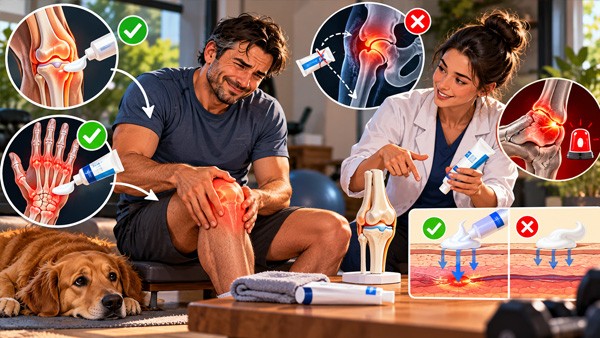

Two people buy the same anti-inflammatory gel. One has knee pain and gets real relief within a fortnight. The other has hip pain and concludes the product is useless.
Both are right about their own experience, and neither was told the thing that explains it: a gel can only treat a joint it can physically reach.
📏 The rule that decides whether topical treatment will work for you. Rubbed-in anti-inflammatories penetrate a few centimetres, no further. So they work well on joints that sit close to the surface — fingers, wrists, elbows, knees, ankles, feet — and they do essentially nothing for the hip or the spine, which lie under thick layers of muscle.
That single fact separates the people a gel will help from the people who need a different approach entirely. It is on the next page down in most patient leaflets and almost never said plainly.
Before the treatment, though, one thing has to be ruled out, because it is the only joint problem on this page that can destroy a joint in a matter of days.
🚨 The joint that cannot wait until Monday
⚠️ Go to emergency care the same day if a single joint is:
🔹 Hot and visibly red or shiny, and
🔹 Extremely painful — too painful to move, or to let anyone touch, and
🔹 Accompanied by fever, shivering or feeling generally unwell
This can be infection inside the joint. It is uncommon and it is a genuine emergency: bacteria in joint fluid can damage cartilage irreversibly within days, and the treatment is drainage and intravenous antibiotics, not a gel and not rest.
Do not apply anything to it, do not take an anti-inflammatory to see whether it settles, and do not wait overnight. Masking the pain and the temperature is what converts a treatable infection into a permanently ruined joint. The same urgency applies to sudden inability to put weight on a leg, and to any single joint getting rapidly worse over hours.
Gout can look almost identical — and it is also treated urgently, by a doctor rather than at home, so the correct move is the same either way. Nobody should be distinguishing those two themselves.
🔎 Which kind of joint pain is this
Everything that follows depends on this, because the four common patterns respond to completely different things. The distinguishing features are mostly about timing and symmetry rather than about how much it hurts.
| Osteoarthritis | Rheumatoid arthritis | Gout | |
|---|---|---|---|
| Onset | Years, gradual | Weeks to months | Hours. Often wakes you at night |
| Morning stiffness | Under 30 minutes, loosens as you move | Over 30 to 60 minutes, sometimes hours | Not the pattern |
| Effect of activity | Worse with use, better with rest | Better with movement, worse after rest | Unbearable either way during an attack |
| Symmetry | Often one-sided or uneven | Symmetrical — same joints both sides | Usually a single joint |
| Which joints | Knees, hips, thumb base, finger end joints, big toe | Knuckles, middle finger joints, wrists, balls of the feet | Base of the big toe most often, also ankle, knee |
| Feel of the swelling | Bony, firm enlargement | Soft, puffy, warm | Red, hot, tight, shiny skin |
| Other symptoms | None | Fatigue, low-grade unwellness, weight loss | Attack settles over 1 to 2 weeks even untreated |
A fourth pattern catches a lot of people out: pain around a joint rather than in it. Where a shoulder or hip hurts on specific movements but the joint itself is not swollen, the problem is often the tendons and soft tissue around it, which is a different condition with different treatment — see our guide to periarthritis.
⏰ One pattern has a deadline attached, and it is worth knowing about. If the picture is symmetrical swelling of the small joints of the hands or feet with morning stiffness lasting over an hour, that needs assessing quickly rather than treating with a gel.
The reason is that in rheumatoid arthritis, starting proper treatment within about the first twelve weeks substantially changes the long-term outcome — joint damage that happens early does not reverse. Months spent on painkillers while waiting to see whether it settles is the expensive mistake. Our guide to rheumatoid arthritis covers what that treatment involves.
📏 Where a gel reaches, and where it does not
Back to the depth question, since this determines whether the rest of the page applies to you.
| Joint | Does topical work? | Why |
|---|---|---|
| Fingers, thumb base, wrists | Yes, very well | Joint is directly under thin skin |
| Knee | Yes — the best-studied use | Joint capsule sits close to the surface at the front and sides |
| Ankle, foot, big toe | Yes | Minimal tissue over the joint |
| Elbow | Yes | Superficial |
| Shoulder | Partly | Surrounding tendons are reachable; the joint itself is deeper |
| Hip | No | Sits under several centimetres of muscle. Nothing applied to the skin gets there |
| Spine, neck, lower back | No for the joints themselves | Too deep. May ease overlying muscle, which is a different problem |
For hip and spinal joint pain the useful routes are oral medication, exercise and strengthening, weight reduction where relevant, and specialist assessment. A gel is not a weaker option there — it is the wrong tool, and no amount of applying more changes that.
Where the pain is muscular rather than in a joint, that is its own subject, covered in our guides to acute muscle pain and painful muscle spasms.
💧 How to use diclofenac gel properly
Jonac (Diclofenac Gel 1%) is a topical anti-inflammatory. The active drug is the same one in oral diclofenac, delivered to a single joint instead of the whole body, and that difference is the point: only around five to six percent of the equivalent oral dose reaches the bloodstream. You get the anti-inflammatory effect at the joint with a small fraction of the systemic exposure.
For knee and hand osteoarthritis, treatment guidelines place topical anti-inflammatories as a first-choice medication, and specifically ahead of tablets in people over 75 or with stomach, kidney or heart concerns. It is not a lesser option for those joints.
Most people use it wrong in the same three ways. The amount, the frequency, and how long they give it.
| Amount per application | Rough guide | |
|---|---|---|
| Hand, wrist, elbow | 2 g | About the size of a cherry |
| Knee, ankle, foot | 4 g | About the size of a walnut |
- 🔄 Four times a day, spread across waking hours — not once when it hurts
- 📊 Maximum 32 g in a day in total across all treated joints; no more than 16 g on any one lower-limb joint or 8 g on any one upper-limb joint
- 🖐️ Rub it in fully over the whole joint, front and sides, not a dab on the sorest spot
- 🧴 Wash your hands afterwards — unless your hands are the treated joint, in which case wait about an hour before washing
- ⏳ Give it one to two weeks. This is the biggest single reason people abandon it. It reduces inflammation progressively rather than numbing on contact, so judging it after two days tells you nothing
Three things that reduce the effect or cause problems: do not cover it with a dressing or wrap, which raises absorption unpredictably; do not apply heat over it for the same reason; and keep the treated area out of strong sun, since the skin becomes more sun-sensitive. Never apply it to broken, infected or rashy skin.
Our Emulgel (Diclofenac 1% emulsion gel) is the same drug and strength in an emulsion base, which some people find absorbs and spreads more easily. The dosing is the same.
⚠️ It is still an anti-inflammatory
Lower systemic exposure is not zero systemic exposure, and the single most important point here is a combination rule.
🚫 Never use two anti-inflammatories at once. That includes topical plus oral.
So while diclofenac gel is on a joint, do not also take ibuprofen, naproxen, diclofenac tablets, meloxicam, celecoxib, indomethacin or piroxicam. Doubling up roughly doubles the risk of stomach bleeding and kidney strain while adding very little relief, and it is extremely easy to do accidentally — particularly with over-the-counter ibuprofen taken for an unrelated headache.
Paracetamol is not an anti-inflammatory and can be combined safely at up to 4 g a day, less in liver disease, heavy alcohol use or low body weight. That is the safe pairing.
The other cautions for the topical form: avoid it in the third trimester of pregnancy, and discuss earlier pregnancy with a clinician first. Take advice before using it if you have significant kidney disease, heart failure, a history of stomach ulcer or bleeding, or if you take anticoagulants, lithium, methotrexate or diuretics. And anyone whose asthma has ever worsened after aspirin or an anti-inflammatory should avoid the class entirely, including topically. Mild skin irritation or dryness where it is applied is common and usually settles; a spreading rash or blistering means stopping.
💊 When tablets are the right answer
Oral anti-inflammatories are the route for multiple joints at once, deep joints such as the hip, or inflammation too active for topical treatment to control. They work better. They also carry real risks that scale with age, dose and duration, and those risks are worth understanding rather than ignoring.
| Option | Where it fits | Honest trade-off |
|---|---|---|
| Paracetamol | First step, and safe to combine with anything above | Modest effect in joint disease — clearly weaker than an anti-inflammatory |
| Naproxen | A common oral choice for joint inflammation | Among the more favourable cardiovascular profiles of the traditional anti-inflammatories |
| Ibuprofen | Short courses, flares | Needs frequent dosing; the familiar option rather than the strongest |
| Meloxicam | Once daily, 7.5 to 15 mg | Somewhat gentler on the stomach than older agents |
| Celecoxib | Where stomach risk is the main concern | Clearly better gastrointestinal profile. Use the lowest effective dose |
| Oral diclofenac | Strongly effective | Of the traditional agents, the least favourable cardiovascular profile — short courses rather than years |
| Prednisolone | Severe inflammatory flares, under medical supervision | Very effective short term; significant effects with prolonged use. Not a long-term painkiller |
Three principles make oral use safer, and they apply regardless of which one: lowest dose that works, shortest time that works, with food. Where there is any history of stomach ulcer or bleeding, where the person is over 65, or where a steroid or blood thinner is also being taken, a stomach-protecting tablet should be prescribed alongside rather than left to chance.
Stop and seek advice for black or tarry stools, vomiting blood, severe stomach pain, swelling of the ankles with breathlessness, or a marked drop in how much urine you pass.
🔥 Heat or cold — people reliably get this backwards
Both work. They do opposite jobs, and using the wrong one makes things worse.
- 🌡️ Heat for stiffness. A warm shower or heat pack for 10 to 15 minutes before moving, in the morning or before exercise. It loosens tissue and makes movement possible
- 🧊 Cold for swelling. An ice pack wrapped in a cloth for 10 to 15 minutes after activity, or during a flare when the joint is puffy and warm
- 🚫 Never heat an acutely hot, red, swollen joint. That adds inflammation to inflammation. And remember the emergency section — a hot joint with fever is not something to treat with either
Simple test: stiff and tight means heat, puffy and warm means cold.
🏋️ The part that outperforms the medication
This needs saying because it is counter-intuitive and because it is the most effective thing on the page.
For knee osteoarthritis, strengthening the muscles around the joint produces pain relief comparable to anti-inflammatory tablets — and unlike the tablets, the effect accumulates and carries no risk. Resting a painful joint feels right and makes it worse: the supporting muscles weaken within weeks, which transfers more load to the joint, which produces more pain.
What actually helps:
- 💪 Strength work two or three times a week, aimed at the muscles around the affected joint — thigh muscles for the knee, hip muscles for the hip, grip and forearm for the hands. This is the highest-value item
- 🚶 Daily movement, little and often. Several short walks beat one long one. Joints are nourished by movement — cartilage has no blood supply and depends on being loaded and unloaded
- 🏊 Low-impact options when weight-bearing hurts — water, cycling, a static bike
- 🌡️ Warm up for five to eight minutes before anything demanding
- 📈 Increase gradually. Soreness during and shortly after is acceptable; pain that is still worse the next morning means the step up was too big
- 🚫 Do not push through sharp or escalating pain, which is a different signal from the ache of working a stiff joint
And the number that makes weight relevant without moralising: each kilogram lost takes roughly four kilograms of load off the knee with every step. So five kilograms removes about twenty kilograms per step, thousands of times a day. Around ten percent of body weight is where people reliably report a clear difference — and the same change reduces inflammation independently of the mechanics.
🍷 If it is gout, the real treatment is not a painkiller
Gout deserves separating out, because it is the one pattern here with a genuinely curable mechanism and the one most often mismanaged as a recurring pain problem.
Attacks are caused by uric acid crystals forming in the joint. Treating each attack as it comes — which is what most people do for years —> leaves the cause running, and the crystals keep accumulating, eventually damaging the joint permanently.
The actual treatment is lowering blood uric acid below a target and keeping it there long term, usually with allopurinol, started after an attack has settled and titrated upward with blood tests. Target is generally under 360 micromol per litre, or 6 mg/dL, and lower where there are visible deposits. Done properly, attacks stop.
Alongside that, the things that reliably provoke attacks: beer and spirits, red meat and offal, shellfish, sugary drinks containing fructose, dehydration, crash dieting, and two medicines worth reviewing with a doctor — thiazide diuretics and low-dose aspirin. Starting allopurinol can itself trigger an attack, which is why cover is prescribed for the first weeks and why it should never be started or stopped during one.
🚫 What does not work
Worth including, because the money spent here is substantial.
- 💊 Glucosamine and chondroitin. Large well-conducted trials have not found a benefit over placebo for most people. Harmless, and not a treatment
- 📎 Copper bracelets and magnetic bands. Tested, and no effect beyond placebo
- 🛋️ Prolonged rest. Actively harmful for joint pain, for the reasons above
- 🧴 Stacking products on one joint — a gel plus a heat rub plus a capsaicin cream mostly produces skin irritation
One reassurance that saves a lot of worry: clicking and crunching noises from a joint, on their own and without pain, are normal and do not indicate damage or wearing out.
📞 When to seek help
Same day, urgently:
- One joint hot, red and severely painful with fever or feeling unwell — possible joint infection
- Sudden inability to bear weight on a leg
- A single joint worsening rapidly over hours
- Joint pain after a significant injury with deformity or immediate swelling
- Black or tarry stools, vomiting blood, or severe stomach pain while taking any anti-inflammatory
- Breathlessness with swollen ankles, or a marked reduction in urine output, on an anti-inflammatory
Within a week or two:
- Symmetrical swelling of small joints in the hands or feet with morning stiffness over an hour — the twelve-week window matters
- Joint pain with fatigue, unexplained weight loss or low-grade fever
- Pain in the hip or spine, where topical treatment will not help and the approach is different
- No improvement after two weeks of correctly used topical treatment at the full amount and frequency
- Repeated gout attacks — ask about uric acid lowering rather than treating each attack
- Needing an anti-inflammatory most days for more than a few weeks, which is a reason to reassess rather than to continue
- Psoriasis or nail pitting alongside joint pain, which suggests a specific type needing different treatment
- New joint pain over 50 with shoulder and hip girdle stiffness, which has its own diagnosis and responds well once identified
- Pregnancy, kidney disease, heart failure, ulcer history, or anticoagulant use — before starting anything in this class
❓ Frequently asked questions
Does diclofenac gel work on hip pain?
No. The hip sits under several centimetres of muscle and rubbed-in anti-inflammatories only penetrate a few centimetres. It works well on fingers, wrists, elbows, knees, ankles and feet, and not on the hip or spine.
How much diclofenac gel should I use?
About 2 g for a hand, wrist or elbow and 4 g for a knee, ankle or foot, four times daily. Maximum 32 g a day in total. Rub it fully into the whole joint rather than dabbing the sorest point.
How long does diclofenac gel take to work?
One to two weeks of consistent four-times-daily use for the full effect. It reduces inflammation progressively rather than numbing on contact, so judging it after a day or two tells you nothing.
Can I take ibuprofen while using diclofenac gel?
No. Never combine two anti-inflammatories, including topical with oral, because it roughly doubles the risk of stomach bleeding and kidney strain for very little extra relief. Paracetamol can be combined safely.
How do I tell osteoarthritis from rheumatoid arthritis?
Osteoarthritis stiffens for under 30 minutes, worsens with use, and is often uneven. Rheumatoid arthritis stiffens for over an hour, improves with movement, affects the same small joints on both sides, and brings fatigue.
When is a swollen joint an emergency?
When a single joint is hot, red and severely painful with fever or feeling unwell. That can be infection inside the joint, which damages cartilage within days. Go the same day and do not mask it with painkillers.
Should I use heat or cold on a painful joint?
Heat for stiffness, before movement, 10 to 15 minutes. Cold for swelling, after activity or during a flare. Stiff and tight means heat; puffy and warm means cold. Never heat an acutely hot red joint.
Should I rest a painful joint?
No, beyond a flare. Supporting muscles weaken within weeks, which transfers more load to the joint and increases pain. For knee osteoarthritis, strengthening gives relief comparable to anti-inflammatory tablets.
How much does losing weight help knee pain?
Each kilogram lost removes roughly four kilograms of load from the knee with every step, so five kilograms removes about twenty per step. Around ten percent of body weight is where people report a clear difference.
Does glucosamine help joint pain?
Large well-conducted trials have not found a benefit over placebo for most people. It is harmless but it is not a treatment. Strengthening, weight reduction and topical anti-inflammatories have real evidence behind them.
📑 Sources and editorial
- Osteoarthritis management guidelines recommending topical anti-inflammatories as a first-line pharmacological option for knee and hand osteoarthritis, including preference over oral agents in older adults and those with comorbidity
- Cochrane reviews of topical anti-inflammatories for chronic musculoskeletal pain, including efficacy by joint and comparison with oral therapy
- Pharmacokinetic studies of topical diclofenac, reporting systemic exposure relative to equivalent oral dosing and tissue penetration depth
- Prescribing information for diclofenac 1 percent gel, including per-joint dosing amounts, four-times-daily frequency, daily maxima, application technique and precautions on occlusion, heat and sun exposure
- Guidance on the gastrointestinal, renal and cardiovascular risks of oral non-steroidal anti-inflammatory drugs, comparative class data, and indications for gastroprotection
- Diagnostic criteria and typical clinical patterns for osteoarthritis, rheumatoid arthritis, gout and septic arthritis
- Guidance on septic arthritis as a medical emergency, including presentation, time to joint damage and management
- Evidence on the window of opportunity in early rheumatoid arthritis and the effect of treatment initiated within the first weeks to months on long-term joint outcomes
- Gout management guidelines, including serum urate targets, urate-lowering therapy, flare prophylaxis during initiation and dietary and medication triggers
- Randomised trials of exercise and quadriceps strengthening in knee osteoarthritis, including comparison with pharmacological analgesia
- Biomechanical studies of knee joint loading relative to body weight, and trials of weight reduction in symptomatic knee osteoarthritis
- Randomised trials of glucosamine and chondroitin in osteoarthritis, and of magnetic and copper devices for joint pain
- Related reading: rheumatoid arthritis, periarthritis, acute muscle pain, painful muscle spasms
- Related products: Jonac (Diclofenac Gel 1%), Emulgel (Diclofenac Emulsion Gel), Celebrex (Celecoxib), Mobic (Meloxicam), Naprosyn (Naproxen), pain medicine category
- RXshop Editorial Team — reviewed by Emily Chen, MD, MPH — Internal Medicine Specialist
Medical Disclaimer: The information in this article is for educational and informational purposes only and is not a substitute for professional medical advice, diagnosis, or treatment. Always seek guidance from a qualified healthcare provider with any questions you may have regarding a medical condition, and before starting, stopping or changing any medication.