Menopause Symptoms by Cluster: Which One to Treat First, and the Rule About Taking Estrogen

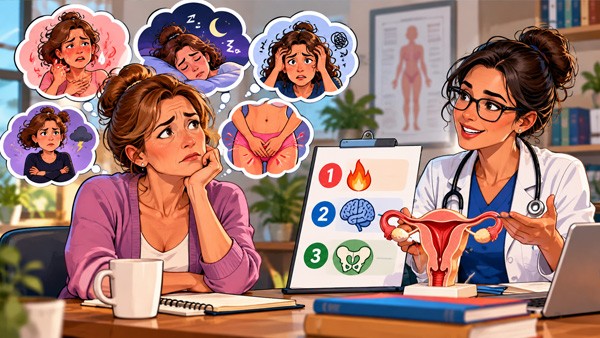

Menopause produces a long list of complaints, and the list is misleading. It suggests ten separate problems needing ten separate solutions.
In practice the symptoms arrive in clusters, because estrogen was doing several jobs at once. And because they cluster, fixing the dominant one usually improves three others without touching them directly. The commonest example: treat the night sweats and the insomnia, the daytime exhaustion, the irritability and the brain fog often improve on their own, because all four were downstream of broken sleep.
So the useful question is not how do I treat all of this. It is which cluster is doing the most damage, and what fixes that one.
⚠️ One rule before any discussion of treatment, because it is the central safety point in menopause medicine.
If you still have a uterus, estrogen must never be taken on its own. It has to be combined with a progestogen.
Estrogen alone thickens the lining of the womb and substantially raises the risk of cancer of that lining. A progestogen prevents it. Estrogen-only treatment is for women who have had a hysterectomy, and for nobody else.
🧩 The five clusters
Work out which of these is dominant for you. That answer drives everything below.
| Cluster | What it includes | Affects roughly |
|---|---|---|
| Vasomotor | Hot flushes, drenching night sweats, sudden flushing of face and chest, chills afterwards, temperature intolerance | 70 to 80 percent |
| Sleep and energy | Waking at 3 or 4 am unable to return to sleep — often without a sweat, which is why it gets labelled plain insomnia. Then exhaustion and no resilience | 45 to 60 percent |
| Mood and cognition | Anxiety with no trigger, irritability, tearfulness, low mood, word-finding difficulty and losing the thread | 30 to 50 percent |
| Genital and urinary | Dryness, burning, pain with sex, urinary urgency, recurrent urine infections | Up to 50 percent, and rising with time |
| Musculoskeletal | Joint aches and stiffness, slower recovery after activity, and frozen shoulder, which is markedly more common in this age band | Very common, rarely attributed |
💡 The one cluster that behaves differently from all the others. Hot flushes eventually fade. Mood settles. Sleep improves. The genital and urinary cluster does not — it progresses, often for decades, and it has the most effective and least risky treatment of the lot. It is also the one women least often mention.
🎯 Which to treat first
The order matters because of how the clusters feed each other.
- 🌙 If night sweats are breaking your sleep — treat the vasomotor cluster first. Sleep, energy, mood and concentration are all downstream, and they recover together
- 😴 If sleep is broken without sweats — treat sleep in its own right, and screen for sleep apnea, which becomes markedly more common after menopause and is routinely missed in women. Snoring, breathing pauses, waking unrefreshed —> see our guide to sleep apnea
- 🚽 If dryness or urinary symptoms are the problem — treat them directly with local estrogen. This cluster does not improve as a side effect of anything else
- 🧠 If mood is the dominant problem and sleep is intact — it needs addressing on its own terms, and may be hormonal, psychiatric, or both
- 💪 If joints are the main complaint — worth checking it is not inflammatory, which has a different pattern and a deadline. See our guide to telling joint conditions apart
🩸 What else it could be
Not every symptom in a woman of this age belongs to menopause, and the overlaps are exact enough to cause years of misattribution.
| Looks like menopause | Could be | Found by |
|---|---|---|
| Fatigue, temperature intolerance, mood change, weight change | Thyroid disease — reproduces this almost exactly | TSH and free T4 |
| Exhaustion, breathlessness on stairs, hair shedding | Iron deficiency, very common with heavy perimenopausal bleeding | Full blood count and ferritin |
| Unrefreshing sleep, daytime sleepiness, morning headache | Sleep apnea | Sleep study |
| Low mood, no drive, flat affect | Depression, or an antidepressant causing emotional blunting | Assessment — see our guide to low drive |
| Cannot start or finish anything, lifelong | ADHD that falling estrogen has unmasked | Assessment — see inattentive ADHD |
| Aches, low energy, poor sleep | Low vitamin D | 25-hydroxyvitamin D |
And one thing you usually do not need: a hormone panel. Over 45 with typical symptoms, menopause is a clinical diagnosis, because FSH swings week to week in perimenopause and a normal result rules nothing out. Testing matters under 45, after hysterectomy, or where the picture is unclear.
🚨 Not a menopausal symptom, and needs assessment: bleeding after periods have stopped for 12 months, bleeding between periods, bleeding after sex, or a new breast lump or nipple change. Also urgent: chest pain, fainting, sudden severe headache with visual change, or pain and swelling in one calf.
💊 Hormone treatment: the two decisions
Not one product. Which estrogen and how it is delivered, and which progestogen beside it.
The route changes the risk, and this is the most useful thing to know before the conversation:
| Tablets | Patch, gel or spray | |
|---|---|---|
| Absorption | Through the gut and liver first | Through the skin, bypassing the liver |
| Clot risk | Raised, from a low baseline | Not meaningfully raised |
| Preferred when | No clot risk factors, simplicity wanted | Any clot history, migraine, higher body weight, liver or gallbladder problems, several other medicines |
The progestogen protects the womb lining, as above. Micronised progesterone has the most favourable breast and metabolic profile; dydrogesterone, medroxyprogesterone and norethisterone are the alternatives — the last available here as Aygestin (Norethindrone), which is also used on its own to control the heavy unpredictable bleeding of perimenopause. A hormone-releasing coil delivers it and handles contraception at the same time.
Regimens come in two shapes: sequential, with a monthly bleed, while periods are still happening; and continuous combined, with no bleed, once they have stopped for a year.
⏰ Why the age you start changes the answer
💡 Starting within about ten years of menopause, or before 60, carries a favourable balance of benefit and risk for most women with troublesome symptoms. Starting much later loses the benefit and adds risk.
The trial that produced two decades of fear was conducted largely in women with an average age of 63, more than a decade past menopause and many with existing cardiovascular risk. Its findings were then applied to 51-year-olds with hot flushes, for whom they were never relevant.
The honest numbers, since they belong in the open:
- 🎈 Breast cancer. Combined treatment adds a small absolute risk, in the region of one extra case per thousand women per year of use, rising with duration. Estrogen alone after hysterectomy shows little or no increase. Regular alcohol and significant excess weight carry risks of comparable or greater size
- 🩸 Clots. Oral treatment roughly doubles a low baseline. Patches and gels do not raise it meaningfully
- 🧠 Stroke. Small increase with oral treatment, mainly over 60
- 🦴 Bone. A clear benefit — it prevents fractures
- ❤️ Heart. Hormone treatment is not prescribed to prevent heart disease. Blood pressure and cholesterol are managed on their own terms — see our guides to blood pressure and cholesterol
Not suitable for systemic hormone treatment: current or past breast cancer or other estrogen-dependent cancer, unprovoked clot in a leg or lung, previous stroke or heart attack, active liver disease, undiagnosed vaginal bleeding, or possible pregnancy.
Two groups where the calculation is different. Periods stopping before 40 is premature ovarian insufficiency; between 40 and 45 is early menopause. In both, hormone treatment is normally recommended until at least the average age of menopause — not for comfort but to protect bone and cardiovascular health through years the body expected estrogen. The risk discussion for a 38-year-old is not the one in the headlines.
🌸 The treatment for the cluster nobody mentions
Lubricants and moisturisers help comfort. They do not restore the tissue, and for the genital and urinary cluster the tissue is the problem.
Low-dose vaginal estrogen does restore it — a small tablet, cream, gel or ring used locally, typically nightly for two weeks then twice weekly indefinitely. What makes it different from systemic treatment:
- 📉 Systemic absorption is minimal, so blood estrogen stays in the postmenopausal range
- 🛡️ No progestogen needed alongside it, because the womb lining is not stimulated
- ♾️ Can be used long term, and needs to be — symptoms return when it stops
- 🏥 Many women who cannot take systemic hormones can use it, including a large proportion of breast cancer survivors with their oncologist agreement
- 💊 It measurably reduces recurrent urinary infections, which for some women is the main reason to use it
Desire and arousal are a related but separate question, covered in our guide to reduced libido.
💊 What works without hormones
Whether because of a contraindication, a personal decision or availability, non-hormonal treatment for the vasomotor cluster is genuinely effective and recommended in guidelines. Less effective than estrogen, and far from nothing.
| Option | Dose | Notes |
|---|---|---|
| Paroxetine | 7.5 mg, up to 25 mg | At the low dose, the one non-hormonal medicine specifically approved for hot flushes. Not with tamoxifen — see below |
| Venlafaxine | 37.5 mg, often to 75 mg | Good evidence, and the preferred choice on tamoxifen |
| Escitalopram | 10 to 20 mg | Useful where anxiety or low mood sit alongside |
| Gabapentin | 300 to 900 mg at night | Particularly for night sweats and sleep; drowsiness is the point at bedtime |
| Cognitive behavioural therapy | — | Real evidence for flush interference and for sleep. No side effects |
⚠️ One interaction matters enormously in exactly this group. Women on tamoxifen after breast cancer often have severe hot flushes and cannot take estrogen — so they are the group most likely to be offered these medicines.
Paroxetine and fluoxetine must be avoided with tamoxifen. They block the enzyme that converts tamoxifen into its active form, which can undermine the cancer treatment. Venlafaxine is the standard choice instead, and it has to be raised explicitly, because it gets missed.
Expect two to four weeks for effect on any of these, and start low, since early side effects are the usual reason people stop.
Alongside them, the practical measures that reliably reduce flush frequency: cutting alcohol, which is the strongest single trigger for most women; reducing caffeine, hot drinks and spicy food; layered clothing and a cool bedroom; and regular exercise. Stopping smoking makes a measurable difference — see our guide to smoking cessation.
📋 A weekly scorecard worth keeping
Memory is unreliable here — people remember the worst night and underestimate improvement. Score the same things on the same day each week and compare over two to four weeks, not day to day.
| What to record | How | Progress looks like |
|---|---|---|
| Flush disruption | 0 to 10 for how much it interfered | Lower across two to four weeks |
| Night awakenings | Number per night, averaged | Fewer, and faster back to sleep |
| Daytime energy | 0 to 10 | Higher, and more consistent |
| Urogenital comfort | 0 to 10 | Less irritation, fewer infections |
Night awakenings is the most useful single number, because it tracks the vasomotor cluster faithfully and it is what improves first when treatment is working.
🦴 The part with no symptoms
Bone loss accelerates sharply around menopause — up to roughly two percent of spinal bone density per year for about five years — and produces no sensation until something breaks.
What reduces it: weight-bearing and resistance exercise, which is the most effective and most neglected measure; adequate calcium from food and vitamin D; not smoking; modest alcohol. Hormone treatment itself prevents fractures in women taking it for symptoms anyway.
Ask about a bone density scan if there is early menopause, a parent who fractured a hip, a previous fracture from a minor fall, low body weight, long-term steroid use, or height loss.
Alongside bone, two things change quietly after menopause and are worth monitoring rather than assuming: blood pressure and cholesterol both tend to rise, and body fat redistributes centrally sometimes without weight gain. Those are managed on their own terms.
❌ What does not work
- 🌿 Black cohosh. Inconsistent trial results and reports of liver injury. Not recommended
- 🌼 Evening primrose oil, wild yam, dong quai. No reliable benefit
- 🍢 Soy and red clover isoflavones. Modest at best
- 💉 Compounded bioidentical pellets and custom creams. Unregulated, unpredictable dosing, and an implanted pellet cannot be removed if the dose is too high. Menopause societies advise against them. Regulated body-identical estradiol as a standard patch, gel or tablet is the actual bioidentical option — tested, measured and reversible
- 🧪 Saliva hormone testing to guide dosing. Not validated
🤞 Two practical things that get overlooked
Contraception is still needed. Fertility falls but does not vanish. Continue until 12 months after the last period if over 50, and 24 months if under 50. Hormone replacement therapy is not contraception.
Heavy or irregular perimenopausal bleeding is common and treatable. Fluctuating hormones cause genuinely heavy periods, and a progestogen or a hormone coil manages them. But heavy bleeding also causes the iron deficiency in the table above, and some patterns need investigating — flooding, clots, bleeding between periods or after sex all deserve an appointment rather than endurance.
📞 When to seek help
Worth an appointment:
- Symptoms interfering with sleep, work or relationships — the bar is impact, not severity
- Periods stopping before 45, and especially before 40
- Dryness, pain with sex, urinary urgency or repeated urine infections — ask specifically about local vaginal estrogen, which is frequently not offered
- Taking tamoxifen with hot flushes — say so before any antidepressant is prescribed for them
- A clot history, migraine or higher body weight — ask about patches or gel rather than tablets
- Being offered estrogen alone while you still have a uterus — query it
- Being offered compounded pellets or custom creams — ask for a regulated preparation
- Heavy or flooding periods — and ask for ferritin
- Mood symptoms not improving, where both the hormonal and the psychiatric route are available
- Snoring, breathing pauses or daytime sleepiness
- Early menopause, a parental hip fracture, or a fracture from a minor fall — ask about bone density
- Thinking about stopping hormone treatment — there is no fixed age at which it must stop
❓ Frequently asked questions
Which menopause symptom should I treat first?
The most disruptive cluster. If night sweats are breaking sleep, treating them usually improves energy, mood and concentration too, because all three are downstream. The genital and urinary cluster must be treated directly.
Can I take estrogen on its own?
Only after a hysterectomy. With a uterus it must always be combined with a progestogen, because estrogen alone thickens the womb lining and substantially raises the risk of cancer of that lining.
Do I need a blood test to confirm menopause?
Usually not. Over 45 with typical symptoms it is a clinical diagnosis, because FSH fluctuates too much in perimenopause. Thyroid function, ferritin and vitamin D are the more useful tests.
How long do menopause symptoms last?
Hot flushes average seven to ten years, longer when they begin early in perimenopause. Mood and sleep settle. The genital and urinary symptoms do not settle — they progress, and need treating directly.
Why does the age I start HRT matter?
Starting within about ten years of menopause or before 60 carries a favourable balance. The trial behind the alarming headlines studied women averaging 63, and its findings were wrongly applied to 51-year-olds.
Are patches safer than tablets?
For clots, yes. Patches and gels bypass the liver and do not meaningfully raise clot risk, while tablets roughly double a low baseline. Patches are preferred with clot history, migraine or higher body weight.
Will lubricants fix vaginal dryness?
They help comfort but do not restore the tissue. Low-dose vaginal estrogen does, has minimal systemic absorption, needs no progestogen alongside, can be used long term, and reduces recurrent urine infections.
What can I take for hot flushes without hormones?
Paroxetine at 7.5 mg is the one non-hormonal medicine specifically approved for them. Venlafaxine, escitalopram and gabapentin also work, as does cognitive behavioural therapy. Allow two to four weeks.
I am on tamoxifen. Which hot flush medicine is safe?
Venlafaxine. Paroxetine and fluoxetine block the enzyme that activates tamoxifen and can undermine the cancer treatment, so they must be avoided. Raise the tamoxifen explicitly before anything is prescribed.
Could my symptoms be something other than menopause?
Often. Thyroid disease, iron deficiency from heavy periods, sleep apnea, depression, low vitamin D and unmasked ADHD all reproduce parts of the picture, and all are found with ordinary tests or assessment.
📑 Sources and editorial
- Menopause society position statements on hormone therapy, including timing of initiation, route-dependent risk and benefit-risk assessment by age and years since menopause
- National guidance on the diagnosis and management of menopause, including the recommendation against routine hormone testing over 45 and the indications for FSH measurement
- Guidance on mandatory progestogen co-administration with systemic estrogen in women with an intact uterus, and data on endometrial hyperplasia and cancer risk with unopposed estrogen
- Longitudinal cohort data on prevalence and duration of vasomotor, sleep, mood and genitourinary symptoms across the menopausal transition
- Reanalyses of the Women Health Initiative by age at randomisation and years since menopause, and commentary on the misapplication of its findings to younger symptomatic women
- Comparative data on venous thromboembolism risk with oral versus transdermal estrogen, and on stroke risk by age and route
- Collaborative analyses of breast cancer risk with combined and estrogen-only hormone therapy by duration of use
- Guidance on genitourinary syndrome of menopause, including systemic absorption of low-dose vaginal estrogen, the absence of a progestogen requirement, long-term use and effect on recurrent urinary tract infection
- Trials of paroxetine, venlafaxine, escitalopram and gabapentin for vasomotor symptoms, and the regulatory approval of low-dose paroxetine for this indication
- Pharmacogenetic and clinical data on CYP2D6 inhibition by paroxetine and fluoxetine and consequent avoidance in women taking tamoxifen
- Trials of cognitive behavioural therapy for vasomotor symptom interference and sleep in menopause
- Evidence on hormone therapy and fracture prevention, and rates of bone loss across the menopausal transition
- Guidance on management of premature ovarian insufficiency and early menopause, including treatment until the average age of natural menopause
- Reviews of black cohosh, isoflavones and other botanical preparations, including reports of hepatotoxicity
- Professional society statements advising against compounded bioidentical hormone preparations, pellet implants and salivary hormone testing
- Guidance on contraception requirements through the perimenopause and on management of abnormal perimenopausal bleeding
- Related reading: reduced libido, obstructive sleep apnea, inattentive ADHD, low drive and fatigue, telling joint conditions apart
- Related products: Paxil (Paroxetine), Effexor (Venlafaxine), Lexapro (Escitalopram), Aygestin (Norethindrone), womens health category
- RXshop Editorial Team — reviewed by Anita Sharma, MD, FACOG — Obstetrician-Gynecologist & Women Health
Medical Disclaimer: The information in this article is for educational and informational purposes only and is not a substitute for professional medical advice, diagnosis, or treatment. Always seek guidance from a qualified healthcare provider with any questions you may have regarding a medical condition, and before starting, stopping or changing any medication.