Early Menopause: Why Hormone Replacement Is Different Here

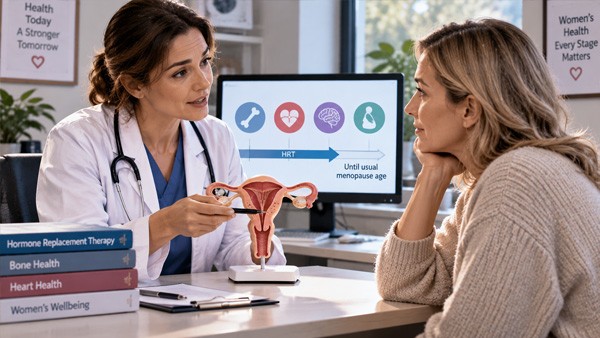

Most of what is written about menopause assumes a woman in her early fifties, and most of the public argument about hormone replacement concerns women of that age and older. For a woman whose periods stop at thirty-six, or forty-two, almost none of that applies — and applying it anyway is one of the more consequential mistakes in women health.
The distinction is not about timing alone. When the ovaries stop early, the body loses hormones it would otherwise have had for another ten or fifteen years, and losing them that early has consequences for bone, heart and brain that do not happen on the same scale at fifty-one.
📅 The terms, because they change the approach.
Premature ovarian insufficiency means the ovaries stop functioning normally before the age of forty. It affects roughly one woman in a hundred.
Early menopause means periods stop between forty and forty-five. It affects around one woman in twenty.
The average age of natural menopause is around fifty-one. Everything on this page follows from the gap between that age and when it actually happened.
🔎 Recognising it, and what else it could be
The picture is the familiar menopausal one arriving too soon: periods becoming irregular and then stopping, hot flushes and night sweats, disturbed sleep, low mood or irritability, reduced libido, vaginal dryness, and difficulty concentrating. In premature ovarian insufficiency the periods may stop and restart unpredictably rather than stopping cleanly.
Missing periods at this age have several other explanations, and they are checked first:
- Pregnancy — always the first test
- Thyroid disease, in either direction
- Raised prolactin, from medication or a pituitary cause, covered in the article on pituitary tumours
- Polycystic ovary syndrome, described in the article on PCOS
- Significant weight loss or intense exercise, which suppress the cycle from above rather than at the ovary
The diagnosis of premature ovarian insufficiency rests on months of absent or very irregular periods together with a raised level of the hormone the brain uses to stimulate the ovaries, measured on two occasions several weeks apart. One test alone is not enough, because the level fluctuates considerably in the early stages.
🧬 Why it happens
| Cause | Notes |
|---|---|
| No identifiable cause | The majority. Finding no reason is common and does not mean the investigation was inadequate |
| Autoimmune | The immune system targeting the ovary, often alongside thyroid disease or, less commonly, adrenal failure |
| Genetic | Including a premutation in the gene responsible for fragile X syndrome, and chromosomal differences. Relevant to family members as well |
| Cancer treatment | Chemotherapy and pelvic radiotherapy, with risk depending on the drugs, the dose and age at treatment |
| Surgery | Removal of both ovaries produces an immediate menopause, often with abrupt and severe symptoms |
| Smoking | Brings natural menopause forward by one to two years on average |
Because of the autoimmune link, thyroid function should be checked, and symptoms suggesting adrenal failure — exhaustion, weight loss, dizziness on standing, salt craving and darkening skin, described in the article on cortisol — should prompt testing rather than being attributed to the menopause. Genetic testing is worth discussing, particularly where there is a family history of early menopause or of learning disability.
⚠️ What losing the hormones early costs
Oestrogen does far more than regulate periods. It maintains bone density, protects the lining of blood vessels, supports brain function, and keeps the tissues of the vagina and bladder healthy. Losing it a decade or more early means a decade or more of exposure to what its absence does.
| System | Consequence of untreated early loss |
|---|---|
| Bone | Accelerated bone loss and a substantially higher risk of osteoporosis and fracture later in life |
| Heart and blood vessels | Higher rates of cardiovascular disease |
| Brain | An association with later cognitive decline, particularly after surgical removal of the ovaries |
| Overall | Reduced life expectancy in women with untreated premature ovarian insufficiency |
| Vagina and bladder | Dryness, painful intercourse, urgency and recurrent urine infections |
The encouraging part is that hormone replacement substantially reduces these risks, which is why it is not simply an option for symptoms here but a recommended treatment in its own right.
💊 Why hormone replacement is different at this age
✅ For women with premature ovarian insufficiency or early menopause, hormone replacement is recommended at least until the average age of natural menopause, around fifty-one — unless there is a specific reason not to take it.
The widely publicised concerns about hormone replacement — breast cancer, stroke, blood clots — come largely from studies of women who started it in their sixties, many years after menopause. A woman of thirty-eight taking oestrogen is not being given something extra. She is being given roughly what her own ovaries would still be producing, and the evidence does not show those risks increasing above those of women of the same age with normally functioning ovaries.
Put simply: the risk at this age lies in not replacing the hormones, rather than in replacing them. Women who decline treatment because of headlines about older women are frequently taking on the larger risk to avoid the smaller one.
Doses are often higher than those used in older women, because the aim is to replace normal premenopausal levels rather than to control symptoms at the lowest possible dose. Oestradiol, chemically identical to the body own hormone, is generally preferred.
If the womb is still present, a progestogen must be taken alongside the oestrogen. Oestrogen alone stimulates the lining of the womb, and over time unopposed stimulation causes overgrowth with a raised cancer risk — the same mechanism described in the article on PCOS. The progestogen can be taken as tablets, cyclically or continuously, or delivered by a hormonal coil. Where the womb has been removed, oestrogen alone is used.
The combined contraceptive pill is an alternative for some younger women, providing hormone replacement and contraception together. It delivers less physiological hormone levels than standard replacement and involves a hormone-free week in most regimens, so the choice is worth discussing rather than defaulting to either.
Local vaginal oestrogen can be added for vaginal and bladder symptoms that persist despite systemic treatment, and is described in the article on bladder symptoms.
👶 Fertility, and a surprise worth knowing about
Premature ovarian insufficiency is not always permanent in the way natural menopause is. The ovaries can resume activity intermittently, and around five to ten per cent of women with the diagnosis conceive naturally at some point afterwards.
That has two practical consequences. For women hoping to conceive, it is a genuine possibility, though an unpredictable one. For women who do not want a pregnancy, contraception is still needed — and standard hormone replacement is not a contraceptive, which is one of the reasons the combined pill is sometimes chosen instead.
For women wanting a pregnancy who do not conceive naturally, assisted conception using donated eggs has high success rates. Where early menopause is anticipated — before cancer treatment, for example — freezing eggs or ovarian tissue beforehand may be possible and is worth raising at the earliest opportunity.
🦴 Protecting bone
A bone density scan is usually done at diagnosis and repeated periodically. Beyond hormone replacement, which is the main protection:
- Weight-bearing and resistance exercise, which build and maintain bone in a way nothing else replaces
- Adequate calcium and vitamin D, from diet or supplements where intake is low
- Stopping smoking and keeping alcohol moderate
Osteoporosis medicines designed for older women are generally not the first choice at this age. Some of them remain in bone for many years, which matters for anyone who may still want a pregnancy, and others worsen hot flushes. Hormone replacement is the primary treatment, with other options considered only where it cannot be used.
💬 The part that is not physical
A diagnosis in the thirties often lands hard. It can mean the loss of expected fertility, an unexpected sense of ageing, and symptoms that friends of the same age do not share or understand. Low mood, grief and anxiety are common and entirely understandable responses, and they deserve attention in their own right rather than being folded into the hormonal picture.
Hormone replacement often helps mood, sleep and concentration, but it is not a substitute for support. Counselling, peer support groups for women with premature menopause, and, where needed, treatment for depression all have a place.
🩺 When to seek help
- Periods stopping or becoming very irregular before forty-five, with or without hot flushes
- Missing periods with a negative pregnancy test — needs investigation rather than waiting
- After cancer treatment or ovarian surgery — discuss hormone replacement early
- Exhaustion, weight loss, dizziness on standing or darkening skin — test for adrenal failure
- A family history of early menopause — worth discussing before planning a family
- Bleeding on hormone replacement that is heavy, prolonged or irregular — needs assessment
- Calf pain or swelling, chest pain, or sudden breathlessness on hormone treatment — emergency
- Hormone replacement stopped because of worries about risk — worth revisiting, since the balance at this age is usually the opposite of what was feared
Hormone replacement is stocked in the womens health category as Progynova (estradiol valerate) and Estrace (estradiol), with Premarin as a conjugated oestrogen alternative. Where the womb is present, a progestogen is taken alongside, such as Duphaston, Provera or Susten (progesterone). Vagifem treats vaginal and bladder symptoms locally. Dose and regimen are set by a prescriber, and doses in younger women are often higher than those used after natural menopause.
❓ Frequently asked questions
What counts as early menopause?
Periods stopping between forty and forty-five is early menopause, affecting about one woman in twenty. Before forty it is called premature ovarian insufficiency, affecting about one in a hundred. The average age of natural menopause is around fifty-one, and the gap between that and when it happened is what shapes treatment.
Is hormone replacement safe if I am under forty-five?
For women with early or premature menopause it is recommended at least until around fifty-one unless there is a specific reason not to. The well-known concerns come mainly from studies of women starting in their sixties. At a younger age it replaces roughly what the ovaries would still be producing, and the greater risk lies in not replacing the hormones.
What happens if I do not take it?
A decade or more without oestrogen accelerates bone loss and raises the risk of osteoporosis and fracture, increases cardiovascular disease, is associated with later cognitive decline, and in untreated premature ovarian insufficiency is linked to reduced life expectancy. Hormone replacement substantially reduces these risks, which is why it is a recommended treatment rather than only a symptom remedy.
Can I still get pregnant?
Possibly. Premature ovarian insufficiency is not always permanent, and around five to ten per cent of women with the diagnosis conceive naturally at some point. That is hopeful for those wanting a pregnancy and means contraception is still needed for those who do not — standard hormone replacement is not a contraceptive. Donor-egg treatment has high success rates where natural conception does not happen.
Why do I need a progestogen as well?
If the womb is still present, oestrogen alone stimulates its lining, and over time unopposed stimulation causes overgrowth with a raised cancer risk. A progestogen, taken as tablets or delivered by a hormonal coil, prevents that. Women who have had the womb removed take oestrogen alone.
Should I take the pill or hormone replacement?
Either can be appropriate. The combined pill provides hormones and contraception together, which suits some younger women. Standard replacement delivers more physiological levels and has no hormone-free week. The choice depends on whether contraception is needed, symptoms, preference and any reasons to avoid one or the other, and is worth discussing rather than defaulting.
How is it diagnosed?
Months of absent or very irregular periods together with a raised level of the hormone the brain uses to stimulate the ovaries, measured on two occasions several weeks apart, since a single result fluctuates. Pregnancy, thyroid disease, raised prolactin, polycystic ovary syndrome and weight loss or intense exercise are excluded first. Thyroid testing and genetic testing are often part of the work-up.
Why check my thyroid and adrenal glands?
Because an autoimmune process attacking the ovary often affects other glands too. Thyroid disease is the commonest companion. Adrenal failure is rarer but important: exhaustion, weight loss, dizziness on standing, salt craving and darkening skin should prompt testing rather than being attributed to the menopause.
What about osteoporosis tablets?
They are generally not the first choice at this age. Some remain in bone for many years, which matters for anyone who may still want a pregnancy, and others worsen hot flushes. Hormone replacement is the main protection for bone, alongside weight-bearing exercise, adequate calcium and vitamin D, and not smoking. A bone density scan is usually done at diagnosis.
Why is the dose higher than my mother was given?
Because the aim is different. After natural menopause the goal is usually to control symptoms at the lowest effective dose. In early or premature menopause the goal is to replace normal premenopausal hormone levels to protect bone, heart and brain, which often requires a higher dose. It is replacement rather than supplementation.
📑 Sources and editorial
- Guidelines on the diagnosis and management of premature ovarian insufficiency
- Epidemiology of premature ovarian insufficiency and early menopause
- Literature on autoimmune, genetic and iatrogenic causes, including the fragile X premutation
- Evidence on bone, cardiovascular, cognitive and mortality outcomes of untreated early oestrogen loss
- Guidance that hormone replacement should continue at least to the average age of natural menopause in this population
- Analyses distinguishing risks observed in older women starting hormone therapy from those in younger women with early menopause
- Guidance on endometrial protection with progestogens and on the combined pill as an alternative
- Data on spontaneous ovarian activity and natural conception after diagnosis
- Evidence on donor-egg treatment and on fertility preservation before gonadotoxic treatment
- Guidance on bone density monitoring and on osteoporosis agents in younger women
- Related reading: polycystic ovary syndrome, pituitary causes of missed periods, irregular cycles
- Related products: womens health category
- RXshop Editorial Team — reviewed by Anita Sharma, MD, Obstetrics and Gynaecology
Medical Disclaimer: The information in this article is for educational and informational purposes only and is not a substitute for professional medical advice, diagnosis, or treatment. Always seek guidance from a qualified healthcare provider with any questions you may have regarding a medical condition, and before starting, stopping or changing any medication.