Pneumonia or Just a Chest Infection: The Four Point Score That Decides Home or Hospital Treatment

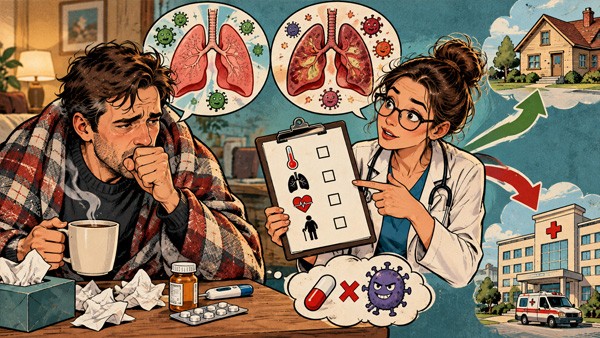

Almost everybody with a chest infection asks the same two questions, in this order. Is this pneumonia? And do I need to be in hospital?
The second question has an actual answer, used in clinics every day, built from four things you can check at a kitchen table. It is below. But it comes after the list that matters more, because pneumonia is one of the few conditions on this site where a few hours changes the outcome.
🚨 Go to emergency care now if any of these are present:
🔹 Breathless while sitting still, or unable to finish a sentence in one breath
🔹 New confusion or unusual drowsiness — and in anyone elderly this may be the only sign, with no fever and no cough
🔹 Blue or grey lips, face or fingertips
🔹 Breathing very fast — more than about 30 breaths a minute
🔹 Coughing up blood
🔹 Chest pain that is sharp and worse on breathing in
🔹 Unable to keep fluids down, or passing very little urine
🔹 Temperature very high, or unusually low with shivering — a low temperature in a sick person is more worrying, not less
And if there is an oxygen monitor in the house: a reading below about 94 percent, or below 92 in someone with known lung disease, needs urgent assessment.
📊 The four point score
This is the tool used to decide whether community-acquired pneumonia can be treated at home. It has four items, each worth one point.
| Item | How to check it | |
|---|---|---|
| C | Confusion, new | Disorientation, muddled speech, not knowing the day or place |
| R | Respiratory rate 30 or more per minute | Count the breaths for 30 seconds and double it, while the person is resting and ideally not aware you are counting. Normal is 12 to 20 |
| B | Blood pressure — top number under 90, or bottom number 60 or less | A home monitor, or at a pharmacy |
| 65 | Age 65 or over | — |
| Score | What it usually means |
|---|---|
| 0 | Low risk. Treatment at home with oral antibiotics is usually appropriate |
| 1 or 2 | Intermediate risk. Needs assessing by a clinician, and hospital is a real possibility |
| 3 or 4 | High risk. Urgent hospital assessment |
Two things about using it honestly. It is a guide, not a verdict — a score of zero in someone who looks dreadful still needs seeing. And the age point means that anyone over 65 starts at one, which is deliberate: pneumonia behaves differently and more dangerously in older people, often with less fever and fewer chest symptoms.
The respiratory rate is the item most worth learning, because it is the earliest thing to change and the thing people never think to measure. A resting rate over 24 is already abnormal and worth reporting even before it reaches 30.
🆚 Pneumonia or bronchitis
This is the distinction the whole page turns on, because one usually needs an antibiotic and the other usually does not.
| Acute bronchitis | Pneumonia | |
|---|---|---|
| What it is | Inflammation of the airways. Viral in the great majority | Infection of the lung tissue itself, usually bacterial |
| How ill you feel | Unwell and coughing, but functioning | Genuinely ill — in bed, no appetite, wiped out |
| Fever | Absent or mild | Often high, with shivering or shaking chills |
| Breathing | Normal at rest; cough may be tiring | Breathless at rest or on minimal effort |
| Chest pain | Rawness or soreness from coughing, across the front | Sharp pain in one place, worse on breathing in |
| On examination | Wheeze or rattles that clear with coughing, both sides | Crackles in one area, reduced air entry there |
| In older people | Cough | May present only as confusion or a fall, with no fever and no cough |
| Antibiotics | Do not help in otherwise healthy adults | Needed |
📌 The honest statement about bronchitis, because it is the commonest reason antibiotics get taken unnecessarily.
Acute bronchitis in an otherwise healthy adult is viral in the great majority of cases, and trials consistently show antibiotics make little or no difference to how quickly it resolves. The cough lasts two to three weeks either way.
What does help: fluids, paracetamol, honey, and time. What the antibiotic adds is side effects and resistance.
The exceptions worth knowing: existing lung disease such as COPD, significant heart or kidney disease, immunosuppression, frailty, or age over 65 with other conditions. In those situations the calculation changes and treatment is often appropriate — see our guide to chronic bronchitis.
🦠 The one amoxicillin misses
Worth its own section because it explains a common treatment failure.
Atypical pneumonia — most often caused by Mycoplasma — behaves differently and is sometimes called walking pneumonia, because people carry on working with it.
- 👤 Younger adults and teenagers, often in clusters within a household, school or workplace
- 📉 Gradual onset over a week rather than a sudden collapse
- 😵 Dry, hacking, persistent cough rather than productive
- 🤢 Headache, sore throat, muscle aches out of proportion to the chest symptoms
- 🩺 Chest signs often mild relative to how extensive the X-ray looks
And here is the point: amoxicillin does not cover it. These organisms have no cell wall for penicillins to attack. Treatment requires a tetracycline such as doxycycline, or a macrolide such as azithromycin or clarithromycin.
So someone with a dry cough, headache and fever who is started on amoxicillin and does not improve after three days has not necessarily failed treatment — they may have been given a drug that cannot reach the organism.
💊 What treats it, and for how long
Antibiotic choice depends on severity, on local resistance, and on whether atypical cover is needed. The broad shape is consistent.
| Option | Typical use | Covers |
|---|---|---|
| Amoxicillin | First line for low-severity community-acquired pneumonia, 500 mg three times daily | Typical bacteria, pneumococcus above all. Not atypicals |
| Doxycycline | 200 mg on day one, then 100 mg daily. First choice in penicillin allergy, and where atypical cover is wanted | Both typical and atypical — the broadest single oral option here |
| Azithromycin or clarithromycin | Atypical cover, alone or added to amoxicillin in moderate disease | Atypicals, and some typical cover |
| Co-amoxiclav | Moderate severity, or where there is COPD, recent antibiotics or other illness | Broader than amoxicillin alone |
| Cefuroxime | Alternative in some situations | Typical bacteria |
| Levofloxacin or moxifloxacin | Reserve. Specific situations where nothing else fits | Very broad, including atypicals |
Duration has changed and it is worth knowing. For low-severity community-acquired pneumonia the recommended course is now commonly five days, provided the person is improving, rather than the seven to ten days many people remember. Shorter courses work as well and cause fewer side effects.
The checkpoint that matters: review at 48 to 72 hours. Fever should be settling and breathing easing by then. If it is not, that is the moment to be reassessed rather than to finish the course and hope.
⚠️ Two cautions on the reserve drugs. The fluoroquinolones — levofloxacin, moxifloxacin, ciprofloxacin — carry warnings about tendon rupture, nerve damage, and effects on mood and the central nervous system, some of which can be lasting. They are excellent antibiotics kept for situations where the alternatives will not do, and they are not a first choice for an ordinary chest infection.
And ciprofloxacin specifically has poor activity against pneumococcus, which makes it a bad choice for pneumonia despite being a familiar name.
Doxycycline has three practical rules worth following: take it with plenty of water and stay upright for half an hour afterwards, because it can irritate the oesophagus; avoid taking it at the same time as indigestion remedies, iron or calcium, which block absorption; and expect sun sensitivity, so use sun protection during the course. It is avoided in pregnancy and in children under 12.
🧪 What gets checked, and what is not needed
In someone being treated at home the assessment is mostly clinical.
- 🩺 Listening to the chest — crackles confined to one area are the classic finding
- 📊 Oxygen saturation, respiratory rate, pulse, blood pressure and temperature
- 📷 A chest X-ray where the diagnosis is uncertain, where there is no improvement, or where hospital admission is being considered. Not needed to treat a clear-cut case at home
- 🩸 Blood tests including CRP in a clinical setting, mainly to judge severity rather than to make the diagnosis
Worth knowing for reassurance: a repeat X-ray is not routine once someone has recovered, and the shadow on the film clears more slowly than the person does — often six weeks or more behind the symptoms.
⏳ How long recovery actually takes
This is the section that saves people a great deal of worry, and it is almost never given.
| Time | Where you should roughly be |
|---|---|
| 3 days | Fever settling. If it is not, be reassessed |
| 1 week | Chest pain and sputum improving |
| 4 weeks | Cough and sputum much reduced |
| 6 weeks | Cough and breathlessness mostly settled |
| 3 months | Most symptoms gone, but a cough may still linger |
| 6 months | Back to normal — though tiredness can persist this long |
Those last two rows are the ones that matter. A cough at week five and tiredness at month three are the normal course of pneumonia recovery, not treatment failure and not a reason for another antibiotic. Knowing that in advance prevents a great deal of unnecessary medication.
What does need reassessing: getting worse rather than slowly better, a new fever after the first one settled, increasing breathlessness, or weight loss and night sweats continuing.
💉 What actually prevents it
- 🚭 Stopping smoking. The single largest modifiable risk factor, and it is also the thing that most improves recovery. The methods that work are in our guide to smoking cessation
- 💉 Pneumococcal vaccination, recommended in older adults and in anyone with chronic lung, heart, liver or kidney disease, diabetes, a suppressed immune system or no spleen
- 🌡️ Annual influenza vaccination — influenza is a common precursor to bacterial pneumonia, so preventing one prevents some of the other
- 🦷 Dental and oral hygiene, which sounds unrelated and is not: mouth bacteria are a route into the lungs, especially in older and frail people
- 🍷 Reducing heavy alcohol use, which impairs the cough reflex and immunity
- 🍴 Swallowing difficulty taken seriously — coughing during meals or a wet voice afterwards suggests food going the wrong way, which is a major cause of pneumonia in older people and is treatable
👤 Why it is different after 65
Short section, and the most important one for anyone caring for an older relative.
Pneumonia in older people frequently presents without fever and without much cough. What appears instead is confusion, a fall, loss of appetite, or simply not being themselves. By the time a chest symptom appears the illness may be well advanced.
So the rule for that age group is different: new confusion or a sudden decline in function is itself a reason to look for infection, and it should not wait for a cough to justify a call.
📞 When to seek help
🚨 Emergency, now: breathless at rest or unable to complete a sentence; new confusion or drowsiness; blue or grey lips; breathing faster than about 30 a minute; coughing blood; oxygen saturation below 94 percent; unable to keep fluids down; or a very high or unusually low temperature with shivering.
Same day:
- A score of 1 or more on the four items above
- Fever with sharp one-sided chest pain worse on breathing in
- Any respiratory illness in someone over 65 who seems confused, has fallen, or has stopped eating
- Existing lung disease, heart failure, diabetes, kidney disease or a suppressed immune system with a new chest infection
- No improvement after 48 to 72 hours of antibiotics
- Getting worse at any point, rather than slowly better
Worth an appointment:
- A new fever after the first one had settled
- Cough still productive and heavy at six weeks
- Weight loss, night sweats or coughing blood at any stage
- Repeated chest infections — more than two in a year deserves investigating rather than treating each one
- Coughing during meals or a wet voice afterwards
- Never having had pneumococcal or influenza vaccination in a risk group
- Pregnancy or breastfeeding — doxycycline is avoided, and the choice differs
❓ Frequently asked questions
How do I know whether pneumonia needs hospital?
Count four things: new confusion, breathing 30 or more a minute, blood pressure under 90 on top or 60 or less on the bottom, and age 65 or over. Zero usually means home treatment; one or more needs assessing.
What is the difference between bronchitis and pneumonia?
Bronchitis affects the airways, is usually viral, and leaves you coughing but functioning. Pneumonia infects lung tissue, brings fever and shivering, breathlessness at rest and sharp one-sided chest pain, and makes you genuinely ill.
Does bronchitis need antibiotics?
Usually not. In otherwise healthy adults it is viral in the great majority and trials show antibiotics make little or no difference. The exceptions are existing lung disease, significant other illness, frailty or immunosuppression.
How long does the cough last after pneumonia?
Much reduced by four weeks and mostly settled by six, but a lingering cough at three months is still within the normal course. Tiredness can persist up to six months. Neither means the treatment failed.
Why did amoxicillin not work for my chest infection?
It may be atypical pneumonia, often caused by Mycoplasma, which has no cell wall for penicillins to attack. That needs doxycycline or a macrolide such as azithromycin or clarithromycin instead.
What is walking pneumonia?
Atypical pneumonia, usually in younger adults, with gradual onset, a dry hacking cough, headache and aches out of proportion to chest symptoms. People carry on working with it, hence the name.
How long is the antibiotic course for pneumonia?
For low-severity community-acquired pneumonia, commonly five days provided you are improving, rather than the seven to ten days many people remember. Review at 48 to 72 hours is the key checkpoint.
How do I count breathing rate at home?
Count the breaths for 30 seconds while the person is resting and ideally unaware, then double it. Normal for an adult is 12 to 20. Over 24 is already abnormal and 30 or more is one point on the severity score.
Can pneumonia happen without fever or cough?
Yes, particularly over 65, where it often presents as new confusion, a fall, loss of appetite or simply not being themselves. In that age group a sudden decline is itself a reason to look for infection.
Why is ciprofloxacin a poor choice for pneumonia?
Because it has poor activity against pneumococcus, the commonest bacterial cause, despite being a familiar antibiotic name. Fluoroquinolones generally are reserve drugs because of tendon, nerve and central nervous system risks.
📑 Sources and editorial
- National and respiratory society guidelines on the diagnosis and management of community-acquired pneumonia in adults, including severity assessment and site-of-care decisions
- Validation studies of the CRB-65 and CURB-65 severity scores and their relationship to mortality risk and admission decisions
- Guidance on respiratory rate measurement and on oxygen saturation thresholds prompting urgent assessment
- Guidance on antibiotic choice in community-acquired pneumonia by severity, including amoxicillin as first line in low-severity disease, doxycycline and macrolides for atypical coverage and in penicillin allergy, and the reserve status of fluoroquinolones
- Evidence and guideline recommendations on five-day antibiotic courses in low-severity community-acquired pneumonia, and on review at 48 to 72 hours
- Data on the limited activity of ciprofloxacin against Streptococcus pneumoniae
- Regulatory warnings on fluoroquinolone-associated tendon, musculoskeletal, peripheral nerve and central nervous system adverse effects
- Clinical features of Mycoplasma pneumoniae and other atypical pathogens, including the absence of a cell wall and consequent ineffectiveness of beta-lactam antibiotics
- Cochrane reviews of antibiotics for acute bronchitis in otherwise healthy adults, and guidance on the groups in whom treatment is appropriate
- Guidance on expected symptom trajectory and recovery milestones following community-acquired pneumonia, and on the timing of radiographic resolution
- Literature on atypical presentation of pneumonia in older adults, including delirium, falls and absence of fever
- Prescribing information for doxycycline, including dosing, oesophageal irritation, interactions with antacids, iron and calcium, photosensitivity and contraindications in pregnancy and young children
- Recommendations on pneumococcal and seasonal influenza vaccination by age and risk group, and evidence on smoking, alcohol, oral hygiene and aspiration as risk factors
- Related reading: bacterial lower respiratory infection, respiratory tract infections, chronic bronchitis, smoking cessation aids
- Related products: Vibramycin (Doxycycline), Amoxil (Amoxicillin), Zithromax (Azithromycin), Biaxin (Clarithromycin), Augmentin (Co-amoxiclav), antibiotics category
- RXshop Editorial Team — reviewed by Emily Chen, MD, MPH — Internal Medicine Specialist
Medical Disclaimer: The information in this article is for educational and informational purposes only and is not a substitute for professional medical advice, diagnosis, or treatment. Always seek guidance from a qualified healthcare provider with any questions you may have regarding a medical condition, and before starting, stopping or changing any medication.