Hidradenitis Suppurativa: Why the Painful Lumps Keep Coming Back and Which Treatments Work

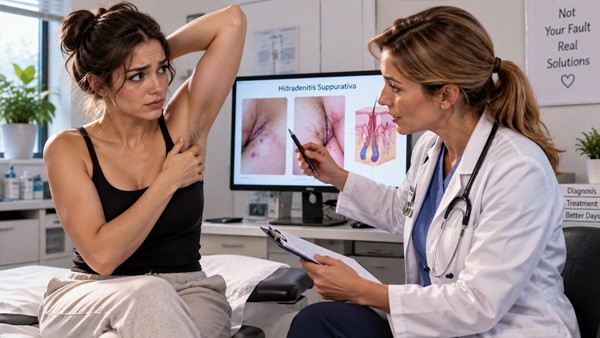

A painful lump appears in the armpit. It swells, may burst and leak, heals slowly, and a few weeks later another one comes up in the same place or the groin. Most people assume boils, or an infected ingrown hair, and are given antibiotics that work for a while. Then it happens again.
When that cycle repeats in body folds over months and years, the likely diagnosis is hidradenitis suppurativa, often shortened to HS. It is a long-term inflammatory skin disease of the hair follicles, and it affects roughly one person in a hundred. On average, people live with it for years before anyone names it.
This guide explains what HS is and is not, how it is staged, the treatments that help at each stage, and the everyday changes that make flares less frequent.
🧬 What it is, and what it is not
HS starts deep in the hair follicle. The follicle becomes blocked, then ruptures under the skin, and the immune system reacts strongly to the spilled contents. The result is a painful inflamed nodule. Over time, repeated inflammation can form tunnels under the skin that connect lumps and leak fluid, and eventually scar.
💡 Three things HS is not:
- Not caused by poor hygiene. Scrubbing harder does not prevent it and can make irritation worse
- Not contagious. It cannot be caught from or passed to anyone
- Not simply an infection. Bacteria play a part, but the main problem is inflammation. That is why antibiotics help partly by damping inflammation, and why lumps return when they stop
Genes play a role: about a third of people have a relative with it. Hormones matter too, since HS usually starts after puberty, often flares before periods, and is more common in women.
🔍 Where and how it shows up
The pattern is what gives HS away. It affects areas where skin rubs against skin and where there are many sweat glands: the armpits, groin, inner thighs, buttocks, under the breasts and around the genitals. Lumps come back in the same places. They are deep, painful and tender, and some drain fluid with an unpleasant smell. Blackheads that come in pairs, sometimes called tombstone comedones, are a telling sign.
| Stage | What it looks like |
|---|---|
| Stage I (mild) | Single or several separate lumps or abscesses, without tunnels or scarring |
| Stage II (moderate) | Recurring lumps with tunnels under the skin and scarring, in patches separated by normal skin |
| Stage III (severe) | Widespread connected tunnels and scarring across a whole area |
Most people have stage I disease. Treating early and consistently is the best chance of keeping it there.
🔥 What makes it worse
- 🚬 Smoking — one of the strongest triggers. Most people with HS smoke or have smoked, and quitting improves the disease
- ⚖️ Extra weight — more friction and more inflammation. Losing weight can reduce flares substantially
- 👕 Friction and tight clothing — tight waistbands, bra straps, synthetic fabrics
- 🌡️ Heat and sweating
- 📅 Hormonal changes — flares before periods are common
- 🪒 Shaving the affected area, which irritates follicles
💊 Treatment for mild disease
For occasional lumps without tunnels, treatment starts on the skin.
- Topical clindamycin
- An antibiotic lotion applied twice daily to affected areas, which reduces the number of lumps.
- Antiseptic washes
- Chlorhexidine or benzoyl peroxide washes may help some people. Rinse well, as they can irritate.
- Steroid injection into a painful lump
- A doctor can inject a single inflamed nodule to calm it within a day or two.
- Warm compresses and pain relief
- Help an acute lump settle or drain. Paracetamol or an anti-inflammatory painkiller eases pain.
💊 Tablets for more frequent flares
When lumps are frequent or tunnels have started, tablets are added. Courses are usually long, around three months, because the aim is to calm inflammation, not just clear one infection.
| Treatment | Typical use | Key points |
|---|---|---|
| Doxycycline or other tetracyclines | 12 weeks | First-line tablets for mild to moderate disease. Take upright with water; avoid dairy and iron at the same time; sun sensitivity |
| Clindamycin plus rifampicin | 10 to 12 weeks | A stronger combination for moderate disease. Rifampicin interacts with many medicines, including the contraceptive pill |
| Metformin | Long term | Helps some people, particularly with insulin resistance or polycystic ovary syndrome |
| Spironolactone or the combined pill | Long term | Hormonal options for women whose flares follow their cycle |
| Acitretin | Months | Used mainly in men. Causes birth defects, so pregnancy must be avoided for three years after stopping |
In our catalogue these include Vibramycin (Doxycycline Hyclate), Minomycin (Minocycline), Cleocin (Clindamycin), Rifadin (Rifampin), Glucophage (Metformin), Aldactone (Spironolactone) and Actoid (Acitretin). All of them should be chosen and monitored by a doctor.
⚠️ Things to know about these tablets. Rarely, tetracyclines cause raised pressure around the brain, with headache and visual disturbance; this is covered in our guide to intracranial hypertension. Rifampicin turns urine, sweat and tears orange and can stain contact lenses, and it makes hormonal contraception unreliable. Any antibiotic can cause severe diarrhoea. Isotretinoin, so effective for acne, usually does little for HS.
🧪 Biologic treatment for severe disease
For moderate to severe HS that does not respond to tablets, injected biologic medicines have changed what is possible. Several are now licensed for HS. They block specific inflammatory signals and can reduce flares, pain and drainage substantially. They are prescribed by dermatologists, need screening beforehand for infections such as tuberculosis, and are not currently in our catalogue. Anyone with frequent flares despite antibiotics should ask about a referral.
🏥 Procedures and surgery
Simply cutting open and draining a lump relieves pressure but almost always leads to recurrence in the same spot. More lasting procedures include:
- Deroofing — removing the skin over a tunnel so it heals from the bottom up. Often done under local anaesthetic, with low recurrence
- Wider excision — removing a whole affected area, for severe localised disease
- Laser hair removal — particular laser types reduce flares in early disease by destroying the follicles where HS starts
🧺 Daily care that makes a difference
| Habit | Why |
|---|---|
| Stop smoking | One of the most effective single changes. Stop-smoking medicines such as Chantix (Varenicline) double the chance of success |
| Lose weight if you carry extra | Weight loss of around 15 percent can markedly improve HS |
| Loose, breathable clothing | Cotton, looser waistbands, soft bra bands |
| Gentle washing | Mild soap-free cleanser; no scrubbing or harsh products |
| Avoid shaving affected areas | Trim or consider laser hair removal instead |
| Absorbent dressings | For draining areas; change often to protect clothing and skin |
🔗 Conditions that travel with HS
HS is linked to several other conditions, and it is worth knowing them because they are treatable in their own right:
- Inflammatory bowel disease, especially Crohns disease — tell your doctor about ongoing diarrhoea, abdominal pain or blood in stools
- Polycystic ovary syndrome, covered in our guide to PCOS
- Diabetes and metabolic syndrome
- Inflammatory arthritis, particularly in the spine and large joints
- Severe acne and pilonidal sinus
- Depression and anxiety, which are common, understandable and worth treating
In long-standing severe disease on the buttocks, a skin cancer can very rarely develop within the scarring. A sore that changes, bleeds or will not heal should be checked.
💛 Living with it
HS can hurt a great deal, leak through clothing, and affect relationships, work and confidence. Many people hide it for years out of embarrassment, often after being told it is due to poor hygiene or just boils. Neither is true. Naming the condition matters, because proper treatment starts from there. The pain deserves treating too, not just the lumps.
📞 When to see a doctor
- Lumps that keep returning in the armpits, groin, buttocks or under the breasts
- Draining tunnels or scarring
- Flares despite antibiotics — ask about specialist referral and biologic treatment
- Fever, spreading redness or feeling unwell with a lump
- Bowel symptoms or joint pain alongside HS
- A sore that changes, bleeds or will not heal
- Low mood or feeling unable to cope
❓ Frequently asked questions
What is the difference between HS and boils?
A boil is a one-off infection of a hair follicle that heals and usually does not return. HS causes deep, painful lumps that keep coming back in the same body folds, can form tunnels under the skin and leave scars. Repeated boils in the armpits or groin should raise the question of HS.
Is hidradenitis suppurativa caused by poor hygiene?
No. It is an inflammatory disease of the hair follicles with genetic and hormonal factors. Harsh scrubbing does not prevent it and can worsen irritation. Gentle washing with a mild cleanser is best.
Is HS contagious?
No. It cannot be caught from or passed to another person, including sexual partners.
What is the best antibiotic for hidradenitis suppurativa?
For mild disease, topical clindamycin. For more frequent flares, a 12-week course of a tetracycline such as doxycycline is usually first. For moderate disease, clindamycin combined with rifampicin for 10 to 12 weeks is often used. The choice depends on stage and other medicines.
Why do the lumps come back after antibiotics?
Because HS is mainly an inflammatory disease rather than an infection. Antibiotics calm it partly through anti-inflammatory effects, but they do not change the underlying tendency. Long-term measures, hormonal treatment, biologics or procedures such as deroofing may be needed.
Does smoking make HS worse?
Yes, smoking is one of the strongest triggers, and quitting improves the disease and response to treatment. Stop-smoking medicines roughly double the chance of success.
Can weight loss help hidradenitis suppurativa?
Yes. Losing around 15 percent of body weight can markedly reduce flares, by cutting friction and inflammation. Metformin may also help people with insulin resistance.
Should I squeeze or drain an HS lump?
Squeezing tends to push inflammation deeper. Warm compresses and pain relief help a lump settle. A doctor may inject a steroid into a painful nodule. Simple drainage usually leads to recurrence, while deroofing gives more lasting results.
Are there injections for severe HS?
Yes. Several biologic medicines are licensed for moderate to severe HS that has not responded to tablets. They are prescribed by dermatologists after screening and can substantially reduce flares and pain.
Can HS be cured?
There is no permanent cure, but it can be well controlled. Early treatment, stopping smoking, weight loss, the right medicines and, where needed, surgery reduce flares and prevent progression to scarring.
📑 Sources and editorial
- European and North American guidelines for the management of hidradenitis suppurativa
- Studies of tetracyclines and clindamycin with rifampicin in HS
- Trials of biologic medicines licensed for moderate to severe HS
- Research on smoking, weight loss and disease severity
- Reviews of surgical options, including deroofing and laser hair removal
- Studies of comorbidities including inflammatory bowel disease, metabolic syndrome and depression
- Related reading: skin diseases, PCOS, intracranial hypertension
- Related products: Vibramycin (Doxycycline Hyclate), Cleocin (Clindamycin), Rifadin (Rifampin)
- RXshop Editorial Team — reviewed by Emily Chen, MD, Internal Medicine
Medical Disclaimer: The information in this article is for educational and informational purposes only and is not a substitute for professional medical advice, diagnosis, or treatment. Always seek guidance from a qualified healthcare provider with any questions you may have regarding a medical condition, and before starting, stopping or changing any medication.