Insomnia Medication: Why Trazodone Is the One Most People End On, and What Melatonin Is Actually For

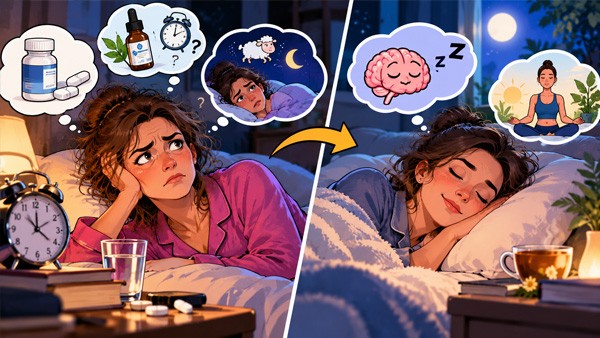

Most people arrive at this subject having already tried the obvious things. Melatonin did nothing. An antihistamine worked for four nights and then stopped. A glass of wine gets them to sleep and wakes them at four. Somebody mentioned trazodone.
So this page answers three questions in order: what actually works best for chronic insomnia, what melatonin is genuinely for, and how trazodone is used — because it is the one most people end up on, and the dose is nothing like the dose on the box.
💡 The honest headline first. For insomnia lasting more than three months, the most effective treatment in every guideline is not a tablet. It is a short behavioural programme, and it outperforms sleeping medication over the long term — because its effect persists after it stops, while medication works only while it is being taken.
Two of its components do most of the work, they are described below, and they are free. Medication has a real place alongside them, and that place is easier to judge once you know what it is competing with.
🛏️ The two techniques that beat most sleeping tablets
Both are counter-intuitive, which is why people skip them for the pharmacy.
One: spend less time in bed, not more.
Someone sleeping five hours but lying in bed for nine has taught their brain that bed is a place for lying awake. The fix is to shrink the window to roughly the amount actually slept — so five and a half hours — with a fixed wake time, and then extend it by fifteen or twenty minutes a week as sleep becomes solid. Sleep becomes compressed and deep instead of broken and thin. This single change is the most powerful element of the whole programme, and the first week is genuinely unpleasant.
Two: if you are awake, get out of bed.
Awake for more than about fifteen or twenty minutes — get up, go to another room, keep the lights low, do something undemanding, and return only when sleepy. Repeat as often as needed. The point is not relaxation; it is breaking the learned link between being in bed and being frustrated and alert. That link is what turns a bad fortnight into a two-year problem.
Alongside those: no clock-watching — turn it away, because calculating remaining sleep is itself arousing. No daytime naps while rebuilding. And anchor the day with a fixed wake time and morning light, which matters more than bedtime.
Worth knowing, because it is widely misunderstood: sleep hygiene advice on its own is not effective treatment for established insomnia. The cool dark room and the screen rules help at the margins. The two techniques above are the treatment.
🔎 What to rule out before taking anything
Several conditions produce insomnia and are made worse by sedatives. Going through this list first prevents months of treating the wrong thing.
| Clue | Likely cause | Why it matters |
|---|---|---|
| Snoring, breathing pauses, unrefreshing sleep, morning headache | Sleep apnea | Sedatives make it worse. See our guide to sleep apnea |
| Urge to move the legs, worse in the evening, relieved by moving | Restless legs | Needs ferritin checked and a different treatment entirely |
| Cannot fall asleep before 2 am, but sleeps well if allowed to start late | Delayed body clock | Needs timed light and melatonin, not a sedative |
| Waking at 4 or 5 am unable to return to sleep, with low mood | Depression | Classically depressive — see our guides to low drive and depression treatment |
| Mind racing, unable to switch off | Anxiety | See our guide to the worry loop |
| Waking drenched at 3 or 4 am, woman over 45 | Menopause | Often without an obvious sweat — see our guide to menopausal symptoms |
| Getting up two or more times to pass urine | Prostate, bladder, or an evening diuretic | Treating that fixes the sleep |
| Pain waking you | Whatever is causing it | Sedating through pain rarely works |
Then the medicine cabinet and the kitchen. Steroids, SSRIs, beta blockers, decongestants, stimulants, thyroid replacement and late-afternoon diuretics all disturb sleep. And caffeine has a half-life of about five hours, so a three o clock coffee still has a quarter of its dose working at bedtime — which is why a two-week caffeine cut-off is worth doing before anything else.
🌙 What melatonin is actually for
This section exists because melatonin is the first thing nearly everyone tries, and it is usually used in a way that cannot work.
📌 Melatonin is a clock signal, not a sedative. It tells the body what time it is. It does not make you drowsy the way a sleeping tablet does, and for ordinary adult sleep-onset insomnia the measured effect is small — in pooled trials, falling asleep roughly seven minutes faster.
Which is why people take 10 mg at bedtime, feel nothing, and conclude it is useless. They used a timing drug as a sedative.
Where it genuinely works, and how to use it there:
- 🕕 A body clock running late — cannot sleep before 2 or 3 am, then sleeps fine. Here a low dose, 0.5 to 3 mg, taken several hours before the target bedtime shifts the clock earlier. Taken at bedtime it does almost nothing. Pair it with bright light on waking
- ✈️ Jet lag — low dose in the evening at the destination, for a few nights
- 🌃 Shift work — timed to the intended sleep period. Covered in our guide to shift work sleep disorder
- 🧓 Older adults, where natural production has fallen — the one group in which it performs better for ordinary insomnia
Practical notes: lower doses often work better than higher ones for clock shifting, which is the opposite of the usual assumption. Altonil is available at 3 mg and 10 mg, and Restfine at 10 mg — the 10 mg strength suits jet lag and older adults, while clock shifting usually wants the smaller dose. It causes no dependence and no rebound, and vivid dreams are the commonest complaint.
💊 Trazodone: the dose is not the dose on the box
Desyrel (Trazodone) is an antidepressant by origin, and the single most prescribed medicine for insomnia in much of the world — used at doses far below its antidepressant range.
The reason is pharmacological rather than accidental. At low doses it blocks histamine and alpha-1 receptors, which is sedating. The serotonergic antidepressant effect needs 150 to 300 mg or more. So 25 to 100 mg of trazodone is, functionally, a sedative rather than an antidepressant — and at that dose it has an advantage nothing else on the sedative shelf can match.
✅ The reason it is the one people stay on:
🔹 No dependence. No craving, no need for rising doses, no compulsive use
🔹 No tolerance to the sleep effect in most people, over months and years
🔹 No rebound insomnia on stopping, unlike benzodiazepines and the z-drugs, where stopping produces worse sleep than before and locks people in
🔹 It increases deep sleep rather than suppressing it, which the older sedatives do
🔹 No sexual side effects and little weight gain, unlike most antidepressants
| How it is used for sleep | |
|---|---|
| Starting dose | 25 to 50 mg, taken 30 to 60 minutes before bed. Start at 25 mg over 65 |
| Usual settled dose | 50 to 100 mg |
| Going higher | Rarely improves sleep and usually adds grogginess. More is not better here |
| With food | Taking it with a small snack reduces dizziness and nausea |
| How quickly | Works on the first night, unlike the weeks an antidepressant dose needs |
The main complaint is next-morning grogginess, and it is fixable rather than a reason to stop. It is dose-related and timing-related: drop from 100 mg to 50, or from 50 to 25, and take it earlier in the evening rather than as the light goes off. The half-life is around five to nine hours, so a dose at midnight is still working at eight in the morning.
⚠️ Trazodone safety, including the one true emergency
🚨 Priapism. Trazodone can rarely cause a prolonged erection, and an erection lasting more than four hours is a medical emergency — untreated it causes permanent damage. It is uncommon, and anyone taking this needs to know it exists and to go to emergency care rather than wait.
🚨 Also urgent: fainting, a racing or irregular heartbeat, or the combination of agitation, shivering, sweating, muscle twitching and confusion, which can indicate too much serotonin activity.
The routine cautions:
- 📉 Dizziness on standing. Trazodone lowers blood pressure, which matters most getting up to the bathroom at night. Sit on the edge of the bed first. This is the main reason to start at 25 mg in older people, where falls are the real risk
- 🚫 Never with an MAOI, and caution combining with other serotonergic drugs — SSRIs, SNRIs, tramadol, triptans, linezolid
- ❤️ Known heart rhythm problems or a long QT interval need discussing first
- 🍺 Alcohol multiplies the sedation considerably
- 🐾 Dry mouth, blurred vision and headache are common in the first week and usually settle
- 📈 In anyone under 25, or with a history of elevated mood, any antidepressant needs closer early monitoring
- 📉 Stopping at these low doses is usually straightforward, and tapering over a week or two is still sensible after long use
🔄 The two alternatives, and when each is better
Both are also free of dependence, and each suits a specific situation better than trazodone does.
| Dose | Choose it when | Drawback | |
|---|---|---|---|
| Mirtazapine | 7.5 to 15 mg at night | Insomnia with low appetite and weight loss, or with depression needing treating anyway — one drug covers all three | Increases appetite and causes weight gain, which is the point for some and unacceptable for others |
| Hydroxyzine | 25 mg at night, up to 50 | Occasional use, and where anxiety is what is keeping you awake. Works within 1 to 2 hours | Anticholinergic — dry mouth, and worth avoiding as a long-term choice in older adults |
The mirtazapine dose deserves a note because it looks like a misprint. Lower doses are more sedating than higher ones. At 7.5 to 15 mg the antihistamine effect dominates; at 30 to 45 mg other actions come in and the sedation lessens. So someone taking 45 mg for sleep is often taking the wrong dose for that purpose.
❌ What to avoid, and why
Four things people reach for that make chronic insomnia worse rather than better.
- 🍷 Alcohol. The most widely used sleep aid and the worst. It shortens the time to fall asleep and then fragments the second half of the night, suppresses the restorative stages and produces the classic three o clock waking. Using it for sleep reliably produces worse sleep on a delay, and the connection is rarely made
- 💊 Benzodiazepines and the z-drugs — zopiclone, zolpidem and relatives. They work immediately, and tolerance develops within weeks, dependence follows, and stopping produces rebound insomnia worse than the original problem, which is what keeps people on them for years. Add falls, confusion and memory problems in older adults. There is a legitimate short-term use for them; chronic insomnia is not it
- 💊 Over-the-counter antihistamine sleep aids containing diphenhydramine. Effective for about three or four nights, then tolerance. They carry a heavy anticholinergic load and next-day impairment, and are a poor choice over 65
- 🌿 Cannabis. Shortens sleep onset, suppresses restorative sleep, and produces marked rebound insomnia and vivid dreams on stopping — which then becomes the reason not to stop
🕐 Why three in the morning, specifically
Worth its own short section, because middle-of-the-night waking has a different cause list from difficulty falling asleep.
Waking after three or four hours and lying awake points towards: alcohol in the evening (the metabolic rebound lands almost exactly then), sleep apnea, night sweats in perimenopause, low blood sugar after a very light evening meal, needing the bathroom, pain, or anxiety — and brief waking is itself normal, with the problem being the inability to return.
Early morning waking at four or five with low mood and dread is a different signal and points at depression rather than at sleep itself.
For the inability to return to sleep, the technique is the same as above: if you are awake beyond fifteen or twenty minutes, get up. Lying there doing arithmetic on the remaining hours is the thing that extends it.
📞 When to seek help
🚨 Emergency: an erection lasting over four hours on trazodone; fainting; a racing irregular heartbeat; or agitation with shivering, sweating, twitching and confusion.
Worth an appointment:
- Snoring with breathing pauses, or waking unrefreshed despite enough hours — get this assessed before taking any sedative
- Falling asleep during the day, at the wheel or in meetings — that is a different problem from insomnia
- Insomnia lasting over three months — ask about the behavioural programme by name rather than only medication
- Urge to move the legs in the evening — ask for ferritin
- Early morning waking with low mood
- Next-day grogginess on trazodone — usually solved by a lower dose or an earlier one, so raise it rather than stopping
- Dizziness on standing at night, especially over 65
- Already taking an SSRI, SNRI, tramadol or triptan — before adding trazodone
- Taking a z-drug or benzodiazepine for more than a few weeks — worth a planned reduction rather than abrupt stopping
- Pregnancy or breastfeeding
- Night sweats and 3 am waking in a woman over 45 — treating the cause works better than sedating
❓ Frequently asked questions
How much trazodone should I take for sleep?
Usually 25 to 50 mg to start, 30 to 60 minutes before bed, with most people settling at 50 to 100 mg. Higher doses rarely improve sleep and mostly add next-day grogginess. Start at 25 mg over 65.
Is trazodone addictive?
No. There is no craving, no need for rising doses and no rebound insomnia on stopping, which is the main reason it is preferred over benzodiazepines and z-drugs for long-term use.
Why does trazodone leave me groggy in the morning?
Because the dose is too high or taken too late. The half-life is five to nine hours, so a midnight dose is still working at eight. Lower it a step and take it earlier in the evening.
Does melatonin actually work?
It is a clock signal rather than a sedative, and for ordinary adult insomnia the effect is small. It works properly for a late body clock, jet lag, shift work and in older adults, taken at a low dose several hours before target bedtime.
What is the most effective treatment for chronic insomnia?
A short behavioural programme, which outperforms medication long term because its effect persists afterwards. The two key elements are shortening time in bed with a fixed wake time, and getting up if awake beyond 15 to 20 minutes.
Why do I wake at 3am every night?
Common causes are evening alcohol, whose rebound lands almost exactly then, sleep apnea, night sweats in perimenopause, needing the bathroom, pain or anxiety. Brief waking is normal; the problem is being unable to return.
Why is a lower dose of mirtazapine more sedating?
Because at 7.5 to 15 mg the antihistamine effect dominates, while at 30 to 45 mg other actions come in and the sedation lessens. Someone taking 45 mg purely for sleep is often on the wrong dose for that purpose.
Does alcohol help you sleep?
It shortens the time to fall asleep and then fragments the second half of the night, suppresses restorative sleep and causes the classic 3 am waking. Using it for sleep reliably produces worse sleep on a delay.
What should I check before taking anything for sleep?
Sleep apnea above all, since sedatives make it worse, plus restless legs, a late body clock, depression, anxiety, menopause, night-time urination, pain, and caffeine, which still has a quarter of its dose active eight hours later.
What is the serious risk with trazodone?
Rarely a prolonged erection. An erection lasting more than four hours is a medical emergency needing immediate care. Also report fainting, an irregular heartbeat, or agitation with shivering, sweating and confusion.
📑 Sources and editorial
- Sleep medicine society and national guidelines on the management of chronic insomnia in adults, including cognitive behavioural therapy for insomnia as first-line treatment and comparative long-term outcomes against pharmacotherapy
- Evidence on sleep restriction and stimulus control as the most effective individual components of behavioural treatment, and on sleep hygiene education alone being insufficient as monotherapy
- Meta-analyses of exogenous melatonin for sleep onset latency in adults, and trials of timed low-dose melatonin for circadian phase shifting in delayed sleep-wake phase disorder, jet lag and shift work
- Pharmacological literature on dose-dependent receptor occupancy of trazodone, including histamine and alpha-1 antagonism at low dose and serotonergic effects at antidepressant doses
- Trials and reviews of low-dose trazodone for insomnia, including effects on sleep architecture, absence of tolerance and absence of rebound insomnia
- Prescribing information for trazodone, including dosing, half-life, orthostatic hypotension, priapism, QT interval considerations, serotonin syndrome risk and MAOI contraindication
- Prescribing information for mirtazapine, including the inverse dose-sedation relationship and effects on appetite and weight
- Prescribing information for hydroxyzine, including onset of action and anticholinergic burden in older adults
- Guidance on benzodiazepine and z-drug prescribing duration, tolerance, dependence, rebound insomnia and risk of falls and cognitive impairment in older adults
- Literature on tolerance to diphenhydramine as a hypnotic and anticholinergic risk in older people
- Evidence on alcohol effects on sleep architecture and second-half-of-night fragmentation, and on cannabis withdrawal insomnia
- Caffeine pharmacokinetic data and its implications for afternoon consumption
- Guidance on screening for obstructive sleep apnea and restless legs syndrome before initiating sedative hypnotics
- Related reading: obstructive sleep apnea, shift work sleep disorder, the worry loop, apathy and low drive, menopausal symptoms
- Related products: Desyrel (Trazodone), Remeron (Mirtazapine), Atarax (Hydroxyzine), Altonil (Melatonin), Restfine (Melatonin), sleeping aid category
- RXshop Editorial Team — reviewed by James Carter, MD — Neurologist & Sleep Medicine Specialist
Medical Disclaimer: The information in this article is for educational and informational purposes only and is not a substitute for professional medical advice, diagnosis, or treatment. Always seek guidance from a qualified healthcare provider with any questions you may have regarding a medical condition, and before starting, stopping or changing any medication.