Tuberculosis Treatment: Why It Takes Six Months, and What Happens If the Course Is Stopped Early

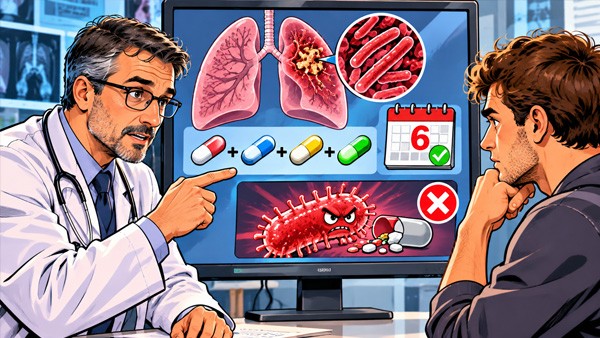

🦠 Tuberculosis is curable, and it is curable with a high success rate. The reason it still kills more than a million people a year is almost never that the drugs do not work. It is that the course is six months long, the person feels well after three weeks, and treatment stops. Everything on this page comes back to that one problem.
🚨 The most important thing on this page, before anything else.
🔹 Tuberculosis is never treated with one drug. A single drug cannot clear it, and taking one alone selects for the bacteria that resist it.
🔹 That is literally how drug-resistant tuberculosis is made. Rifampin on its own, or ethambutol on its own, does not treat tuberculosis — it converts a curable infection into one that takes 18 months and far harsher drugs.
🔹 Active tuberculosis is managed through a treatment programme, with the drugs supplied together, the dosing weight-based and the course supervised. In most countries that care is free, including for people without documents, because an untreated case is a public health matter.
🔹 If you are already on a regimen, this page explains what each drug is doing and why the length is not negotiable.
📅 What the six months actually consists of
📋 The regimen has two phases with different jobs, and the drugs change between them. This is the schedule for drug-susceptible pulmonary tuberculosis.
🤔 So why two phases rather than one long course of everything? Because the bacteria are not all in the same state. Most are dividing fast and die quickly; a minority sit dormant inside tissue and are almost untouchable while they sleep. The first two months deal with the crowd. The remaining four exist entirely for the stragglers.
📉 Why stopping at two months fails, in one picture
💡 This is why supervised treatment exists, and why it is not about mistrust. No symptom tells you the dormant population has gone. The only thing that correlates with cure is having taken the full course, which is an unsatisfying answer and also the true one.
💊 What each drug in the regimen does
| 💊 Drug | 🎯 Its job, and what to watch for |
|---|---|
|
Rifadin (Rifampin) and R-Cin (Rifampicin) the same drug, two naming conventions |
The backbone of the whole regimen, and the drug that kills the dormant bacteria. It is the reason the course is six months rather than eighteen. Turns urine, tears and sweat orange — harmless, expected, and it stains soft contact lenses permanently. Carries the most interactions of any drug here, covered in its own section below |
| Isoniazid | The other backbone, running the full six months alongside rifampin. Can irritate nerves in the hands and feet, which is why vitamin B6 is given with it as a routine. Liver enzymes are checked, and it does not mix with alcohol |
| Pyrazinamide | Only in the first two months, and it is what made the six-month course possible at all. Works best in the acidic environment of active inflammation. Raises uric acid, so joint aches are common and gout can flare |
| Myambutol (Ethambutol) | First two months, as cover in case the strain resists one of the others. Its one serious risk is the optic nerve: any change in vision, especially losing the difference between red and green, means stopping and ringing the clinic the same day. Vision is checked before starting |
| 🦠 Second-line and injectable drugs | Used when the strain is resistant. Longer, harsher and supervised in specialist care. Levaquin (Levofloxacin) and Avelox (Moxifloxacin) belong to the class used in resistant regimens, and that is also why a fluoroquinolone should never be taken casually for a cough in someone who might have tuberculosis — it partly suppresses it and ruins the diagnosis |
⚠️ Rifampin and the interaction problem nobody mentions
🔄 Rifampin switches on the liver enzymes that clear other drugs, and it does it powerfully. The result is that a long list of medicines quietly stop working while someone takes it. This is not a theoretical interaction list; these failures happen.
| 💊 What rifampin weakens | 🚨 What happens in practice |
|---|---|
| 💊 Hormonal contraception — pill, patch, ring, implant | It stops being reliable. A second, non-hormonal method is needed for the whole course and for a month afterwards. This one causes real unplanned pregnancies |
| 🩸 Warfarin | Blood thinning drops sharply, so clotting tests need to be far more frequent and the dose usually rises a lot |
| 🦠 HIV medication | Several combinations become ineffective. Tuberculosis and HIV together always need the regimens planned jointly, never separately |
| 💊 Methadone | Levels fall and withdrawal can start, so the dose is adjusted in advance rather than in response |
| 🧪 Steroids, some diabetes tablets, some blood pressure and heart drugs, some antifungals, transplant medicines | All weakened to varying degrees. Transplant anti-rejection drugs are the dangerous one and need specialist handling |
| 🌿 St John wort and other herbal products | Add their own enzyme effects on top, making the result unpredictable. Worth declaring them, not hiding them |
📌 The rule is simple: everything you take, including the things you do not think of as medicines, goes on the list before the first dose. Supplements, herbal remedies, the contraceptive pill and anything bought over the counter.
🟡 Latent infection is a different thing with a different course
🧬 About a quarter of the world has been infected without becoming ill. The bacteria are contained but alive, and nothing is contagious. This is not a mild case of tuberculosis; it is a separate state with its own treatment.
🟢 Latent infection
🤐 No symptoms at all
🚫 Not contagious — you cannot pass it to anyone
📷 Chest X-ray normal, sputum negative
🧪 Found only on a skin or blood test, usually done because of a contact or before starting an immune-suppressing medicine
💊 Shorter course, one or two drugs, taken to prevent it ever waking up
🔴 Active disease
😡 Cough over three weeks, fever, drenching night sweats, weight loss, exhaustion
⚠️ Contagious through the air while untreated, if it is in the lungs
📷 Visible on X-ray, and the bacteria are detectable in sputum
🩸 Can affect the spine, lymph nodes, kidneys or the lining of the brain, not only lungs
💊 Four drugs, six months, no shortcuts
📊 Who should be tested for latent infection
📈 What happens to the risk when immunity drops
🚨 The two bars are the same height on purpose. The same number, over a lifetime versus over one year, is a roughly fiftyfold difference in risk — and it is why anyone with HIV and a positive latent test is treated without debate, and why tuberculosis remains the leading cause of death in people living with HIV.
😤 The symptoms, and the ones that mean go now
| 🌡️ Symptom | 📝 What it means here |
|---|---|
| 😤 Cough lasting more than three weeks | The threshold symptom. A post-viral cough fades; this one does not, and it slowly gets worse rather than better |
| 💧 Drenching night sweats | Changing bedding or nightclothes, not just feeling warm. Classic and often dismissed |
| ⚖️ Unintended weight loss | Weeks to months of it, without trying. The historic name for tuberculosis was consumption for this reason |
| 🌡️ Low fever, usually in the afternoon | Low grade and persistent rather than a spike |
| 😴 Exhaustion and loss of appetite | Builds gradually, which is why people date the illness months later than it began |
| 🩸 Coughing blood | Needs assessment the same day. Not necessarily severe disease, but never something to monitor at home |
| 🫁 Chest pain on breathing, or breathlessness | Suggests involvement of the lung lining or extensive disease. Same-day assessment |
| 🦴 Back pain with fever and weight loss | Tuberculosis of the spine. Easy to miss because the lungs may look clear |
| 🤧 Headache, neck stiffness or confusion | Emergency. Tuberculosis of the lining of the brain, and outcomes depend entirely on how fast treatment starts |
⏱️ Once treatment starts, what happens when
Isolation measures while still potentially infectious. Nausea and orange urine start
Usually no longer infectious on effective treatment, confirmed by repeat sputum
Fever and night sweats gone, appetite back. The dangerous point for stopping
Sputum rechecked, susceptibility results in, regimen drops to two drugs
Feeling entirely normal while the dormant bacteria are still being cleared
⚠️ Four things during treatment that mean ring the clinic, not wait.
🔹 Yellow eyes or skin, dark urine, pain under the right ribs, or vomiting that will not settle — possible liver injury, the most important adverse effect of this regimen.
🔹 Any change in vision, particularly difficulty telling red from green, while on ethambutol. Stop that drug and call the same day.
🔹 Numbness, burning or tingling in the hands or feet on isoniazid — usually managed by adjusting vitamin B6 rather than stopping.
🔹 A rash with fever, or bruising easily, which can be a reaction to rifampin.
💡 And the one that is not a problem: orange urine, orange tears, orange sweat. Expected, harmless, and in fact a useful sign the drug is being taken.
🦠 Drug-resistant tuberculosis, and where it comes from
📉 Resistance is not bad luck. It is manufactured, and it is manufactured by interrupted or incomplete treatment. The outcome gap is the clearest argument for finishing a course that anyone could ask for.
🏠 Living with it, and protecting the people around you
💨 Tuberculosis spreads through air that someone with active lung disease has coughed into, and it needs prolonged shared air rather than a passing contact. A few practical points follow from that.
- 🪟 Ventilation beats disinfection. Open windows matter; wiping surfaces does almost nothing, because this is not spread by touch
- 🍽️ Crockery, bedding and handshakes are not routes. There is no need to separate dishes or laundry, and the belief that there is causes a lot of unnecessary shame
- 😷 A mask on the person who is ill does more than masks on everyone else, for the first couple of weeks
- 👥 Household members get tested, and that is not optional — it is how the next case gets caught while it is still latent and takes three months instead of six
- 🚬 Smoking roughly doubles the risk of developing active disease and worsens the outcome, which makes it the single most useful thing to change
- 🍺 Alcohol matters more than usual here, because isoniazid, rifampin and pyrazinamide all stress the liver at once
- 🍛 Nutrition is treatment, not comfort. Weight loss is part of the disease and regaining it tracks recovery
- 💊 Diabetes control changes the outcome, because poorly controlled blood sugar roughly triples the risk of active disease
🗿 What people get wrong about it
| 💭 The belief | ✔️ What is actually the case |
|---|---|
| "Tuberculosis is a disease of the past." | It is among the deadliest infections in the world, with roughly ten million new cases a year. It never left; it concentrated |
| "A positive skin test means I have tuberculosis." | It means your immune system has met the bacteria. Most positive tests are latent infection: no illness, nothing contagious, and a short preventive course |
| "I had the BCG vaccine, so I am protected." | BCG protects infants well against the severe forms. It does not reliably prevent lung tuberculosis in adults, and its effect fades |
| "It only affects the lungs." | Spine, lymph nodes, kidneys, gut, joints and the lining of the brain are all possible, and those forms are not contagious through the air |
| "Rifampin is the tuberculosis drug, so rifampin will treat it." | No. Alone it fails and breeds resistance. It is one of four, and it is the drug that makes the other three worth taking for six months rather than eighteen |
| "I feel fine, so it is gone." | Symptoms disappear in weeks; the dormant bacteria take months. These two facts are the reason the disease still kills |
❓ Frequently asked questions
What is Rifadin used for?
Rifampin treats tuberculosis as part of a four-drug regimen, and also leprosy, certain staphylococcal infections and meningococcal carriage. In tuberculosis it is never used alone.
Why does tuberculosis treatment take six months?
The first two months kill the actively dividing bacteria. The remaining four exist to clear the dormant ones, which no symptom can detect and which cause relapse if left.
Can one drug treat tuberculosis?
No. A single drug cannot clear it and selects for resistant bacteria, which is how drug-resistant tuberculosis is created. Four drugs are used in the first two months.
Why is my urine orange on rifampin?
That is the drug colouring body fluids and it is harmless. It also affects tears and sweat, and it will permanently stain soft contact lenses, so glasses are better during the course.
How long am I contagious?
Usually about two weeks after effective treatment starts, confirmed by repeat sputum tests. Tuberculosis outside the lungs is generally not contagious at all.
Does rifampin stop the contraceptive pill working?
Yes. Rifampin makes hormonal contraception unreliable, including the patch, ring and implant. A second non-hormonal method is needed throughout and for a month afterwards.
What is latent tuberculosis?
Infection without illness. No symptoms, not contagious, normal chest X-ray, found only on a skin or blood test. Treated with a shorter course of one or two drugs to prevent it activating.
Does the BCG vaccine protect adults?
It protects infants well against the severe forms, but it does not reliably prevent lung tuberculosis in adults and its effect fades over time.
What if I miss doses?
Tell the clinic rather than catching up on your own. Scattered missed doses are the main route to resistance, and the course may need extending or the plan changing.
Is tuberculosis curable?
Yes. Drug-susceptible tuberculosis is cured in roughly 85 percent of people who complete the course. Success falls to about 60 percent once the strain is multidrug-resistant.
📑 Sources and editorial
- 📘 World Health Organization global tuberculosis reporting, including annual incidence and mortality estimates, treatment success rates for drug-susceptible, multidrug-resistant and extensively drug-resistant disease, and estimates of the proportion of the world population with latent infection
- 💊 Clinical guidelines on the treatment of drug-susceptible pulmonary tuberculosis, including the two-month intensive phase with rifampin, isoniazid, pyrazinamide and ethambutol followed by a four-month continuation phase with rifampin and isoniazid
- 🧬 Guidance on the diagnosis and treatment of latent tuberculosis infection, including the weekly combination regimen, four months of rifampin and six to nine months of isoniazid
- 📉 Literature on the microbiological basis of the six-month course, including dormant and persisting bacterial populations and the role of rifampin and pyrazinamide in shortening treatment
- 🦠 Evidence on the development of drug resistance through monotherapy, interrupted treatment and incomplete adherence, and on primary transmission of resistant strains
- 📊 Estimates of the lifetime risk of progression from latent infection to active disease in the general population, and the annual risk in people living with untreated HIV
- 💉 Guidance on screening for latent tuberculosis before starting tumour necrosis factor inhibitors and other immunosuppressive therapy, and in dialysis, transplantation and diabetes
- ⚠️ Prescribing information for rifampin, isoniazid, pyrazinamide and ethambutol, including hepatotoxicity monitoring, ethambutol optic neuropathy and red-green colour discrimination, isoniazid peripheral neuropathy and pyridoxine supplementation, and pyrazinamide effects on uric acid
- 🔄 Rifampin drug interaction data as a potent inducer of hepatic enzymes, including effects on hormonal contraception, warfarin, antiretroviral therapy, methadone, corticosteroids and immunosuppressants
- 💨 Guidance on airborne transmission, duration of infectiousness after starting effective treatment, ventilation, respiratory protection and household contact tracing
- 🚬 Epidemiological evidence on smoking, alcohol, undernutrition and diabetes as risk factors for progression to active tuberculosis and for worse treatment outcomes
- 🩸 Guidance on extrapulmonary tuberculosis, including spinal, lymph node, renal and meningeal disease, and on the urgency of treatment in tuberculous meningitis
- 💉 Evidence on BCG vaccine efficacy, including protection against severe childhood forms and limited and waning protection against adult pulmonary disease
- 📖 Related reading: pneumonia or bronchitis, and when to go in, when a cough becomes a long-term signal, the cough that does not quit, chronic bronchitis and how it is treated
- 🛒 Related products: Rifadin (Rifampin), R-Cin (Rifampicin), Myambutol (Ethambutol), Levaquin (Levofloxacin), Avelox (Moxifloxacin), antibiotic range
- 👩⚕️ RXshop Editorial Team — reviewed by Emily Chen, MD, MPH — Internal Medicine Specialist
Medical Disclaimer: The information in this article is for educational and informational purposes only and is not a substitute for professional medical advice, diagnosis, or treatment. Always seek guidance from a qualified healthcare provider with any questions you may have regarding a medical condition, and before starting, stopping or changing any medication.