Warfarin and Your INR: What to Eat, What Interacts, and the Bleeding Signs That Need Attention

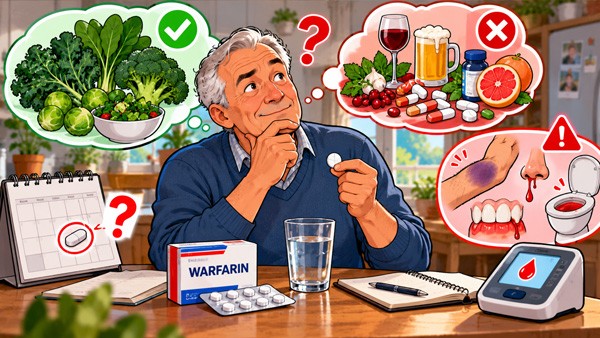

Most tablets do roughly the same thing every day. Warfarin does not. A bowl of spinach, a course of antibiotics for a tooth, a heavy weekend or a new painkiller can all change how strongly it works — and the result shows up as a number that is suddenly wrong.
Which makes warfarin unusual: it is less a drug you take than one you manage. The people who do well with it are not the careful ones, they are the consistent ones.
💡 The two rules that prevent most warfarin trouble.
🔹 Consistency beats avoidance. The green vegetable advice is almost universally misunderstood. You do not avoid them — you eat about the same amount every week. A steady intake gives a steady number, and it is the sudden change in either direction that causes problems.
🔹 Check every new medicine, including the ones that feel harmless. Antibiotics, antifungal creams and gels, painkillers bought without a prescription and herbal remedies all interact. This is the commonest reason an INR that has been stable for years suddenly is not.
🧪 What the INR number means
Warfarin blocks the recycling of vitamin K, which the liver needs to build several clotting factors. Fewer of those factors means blood that clots more slowly, which is the whole point — and also the whole risk.
The INR measures how long your blood takes to clot compared with normal. Someone not taking warfarin sits at about 1.0. An INR of 2.5 means roughly two and a half times longer than normal.
| Situation | Usual target |
|---|---|
| Atrial fibrillation, DVT, pulmonary embolism and most indications | 2.0 to 3.0, aiming at 2.5 |
| Mechanical heart valves and certain high-risk situations | 2.5 to 3.5 or higher, set individually |
Both directions matter and they fail differently:
- 📈 INR too high — blood too thin, bleeding risk rises steeply. Above about 5 it climbs sharply
- 📉 INR too low — not protected, and the clot or stroke you are taking it to prevent becomes possible again
📌 Why the number does not respond immediately.
A change in dose takes three to five days to show its full effect, because the clotting factors already in circulation have to be used up first.
This has a practical consequence: do not chase the number. Adjusting your own dose because today's reading looked off, then adjusting again two days later, produces wild swings. Dose changes belong to the clinic, and the next test tells you whether the last change worked — not the one before it.
Testing is usually frequent at the start and stretches out to several weeks once the number holds steady.
🥬 The food rule everybody gets backwards
People are told that greens are dangerous on warfarin, so they stop eating them. That is the wrong conclusion from a correct fact.
✅ Keep vitamin K intake steady rather than low.
Your warfarin dose was worked out against your usual diet. If that diet includes a portion of greens most days, the dose accounts for it and the number stays where it should.
What destabilises the INR is change: a sudden healthy-eating phase with salad every day will push the number down; abruptly stopping greens pushes it up. Both are riskier than simply carrying on as you were.
So eat normally and eat consistently. If you genuinely want to change your diet, that is fine — tell the clinic beforehand so the dose can be adjusted alongside it.
| Category | Examples | What to do |
|---|---|---|
| High in vitamin K | Kale, spinach, broccoli, Brussels sprouts, cabbage, spring greens, lettuce, parsley, green tea, liver | Keep the amount steady week to week. No need to avoid |
| Can push the INR up | Cranberry juice, large quantities of mango, grapefruit | Keep intake modest and consistent, and mention large changes |
| Supplements | Vitamin K, fish oil, vitamin E, multivitamins containing vitamin K | Check before starting any of them |
| Herbal remedies | St John's wort, ginkgo, high-dose garlic, ginger, ginseng, dong quai, turmeric supplements | Discuss first. Several affect the INR significantly, and herbal is not the same as harmless |
Alcohol gets its own note because the pattern matters more than the amount. A binge raises the INR sharply; sustained heavy drinking lowers it over time. A steady, modest intake is usually manageable. The dangerous version is the person who drinks nothing all week and a great deal on Saturday.
💊 The interactions that catch people out
Warfarin interacts with a very long list of drugs. These are the ones that cause actual problems in practice.
| Raises the INR (more bleeding) | Lowers the INR (clot risk) |
|---|---|
| Most antibiotics — especially metronidazole, co-trimoxazole, ciprofloxacin, clarithromycin and erythromycin | Rifampicin |
| Antifungals — fluconazole, and miconazole oral gel, which is often bought for mouth thrush and badly underestimated | Carbamazepine, phenytoin, phenobarbital |
| Amiodarone, which has a long-lasting effect | St John's wort |
| NSAIDs — ibuprofen, naproxen, diclofenac. A double hit: they raise the INR and irritate the stomach lining | Vitamin K supplements |
| Aspirin, and SSRI antidepressants | Some antivirals and azathioprine |
| Omeprazole, some statins, thyroid hormone | Large increases in green vegetables |
⚠️ Three things that account for a large share of warfarin emergencies.
🔹 A course of antibiotics started without telling the anticoagulation clinic. Most antibiotics push the INR up, sometimes a long way. An extra test during the course is standard practice
🔹 Ibuprofen bought for a bad back. It raises the INR and damages the stomach lining at the same time, which is exactly the wrong combination. Paracetamol is the alternative — though regular maximum-dose paracetamol over several days also nudges the INR up, so occasional use is fine and daily use is worth mentioning
🔹 Miconazole gel for mouth thrush. A small tube bought over the counter, applied to the mouth, and it can raise the INR dramatically. Easily missed because nobody thinks of a gel as a drug interaction
⏰ Missed and doubled doses
- 🕒 Remembered the same day — take it as soon as you remember
- 📅 Remembered the next day — skip it entirely and take your normal dose at the usual time
- 🚫 Never take two doses to catch up. That is the single most important sentence here
- 📝 Write down any missed or doubled dose and tell the clinic at the next test, since it explains an otherwise puzzling reading
- 📱 Set a daily alarm and take it at the same time, conventionally early evening, so that a dose change made at an afternoon appointment can start the same day
- 💊 If you took a double dose by accident, contact the clinic rather than waiting for the scheduled test
Tablets come in different strengths and colours and the daily dose often varies between days. A pill organiser filled from a written schedule removes most of that risk, particularly where the dose alternates.
🩸 Bleeding: what is normal and what is not
Some easy bruising and slightly longer bleeding from small cuts is expected on warfarin. These are not.
🚨 Contact a doctor urgently for any of these.
🔹 A nosebleed that does not stop within about ten minutes of pinching
🔹 Blood in the urine — pink, red or brown
🔹 Black, tarry or sticky stools, or visible blood
🔹 Vomiting blood or material like coffee grounds
🔹 Coughing up blood
🔹 Bleeding gums that continue rather than stopping after brushing
🔹 Unusually heavy or prolonged periods
🔹 Large unexplained bruises, or bruises appearing without injury
🔹 A cut that will not stop bleeding with ten minutes of firm pressure
🔹 Sudden severe headache, unusual weakness, confusion or difficulty speaking — call emergency services
⚠️ The head injury rule, and it applies even when you feel completely fine.
Any significant blow to the head while taking warfarin needs medical assessment on the day, including a fall where you hit your head and got up normally.
The reason is that bleeding inside the skull can develop slowly, over hours or even days, with no symptoms at first. By the time a headache or drowsiness appears, a great deal has already happened.
So: hit your head, get seen. Say you are on warfarin immediately so you are assessed accordingly rather than sent home.
The same applies to anyone who has fallen repeatedly — falls are worth reporting, because they change the balance of risk and may change the plan.
🏥 Everyday situations
- 🦷 Dental work. Do not stop warfarin on your own before a dental appointment. Most dental treatment, including extractions, is done safely with the INR in range. Tell the dentist, bring a recent reading
- 🔪 Surgery and procedures. The plan is made in advance and may involve stopping warfarin for a few days, sometimes with an injectable substitute in between. Always arranged by the team, never improvised
- 💉 Vaccinations are generally fine, given into the muscle with firm pressure afterwards
- ✈️ Travel. Carry more tablets than you need in hand luggage, take your anticoagulant card, and find out before you go how to get an INR checked if the trip is long. Time zone changes rarely matter for a once-daily dose
- 🤢 Illness. Vomiting, diarrhoea or several days of eating almost nothing all shift the INR, usually upward. A few days of illness is a reason for an extra test
- ⚽ Activity. Normal exercise is encouraged. Contact sports and activities with a high fall risk are the ones to discuss
- 🪒 Shaving and nail care — an electric razor and careful nail trimming save a lot of minor nuisance
- 🤰 Pregnancy. Warfarin can cause birth defects, so it is avoided in pregnancy. Anyone who could become pregnant needs this planned in advance, not discovered afterwards
✅ Carry the anticoagulant card at all times.
It tells anyone treating you — including in an emergency where you cannot speak — that you take warfarin, what your target range is and who monitors you. That single piece of card changes how a head injury, a car accident or sudden bleeding is handled.
Tell your dentist, your pharmacist and anyone prescribing anything, every time.
💚 Why the monitoring is worth it
Warfarin demands more than newer anticoagulants, which need no routine blood tests. It remains in use for good reasons.
- 💛 It is the required treatment for mechanical heart valves, where the newer drugs are not an acceptable substitute
- 💚 It has a reliable antidote. Vitamin K reverses it, and faster treatments exist for serious bleeding. That is reassuring in a way that is easy to overlook
- 💙 You know where you stand. The INR tells you whether the drug is working today, which no blood test does for the alternatives
- 💷 It is inexpensive and long established, with decades of experience behind every situation you are likely to meet
- 🩸 It works in severe kidney impairment, where other anticoagulants are limited
🫀 The rest of the cardiovascular range
| Drug | What it is for | Worth knowing |
|---|---|---|
| Lanoxin (Digoxin) | Slows the heart rate in atrial fibrillation and eases heart failure symptoms | Narrow safety margin. Nausea, visual disturbance with yellow-green haloes, confusion and a very slow pulse mean too much. Low potassium increases the risk |
| Persantine (Dipyridamole) | Antiplatelet, used in stroke prevention, often with aspirin | Headache in the first days is common and usually settles |
| Pletal (Cilostazol) | Cramping leg pain on walking from narrowed leg arteries | Improves walking distance over weeks. Not used in heart failure. Walking exercise matters as much as the tablet |
| Gutron (Midodrine) | Dizziness and faintness on standing from low blood pressure | Not taken within a few hours of lying down, because it raises pressure while lying flat |
More on the conditions these treat in our guides to thrombosis and embolism, heart failure and stroke.
📞 When to seek help
🚨 Emergency: sudden severe headache, weakness on one side, confusion or difficulty speaking; any blow to the head, even feeling fine; bleeding that will not stop; vomiting or coughing blood; black tarry stools; or a fall with injury.
Contact the clinic the same day:
- Any new medicine has been started, including antibiotics, antifungal gels, painkillers and herbal products
- A double dose was taken, or several doses missed
- Blood in urine or stool, persistent nosebleeds, or bleeding gums that continue
- Several days of vomiting, diarrhoea or barely eating
- An INR reading well outside your range
- Unusually heavy periods
Worth an appointment:
- Planning a significant diet change, so the dose can move with it
- Dental work or surgery coming up — never stop warfarin yourself
- Travelling, to arrange supply and testing
- Falls, even without injury, since they change the risk balance
- Pregnancy, or planning one
- The INR swinging repeatedly despite an unchanged routine
- No anticoagulant card
- Difficulty with the varying daily doses — a written schedule and organiser help
❓ Frequently asked questions
What is a normal INR on warfarin?
Usually 2.0 to 3.0 for atrial fibrillation, DVT and most indications, and 2.5 to 3.5 or higher for mechanical heart valves. Someone not taking warfarin sits at around 1.0.
Do I have to avoid green vegetables on warfarin?
No. The rule is consistency, not avoidance. Your dose was set against your usual diet, so eating a steady amount keeps the INR steady. Sudden increases or sudden stopping are what destabilise it.
What should I do if I miss a warfarin dose?
Take it if you remember the same day. If it is already the next day, skip it and take your normal dose at the usual time. Never take two doses to catch up, and record the miss for the clinic.
Which medicines interact with warfarin?
Most antibiotics, antifungals including miconazole oral gel, amiodarone, NSAIDs, aspirin, SSRIs and omeprazole raise the INR. Rifampicin, carbamazepine, phenytoin and St John's wort lower it.
Can I take ibuprofen while on warfarin?
It is best avoided. NSAIDs raise the INR and irritate the stomach lining at the same time. Paracetamol is the alternative, though regular maximum doses over several days also raise the INR slightly.
What should I do after hitting my head on warfarin?
Seek medical assessment the same day even if you feel completely fine, and say you take warfarin. Bleeding inside the skull can develop slowly over hours or days with no early symptoms.
Can I drink alcohol on warfarin?
The pattern matters more than the amount. A binge raises the INR sharply, while sustained heavy drinking lowers it. Steady modest intake is usually manageable; large weekend drinking is the risky version.
Why does my INR take days to change?
A dose change takes three to five days to show fully, because clotting factors already in circulation must be used up first. That is why you should not adjust the dose yourself in response to a single reading.
Should I stop warfarin before dental work?
Not on your own. Most dental treatment including extractions is carried out safely with the INR in range. Tell the dentist you take warfarin and bring a recent reading.
Why is warfarin still used when newer drugs need no testing?
It is required for mechanical heart valves, has a reliable antidote in vitamin K, works in severe kidney impairment, is inexpensive, and the INR tells you whether it is working today.
📑 Sources and editorial
- Prescribing information for warfarin sodium, including mechanism through vitamin K epoxide reductase inhibition, dosing, monitoring and reversal
- Anticoagulation guidance on target international normalised ratio ranges by indication, including atrial fibrillation, venous thromboembolism and mechanical heart valves
- Guidance on the time course of international normalised ratio response to dose adjustment and recommended monitoring intervals during initiation and maintenance
- Dietary guidance on vitamin K intake during warfarin therapy, emphasising consistency of intake rather than restriction, and the effect of abrupt dietary change
- Literature on the interaction between warfarin and cranberry, grapefruit and herbal preparations including St John's wort, ginkgo, garlic, ginger and dong quai
- Evidence on the effect of acute and chronic alcohol consumption on the international normalised ratio
- Clinically significant warfarin drug interaction listings, including antibiotics, azole antifungals including topical and oromucosal miconazole, amiodarone, non-steroidal anti-inflammatory drugs, aspirin, selective serotonin reuptake inhibitors, proton pump inhibitors, rifampicin and enzyme-inducing antiepileptics
- Guidance on paracetamol use during warfarin therapy and the effect of sustained maximum dosing on the international normalised ratio
- Guidance on managing missed doses and inadvertent double doses of warfarin
- Guidance on anticoagulated patients sustaining head injury, including the risk of delayed intracranial haemorrhage and recommendations for same-day assessment irrespective of symptoms
- Dental and perioperative guidance on continuing oral anticoagulation for most dental procedures and on planned perioperative management including bridging
- Teratogenicity data for warfarin and guidance on anticoagulation in pregnancy and preconception planning
- Guidance on anticoagulant alert cards and patient-held monitoring records
- Prescribing information for digoxin, dipyridamole, cilostazol and midodrine, including digoxin toxicity features and the relationship to potassium, cilostazol contraindication in heart failure, and midodrine administration timing relative to recumbency
- Related reading: thrombosis and embolism, heart failure, types of stroke
- Related products: Coumadin (Warfarin), Lanoxin (Digoxin), Persantine (Dipyridamole), Pletal (Cilostazol), cardiovascular category
- RXshop Editorial Team — reviewed by Robert Hayes, MD, FACC — Cardiologist
Medical Disclaimer: The information in this article is for educational and informational purposes only and is not a substitute for professional medical advice, diagnosis, or treatment. Always seek guidance from a qualified healthcare provider with any questions you may have regarding a medical condition, and before starting, stopping or changing any medication.