The 4 Types of Stroke: Symptoms, Causes and Why Every Minute Counts
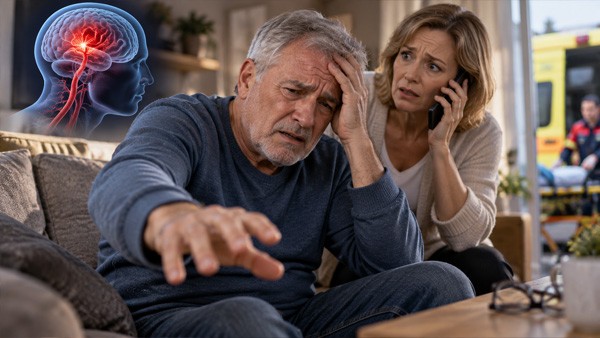
A stroke happens when part of the brain suddenly loses its blood supply. Brain cells need a constant flow of oxygen, and when it stops they begin to die within minutes. That is why doctors say time is brain: the faster treatment starts, the more of the brain can be saved.
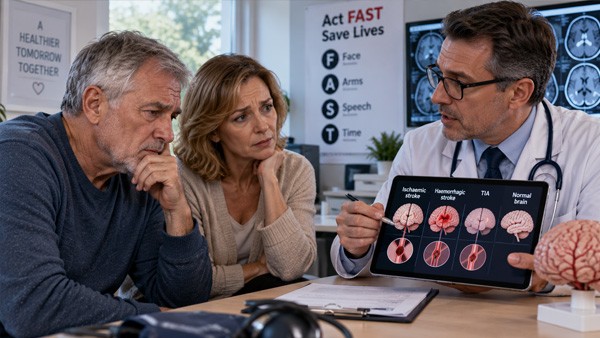
Strokes are not all the same. Most are caused by a blocked artery, a smaller share by a bleed, and some are brief warning episodes that clear on their own but signal a high risk of a full stroke within days. The type matters, because treatments that save one kind of stroke can be dangerous in another.
This guide explains the four main types, how to recognise a stroke, what happens in hospital, and the medicines and changes that prevent another one.

🚨 Recognise it: BE FAST
🔴 Call emergency services immediately if you notice any of these, even if they go away:
- B — Balance: sudden loss of balance, dizziness, or trouble walking
- E — Eyes: sudden loss of vision in one or both eyes, or double vision
- F — Face: one side of the face droops; the smile is uneven
- A — Arm: one arm or leg is weak or numb and drifts down when raised
- S — Speech: slurred speech, wrong words, or unable to understand
- T — Time: call immediately and note the time symptoms started
A sudden, severe headache unlike any before, the worst of your life, can signal a bleed. Do not drive yourself to hospital, and do not give aspirin before a scan: if the stroke is a bleed, aspirin can make it worse.
🧠 The four types
| Type | What happens | Share of strokes |
|---|---|---|
| 1. Thrombotic ischaemic stroke | A clot forms on a fatty, narrowed artery supplying the brain and blocks it | Together about 85 percent |
| 2. Embolic ischaemic stroke | A clot forms elsewhere, often in the heart in atrial fibrillation, travels to the brain and lodges in an artery | |
| 3. Intracerebral haemorrhage | A small artery inside the brain bursts, usually weakened by years of high blood pressure | Together about 15 percent |
| 4. Subarachnoid haemorrhage | Bleeding into the space around the brain, most often from a ruptured aneurysm; typically a sudden explosive headache |
A fifth event belongs alongside them: the transient ischaemic attack, or TIA, often called a mini-stroke. It causes the same symptoms but clears within minutes to hours, because the blockage dissolves on its own.
⚠️ A TIA is a warning, not a relief
Because symptoms disappear, people often decide it was nothing and carry on. That is a dangerous mistake. The risk of a full stroke is highest in the first few days after a TIA. Urgent assessment and starting preventive treatment straight away cut that risk dramatically. Anyone who has had stroke symptoms that went away should be seen the same day.
🏥 What happens in hospital
The first step is a brain scan, usually CT, to tell a clot from a bleed. That single question decides everything that follows.
- For a clot
- A clot-dissolving medicine can be given through a drip, usually within 4.5 hours of symptoms starting. For large blockages, a specialist can pull the clot out through a catheter threaded from the groin or wrist. This is called thrombectomy, and in selected patients it can be done many hours later. Both can transform the outcome, but only if the patient arrives in time.
- For a bleed
- Blood pressure is brought down carefully, blood thinners are reversed, and some bleeds need surgery. For an aneurysm, the source is sealed to prevent a second bleed.
This is why knowing when symptoms started, or when the person was last seen well, is so valuable to the team.
📋 Risk factors
| Risk factor | Why it matters |
|---|---|
| High blood pressure | The single biggest cause of both clots and bleeds |
| Atrial fibrillation | An irregular heartbeat lets clots form in the heart; it raises stroke risk around fivefold |
| Smoking | Damages arteries and makes blood clot more easily |
| Diabetes | Accelerates artery narrowing |
| High cholesterol | Builds fatty plaques in arteries to the brain |
| Heavy drinking | Raises blood pressure and the risk of bleeds |
| Inactivity and extra weight | Feed into blood pressure, diabetes and cholesterol |
| Age and family history | Cannot be changed, which makes the others more important |
Strokes in younger adults have some particular causes: a tear in a neck artery after injury or sudden neck movement, cocaine and amphetamines, and migraine with aura combined with smoking and the combined contraceptive pill.
💊 Medicines that prevent another stroke
After an ischaemic stroke or TIA, the chance of another is highest in the first weeks and stays raised for years. Prevention combines several medicines, each targeting a different cause.
| Medicine | Role |
|---|---|
| Clopidogrel | An antiplatelet that stops platelets sticking together. Used long term, and often combined with aspirin for the first three weeks after a minor stroke or high-risk TIA |
| Aspirin | Another antiplatelet, often started early after a clot-type stroke |
| Anticoagulants | For stroke caused by atrial fibrillation, blood thinners such as warfarin or newer anticoagulants prevent clots forming in the heart |
| Statins | A high-intensity statin such as atorvastatin lowers the risk of another clot-type stroke |
| Blood pressure medicines | Lowering pressure is the most important step after any stroke, including bleeds |
In our catalogue these include Plavix (Clopidogrel), Coumadin (Warfarin) and Lipitor (Atorvastatin), with options for pressure in the blood pressure category. The choice and combination must be made by the treating doctor. Antiplatelets are the wrong treatment for atrial fibrillation, and blood thinners are dangerous after a bleed.
🧪 Living with clopidogrel or warfarin
💡 Clopidogrel is activated by a liver enzyme that some people have in a less active form, so it works less well for them. Omeprazole and esomeprazole, common heartburn medicines, block the same enzyme; pantoprazole, such as Protonix (Pantoprazole), is usually preferred alongside it. Bruising more easily is expected. Do not stop it before dental work or surgery without asking the doctor who prescribed it.
💡 Warfarin needs regular blood tests (INR) and a steady intake of vitamin K foods such as leafy greens. Many antibiotics, painkillers and supplements change its effect, so check every new medicine.
🔴 On any blood thinner, seek urgent help for: black or bloody stools, vomiting blood, blood in urine, severe headache, a head injury, or bleeding that will not stop.
🛡️ Changes that cut the risk
- Know and treat your blood pressure. For most people after a stroke the target is below about 130/80
- Stop smoking — the risk falls quickly after quitting
- Cut down on salt. Our guide to replacing salt has practical swaps
- Move every day. Regular walking lowers blood pressure and improves recovery; see our guide to exercise and heart health
- Keep alcohol low
- Get an irregular pulse checked, which may be atrial fibrillation
- Control diabetes and cholesterol
🌱 Recovery
The brain can rewire itself after a stroke, and most recovery happens in the first three to six months, though gains can continue for much longer. Rehabilitation starts early: physiotherapy for movement and balance, occupational therapy for daily tasks, speech and language therapy for communication and swallowing.
Some effects are less visible but common. Depression affects around a third of people after a stroke and responds to treatment. Fatigue can last months. Memory and concentration problems, emotional changes and anxiety are frequent and deserve attention. Returning to driving depends on local rules and the type of stroke, and usually involves a pause of at least a month.
📞 When to seek help
- Any BE FAST symptom — emergency services immediately
- Symptoms that came and went — same-day assessment for possible TIA
- Sudden severe headache unlike any before — emergency
- An irregular or racing pulse — check for atrial fibrillation
- Bleeding on a blood thinner — urgent
- Low mood or anxiety after a stroke — tell your doctor, it is treatable
❓ Frequently asked questions
What are the main types of stroke?
Ischaemic strokes, caused by a clot forming in a brain artery or travelling from the heart, make up about 85 percent. Haemorrhagic strokes, caused by bleeding inside the brain or around it, make up about 15 percent. A TIA, or mini-stroke, causes temporary symptoms and is a warning of a possible full stroke.
What are the warning signs of a stroke?
Use BE FAST: sudden loss of balance, sudden vision loss or double vision, a drooping face, weakness in an arm or leg, slurred or confused speech, and time to call emergency services. A sudden, severe headache can signal a bleed.
Is a mini-stroke serious if symptoms go away?
Yes. The risk of a full stroke is highest in the first few days after a TIA. Same-day assessment and preventive treatment greatly reduce that risk.
Should I give aspirin to someone having a stroke?
No. Until a scan shows whether the stroke is a clot or a bleed, aspirin could make a bleed worse. Call emergency services and let the hospital decide.
How quickly does stroke treatment need to start?
As soon as possible. Clot-dissolving treatment is usually given within 4.5 hours of symptoms starting, and clot removal works best early, though some patients can be treated later. Every minute of delay costs brain cells.
What medicines prevent another stroke?
After a clot-type stroke, antiplatelets such as clopidogrel or aspirin, a high-intensity statin, and blood pressure treatment. If atrial fibrillation caused it, an anticoagulant instead of antiplatelets. After a bleed, blood pressure control is the priority.
Can I take heartburn tablets with clopidogrel?
Omeprazole and esomeprazole can reduce clopidogrel's effect, so pantoprazole is usually preferred. Check with your pharmacist before combining any acid reducer with clopidogrel.
What is the biggest risk factor for stroke?
High blood pressure. It drives both clot-type strokes and bleeds, and treating it is the most important step in prevention. Atrial fibrillation, smoking, diabetes and high cholesterol follow.
How long does stroke recovery take?
Most recovery happens in the first three to six months, but improvement can continue for much longer with rehabilitation. Fatigue and low mood are common and treatable.
Can young people have strokes?
Yes. Causes in younger adults include a tear in a neck artery, heart defects, cocaine and amphetamines, and migraine with aura combined with smoking and the combined pill.
📑 Sources and editorial
- Guidelines for the early management of acute ischaemic stroke, including thrombolysis and thrombectomy
- Guidelines for secondary prevention of stroke and transient ischaemic attack
- Trials of short-term dual antiplatelet therapy after minor stroke and high-risk TIA
- Guidance on anticoagulation in atrial fibrillation
- Regulatory information on clopidogrel and interacting proton pump inhibitors
- Guidance on intracerebral and subarachnoid haemorrhage
- Related reading: replacing salt, exercise and heart health
- Related products: Plavix (Clopidogrel), Coumadin (Warfarin), Lipitor (Atorvastatin)
- RXshop Editorial Team — reviewed by James Carter, MD, Neurology
Medical Disclaimer: The information in this article is for educational and informational purposes only and is not a substitute for professional medical advice, diagnosis, or treatment. Always seek guidance from a qualified healthcare provider with any questions you may have regarding a medical condition, and before starting, stopping or changing any medication.