Blood Sugar Numbers: What Your Readings and HbA1c Actually Mean, and Which Ones Need Action

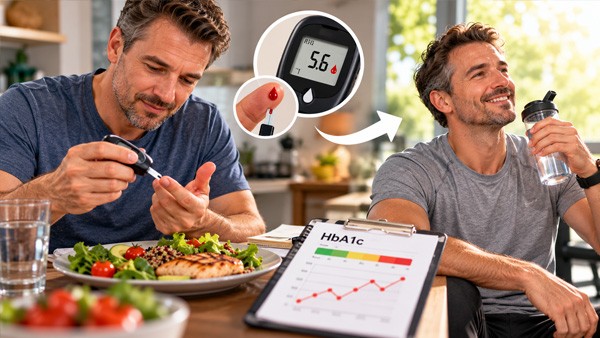

Diabetes is managed with numbers, and the numbers are explained to people badly. Someone gets told their HbA1c is 7.4 and that this is a bit high. They get told to keep their sugars in range. Nobody says which range, whether the morning reading and the after-dinner reading are supposed to match, or what to do when one of them is stubbornly wrong.
So here is the whole thing laid out: what each number measures, what it should be, why the morning one misbehaves, when the laboratory result is misleading, and which reading each class of medicine actually moves.
📊 Three numbers, measuring three different things
The first source of confusion is treating all glucose readings as one measurement taken at different moments. They are not interchangeable, and a person can be fine on one and badly off on another.
| Number | What it measures | What it tells you |
|---|---|---|
|
Fasting glucose first thing, before food |
What the liver released overnight | Your baseline. The level everything else is built on. High here and the whole day runs high |
|
Post-meal glucose around 2 hours after eating |
How well that specific meal was handled | Your response to food. This is where the day peaks, and where most of the damage to blood vessels happens |
|
HbA1c a laboratory blood test |
The proportion of your red blood cells coated in glucose | Your average over about three months. It cannot be improved by behaving well for a week before the appointment |
HbA1c works the way it does because red cells live roughly three months and accumulate glucose permanently while they circulate. More glucose around them, more coating. Which means the test is an average, and an average hides its own shape. Two people can both sit at 7.2 percent, one running steadily in the high sevens all day, the other swinging between 3.5 and 15. The second person is in far more trouble and the test does not show it.
🎯 The targets, and why yours may not be the standard one
| Measurement | Usual target in type 2 diabetes |
|---|---|
| Fasting, and before meals | 4.0 to 7.0 mmol/L — about 72 to 126 mg/dL |
| Two hours after a meal | under 8.5 mmol/L — about under 153 mg/dL |
| HbA1c, managed with diet or metformin alone | 6.5 percent — 48 mmol/mol |
| HbA1c, on a medicine that can cause lows | 7.0 percent — 53 mmol/mol |
| HbA1c, relaxed target | 7.5 to 8.0 percent — 58 to 64 mmol/mol |
💡 A looser target is a clinical decision, not a lower standard.
Chasing a low HbA1c costs something, and in some people the cost outweighs the benefit. Targets are deliberately relaxed when there is significant frailty or older age, a history of severe or unrecognised lows, established heart disease, advanced kidney disease, a limited life expectancy, or when someone lives alone and would not be found if they went low.
The reasoning is simple. The damage from a glucose of 9 instead of 7 accumulates over decades. The damage from a collapse in the kitchen at 03:00 happens in one night. If your target was set higher than the textbook figure, it is worth asking why, because the answer is usually a good one — and if nobody set a target with you at all, that is the conversation to have.
🧮 Turning HbA1c into numbers you recognise
The most useful translation in diabetes care, and the one least often handed over. An HbA1c corresponds to an estimated average glucose, so a percentage becomes a figure you can compare with your own meter.
| HbA1c | mmol/mol | Average glucose | In mg/dL |
|---|---|---|---|
| 6.0% | 42 | 7.0 mmol/L | 126 |
| 6.5% | 48 | 7.8 mmol/L | 140 |
| 7.0% | 53 | 8.6 mmol/L | 154 |
| 7.5% | 58 | 9.4 mmol/L | 169 |
| 8.0% | 64 | 10.2 mmol/L | 183 |
| 9.0% | 75 | 11.8 mmol/L | 212 |
| 10.0% | 86 | 13.4 mmol/L | 240 |
This table does a second job, and it is the more valuable one. If your meter readings average 7 and your HbA1c comes back at 9, the two disagree and the gap is information. Either you are testing at the flattering times of day and missing the peaks, or the HbA1c itself is unreliable — which happens more often than people are told.
⚠️ When the HbA1c is wrong
⚠️ HbA1c measures red blood cells, so anything that changes red blood cells changes the result — regardless of your glucose.
🔹 Falsely high in iron deficiency and iron deficiency anemia, in B12 or folate deficiency, after the spleen has been removed, and in advanced kidney disease. Iron deficiency is the common one, and it is common enough that a surprisingly high result in someone whose meter looks fine is worth a ferritin test.
🔹 Falsely low after a recent blood transfusion, in pregnancy, in conditions that shorten red cell survival such as hemolytic anemia, after treatment that has just corrected an iron or B12 deficiency, in significant liver disease, and with some medicines including high-dose vitamin C and erythropoietin.
🔹 Unreliable in either direction with hemoglobin variants, including sickle cell trait and thalassemia trait, where the test may need a different laboratory method entirely.
🔹 Always lagging after a real change. Start a new medicine and the HbA1c keeps carrying the old three months with it. Judging a new treatment on an HbA1c taken at six weeks underestimates it, and twelve weeks is the fair point to measure.
Where the test is unreliable, management runs on meter readings or on continuous monitoring instead. It is not a reason to stop measuring, it is a reason to stop measuring with that one instrument.
🌅 Why the morning number is the high one
Almost universal, almost always misinterpreted. People eat nothing for ten hours and wake with their highest reading of the day, and conclude their meter is broken or that they are doing something wrong overnight.
Neither. Between roughly 03:00 and 08:00 the body releases cortisol and growth hormone to get you going, and those hormones instruct the liver to pour glucose into the blood. In someone without diabetes, insulin covers it invisibly. With diabetes, it shows up on the meter. This is the dawn phenomenon, and it is physiology rather than a mistake.
But there is a second cause that produces the same morning reading and needs the opposite response.
| Dawn phenomenon | Rebound after a night-time low | |
|---|---|---|
| What happened | Normal morning hormones, insufficient insulin to cover them | Glucose fell too low in the night and the body over-corrected it |
| The 03:00 reading | Normal or rising | Low — this is the test that separates them |
| Overnight clues | None | Night sweats, vivid dreams or nightmares, waking with headache, feeling wrung out despite the high number |
| What it needs | More glucose-lowering effect overnight | Less — usually a reduction in the evening dose |
The distinction matters because the instinctive response to a high morning number is to increase the evening medication, and in the second case that makes everything worse. One or two readings taken at around 03:00 settle it, and a continuous monitor settles it without the alarm clock. Severe lows and what they look like are covered in hypos, emergencies and losing control in type 2 diabetes.
Worth ruling out alongside: undiagnosed sleep apnea, which worsens overnight glucose through repeated oxygen dips and stress hormone release, and which is markedly more common in type 2 diabetes than most people realise. See obstructive sleep apnea.
🍽️ The post-meal spike, and what flattens it
The reading two hours after eating is the one most people test least and the one that carries a lot of the long-term vascular risk. The peak itself usually arrives between 60 and 90 minutes, so a reading at two hours is already on the way down.
Two interventions change it more than most people expect, and neither involves medication.
- 🥗 Eat the carbohydrate last. Vegetables and protein first, starch and bread afterwards, same meal, same quantity. The measured reduction in the post-meal peak from food order alone is substantial, and it costs nothing
- 🚶 Walk for ten to fifteen minutes after eating. Muscle takes glucose out of the blood without needing insulin to do it. A short walk after the largest meal of the day is the single highest-yield habit in this whole article
- 🍚 The form of the carbohydrate matters as much as the amount. Liquid hits fastest — juice and sweetened drinks give the sharpest spike of anything. Finely milled flour is next. Intact grains, beans and lentils are slowest
- 🧀 Fat and protein in the same meal slow absorption, flattening the peak and pushing it later. Which is why a very fatty meal can read fine at two hours and high at four
- 🥣 Breakfast is usually the worst meal of the day for glucose, because morning insulin resistance is at its peak. The same bowl of cereal at 19:00 does less than it does at 07:00
- ☕ Caffeine raises glucose modestly in some people, which is worth knowing before blaming the food
📉 Reading the pattern instead of the number
One reading is almost useless. A week of readings at consistent times has a shape, and the shape points at what needs changing.
| Pattern | What it usually means |
|---|---|
| High fasting, reasonable rest of the day | Overnight liver output. The dawn question above, and the medicine that works overnight |
| Fasting fine, high two hours after meals | The meals themselves, or a medicine that works on baseline rather than on peaks |
| High everywhere, flat and unvarying | Overall treatment is short of what is needed. Dose or additional agent |
| Big swings between low and high in the same day | Often a medicine acting too strongly at the wrong time, with rebound. The pattern that an HbA1c hides |
| Climbing steadily over months on unchanged treatment | Natural progression of the condition. Expected, and the usual reason a second agent gets added — see combination therapy |
| Suddenly much worse over days | An infection, a new medicine such as a steroid, or a missed dose. Look for a cause rather than increasing the dose |
| One bad reading among good ones | Usually nothing. Repeat before reacting |
🩸 Testing so that the number is worth having
Meter readings get dismissed as unreliable, and a good share of that unreliability is technique rather than the device.
- 🧼 Wash and dry your hands. Not an alcohol wipe — soap and water. Traces of fruit, juice or anything sweet on a fingertip will give a reading dramatically higher than the truth, and this is the commonest cause of an inexplicably bad result
- 💧 Use the first drop once hands are clean, and do not squeeze the finger hard. Squeezing dilutes the sample with tissue fluid and lowers the reading
- 👆 Use the sides of the fingertips, not the pads, and rotate between fingers. Less painful and it preserves sensation in the parts you use
- 🌡️ Cold hands give unreliable readings. Warm them first
- 📦 Check the strips. They expire, they degrade once the pot has been open a while, and they are affected by heat — a pot left in a car is suspect
- ⏲️ Test at the same times when building a picture. Random readings make a cloud, not a pattern
- 📓 Record what was happening alongside the number. A reading of 12 means something different after a birthday meal than it does after a normal Tuesday lunch
- 📏 Expect a margin. Home meters are permitted a deviation of around 15 percent from the laboratory, so 7.0 and 7.8 are the same reading. Do not chase differences that small
📱 What a continuous monitor adds, and why time in range caught on.
A sensor worn on the arm or abdomen reads glucose continuously and produces a figure that HbA1c cannot: the percentage of the day spent inside your target range. A common goal is above 70 percent of the day in range, with under 4 percent of the day below target.
That second figure is the point. It catches the person whose average looks respectable because the highs and the lows cancel each other out, and it catches lows during sleep that nobody would ever have tested for.
🔹 It also shows the direction of a reading, not just its value. A glucose of 5.5 falling fast and a glucose of 5.5 rising need opposite responses, and a finger-prick cannot tell them apart.
🔹 Sensor readings sit slightly behind blood glucose, by several minutes, so during a rapid change the finger-prick is the one to trust.
💊 Which number does each medicine move?
Worth understanding, because it explains why one person is told to take a tablet with every meal and another takes one in the morning, and because it tells you whether your treatment is even aimed at the problem your readings show.
| Class | Mainly moves | Notes |
|---|---|---|
| Metformin | Fasting | Reduces liver glucose output. First choice for most people, no weight gain, does not cause lows on its own |
|
Dapagliflozin and canagliflozin SGLT2 inhibitors |
Both | Remove glucose through the urine. Modest weight and blood pressure reduction, and benefits for heart and kidney independent of glucose |
|
Sitagliptin DPP-4 inhibitor |
Post-meal | Enhances the body own meal-response hormones. Weight neutral, does not cause lows, generally very well tolerated |
|
Glipizide sulfonylurea |
Both, strongest on fasting | Pushes the pancreas to release insulin. Works quickly and powerfully — and is the class that causes lows, so readings matter most here |
| Pioglitazone | Fasting | Improves insulin sensitivity. Takes several weeks to show its full effect, so do not judge it early |
| Meglitinides and acarbose | Post-meal only | Taken with meals and skipped when a meal is skipped, which is why the instructions look odd |
| Basal insulin | Fasting | Titrated against the morning reading specifically |
| Mealtime insulin | Post-meal | Matched to the carbohydrate in that meal |
Read that table against your own pattern and something often becomes obvious. Post-meal readings that stay high on a medicine that only works on the baseline are not a failure of effort. They are a mismatch, and the fix is a conversation rather than more willpower. Which agent gets chosen first, and why, is covered in choosing your first diabetes medication.
🤒 The things that push numbers up and have nothing to do with food
Before concluding that treatment has stopped working, this list accounts for a lot of unexplained weeks.
- 💊 Steroids, in any form — tablets, a joint injection, a strong skin preparation. The effect is large, it can last weeks after a short course, and people are frequently not warned
- 🦠 Any infection, including one you have barely noticed. A urinary infection or a dental abscess can lift glucose for days before the infection itself becomes obvious
- 😢 Pain, injury, surgery and acute stress, all through the same stress-hormone route
- 😴 Short or broken sleep. A few nights of poor sleep measurably worsens insulin sensitivity
- 💧 Dehydration, which concentrates what is there — and matters more on an SGLT2 inhibitor, which increases urine output
- 💊 Other prescriptions: thiazide diuretics, some antipsychotics, beta-blockers (which also mask the warning signs of a low), and statins to a small degree
- 📅 The menstrual cycle, which shifts insulin sensitivity predictably enough to be worth tracking alongside readings
- 📦 A new box of strips, or a new meter. Before believing a step change, confirm it on the old equipment
- 🚫 A missed or doubled dose, which is the explanation often enough to check first
🚨 The readings that need acting on today
🚨 Seek urgent medical help with:
🔹 Glucose above 20 mmol/L (360 mg/dL) with vomiting, abdominal pain, deep rapid breathing, breath smelling sweet or fruity, or drowsiness. This combination is a medical emergency regardless of which type of diabetes you have
🔹 Any reading you cannot bring down over several hours while you are also unable to keep fluids down
🔹 Confusion or a drop in consciousness, high or low
🔹 A low that does not respond to two rounds of fast sugar fifteen minutes apart
🔹 Any severe low needing another person to help you, even after you recover — that event should change the treatment plan, not just the afternoon
Detail on both emergencies is in hypos, emergencies and losing control.
📋 Before anything gets changed
If the numbers are not where they should be, this is the sequence worth going through, in order, because the later steps are wasted if the earlier ones are skipped.
- ✅ Confirm the readings are real — hand washing, strips in date, no squeezing
- ✅ Collect a week of readings at fixed times rather than a month of random ones, so there is a pattern to look at
- ✅ Check whether your HbA1c and your meter agree. If they disagree badly, work out which one is lying before acting on either
- ✅ Account for the list above — steroids, infection, sleep, a new prescription
- ✅ Establish whether the problem is fasting or post-meal, because this determines everything that follows
- ✅ Apply the two free interventions — carbohydrate last, walk after the main meal — and measure whether they moved anything
- ✅ Confirm your target was set deliberately and is still appropriate for your age, your other conditions and your risk of lows
- ✅ Then discuss the medication, with your week of readings in hand and knowing which number needs moving
Long-term, the reason any of this matters is damage that accumulates quietly in small blood vessels — the kidneys and the nerves first, usually without symptoms until late. Both have their own guides: diabetic kidney disease and diabetic neuropathy. For readings that are raised but not yet in the diabetic range, see prediabetes and what the numbers mean, and on weight, which moves insulin resistance more than anything else available, weight loss and what works.
📞 When to contact your doctor
- Fasting readings consistently above 7 mmol/L (126 mg/dL) for two weeks or more on unchanged treatment
- Post-meal readings consistently above 10 mmol/L (180 mg/dL), even when fasting numbers look acceptable
- Any low reading at all if you are not on a medicine that should cause one — that needs explaining rather than accepting
- More than one low a week, however mild
- Night sweats, nightmares, or waking with a headache and a high reading — the rebound pattern, and the dose may need reducing rather than raising
- Your meter average and your HbA1c disagree substantially
- Readings have changed sharply over days rather than drifting over months
- You have been started on a steroid — before the numbers climb, not after
- Increasing thirst, urination, weight loss or blurred vision, which indicate glucose has been high for a while
- You have never been given a target, or do not know what yours is
❓ Frequently asked questions
What should my blood sugar be in type 2 diabetes?
Usually 4.0 to 7.0 mmol/L fasting, which is 72 to 126 mg/dL, and under 8.5 mmol/L or 153 mg/dL two hours after eating. Targets are set individually and may be looser.
What does an HbA1c of 7 percent mean in daily readings?
An average glucose of about 8.6 mmol/L, or 154 mg/dL, across roughly three months. It is 53 in mmol/mol units.
Why is my blood sugar highest in the morning when I have not eaten?
Morning hormones tell the liver to release glucose, called the dawn phenomenon. It can also follow an unnoticed night-time low that the body over-corrected, which needs the opposite treatment.
Can an HbA1c result be wrong?
Yes. Iron deficiency and kidney disease raise it falsely; recent transfusion, pregnancy and shortened red cell survival lower it. Hemoglobin variants make it unreliable either way.
Why does my meter disagree with my laboratory result?
Either you are testing at times that miss the peaks, or the HbA1c is affected by a red cell condition. Home meters are also allowed about 15 percent deviation.
How soon after starting a medicine should HbA1c be rechecked?
About twelve weeks. The test carries three months of history, so a result at six weeks still contains the old numbers and understates the improvement.
What lowers blood sugar after a meal without medication?
Eating the carbohydrate last in the meal, and walking for ten to fifteen minutes afterwards. Both measurably reduce the peak, and the walk works without needing insulin.
Why did my readings suddenly get worse?
Look for a cause before raising a dose. Steroids, any infection, poor sleep, dehydration, a new prescription, or a new pot of test strips account for most sudden changes.
What is time in range and is it better than HbA1c?
The share of the day spent inside target, usually aiming above 70 percent with under 4 percent below target. It catches swings and night-time lows that an average hides.
Which diabetes medicines work on fasting and which on after meals?
Metformin and pioglitazone mainly lower fasting glucose, sitagliptin mainly post-meal, SGLT2 inhibitors such as dapagliflozin lower both, and sulfonylureas lower both with a risk of lows.
📑 Sources and editorial
- Clinical guidance on glycemic targets in type 2 diabetes, including fasting, pre-meal and post-prandial ranges and the basis for individualised HbA1c goals
- Guidance on relaxing HbA1c targets in frailty, advanced age, established cardiovascular disease, advanced kidney disease, limited life expectancy and prior severe hypoglycemia
- Reference data for the relationship between HbA1c and estimated average glucose, and for conversion between percentage and mmol/mol units
- Literature on conditions causing falsely elevated HbA1c, including iron deficiency with and without anemia, B12 and folate deficiency, splenectomy and advanced chronic kidney disease
- Literature on conditions causing falsely lowered HbA1c, including recent transfusion, pregnancy, hemolysis, recent correction of hematinic deficiency, liver disease, high-dose ascorbic acid and erythropoietin therapy
- Guidance on hemoglobin variants, including sickle cell and thalassemia traits, and the need for alternative assay methods or alternative monitoring
- Evidence on the three-month red cell lifespan as the basis for the lag in HbA1c response following a treatment change, and the recommended twelve-week interval for reassessment
- Literature on the dawn phenomenon and on post-hypoglycemic rebound hyperglycemia, including the role of overnight glucose measurement in distinguishing them
- Evidence on the association between obstructive sleep apnea and impaired glycemic control in type 2 diabetes
- Trial evidence on food order and post-prandial glucose excursion, and on short post-meal walking and glucose disposal through non-insulin-dependent muscle uptake
- Guidance on self-monitoring technique, including hand washing rather than alcohol swabbing, first-drop sampling, avoidance of excessive squeezing, and strip storage and expiry
- International consensus on continuous glucose monitoring metrics, including time in range targets and time below range limits, and on sensor lag during rapid glucose change
- Prescribing information and clinical guidance for metformin, SGLT2 inhibitors, DPP-4 inhibitors, sulfonylureas, thiazolidinediones, meglitinides and alpha-glucosidase inhibitors, including their differential effects on fasting and post-prandial glucose
- Guidance on medicines that raise blood glucose, including corticosteroids, thiazide diuretics, atypical antipsychotics and statins, and on beta-blockers masking hypoglycemia awareness
- Guidance on the recognition of diabetic ketoacidosis and hyperosmolar hyperglycemic state, and on sick day management
- Related reading: choosing your first diabetes medication, combination therapy, hypos and emergencies, diabetic neuropathy, diabetic kidney disease, prediabetes, weight loss, obstructive sleep apnea
- Related products: Dapasmart (Dapagliflozin), Sitasmart (Sitagliptin), Canagliflowin (Canagliflozin), Glucotrol (Glipizide SR), Actos (Pioglitazone), diabetes medications category
- RXshop Editorial Team — reviewed by Daniel Kim, MD — Endocrinologist and Diabetes Specialist
Medical Disclaimer: The information in this article is for educational and informational purposes only and is not a substitute for professional medical advice, diagnosis, or treatment. Always seek guidance from a qualified healthcare provider with any questions you may have regarding a medical condition, and before starting, stopping or changing any medication.