Allergic Conjunctivitis: Why Eyes Itch, What Stops It and What Makes It Worse

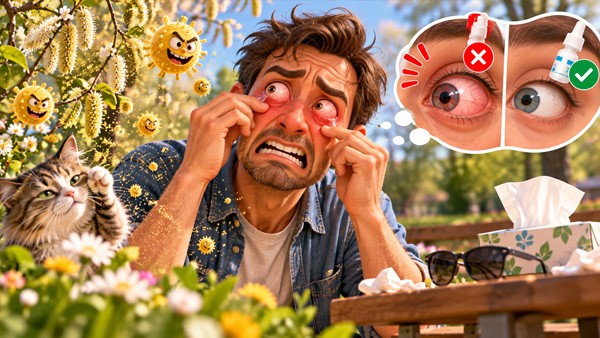

The conjunctiva, the thin membrane covering the white of the eye and the inside of the lids, is one of the few surfaces of the immune system left permanently exposed to the air. It is densely populated with mast cells, and mast cells are the cells that release histamine. That combination is why an allergic reaction shows up in the eyes faster and more intensely than almost anywhere else.
The sequence is direct. Pollen lands on the eye surface. It binds IgE antibodies on the mast cells. The mast cells degranulate within seconds, releasing histamine, which dilates vessels, leaks fluid into the tissue and, above all, stimulates the nerve endings that produce itch.
Which gives the single most useful fact about red eyes:
🔍 Itching is the allergic symptom. Bacterial and viral conjunctivitis cause grittiness, burning and soreness, but they do not make the eye truly itch. If the dominant complaint is an urge to rub, and both eyes are affected, allergy is by far the most likely explanation.
👀 Telling the three apart
| Allergic | Viral | Bacterial | |
|---|---|---|---|
| Main symptom | Itching | Watering, grittiness | Sticky discharge |
| Discharge | Clear, watery, stringy | Clear and profuse | Yellow or green, thick |
| Eyes involved | Both, simultaneously | Often one then the other | One, sometimes spreading |
| On waking | Lids puffy | Mild crusting | Lids stuck together |
| Other features | Sneezing, blocked nose | Recent cold, tender node in front of the ear | None systemic |
| Contagious | No | Highly | Yes |
| Course | Recurs with exposure | Worsens 3 to 5 days, then settles over 2 weeks | Improves in days |
Also worth ruling out before assuming allergy: dry eye, which produces burning and a gritty feeling that worsens through the day, and blepharitis, inflammation of the lid margins with crusting at the lash roots, which causes chronic irritation and is treated with lid hygiene rather than antihistamines.
🌼 The forms, and the one that matters clinically
- Seasonal allergic conjunctivitis
- The commonest by far. Tree pollen in spring, grass in early summer, weeds and moulds in late summer. Almost always accompanied by nasal symptoms, which is why the combined term allergic rhinoconjunctivitis is used.
- Perennial allergic conjunctivitis
- Year-round, from house dust mite, pet dander and indoor mould. Milder but constant, and frequently mistaken for chronic dry eye.
- Giant papillary conjunctivitis
- Caused by a chronic foreign body, nearly always contact lenses, occasionally a suture or prosthesis. Large bumps form under the upper lid. It resolves by removing the cause, not by treating the allergy.
- Atopic keratoconjunctivitis
- In adults with eczema. Chronic, affects the lids and cornea, and needs specialist care.
⚠️ Vernal keratoconjunctivitis is the one that can threaten sight. It affects mainly boys and young men, often with eczema or asthma, and flares in warm months. Symptoms are far more severe than ordinary eye allergy: intense itching, thick ropy mucus, marked light sensitivity and a sensation that something is stuck in the eye. Large cobblestone-like bumps form under the upper lid, and they can abrade the cornea and produce a shield ulcer, which scars. A child or young adult with severe itching plus light sensitivity and pain needs an ophthalmologist, not a pharmacy.
🧊 What to do before reaching for a medicine
- 💧 Rinse the eye with preservative-free artificial tears. This physically washes allergen off the surface, and it is more useful than it sounds. Keeping the bottle in the fridge adds a cooling effect that reduces itch directly
- ❄️ Cold compress for 5 to 10 minutes, several times a day. Cold constricts the vessels and calms the nerve endings
- 🤏 Do not rub. Mechanical pressure triggers further mast cell degranulation, so rubbing releases more histamine and produces a cycle of relief followed by worse itching. In severe or prolonged cases it also contributes to keratoconus, a distortion of the corneal shape
- 👓 Wrap-around sunglasses outdoors during pollen season
- 🚿 Rinse hair and change clothes in the evening, since pollen carried indoors keeps exposure going overnight
- 👀 Take contact lenses out during a flare. Lenses hold allergen against the surface, and drops behave unpredictably with them in
💊 Medication, by what each class actually does
| Class | How fast | Role |
|---|---|---|
|
Antihistamine and mast cell stabiliser drops olopatadine, ketotifen, azelastine |
Minutes | First line for ocular symptoms. Dual action: block histamine now, prevent release later |
|
Mast cell stabiliser drops alone sodium cromoglicate |
Two weeks | Preventive only, started before the season. Useless once symptoms have begun |
|
NSAID drops ketorolac |
Within a day | Reduce itch and inflammation where antihistamines are not enough |
|
Oral antihistamines cetirizine, desloratadine, bilastine |
1 to 2 hours | For the whole allergic picture including the nose |
|
Intranasal steroid fluticasone |
Several days | Improves eye symptoms as well as nasal ones, through the nasal-ocular reflex |
| Steroid eye drops | Fast | Specialist only. See the warning below |
🚫 Two categories of eye drop to avoid buying on your own.
Redness-relieving drops containing naphazoline or tetrahydrozoline constrict the vessels and whiten the eye within minutes. After a few days of regular use the vessels rebound wider than before, the eye becomes redder without the drops, and a chronic irritation called conjunctivitis medicamentosa develops. They treat the appearance and worsen the condition.
Steroid eye drops work well and carry real risk without supervision: cataract with prolonged use, a rise in eye pressure leading to glaucoma in susceptible people, and, most dangerously, rapid worsening of an undiagnosed herpes simplex infection of the cornea, which can cause permanent scarring.
🔬 Ketorolac drops in practice
Acular LS (Ketorolac 0.4%) is a non-steroidal anti-inflammatory eye drop. It blocks cyclo-oxygenase, reducing the prostaglandins that contribute to redness, swelling and the itch that histamine alone does not explain. Because it is not a steroid, it does not raise eye pressure or cause cataract, which is what makes it a usable option where an antihistamine drop is not enough.
- 💧 One drop in the affected eye, up to four times daily during symptomatic periods
- 🔥 Transient stinging on instillation is common and brief
- 👀 Not used with contact lenses in place. Wait 15 minutes after the drop before reinserting
- ⚠️ Caution with aspirin or NSAID sensitivity, and in anyone with a bleeding tendency or recent eye surgery, where prolonged NSAID use can affect corneal healing
- 📅 For symptomatic periods, not indefinite use. If it is needed continuously for months, the diagnosis and the plan both need review
🤬 Treating the nose treats the eyes
Allergic conjunctivitis rarely arrives alone. Around three quarters of people with allergic rhinitis have eye symptoms too, and there is a reflex connection: allergen in the nose triggers eye symptoms through a nerve pathway, which is why a nasal steroid improves itchy eyes even though nothing has been put in the eye.
From our allergy category, the oral options in stock:
- 💊 Zyrtec (Cetirizine 5/10 mg) — 10 mg once daily. The most potent of the second-generation antihistamines and the most likely to cause mild drowsiness
- 💊 Clarinex (Desloratadine 5 mg) — 5 mg once daily, minimal sedation
- 💊 Billargic (Bilastine 20 mg) — 20 mg once daily, taken one hour before or two hours after food, because food substantially reduces its absorption. The least sedating of the group
🤔 The counterintuitive part. Oral antihistamines have an anticholinergic drying effect, so they reduce tear production. In someone whose eyes are already dry, a tablet taken for itchy eyes can leave them feeling worse rather than better. If that happens, the answer is usually a drop applied to the eye plus artificial tears, rather than a stronger tablet.
For the nasal component, Flomist (Fluticasone) and Astelin (Azelastine) are the intranasal options. Nasal sprays work best aimed outwards, towards the ear on the same side, not up towards the bridge of the nose, which is where they cause nosebleeds.
🏠 Reducing exposure, by allergen
| Allergen | What actually helps |
|---|---|
| Pollen | Windows shut on high-count days, especially morning and early evening. Dry laundry indoors. Shower and change clothes on coming in |
| Dust mite | Mattress and pillow covers, wash bedding at 60 ℃, remove bedroom carpet, keep humidity under 50 percent |
| Pet dander | Keep the animal out of the bedroom. Washing the pet helps only briefly. Dander persists in a house for months after a pet leaves |
| Mould | Fix damp, ventilate bathrooms, dehumidify |
| Cosmetics | Eye make-up, mascara and false lash adhesive are a common overlooked cause of chronic lid and conjunctival irritation |
Where symptoms are severe, prolonged and clearly driven by an identified allergen, allergen immunotherapy, given as injections or under-the-tongue tablets over three years, is the only treatment that changes the underlying sensitivity rather than suppressing symptoms.
📞 When to see a doctor
- Pain in the eye, as opposed to itching or irritation
- Any change in vision
- Marked light sensitivity
- Thick yellow or green discharge, suggesting infection instead
- One eye only, which is unusual for allergy
- A contact lens wearer with a red painful eye — treat as urgent until a corneal infection is excluded
- No improvement after a week of appropriate treatment
- Severe symptoms in a child or teenager with light sensitivity, which may be vernal disease
- Symptoms after starting a new eye drop, which may be a reaction to the preservative rather than the original allergy
❓ Frequently asked questions
How do I know if my red eyes are allergy or infection?
Itching is the allergic symptom, and allergy affects both eyes at once with clear watery discharge. Infection causes soreness or grittiness rather than itch, often starts in one eye, and bacterial infection produces thick yellow or green discharge that sticks the lids together overnight.
Is allergic conjunctivitis contagious?
No. It is an immune reaction to an allergen, not an infection, so it cannot be passed to anyone. Viral and bacterial conjunctivitis are contagious.
Why does rubbing make it worse?
Mechanical pressure causes mast cells to release more histamine, so relief is followed by stronger itching. Prolonged vigorous rubbing also contributes to keratoconus, a distortion of the corneal shape.
Are redness-relief eye drops safe to use?
Not for regular use. Drops containing naphazoline or tetrahydrozoline whiten the eye by constricting vessels, but after a few days the vessels rebound wider than before and a chronic irritation develops that is harder to treat than the original allergy.
Can I use steroid eye drops for eye allergy?
Only under an ophthalmologist. They work, but unsupervised use risks cataract, raised eye pressure leading to glaucoma, and rapid worsening of an undiagnosed herpes infection of the cornea, which can scar permanently.
How do I use ketorolac eye drops?
One drop in the affected eye up to four times daily during symptomatic periods. Brief stinging is normal. Contact lenses go back in 15 minutes after the drop, and caution applies with aspirin or NSAID sensitivity.
Why did my antihistamine tablet make my eyes feel drier?
Oral antihistamines have a drying effect and reduce tear production, so in someone whose eyes are already dry a tablet taken for itching can make them feel worse. A drop applied to the eye plus artificial tears usually suits better.
Does treating my blocked nose help my eyes?
Yes. Allergen in the nose triggers eye symptoms through a nerve reflex, so an intranasal steroid improves itchy watery eyes even though nothing is put in the eye. Around three quarters of people with allergic rhinitis have eye symptoms too.
Can I wear contact lenses during a flare?
Better not. Lenses trap allergen against the eye surface and interact unpredictably with drops. A contact lens wearer with a red painful eye should be seen urgently, because a corneal infection has to be excluded first.
When is eye allergy dangerous?
When there is pain, changed vision or marked light sensitivity, and particularly in a child or teenager with severe itching and thick ropy mucus, which suggests vernal keratoconjunctivitis. That form can damage the cornea and needs an ophthalmologist.
📑 Sources and editorial
- Ophthalmology and allergy guidance on the diagnosis and management of ocular allergy
- Prescribing information for ketorolac ophthalmic solution, cetirizine, desloratadine and bilastine, including the bilastine food interaction
- Evidence on dual-acting antihistamine and mast cell stabiliser drops, and on the loading period required for cromoglicate
- Reports of conjunctivitis medicamentosa from topical vasoconstrictor use
- Reviews of vernal keratoconjunctivitis, shield ulcers and eye rubbing in keratoconus
- Studies of the nasal-ocular reflex and the effect of intranasal corticosteroids on eye symptoms
- Related reading: chronic open-angle glaucoma
- Related products: Acular LS (Ketorolac), Zyrtec (Cetirizine), Clarinex (Desloratadine), Billargic (Bilastine), allergy category
- RXshop Editorial Team — reviewed by Emily Chen, MD, MPH — Internal Medicine Specialist
Medical Disclaimer: The information in this article is for educational and informational purposes only and is not a substitute for professional medical advice, diagnosis, or treatment. Always seek guidance from a qualified healthcare provider with any questions you may have regarding a medical condition, and before starting, stopping or changing any medication.