Angioedema: Types, Emergency Care and Treatment

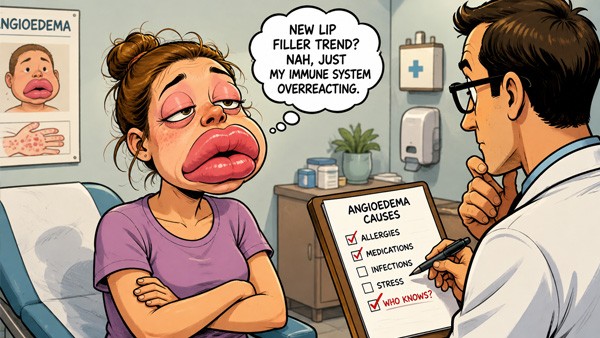
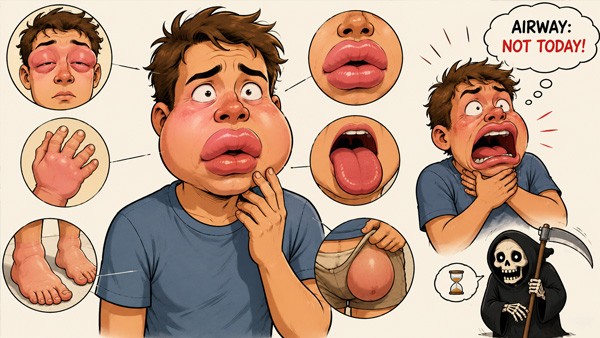
Angioedema is swelling of the deeper layers of skin and the tissue beneath mucous membranes — typically the lips, eyelids, tongue, throat, hands, feet or genitals. It looks alarming, it usually resolves, and in a small proportion of cases it obstructs the airway and kills.
Everything that matters about managing it follows from one question that the older version of this article never asked: which of two entirely different mechanisms is causing it. The two look nearly identical and respond to completely different treatment, and giving the wrong one wastes the time that matters most.
🧠 The distinction that governs everything: angioedema is either driven by histamine, released from mast cells in an allergic reaction, or by bradykinin, a different molecule entirely. Histamine-driven swelling responds to adrenaline, antihistamines and steroids. Bradykinin-driven swelling responds to none of the three. Someone with bradykinin angioedema being given repeated antihistamines while their throat closes is receiving no treatment at all, and this happens.
🔬 What is happening in the tissue
In both forms, small blood vessels in the deeper layers become abnormally leaky and fluid escapes into the surrounding tissue. Because that tissue is loose in certain areas — around the eyes, the lips, the tongue, the throat — those are the places swelling accumulates most visibly.
Angioedema differs from urticaria, or hives, mainly by depth. Hives are superficial, raised, red and intensely itchy, and they fade within a day. Angioedema is deeper, so the skin over it often looks normal in colour, it feels tense or painful rather than itchy, and it takes longer to resolve. The two frequently occur together, and when they do it is a strong clue about the mechanism.
⚖️ Telling the two mechanisms apart
| Histamine-driven | Bradykinin-driven | |
|---|---|---|
| Hives alongside | Usually present | Absent |
| Itching | Prominent | Absent — tension or pain instead |
| Onset | Minutes | Hours, building gradually |
| Duration | Hours to a day or two | Two to five days |
| Trigger | Food, drug, insect sting, latex | Trauma, dental work, stress, infection, or nothing identifiable |
| Abdominal pain | Uncommon | Common, sometimes severe, from swelling of the bowel wall |
| Family history | Not typical | Often present in the hereditary form |
| Responds to adrenaline, antihistamines, steroids | Yes | No |
The three most useful items are the presence of hives, the itching, and the speed. Swelling that comes on over hours, does not itch, has no hives with it and lasts several days is bradykinin-driven until proven otherwise, and it needs different management.
🚨 When the airway is involved
This is the part that determines survival, and it should be read before the rest.
Signs that the airway is threatened: swelling of the tongue or throat, difficulty swallowing, drooling, a change in voice or hoarseness, a sensation of throat tightness, noisy breathing, difficulty breathing, or sitting forward to breathe.
🔴 What to do, in order. Call emergency services immediately. If an adrenaline auto-injector is available, use it into the outer thigh without delay — it works for the histaminergic form and is given whenever the mechanism is uncertain, because the cost of giving it unnecessarily is small and the cost of withholding it is not. Do not wait to see whether things worsen. Keep the person sitting upright if breathing is difficult, and lying flat with legs raised if they feel faint. Antihistamines and steroids do not treat airway swelling and must never delay adrenaline. A second dose of adrenaline may be needed after five to fifteen minutes.
Where the cause is known to be bradykinin-mediated — hereditary angioedema or an ACE inhibitor — adrenaline will not reverse it, and treatment is specific medication where available plus airway management in hospital. Anyone with a known diagnosis should carry documentation stating it, because emergency teams otherwise treat the swelling as allergic.
🗂️ What causes it
| Mechanism | Causes |
|---|---|
| Histamine-driven | Food allergy — nuts, shellfish, egg, milk, sesame among others |
| Drug allergy — penicillins and other antibiotics, contrast media | |
| Insect stings | |
| Latex, and physical triggers such as cold, pressure or vibration | |
| Bradykinin-driven | ACE inhibitors — a common and under-recognised cause |
| Hereditary angioedema from C1-inhibitor deficiency | |
| Acquired C1-inhibitor deficiency, sometimes associated with lymphoproliferative disease | |
| Other | NSAIDs, which can trigger swelling by a mechanism distinct from true allergy; and idiopathic cases where no cause is ever identified |
Idiopathic angioedema, with or without chronic urticaria, is common. It is frustrating rather than dangerous in most cases, and it is managed rather than cured.
💊 Angioedema caused by blood pressure medication
This deserves its own section because it is frequent, frequently missed, and entirely reversible once identified.
ACE inhibitors — lisinopril, ramipril, enalapril, perindopril and others, all ending in the same way — are among the most prescribed drugs in the world. They work partly by blocking an enzyme that also breaks down bradykinin, so bradykinin accumulates. In a minority of people that produces angioedema, most often of the lips, tongue and face.
Three features cause the diagnosis to be missed.
It can begin years after starting the drug. The most common assumption — that a medication taken for five years without trouble cannot suddenly cause a reaction — is wrong for this specific drug class. Most cases occur in the first months, but onset after years is well documented.
It is not an allergy, so allergy testing is negative and antihistamines do not help. This is frequently read as evidence that the drug is not responsible.
It recurs unpredictably. Episodes come and go with no identifiable trigger, so the connection to a daily medication is not obvious.
⚠️ If angioedema occurs in someone taking an ACE inhibitor, the drug is the leading suspect regardless of how long they have taken it. It must be stopped permanently — not paused — and never restarted, because subsequent episodes can be more severe. Alternative blood pressure treatments are readily available. Angiotensin receptor blockers, the drug class ending in sartan, carry a much lower but not zero risk and are used with awareness. Never stop blood pressure medication independently; this is a conversation to have promptly rather than a decision to make alone.
The risk is higher in people of African ancestry, in smokers, in older people and in women, which is worth knowing when weighing the choice of blood pressure treatment.
🧬 Hereditary angioedema
Rare, serious, and worth knowing about because it is routinely misdiagnosed as allergy for years.
It results from a deficiency or malfunction of C1 inhibitor, a protein that restrains the pathway producing bradykinin. Without adequate restraint, bradykinin is generated in bursts, producing swelling that follows a characteristic pattern.
Features that distinguish it:
- No hives, no itching — the swelling is tense and sometimes painful
- Builds over hours and lasts two to five days
- Attacks of severe abdominal pain from swelling of the bowel wall, frequently mistaken for surgical emergencies; some patients have had unnecessary operations
- Triggered by trauma, dental procedures, surgery, infection and stress rather than by allergens
- Usually begins in childhood or adolescence and often has a family history, though a proportion of cases arise from new mutations
- Does not respond to adrenaline, antihistamines or steroids
Diagnosis is straightforward once considered: complement C4 is low between attacks in almost all cases, which makes it a useful screening test, followed by measurement of C1-inhibitor level and function.
Treatment has improved substantially. Specific medications now exist to stop attacks — C1-inhibitor concentrate and drugs that block bradykinin directly — along with long-term preventive treatment for people with frequent attacks, and short-term cover before dental work or surgery. Anyone with this diagnosis should carry an emergency plan and documentation, and family members should be tested.
🧪 Investigating it
The history does most of the work, and a small number of tests settle the rest.
| Step | Purpose |
|---|---|
| Detailed history | Presence of hives, itching, speed of onset, duration, triggers, family history, abdominal attacks |
| Full medication review | ACE inhibitors above all; also NSAIDs and sartans |
| Complement C4 | Screening for C1-inhibitor deficiency — low between attacks in nearly all cases |
| C1-inhibitor level and function | Confirms hereditary or acquired deficiency where C4 is low |
| Allergy testing | Only where the history points to a specific allergen; unhelpful otherwise |
| Tryptase during an acute episode | Raised in mast cell activation, supporting a histaminergic mechanism |
| Basic blood tests and thyroid antibodies | Where chronic urticaria coexists, since autoimmune thyroid disease is associated |
Broad allergy panels ordered without a suggestive history are unhelpful here and produce misleading positives, exactly as they do in other allergy contexts.
💊 Treating the allergic form
In an acute episode without airway involvement, a second-generation antihistamine is the mainstay, sometimes with a short course of oral corticosteroid where swelling is marked. Improvement usually follows within hours.
Where the airway is involved, adrenaline comes first, as set out above, and hospital assessment follows regardless of apparent recovery, because a delayed second reaction can occur hours later.
For recurrent or chronic angioedema with urticaria, the approach is stepwise and one detail in it is widely unknown.
| Step | Treatment |
|---|---|
| First | A non-sedating antihistamine daily, such as fexofenadine, bilastine, cetirizine or desloratadine |
| Second | The same drug at up to four times the standard dose, which guidelines specifically endorse |
| Third | Omalizumab, an injectable antibody treatment, where antihistamines at high dose are insufficient |
| Fourth | Ciclosporin or other immunomodulation under specialist supervision |
✅ The up-dosing step is the one most often missed. International guidance supports increasing a second-generation antihistamine to as much as four times the standard dose in chronic urticaria and angioedema before moving on, and many people improve at that point having concluded that antihistamines did not work for them. This is precisely why the choice of a genuinely non-sedating agent matters — taking four times the dose of a sedating antihistamine is not workable, while fexofenadine and bilastine remain tolerable at higher doses. Up-dosing should be done on medical advice rather than independently.
This is also why first-generation antihistamines such as cyproheptadine, promethazine and hydroxyzine are no longer preferred for this purpose. They work, but they cause marked sedation and next-day impairment, they have anticholinergic effects that suit older adults poorly, and they cannot be escalated the way modern agents can. They retain narrow roles, and routine treatment of angioedema is not among them.
❌ Measures that do not help
Intravenous calcium and vitamin infusions appear in older protocols for angioedema and have no evidence behind them. They persist in some settings out of tradition rather than effect.
Cold compresses may feel soothing on facial swelling and do nothing for the underlying process. They are comfort measures, not treatment, and should never occupy the minutes in which adrenaline is needed.
Antihistamines for bradykinin-driven swelling do nothing at all, as described throughout.
Waiting to see whether it settles is the most dangerous non-treatment. Throat swelling can progress from mild tightness to obstruction within minutes.
📋 Living with recurrent episodes
For people with a known tendency to angioedema, a few things reduce both risk and anxiety.
Know your mechanism. Whether your swelling is histamine or bradykinin driven determines what will help in an emergency, and it should be written down.
Carry documentation, and an adrenaline auto-injector where one has been prescribed, along with knowing how to use it before you need to.
Avoid identified triggers, and be aware that ACE inhibitors must never be taken again by anyone who has had angioedema on them.
Tell dentists and surgeons in advance if you have hereditary angioedema, since procedures are a recognised trigger and preventive cover is available.
Keep a record of episodes — timing, duration, what preceded them, what was taken. Patterns emerge in writing that are invisible in memory.
Take antihistamines regularly rather than as needed where episodes are frequent, since prevention works considerably better than treating each episode after it starts.
🚩 When to seek emergency help
- Any swelling of the tongue, throat or floor of the mouth
- Difficulty breathing, swallowing or speaking, or a change in voice
- Noisy breathing or drooling
- Swelling accompanied by faintness, collapse, widespread hives or vomiting, indicating anaphylaxis
- Rapidly progressing facial swelling
- Severe abdominal pain in someone known to have hereditary angioedema
- Any first episode where the cause is unknown, which warrants assessment even if it settles
Non-sedating antihistamines used for recurrent and chronic angioedema are stocked in the allergy category, including Allegra (fexofenadine), which remains tolerable at the higher doses guidelines support. They treat the histamine-driven form only, and any episode involving the airway is an emergency requiring adrenaline and emergency services rather than a tablet.
For allergic swelling with hives, a non-sedating antihistamine is the usual first choice, and a sedating one such as Atarise (hydroxyzine) is sometimes added at night. Antihistamines do not help swelling caused by ACE inhibitors or hereditary angioedema.
❓ Frequently asked questions
What is the difference between angioedema and hives?
Depth. Hives are superficial, raised, red and intensely itchy, and fade within a day. Angioedema affects deeper layers, so the overlying skin often looks normal in colour, it feels tense or painful rather than itchy, and it takes longer to settle. The two frequently occur together, and their presence together is a useful clue that the mechanism is histamine-driven rather than bradykinin-driven.
Why do antihistamines sometimes not work at all?
Because there are two mechanisms and antihistamines address only one. Histamine-driven angioedema responds to them; bradykinin-driven angioedema, caused by ACE inhibitors or by C1-inhibitor deficiency, does not respond to antihistamines, adrenaline or steroids. Swelling that builds over hours, does not itch, has no hives with it and lasts several days is bradykinin-driven until proven otherwise.
What should be done if the throat starts to swell?
Call emergency services immediately and, if an adrenaline auto-injector is available, use it into the outer thigh without waiting to see whether things worsen. It is given whenever the mechanism is uncertain because the cost of giving it unnecessarily is small. Keep the person upright if breathing is difficult. Antihistamines and steroids do not treat airway swelling and must never delay adrenaline. A second dose may be needed after five to fifteen minutes.
Can blood pressure tablets cause this?
Yes. ACE inhibitors such as lisinopril, ramipril and enalapril block an enzyme that also breaks down bradykinin, so it accumulates and can cause swelling of the lips, tongue and face. It can begin years after starting the drug, which is why the connection is so often missed. If angioedema occurs in someone taking one, that drug is the leading suspect regardless of how long it has been taken.
I have taken my blood pressure tablet for years without problems though?
That does not exclude it for this drug class. Most ACE inhibitor angioedema occurs in the first months, but onset after years is well documented and the assumption that a long-tolerated drug cannot suddenly cause it is a common reason for delayed recognition. The drug must be stopped permanently and never restarted, since later episodes can be more severe. Never stop blood pressure medication independently — raise it promptly instead.
What is hereditary angioedema?
A rare condition caused by deficiency or malfunction of C1 inhibitor, a protein that restrains bradykinin production. Swelling builds over hours, lasts two to five days, never itches and has no hives with it. Attacks of severe abdominal pain from bowel wall swelling are common and have led to unnecessary operations. Triggers are trauma, dental work, surgery, infection and stress rather than allergens.
Which test identifies hereditary angioedema?
Complement C4 is the screening test — it is low between attacks in almost all cases, which makes a normal result reassuring. Where it is low, C1-inhibitor level and function are measured to confirm. The diagnosis is straightforward once it is considered, and the difficulty is that it is often not considered for years while the swelling is treated as allergy.
Can antihistamines be taken at higher than the standard dose?
Yes, under medical advice, and this step is frequently missed. International guidance supports increasing a second-generation antihistamine to as much as four times the standard dose in chronic urticaria and angioedema before moving to other treatments. Many people improve at that point having concluded antihistamines did not work. It is also why a genuinely non-sedating agent matters — four times the dose of a sedating one is not workable.
Why are older antihistamines not preferred?
Because they work at the cost of marked sedation and next-day impairment, they have anticholinergic effects that suit older adults poorly, and they cannot be escalated the way modern agents can. Cyproheptadine, promethazine and hydroxyzine retain narrow specific roles, but routine treatment of angioedema and chronic urticaria is not among them, where non-sedating agents at adjustable doses are the standard.
Do intravenous calcium or vitamins help?
No. They appear in older treatment protocols for angioedema and have no evidence supporting them, persisting in some settings out of tradition. Cold compresses are similarly comfort measures rather than treatment. Neither should occupy time that adrenaline and emergency assessment require when the airway is involved.
What if no cause is ever found?
That is common, and idiopathic angioedema with or without chronic urticaria is a recognised situation rather than a failure of investigation. It is managed rather than cured, usually with a daily non-sedating antihistamine, escalated in dose if needed, and with omalizumab or immunomodulation where that is insufficient. Most cases eventually settle over months to years.
Should I carry an adrenaline injector?
If you have had angioedema involving the airway or anaphylaxis, or have a confirmed allergy capable of causing it, then yes, and knowing how to use it before you need to matters as much as carrying it. For bradykinin-driven angioedema an injector will not reverse the swelling, and what matters instead is carrying documentation of the diagnosis, since emergency teams will otherwise treat it as an allergic reaction.
📑 Sources and editorial
- EAACI and GA2LEN guideline on the definition, classification, diagnosis and management of urticaria and angioedema
- World Allergy Organisation guideline for the management of hereditary angioedema
- International consensus guidance on anaphylaxis recognition and adrenaline use
- Literature on ACE inhibitor-induced angioedema, including delayed onset and risk factors
- Evidence for antihistamine up-dosing in chronic spontaneous urticaria
- FDA prescribing information for fexofenadine, cetirizine and bilastine
- Related reading: allergies explained
- Related products: allergy category
- RXshop Editorial Team — reviewed by Emily Chen, MD, MPH, Internal Medicine
Medical Disclaimer: The information in this article is for educational and informational purposes only and is not a substitute for professional medical advice, diagnosis, or treatment. Always seek guidance from a qualified healthcare provider with any questions you may have regarding a medical condition, and before starting, stopping or changing any medication.