Shift Work Sleep Disorder: How to Cope With Nights

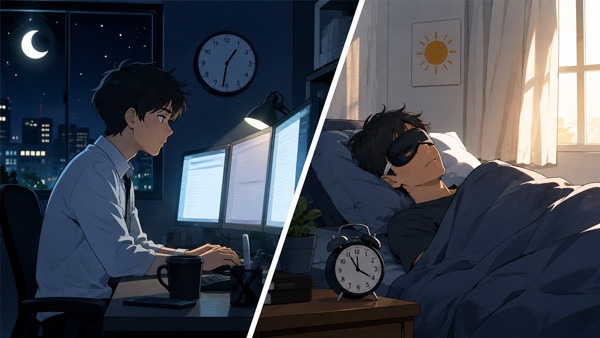

Working nights is not simply inconvenient. It requires being alert when every internal system is preparing for sleep, and asleep when the same systems are pushing hard toward wakefulness. Some people manage it for decades. Others develop a genuine clinical disorder, and the difference is not willpower.
Shift work sleep disorder is a recognised diagnosis with defined criteria and effective management. This guide covers what is actually happening, why light timing does more than anything else, how to use naps and caffeine deliberately, where medication genuinely belongs, and the health consequences that make this worth taking seriously rather than enduring.
🧠 Why the body clock never adapts, even after years of nights: adaptation requires consistent light and dark signals in the new pattern. A night worker gets bright daylight on the commute home, sleeps in a room that is not properly dark, and reverts to daytime living on days off. Those signals keep resetting the clock toward the day schedule, so it stays permanently caught between the two. The clock is not stubborn — it is being given contradictory instructions.
🕐 What is going wrong
The internal clock governs far more than sleep: core body temperature, melatonin and cortisol release, digestion, blood pressure, immune activity and cognitive performance all run on a daily rhythm synchronised mainly by light reaching the eyes.
Working at night forces behaviour into opposition with all of it. Alertness is demanded during the hours when core temperature is at its lowest and melatonin is at its peak — the physiological low point, typically between about three and six in the morning. Sleep is then attempted when temperature is rising and the clock is actively promoting wakefulness.
The result is sleep that is shorter and lighter. Day sleep after a night shift typically runs one to four hours shorter than night sleep, and it fragments more easily, so the deficit accumulates across a run of shifts.
Shift work sleep disorder is diagnosed when this produces excessive sleepiness or insomnia linked to the work schedule, persisting for at least three months, with significant impairment and no better explanation. Not every shift worker develops it; estimates of how many do vary widely but consistently show it affects a substantial minority.
👥 Who struggles most
| Factor | Effect |
|---|---|
| Rotating shifts | Hardest of all — the clock never settles into any pattern |
| Permanent nights | Somewhat easier, though full adaptation is rare |
| Backward rotation (nights, then evenings, then days) | Harder than forward rotation, since it demands advancing the clock |
| Older age | Tolerance declines from around the forties; sleep becomes lighter and more fragmented |
| Morning chronotype | Natural early risers adapt considerably worse than natural night owls |
| Long commutes | Cut into sleep and add daylight exposure at the worst possible time |
| Caring responsibilities | Daytime demands make protected sleep almost impossible |
| Existing sleep disorder | Sleep apnoea or insomnia compounds the problem substantially |
Chronotype is worth knowing about, because it is largely genetic and it predicts tolerance. Someone who has always woken naturally at six and faded by nine in the evening will find night work considerably harder than someone whose natural pattern already runs late, and neither is a matter of attitude.
⚠️ Why this matters beyond feeling tired
Night work is associated with a range of health outcomes, and the associations are consistent enough across large studies to be taken seriously rather than dismissed.
| Area | What the evidence shows |
|---|---|
| Cardiovascular | Higher rates of hypertension, coronary disease and stroke among long-term shift workers |
| Metabolic | Increased risk of type 2 diabetes, obesity and metabolic syndrome; glucose handling is measurably worse at night |
| Digestive | Reflux, ulcers and irritable bowel symptoms are considerably more common |
| Cancer | The International Agency for Research on Cancer classifies night shift work involving circadian disruption as probably carcinogenic to humans |
| Mental health | Higher rates of depression and anxiety |
| Accidents | Errors and injuries rise sharply on night shifts, particularly toward the end and in the early hours |
| Driving | Crash risk after a night shift is substantially elevated, and this is the most immediate danger of all |
| Pregnancy | Some evidence of increased risk of preterm birth and miscarriage with extensive night work |
None of this means night work should be abandoned — a great deal of essential work happens at night. It means the risks are real and worth mitigating, and that a shift worker with high blood pressure, rising glucose or worsening reflux is not experiencing a coincidence.
☀️ Light is the strongest lever
Light does more to shift the internal clock than everything else combined, and it works in both directions depending on timing. Getting it right is the difference between partial adaptation and none.
For a night worker, the goal is to push the clock later so that the physiological low point moves out of the working hours and into the daytime sleep period.
| When | What to do | Why |
|---|---|---|
| First part of the shift | Bright light, as bright as the workplace allows | Pushes the clock later and improves immediate alertness |
| Last hours of the shift | Reduce light where possible | Light at this point can start pulling the clock earlier, the wrong direction |
| Commute home | Dark wraparound sunglasses, from the moment you step outside | Morning daylight is the strongest signal telling the clock it is daytime, undoing the whole shift |
| At home before sleep | Dim light, no bright screens | Allows melatonin to rise |
| Sleeping | Complete blackout — proper blinds, not just curtains | Even modest light through the eyelids affects sleep depth |
| On waking before a shift | Bright light immediately | Reinforces the pattern and clears grogginess |
The sunglasses on the commute are the measure most often skipped and among the most valuable. Ordinary daylight is orders of magnitude brighter than any indoor lighting, and twenty minutes of it on the way home can undo a night of carefully managed exposure.
🛏️ Protecting the sleep itself
Daytime sleep is fighting the clock, so the environment has to do more work than it would at night.
Darkness above all. Blackout blinds rather than curtains, gaps sealed, and an eye mask as well if needed.
Sound. Daytime is noisy in a way night is not — deliveries, traffic, neighbours, phones. Earplugs or steady background sound, and a phone silenced with exceptions only for genuine emergencies.
Temperature. A cool room supports sleep, and daytime rooms are warmer than night-time ones.
Household agreement. The single largest practical obstacle for most people is that everyone else is awake. A clear understanding about noise, visitors and interruptions during protected hours is worth negotiating explicitly rather than hoping for.
Timing. Two approaches work, and which suits depends on the schedule. Sleeping immediately after the shift gives the longest continuous block while sleep pressure is highest, but leaves a long gap before the next shift. Splitting sleep — a few hours on getting home and a few more before the shift — suits people who cannot sleep long in one stretch and keeps alertness closer to the shift start. Split sleep is a legitimate strategy rather than a failure to sleep properly.
Days off are the trap. Reverting completely to daytime living means starting from scratch on the next run of nights. Keeping an anchor of several hours of sleep at a consistent time across both patterns limits how far the clock swings back.
💤 Napping, used deliberately
Napping is one of the best-supported countermeasures in shift work and is frequently treated as an admission of weakness rather than a tool.
A nap before the shift — ideally an hour and a half to two hours in the late afternoon or early evening — reduces sleepiness across the whole night and is worth building into the routine rather than doing occasionally.
A nap during the shift, where the workplace permits it, measurably improves alertness and performance in the second half. Between fifteen and twenty minutes avoids deep sleep and grogginess; a full ninety-minute cycle also works if there is time.
Sleep inertia is the grogginess after waking, worst when waking out of deep sleep, and it can last twenty to thirty minutes. Allow for it before doing anything requiring judgement, and use bright light and movement to clear it faster.
A caffeine nap — taking caffeine immediately before a fifteen to twenty minute nap — works because caffeine takes about that long to have effect, so the two combine on waking. It is a genuine technique rather than folklore.
☕ Caffeine with a schedule
Caffeine is effective for night work and most people use it in the pattern most likely to damage their sleep.
It works best in moderate doses spread across the first half of the shift rather than a large amount at the start, which produces a peak and then a decline exactly when the physiological low point arrives.
Its half-life is around five hours and longer in some people, which means a coffee at four in the morning is still substantially present at ten. A practical rule is to stop caffeine at least six hours before the intended sleep, which for most night workers means nothing after roughly the midpoint of the shift.
Tolerance also develops, so the person drinking large amounts continuously gets less benefit than the person using it strategically on the nights that need it.
💊 Where medication fits
This is one of the few contexts in which wakefulness-promoting medication is not off-label improvisation but an approved treatment.
Modafinil and armodafinil are specifically licensed for excessive sleepiness in shift work sleep disorder, alongside narcolepsy and residual sleepiness in treated sleep apnoea. Trials in shift workers showed improved alertness and reduced sleepiness during night shifts and on the commute home.
Two points determine whether they help.
Timing. Taken about an hour before the shift begins. Taken later, the effect runs into the period when sleep is needed.
Duration matters for shift work specifically. A night shift plus a commute is a long window, and armodafinil, with a half-life of around fifteen hours against roughly twelve for modafinil, holds through it more reliably. That is the one situation where the longer-acting option is clearly the better fit — the reverse of the advice for travel, where the goal includes sleeping the same night.
⚠️ What medication does not do. It reduces sleepiness; it does not repay sleep debt, realign the body clock, or remove the health consequences of circadian disruption. Someone who is chronically under-slept and taking a wakefulness drug is still chronically under-slept. It belongs alongside light management, protected sleep and napping rather than instead of them — and if it is the only measure being taken, it is doing the least valuable part of the job.
The usual cautions apply: both are prescription controlled substances in most countries; both reduce the effectiveness of hormonal contraception during use and for a month afterwards; any rash requires stopping and medical assessment; and both are avoided in significant cardiac disease and in pregnancy, with caution in anxiety and bipolar disorder.
Melatonin taken before daytime sleep helps some people fall asleep and can modestly assist the clock shift. Doses are small, timing matters more than amount, and availability varies by country.
Sleeping tablets are sometimes used short term for daytime sleep. They carry next-day impairment, tolerance and dependence concerns, and they do nothing for the alertness half of the problem. Where used, it should be briefly and under supervision, never combined with alcohol before driving home.
Alcohol as a sleep aid is the common self-prescribed version and the worst option. It shortens time to sleep and then fragments the second half badly, which is precisely the part already compromised by daytime sleeping.
🔄 How the schedule itself is built
Some of the most effective changes are not available to the individual worker, which is worth knowing in order to ask for them.
Forward rotation beats backward. Moving days to evenings to nights asks the clock to delay, which it does naturally. Moving nights to evenings to days asks it to advance, which is much harder. Schedules built the wrong way round cause avoidable difficulty.
Rapid rotation or permanent assignment beat slow rotation. Either changing every two or three days, so the clock never attempts to shift, or staying on one pattern long enough to partially adapt, works better than switching weekly, which produces the worst of both.
Adequate recovery between runs matters more than the total number of nights, and at least two full days after a run of nights is a reasonable minimum.
Shift length interacts with everything. Twelve-hour nights concentrate the fatigue and are associated with more errors in the final hours.
Predictability lets people plan sleep. Schedules issued at short notice make protected sleep impossible however motivated the worker is.
🚗 The drive home
This is the most dangerous part of night work and it receives the least attention.
Driving after a night shift means driving at the end of a long period awake, during the hours when the internal clock is pushing hardest toward sleep, and often in bright morning sun that itself induces drowsiness. Crash risk is measurably elevated, and microsleeps of a few seconds are enough at road speed.
Practical measures worth taking seriously:
- Take a short nap before driving if there is any doubt — fifteen or twenty minutes in the car park is a reasonable trade
- Caffeine before setting off, allowing twenty minutes for it to work
- Sunglasses, which serve the clock and reduce glare-related drowsiness together
- Share lifts or use public transport where possible
- Stop if you notice the signs — drifting, missing the last few miles, heavy eyelids, repeated yawning. Opening a window and turning up music does not work
👪 The part nobody schedules
Night work costs more than sleep. Social events, family meals, children bedtimes and ordinary daytime errands all sit inside the sleep window, and the isolation accumulates.
What helps is treating it deliberately rather than letting it erode: protecting specific times for family that are genuinely protected in both directions, planning social contact around the schedule instead of hoping it fits, and being explicit with people about which hours are actually available. Partners and children who understand the schedule respond very differently from those who experience it as unexplained absence.
Eating patterns deserve attention too. Digestion is genuinely impaired at night, and large meals during the shift sit badly and worsen sleepiness. Lighter food during the night with the main meal outside working hours suits most people better, and it also limits the weight gain that shift work tends to produce.
🚩 When to get help
Some situations warrant assessment rather than more coping strategies.
- Falling asleep unintentionally at work or while driving
- Sleepiness that persists on days off and after adequate sleep, which suggests something other than shift work alone
- Loud snoring with pauses, suggesting sleep apnoea — which is common, worsens everything, and is highly treatable
- Insomnia continuing even when the schedule allows sleep
- Persistent low mood or anxiety
- Reliance on alcohol or sedatives to get to sleep
- New high blood pressure, rising glucose or worsening reflux, all of which are associated with long-term shift work and need managing
Night work is also genuinely inadvisable for some people: those with poorly controlled epilepsy, since sleep deprivation lowers the seizure threshold; those with bipolar disorder, where circadian disruption can precipitate episodes; and those with untreated sleep apnoea until it is treated. These are worth discussing rather than pushing through.
✅ If you change only three things: wear dark sunglasses for the entire journey home, make the bedroom genuinely black rather than merely dim, and take a proper nap in the late afternoon before a night shift. Those three cost almost nothing, address the clock, the sleep and the alertness respectively, and between them do more than most people achieve with anything else.
Where sleepiness persists despite these measures, the licensed treatment is stocked in the wakefulness category, with Waklert (armodafinil) suiting shift work particularly because its longer duration covers the shift and the journey home. It requires a prescription and works best as one part of a plan rather than the whole of it.
For persistent sleepiness on night shifts, armodafinil is licensed in some countries specifically for shift work sleep disorder. Armod (armodafinil) is taken about an hour before the shift starts, never on the way home.
❓ Frequently asked questions
Why does my body never get used to nights?
Because adaptation needs consistent light and dark signals in the new pattern, and shift workers rarely get them. Bright daylight on the commute home, a bedroom that is not properly dark, and a return to daytime living on days off all reset the clock toward the day schedule. The clock is not being stubborn — it is receiving contradictory instructions and settling permanently between the two patterns.
Why do sunglasses on the way home matter so much?
Because ordinary daylight is far brighter than any indoor lighting, and morning light is the strongest possible signal telling the clock that it is daytime. Twenty minutes of it on the commute can undo a whole night of carefully managed light exposure. Dark wraparound sunglasses worn from the moment you step outside are among the cheapest and most effective measures available.
Should I sleep straight after the shift or later?
Both work and it depends on the schedule. Sleeping immediately gives the longest continuous block while sleep pressure is highest, but leaves a long gap before the next shift. Splitting sleep — a few hours on getting home and a few more before the shift — suits people who cannot sleep long in one stretch and keeps alertness closer to the shift start. Split sleep is a legitimate strategy, not a failure.
What should I do on days off?
Days off are where most of the ground gets lost. Reverting completely to daytime living means starting from scratch on the next run of nights. Keeping an anchor of several hours of sleep at a consistent time across both patterns limits how far the clock swings back. Complete consistency is unrealistic for most people, and a partial anchor is considerably better than none.
Do naps actually help or just make things worse?
They help, and napping is one of the best-supported countermeasures in shift work. A ninety-minute to two-hour nap in the late afternoon before a night shift reduces sleepiness across the whole night. A fifteen to twenty minute nap during the shift improves alertness in the second half without causing grogginess. Sleep inertia after waking lasts twenty to thirty minutes, so allow for it before doing anything requiring judgement.
When should I stop drinking coffee during a shift?
At least six hours before you intend to sleep, which for most night workers means nothing after roughly the midpoint of the shift. Caffeine has a half-life of around five hours and longer in some people, so a coffee at four in the morning is still substantially present at ten. Moderate doses spread across the first half of the shift work better than one large amount at the start.
Is medication for shift work legitimate?
Yes — this is one of the few situations where wakefulness-promoting drugs are specifically licensed rather than used off-label. Modafinil and armodafinil are approved for excessive sleepiness in shift work sleep disorder, and trials showed improved alertness during night shifts and on the commute home. They are prescription controlled substances and belong alongside light management, protected sleep and napping rather than instead of them.
Modafinil or armodafinil for night shifts?
Armodafinil generally suits shift work better. A night shift plus the journey home is a long window, and armodafinil half-life of around fifteen hours holds through it more reliably than modafinil at roughly twelve. This is the reverse of the advice for travel across time zones, where the goal includes sleeping at the destination that night and the shorter option is preferable. Either is taken about an hour before the shift.
Is night work actually bad for health?
The associations are consistent across large studies: higher rates of hypertension, coronary disease and stroke, increased risk of type 2 diabetes and obesity, more reflux and digestive problems, higher rates of depression and anxiety, and more workplace errors and injuries. The International Agency for Research on Cancer classifies night shift work involving circadian disruption as probably carcinogenic. The risks are real and worth mitigating rather than a reason to stop working nights.
Why is the drive home so dangerous?
Because it combines a long period awake, the hours when the body clock pushes hardest toward sleep, and bright morning sun that itself induces drowsiness. Crash risk after a night shift is substantially elevated, and microsleeps of a few seconds are enough at road speed. Take a fifteen minute nap before setting off if there is any doubt, use caffeine twenty minutes ahead, and stop if you notice drifting or missing stretches of road.
Which shift patterns are least damaging?
Forward rotation — days, then evenings, then nights — because it asks the clock to delay, which it does naturally, rather than advance. Either rapid rotation every two or three days, so the clock never attempts to shift, or permanent assignment long enough to partly adapt, both beat weekly rotation. Adequate recovery between runs matters more than the total number of nights worked.
When should I see a doctor about this?
If you fall asleep unintentionally at work or while driving, if sleepiness persists on days off after adequate sleep, if you snore loudly with pauses suggesting sleep apnoea, if insomnia continues even when the schedule allows sleep, if mood is persistently low, or if you are relying on alcohol or sedatives to sleep. New high blood pressure, rising glucose or worsening reflux in a long-term shift worker also warrant attention.
📑 Sources and editorial
- American Academy of Sleep Medicine practice parameters for circadian rhythm sleep-wake disorders, including shift work disorder
- International Classification of Sleep Disorders diagnostic criteria for shift work disorder
- IARC monograph on night shift work and carcinogenicity
- Cochrane and systematic reviews of interventions for sleepiness and sleep disturbance in shift workers
- Trial evidence for modafinil and armodafinil in shift work sleep disorder
- Research on light exposure timing, napping strategies and driver drowsiness after night shifts
- FDA prescribing information for modafinil and armodafinil
- Related products: wakefulness category
- RXshop Editorial Team — reviewed by James Carter, MD, Neurology and Sleep Medicine
Medical Disclaimer: The information in this article is for educational and informational purposes only and is not a substitute for professional medical advice, diagnosis, or treatment. Always seek guidance from a qualified healthcare provider with any questions you may have regarding a medical condition, and before starting, stopping or changing any medication.