Nuvigil vs Adderall: How These Drugs Differ

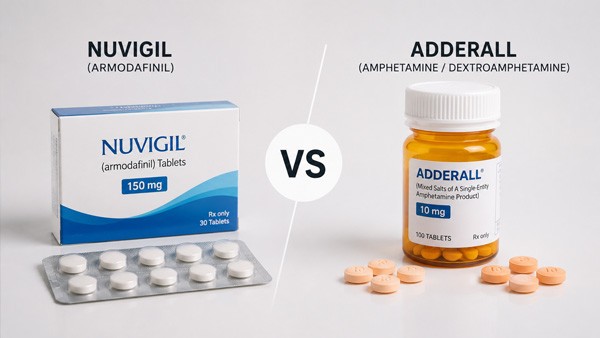
Nuvigil and Adderall get compared constantly, usually by someone deciding between them. The comparison is worth making, but it starts from a premise that does not hold: these are not two versions of the same thing, and for most conditions the choice between them is settled by the diagnosis rather than by preference.
One is a wakefulness-promoting agent whose approved uses are three specific sleep disorders. The other is an amphetamine, approved primarily for attention deficit hyperactivity disorder. They overlap in exactly one place, and outside that place they are not alternatives to each other.
🧠 The question behind most searches for this comparison is whether armodafinil can replace amphetamine for ADHD. The evidence does not support it. Trials of modafinil and armodafinil in adult ADHD have been inconsistent and generally disappointing, and neither drug is approved for it. They increase wakefulness; ADHD is not a disorder of wakefulness. Someone struggling to obtain a stimulant deserves an honest answer about that rather than an encouraging one.
🧬 What each one is
Nuvigil is the brand name for armodafinil, which is one of the two mirror-image forms of modafinil isolated on its own. Its mechanism remains incompletely characterised. It weakly inhibits dopamine reuptake, but it also affects histamine, orexin, noradrenaline and glutamate signalling in ways that do not resemble classical stimulants. It raises wakefulness without the peripheral stimulation, euphoria and crash associated with amphetamines.
Adderall is a mixture of four amphetamine salts. It acts far more forcefully on the same neurotransmitter systems, both blocking reuptake of dopamine and noradrenaline and actively driving their release from nerve terminals. That release mechanism is the crucial difference: it produces a much stronger effect, and it is also the reason for the euphoria, the abuse potential and the withdrawal.
A common description of armodafinil as a nootropic is worth setting aside. Nootropic is a marketing category rather than a pharmacological class, and it obscures the fact that armodafinil is a prescription medicine with a specific licensed purpose.
📋 What each is approved for
This table is where the comparison genuinely resolves.
| Condition | Armodafinil | Adderall |
|---|---|---|
| Narcolepsy | Approved, for the sleepiness component | Approved |
| Obstructive sleep apnoea | Approved, as an addition to treating the apnoea | Not approved |
| Shift work sleep disorder | Approved | Not approved |
| ADHD | Not approved; evidence weak | Approved, and first-line |
| Binge eating disorder | Not approved | A related amphetamine is approved |
Narcolepsy is the only genuine overlap, and even there the two are used differently: armodafinil is generally first-line for the excessive sleepiness, while amphetamines are reserved for cases where wakefulness agents prove insufficient. Neither treats cataplexy, the sudden loss of muscle tone that accompanies narcolepsy in many people, which requires different medication.
⚖️ Direct comparison
| Armodafinil (Nuvigil) | Amphetamine salts (Adderall) | |
|---|---|---|
| Class | Wakefulness-promoting agent | Central nervous system stimulant |
| Mechanism | Weak dopamine reuptake inhibition plus effects on several other systems | Reuptake blockade plus active release of dopamine and noradrenaline |
| Half-life | Around 15 hours | About 10 to 13 hours |
| Effect duration | Roughly 12 to 15 hours, flat | 4 to 6 hours immediate release; 10 to 12 hours extended release |
| Effect character | Alert rather than stimulated; little euphoria | Noticeable stimulation, often euphoria, then a decline |
| Heart rate and blood pressure | Modest effect | Consistently raised |
| Appetite | Reduced somewhat | Markedly suppressed |
| Sleep disruption | Substantial if taken late, due to long half-life | Substantial if taken late in the day |
| Control status | Lower-tier controlled substance in most countries | High-tier controlled substance with strict prescribing rules |
| Dependence potential | Low but not zero | Substantial, and well documented |
| Withdrawal | Mild — fatigue and low mood returning | Genuine — fatigue, depressed mood, increased sleep, craving |
The row on effect character explains most of the subjective reports. Armodafinil tends to be described as simply not feeling tired, with the absence of sleepiness rather than the presence of stimulation. Amphetamine is felt. That difference is why one carries far more abuse potential than the other, and it is also why some people find armodafinil underwhelming: they were expecting something to happen.
🧠 The ADHD question
This deserves a direct answer, because it is the reason most people arrive at this comparison — and increasingly because stimulant shortages have made prescriptions difficult to fill in several countries.
ADHD is not a disorder of insufficient wakefulness. It involves difficulty with sustained attention, working memory, impulse control, task initiation and emotional regulation, and the stimulant response in ADHD is specific rather than general alerting. Amphetamines and methylphenidate produce large, consistent, well-replicated improvements in core symptoms.
Modafinil and armodafinil have been trialled in ADHD, and the results have not supported approval. Some studies in children showed modest benefit; adult studies have been inconsistent; and a serious rash in paediatric trials contributed to the drug not being approved for this use. What people frequently report on armodafinil is that they stay awake and feel able to work, which is not the same as the executive function improvement stimulants produce in ADHD.
There are also legitimate non-stimulant options for ADHD — atomoxetine, guanfacine, viloxazine, bupropion off-label — which have actual evidence in the condition. Anyone unable to access a stimulant is better served by discussing those than by substituting a wakefulness drug that was studied for this purpose and did not perform.
⚠️ One genuine exception: ADHD and narcolepsy can coexist, and daytime sleepiness from any cause worsens attention in everyone. Where a person has both a sleep disorder and ADHD, treating the sleep disorder with armodafinil may improve concentration substantially — because the sleepiness was the problem, not because armodafinil treats ADHD. Untangling that requires proper sleep assessment rather than trial and error.
⏱️ Duration and how each is taken
The practical differences here shape daily life more than the pharmacology does.
Armodafinil is taken once in the morning for daytime wakefulness, or about an hour before a night shift begins. The typical dose is 150 mg, and the effect is flat across the day rather than peaked. The long half-life is a benefit for anyone needing all-day coverage and a liability for anyone who takes it late — a tablet at midday is still working at midnight, and the resulting poor sleep produces more sleepiness the following day, which is how escalating use cycles begin.
Amphetamine salts come in immediate-release form lasting four to six hours, often taken twice or three times daily, and extended-release lasting ten to twelve hours taken once in the morning. Dosing is individualised through titration, and the decline at the end of a dose — the so-called crash, with fatigue, irritability and returning symptoms — is a familiar problem that the extended forms partly address.
⚠️ Side effects compared
| Effect | Armodafinil | Adderall |
|---|---|---|
| Headache | Common, often settles | Common |
| Insomnia | Common if taken late | Common |
| Appetite loss | Mild to moderate | Marked; weight loss frequent |
| Anxiety and jitteriness | Occasional | Common |
| Raised heart rate and blood pressure | Modest | Consistent; requires monitoring |
| Dry mouth | Common | Common |
| Mood effects | Occasional irritability | Irritability, emotional blunting, low mood as the dose wears off |
| Serious skin reactions | Rare but documented; any rash requires stopping | Rare |
| Psychosis or mania | Uncommon | Uncommon but recognised, particularly at higher doses |
| Cardiovascular events | Rare | Serious events reported, mainly with existing heart disease |
🔴 The rash warning applies specifically to armodafinil. Serious skin reactions including Stevens-Johnson syndrome and toxic epidermal necrolysis have been reported, which is why the prescribing information carries a warning about it. Any rash while taking it should prompt stopping the drug and seeking assessment, especially with fever, mouth ulcers, blistering or facial swelling. Most rashes prove trivial; the ones that are not progress fast.
🔒 Dependence, control and withdrawal
The old framing — that armodafinil has insignificant addiction risk and no withdrawal, full stop — is more confident than the evidence supports, though the direction is right.
Amphetamines have well-documented dependence potential. They are placed in the strictest practical control schedule in most countries, with prescribing restrictions, quantity limits and no repeat prescriptions in many systems. Tolerance develops, dose escalation occurs, and stopping after prolonged use produces a genuine withdrawal state with fatigue, depressed mood, excessive sleep and craving. Diversion and misuse are significant enough to be a public health issue in their own right.
Armodafinil sits in a lower control schedule, reflecting a real but much lower abuse potential. Studies in people with a history of stimulant use found it produced some reinforcing effects, which is why it is scheduled at all rather than being unrestricted. Physical dependence is minimal and withdrawal is mild — typically a return of the underlying tiredness rather than a distinct syndrome. What is genuinely common is psychological reliance among people using it for productivity rather than for a diagnosed condition, who find working without it difficult after months of daily use.
Both are prohibited in competitive sport.
💊 Interactions worth knowing
Armodafinil induces the liver enzyme that metabolises hormonal contraception, reducing the effectiveness of the pill, patch, ring and implant during use and for about a month after stopping. Additional non-hormonal contraception is necessary. This is documented in the prescribing information and is the single most consequential interaction either drug has, because the consequence is a pregnancy. It also alters levels of some anticonvulsants, anticoagulants and immunosuppressants.
Amphetamine must not be combined with monoamine oxidase inhibitors, and requires care with other serotonergic drugs including many antidepressants. It interacts with drugs affecting urine acidity, which changes how much is excreted, and with blood pressure medication.
Both combine poorly with caffeine and other stimulants, and both can mask the effects of alcohol without reducing impairment.
🚫 Who should avoid each
Armodafinil is avoided in significant cardiac disease including left ventricular hypertrophy and mitral valve prolapse associated with previous stimulant use, in anyone who has had a serious reaction to it or to modafinil, in pregnancy given registry concerns about malformations, and with caution in psychosis or bipolar disorder.
Amphetamine is avoided in structural heart disease, symptomatic cardiovascular disease, moderate to severe hypertension, hyperthyroidism, glaucoma, a history of drug misuse, and alongside monoamine oxidase inhibitors. It requires careful assessment in psychosis, bipolar disorder and significant anxiety, all of which it can worsen.
Both warrant caution in anyone with an anxiety disorder, because both can amplify it — amphetamine considerably more.
💰 Access and cost
Availability differs more than price does.
Amphetamine prescribing is tightly restricted almost everywhere: specialist involvement is often required for initiation, prescriptions may be limited in quantity and duration, and repeat supply frequently requires a new paper prescription each time. Supply shortages in several countries over recent years have made even established prescriptions difficult to fill.
Armodafinil is prescription-only and controlled at a lower tier, with correspondingly lighter restrictions. It is widely available as a generic from large manufacturers, which makes it considerably cheaper than the brand.
| Brand | Manufacturer | Strength |
|---|---|---|
| Waklert | Sun Pharmaceutical | 150 mg |
| Artvigil | HAB Pharmaceuticals | 150 mg |
| Armod | Intas | 150 mg |
All contain the same molecule at the same strength; the differences are manufacturer and price. Modafinil is also available as Modalert for anyone who finds fifteen hours of effect too long.
📋 How the choice is actually made
Set out plainly, the decision tree is short.
If the diagnosis is ADHD, a stimulant licensed for it is the evidence-based choice, with non-stimulant alternatives where stimulants are unsuitable or unavailable. Armodafinil is not a substitute.
If the diagnosis is narcolepsy, armodafinil or modafinil is usually tried first for the sleepiness, with amphetamines held in reserve. Cataplexy needs separate treatment.
If the diagnosis is shift work sleep disorder or residual sleepiness in treated sleep apnoea, armodafinil is the approved option and amphetamine is not.
If there is no diagnosis and the aim is productivity, the honest position is that both are prescription medicines being used outside their purpose, that armodafinil carries the lower risk of the two by a considerable margin, and that persistent daytime sleepiness is itself a symptom worth explaining. Obstructive sleep apnoea, insufficient sleep, depression, thyroid disease, anaemia and medication effects all cause it, and several are serious. Suppressing the symptom while the cause continues is the one genuinely poor use of either drug.
✅ Worth stating clearly: the more useful comparison is usually not between these two drugs but between medication and the reasons a person is exhausted. Chronic short sleep, untreated apnoea, night shifts without recovery time and unaddressed depression are extremely common, and none of them is fixed by a wakefulness agent. Where a genuine sleep disorder is present, treatment works well and is worth having.
Armodafinil products are stocked in the wakefulness category. Amphetamine salts are not sold here, and should be obtained through a prescriber who can monitor cardiovascular health and dose escalation.
❓ Frequently asked questions
Can armodafinil replace Adderall for ADHD?
The evidence does not support it. Modafinil and armodafinil have been trialled in ADHD with inconsistent and generally disappointing results, and neither is approved for it. ADHD is not a disorder of insufficient wakefulness — it involves sustained attention, working memory, impulse control and task initiation, where stimulants produce large and well-replicated improvements. Non-stimulant options licensed for ADHD are a better route where stimulants are unavailable.
Which is stronger?
Amphetamine, by a considerable margin, because it actively drives release of dopamine and noradrenaline rather than merely slowing their reuptake. That mechanism produces a much more noticeable effect and is also the source of the euphoria, abuse potential and withdrawal. Armodafinil tends to be described as the absence of tiredness rather than the presence of stimulation, which is why some people find it underwhelming.
How long does each one last?
Armodafinil has a half-life around fifteen hours and produces a flat effect across roughly twelve to fifteen hours. Adderall immediate release lasts four to six hours and is often taken more than once daily; the extended-release form lasts ten to twelve hours from a single morning dose. The long armodafinil window suits all-day coverage but disrupts sleep badly if the tablet is taken later than early morning.
Is armodafinil really non-addictive?
Lower risk, not zero risk. Studies in people with a history of stimulant use found some reinforcing effects, which is why it is a controlled substance rather than unrestricted. Physical dependence is minimal and withdrawal is mild, usually just the underlying tiredness returning. What is genuinely common is psychological reliance among people using it for productivity, who find working without it difficult after months of daily use.
Do both treat narcolepsy?
Yes, and it is the only genuine overlap in their approved uses. Armodafinil or modafinil is usually tried first for the excessive sleepiness, with amphetamines reserved for cases where wakefulness agents prove insufficient. Neither treats cataplexy, the sudden loss of muscle tone many people with narcolepsy experience, which requires separate medication.
Does armodafinil affect contraception?
Yes, and it is the most consequential interaction either drug has. It induces the liver enzyme that metabolises hormonal contraception, reducing the effectiveness of the pill, patch, ring and implant during use and for about a month after stopping. Additional non-hormonal contraception is required throughout. Registry data has also raised concern about congenital malformations, which makes the pairing more important still.
Which is safer for the heart?
Armodafinil, clearly. Amphetamine consistently raises heart rate and blood pressure and requires cardiovascular monitoring, and serious events have been reported mainly in people with existing heart disease. Armodafinil has a modest effect on both. That said, it is still avoided in significant cardiac disease, and anyone with structural heart problems, arrhythmia or uncontrolled hypertension needs assessment before either drug.
Why is a rash serious with armodafinil?
Because serious skin reactions including Stevens-Johnson syndrome and toxic epidermal necrolysis have been reported, and the prescribing information carries a warning about it. Any rash while taking armodafinil should prompt stopping the drug and seeking medical assessment, particularly with fever, mouth ulcers, blistering or facial swelling. Most rashes prove trivial, but the ones that are not progress quickly.
Can they be taken together?
Only under specialist supervision, and it is uncommon. Combining a wakefulness agent with a stimulant is occasionally done in severe narcolepsy that responds poorly to either alone, with monitoring of cardiovascular effects and sleep. It is not something to arrange independently, since the additive effects on heart rate, blood pressure, anxiety and sleep disruption are real and the benefit outside that narrow situation is not established.
Why is Adderall harder to get?
Because it sits in the strictest practical control schedule in most countries, reflecting documented dependence potential and diversion. That brings specialist involvement for initiation, limits on quantity and duration, and often a new paper prescription for each supply. Manufacturing and supply shortages in several countries over recent years have compounded the difficulty even for people with established prescriptions.
Neither is prescribed to me. What should I do?
Find out why you are tired. Persistent daytime sleepiness is a symptom with causes: obstructive sleep apnoea, chronic insufficient sleep, narcolepsy, depression, thyroid disease, anaemia, restless legs, medication effects. Several are serious and all are treatable. Suppressing the symptom while the cause continues is the one genuinely poor use of either drug, and it is also the commonest.
Is Nuvigil the same as Waklert?
Same active ingredient at the same strength. Nuvigil is the original brand name for armodafinil; Waklert, Artvigil and Armod are generic versions from Sun Pharmaceutical, HAB and Intas respectively. Differences between generics relate to tablet formulation and how quickly they dissolve rather than to the drug itself, which is why reports of one feeling different from another are not necessarily imagined.
📑 Sources and editorial
- FDA prescribing information for armodafinil (Nuvigil) and mixed amphetamine salts (Adderall)
- American Academy of Sleep Medicine guidance on treatment of central disorders of hypersomnolence
- Clinical guidelines on the diagnosis and management of ADHD in children, young people and adults
- Trial evidence on modafinil and armodafinil in attention deficit hyperactivity disorder
- Abuse liability studies of modafinil and armodafinil in individuals with stimulant use histories
- European Medicines Agency review of modafinil-containing medicines and pregnancy outcomes
- Related products: wakefulness category
- RXshop Editorial Team — reviewed by Thomas Walsh, MD, Psychiatry and Adult ADHD
Medical Disclaimer: The information in this article is for educational and informational purposes only and is not a substitute for professional medical advice, diagnosis, or treatment. Always seek guidance from a qualified healthcare provider with any questions you may have regarding a medical condition, and before starting, stopping or changing any medication.