Breast Cancer Prevention: What Actually Lowers Risk


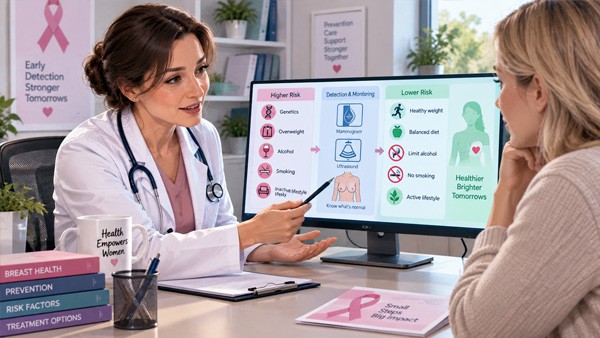
For decades women were taught a precise monthly routine: the same day each month, a set pattern of circles, lying down and standing in front of a mirror. The intention was good. But when large trials tested structured self-examination, they found it did not reduce deaths from breast cancer — while it did lead to more biopsies of lumps that turned out to be harmless.
That does not mean paying attention to your breasts is pointless. It means the advice has changed: from a formal technique to breast awareness, which is simpler and arguably more useful. This article explains what that means, what changes to report, what actually lowers risk, and the options available to women at higher risk.
👁️ Breast awareness, in one sentence: know how your breasts normally look and feel, and report any change promptly. There is no required day, method or pattern. Many cancers are found by women who simply noticed something different while washing or dressing.
🔎 Changes to report
| Change | Notes |
|---|---|
| A new lump or thickening | In the breast or armpit, even if a recent mammogram was normal |
| Change in size or shape | Particularly in one breast only |
| Skin changes | Dimpling, puckering, or skin that looks like orange peel |
| Nipple changes | A nipple that has newly turned inwards, or changed position |
| Nipple discharge | Especially if bloody or from one nipple without squeezing |
| Rash or crusting on the nipple | A persistent rash that does not settle |
| Persistent pain in one area | Pain alone is rarely cancer, but pain in one spot that does not come and go with the cycle should be checked |
Most breast changes turn out not to be cancer. Cysts, fibroadenomas and normal cyclical lumpiness are very common. But the only way to know is assessment, and a normal mammogram does not rule out a lump you can feel — some cancers do not show on mammography, particularly in dense breasts.
🔴 Do not wait for your next scheduled screening if you notice a change. Book an appointment promptly. Men can get breast cancer too, and a lump behind the nipple in a man also needs checking.
📋 Screening mammograms
Screening looks for cancer before any symptoms appear. The recommended age ranges differ between countries, typically starting somewhere between 40 and 50 and continuing to around 74, every one to three years.
Screening reduces deaths from breast cancer, and it is worth understanding its limits honestly. It can miss some cancers, it can produce false alarms that need further tests, and it sometimes finds slow-growing cancers that would never have caused harm but are then treated — known as overdiagnosis. For most women in the recommended age range, the benefits are considered to outweigh these drawbacks.
Women with a strong family history or known genetic risk are often offered screening earlier, sometimes with MRI scans in addition to mammography.
🏃 Risk factors you can change
| Factor | What the evidence shows |
|---|---|
| Alcohol | Risk rises with the amount drunk, and there is no clearly safe level. Cutting down reduces risk |
| Weight after menopause | Excess weight raises risk after menopause, because fat tissue produces oestrogen |
| Physical activity | Regular activity is associated with lower risk |
| Breastfeeding | Associated with a small reduction in risk |
| Combined HRT after menopause | Increases risk slightly, more with longer use, and the extra risk falls after stopping |
| Smoking | Associated with a modest increase in risk |
The HRT point needs context. For women with early or premature menopause, hormone replacement until the usual age of menopause does not raise risk above that of women of the same age whose ovaries are still working, as explained in the article on early menopause. The contraceptive pill carries a very small increase in risk while it is being taken, which returns to normal within years of stopping, as noted in the article on stopping birth control.
🧬 Risk factors you cannot change
- Age — the biggest single factor; most cases occur after 50
- Family history — close relatives with breast or ovarian cancer, especially at a young age
- Inherited gene changes, such as BRCA1 and BRCA2
- Dense breast tissue on mammogram
- Early first period or late menopause, meaning longer lifetime oestrogen exposure
- Previous radiotherapy to the chest, particularly at a young age
- Previous breast conditions, including some types of benign changes found on biopsy
💊 Options for women at higher risk
Women with a significantly raised risk, for example because of family history, can be referred for genetic counselling and a specialist risk assessment. Beyond enhanced screening, there are medicines that reduce the chance of developing breast cancer.
| Medicine | Who it may suit | Main considerations |
|---|---|---|
| Tamoxifen | Women at high risk, before or after menopause | Hot flushes, increased risk of blood clots, and after menopause a small increased risk of womb cancer |
| Raloxifene | Women after menopause at high risk, or with osteoporosis | Also protects bone. Increases blood clot risk and hot flushes; not used before menopause |
| Anastrozole | Women after menopause at high risk | Joint aches and bone thinning; bone health needs monitoring |
These medicines reduce the risk of the most common hormone-sensitive breast cancers by a meaningful proportion in women at high risk. They are not suitable for everyone, and the decision balances the size of a woman personal risk against side effects — which is why they are started only after specialist assessment.
For women with inherited gene changes carrying very high risk, surgical options may also be discussed with a specialist team.
🩺 When to seek help
- Any new lump, thickening, skin change or nipple change — book promptly, even after a normal mammogram
- Bloody nipple discharge or a persistent nipple rash
- A lump in the armpit
- Several close relatives with breast or ovarian cancer, or a relative diagnosed young — ask about genetic counselling
- A known BRCA gene change in the family
- On tamoxifen or raloxifene: calf pain or swelling, chest pain or sudden breathlessness — emergency. Unexpected vaginal bleeding on tamoxifen after menopause — prompt assessment
Risk-reducing and breast cancer medicines are stocked as Evista (raloxifene) in the womens health category, and as Nolvadex (tamoxifen) and Arimidex (anastrozole) in the cancer category. These medicines are used only after specialist risk assessment and under medical supervision.
❓ Frequently asked questions
Should I still do monthly breast self-examination?
Large trials found that a structured monthly routine did not reduce breast cancer deaths and led to more biopsies of harmless lumps. Current advice is breast awareness instead: know how your breasts normally look and feel, and report any change promptly. There is no required day or technique.
What breast changes should I report?
A new lump or thickening in the breast or armpit, a change in size or shape, skin dimpling or puckering, a nipple that has newly turned inwards, bloody or one-sided nipple discharge, a persistent nipple rash, or persistent pain in one spot. Most changes are not cancer, but all should be checked.
My mammogram was normal but I found a lump. What now?
Get it checked anyway. Mammograms can miss some cancers, particularly in dense breast tissue. A lump you can feel needs assessment regardless of a recent normal screening result.
Does alcohol really increase breast cancer risk?
Yes. Risk rises with the amount of alcohol drunk, and there is no clearly safe level. Reducing alcohol is one of the more straightforward ways to lower risk.
Does HRT cause breast cancer?
Combined HRT after menopause increases risk slightly, more so with longer use, and the extra risk falls after stopping. For women with early or premature menopause, HRT until the usual age of menopause does not raise risk above that of women of the same age with naturally working ovaries.
When should I start mammograms?
Recommended ages vary by country, typically starting between 40 and 50 and continuing to around 74. Women with a strong family history or known genetic risk may be offered screening earlier, sometimes including MRI.
Are there medicines that prevent breast cancer?
For women at significantly raised risk, tamoxifen, raloxifene and anastrozole reduce the chance of developing hormone-sensitive breast cancer. They have side effects, including blood clot risk with tamoxifen and raloxifene and joint aches with anastrozole, so they are started only after specialist assessment.
What is the difference between tamoxifen and raloxifene?
Tamoxifen can be used before or after menopause, but after menopause it carries a small increased risk of womb cancer. Raloxifene is used only after menopause, does not increase womb cancer risk and also protects bone. Both increase the risk of blood clots.
Should I have genetic testing?
It may be worth discussing if several close relatives have had breast or ovarian cancer, if a relative was diagnosed young, if there is male breast cancer in the family, or if a BRCA gene change is already known in the family. A genetic counsellor can assess whether testing is appropriate.
Can men get breast cancer?
Yes, although it is much less common. A lump behind the nipple, nipple changes or discharge in a man should be checked promptly.
📑 Sources and editorial
- Randomised trials of structured breast self-examination and mortality
- Guidance on breast awareness and symptoms requiring referral
- Reviews of the benefits and harms of mammography screening, including overdiagnosis
- Evidence on alcohol, body weight, physical activity, breastfeeding and hormone therapy as breast cancer risk factors
- Guidance on familial breast cancer, genetic counselling and enhanced surveillance
- Trials of tamoxifen, raloxifene and aromatase inhibitors for breast cancer risk reduction
- Related reading: early menopause and HRT, stopping the pill, womens heart health
- Related products: womens health category, cancer category
- RXshop Editorial Team — reviewed by Anita Sharma, MD, Obstetrics and Gynaecology
Medical Disclaimer: The information in this article is for educational and informational purposes only and is not a substitute for professional medical advice, diagnosis, or treatment. Always seek guidance from a qualified healthcare provider with any questions you may have regarding a medical condition, and before starting, stopping or changing any medication.