Microcephaly: What a Small Head Size Means, What Causes It and How Some Cases Are Prevented

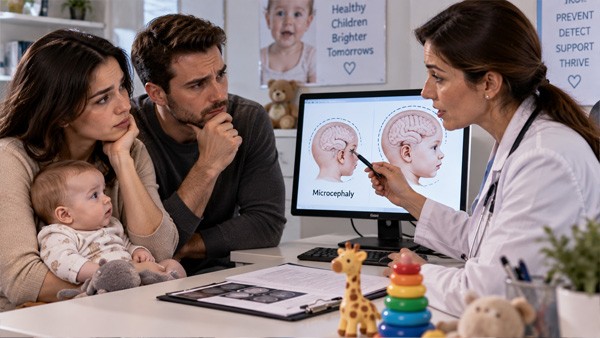

Microcephaly means that a baby's head is smaller than expected for its age and sex. Because the skull grows around the brain, a small head usually reflects a brain that has grown less than usual, either before birth or in the first years afterwards.
The word covers a very wide range. Some children with a small head develop entirely normally, often because small heads run in the family. Others have learning difficulties, epilepsy or problems with movement, hearing or sight. What matters most is not the measurement alone but the cause, and how the child develops over time.
This guide explains how microcephaly is measured and diagnosed, its main causes, what the outlook can be, and the steps before and during pregnancy that prevent some cases.
📏 How it is measured
Head size is measured with a tape around the widest part of the head, just above the eyebrows and ears, and plotted on a growth chart for age and sex. Microcephaly is usually defined as a head circumference well below the average, typically more than two standard deviations below. Severe microcephaly is more than three standard deviations below.
💡 A single low measurement is not a diagnosis. Measurements can be off, especially in newborns with moulded heads after birth. Doctors repeat them, compare with the parents' head sizes, and follow growth over months. A baby who is small overall, or whose parents have small heads, may simply be following the family pattern.
📋 Two broad types
| Present at birth | Develops after birth | |
|---|---|---|
| What it means | The brain grew less than expected in the womb | Head size is normal at birth but growth slows afterwards |
| Typical causes | Genetic conditions, infections in pregnancy, alcohol, some medicines, severe maternal illness | Brain injury around birth, some genetic and metabolic conditions, severe malnutrition, infections of the brain |
| When noticed | Late pregnancy scan or at birth | At routine checks during the first year or two |
🧬 Causes
Many causes are known, and in some children none is found despite testing.
- Genetic conditions
- Changes in single genes that control brain growth, or chromosome differences. Some run in families, which matters for future pregnancies.
- Infections during pregnancy
- Cytomegalovirus (CMV) is the most common infectious cause worldwide. Toxoplasmosis, rubella and Zika virus can also damage the developing brain.
- Alcohol
- Alcohol crosses the placenta freely. Heavy drinking in pregnancy is a well-known cause, as part of fetal alcohol spectrum disorder, and no safe amount has been established.
- Certain medicines
- Some medicines harm the developing brain, notably isotretinoin and valproate, and certain drugs used for cancer and after transplants.
- Maternal conditions
- Uncontrolled phenylketonuria (PKU), poorly controlled diabetes, severe malnutrition and placental problems.
- After birth
- Lack of oxygen around birth, serious brain infections, head injury and some metabolic disorders can slow brain growth later.
🔬 Diagnosis before and after birth
Microcephaly is sometimes suspected on an ultrasound scan, more often later in pregnancy than at the routine mid-pregnancy scan. A small head on one scan is followed up with repeat measurements and a detailed look at the brain. Sometimes MRI and tests for infection or genetic causes follow.
After birth, the assessment usually includes:
- 📏 Repeated head measurements, plus the parents' head sizes
- 🧠 Brain imaging, usually MRI, to look at brain structure
- 🧪 Tests for infection — congenital CMV must be tested for within the first three weeks of life, because after that it cannot be distinguished from infection caught later
- 🧬 Genetic testing, especially when there are other features or a family history
- 👂 Hearing and eye checks, since these are often affected
⏱️ Why early CMV testing matters. Babies born with symptoms of CMV infection can be offered antiviral treatment, ideally started within the first month. It can improve hearing and development outcomes. That treatment depends on the diagnosis being made quickly.
👶 What it can mean for a child
The outlook depends on the cause and on how much the brain is affected, and it can range from normal development to severe disability. Some children have none of the problems below. Others have several:
| Area | Possible effects |
|---|---|
| Learning and development | Delays in speech, movement and learning, from mild to severe |
| Epilepsy | Seizures are common in more severe forms and are treated with anti-seizure medicines |
| Movement | Stiff muscles, balance and coordination problems |
| Hearing and sight | Particularly after infections such as CMV or Zika |
| Feeding | Difficulty swallowing, slow weight gain |
| Behaviour | Attention difficulties, hyperactivity |
Because development is so variable, doctors usually avoid firm predictions in the first months and watch how the child progresses.
🤝 Care and support
There is no treatment that makes the head or brain grow larger. Care focuses on helping each child reach their potential and treating complications early. That usually means a team: developmental and physiotherapy, speech and feeding therapy, epilepsy treatment where needed, hearing and vision support, and educational planning. Early intervention programmes make a real difference to what children achieve. Support for parents, including practical help and contact with other families, matters as much as the medical side.
🛡️ Lowering the risk: before pregnancy
- Check rubella immunity. If not immune, have the MMR vaccine at least a month before trying to conceive
- Review your medicines with a doctor, especially for acne, epilepsy, mood disorders, cancer, autoimmune disease and after transplants
- Control long-term conditions such as diabetes, and follow the special diet for PKU well before conception
- Take folic acid. It mainly prevents neural tube defects rather than microcephaly, but it is recommended for every pregnancy
🤰 Lowering the risk: during pregnancy
| Risk | What helps |
|---|---|
| CMV | Young children often shed the virus in saliva and urine. Wash hands after nappy changes and wiping noses; avoid sharing cutlery, cups and dummies with toddlers; kiss on the forehead rather than the mouth |
| Toxoplasmosis | Cook meat thoroughly, wash fruit and vegetables, wear gloves for gardening, and let someone else empty the cat litter |
| Zika | Follow official travel advice for pregnant women and couples trying to conceive, and protect against mosquito bites in affected areas |
| Alcohol | None during pregnancy, or when trying to conceive |
| Medicines | Do not stop prescribed medicines abruptly on your own, and do not start new ones without checking. Ask before any medicine, including herbal products |
⚠️ Medicines that need special care
Two medicines in particular come up again and again in pregnancy safety, and both are in wide use.
🔴 Isotretinoin (used for severe acne) causes serious birth defects, including brain malformations. Women who can become pregnant must use reliable contraception before, during and for at least a month after treatment, and have pregnancy tests. In our catalogue it is Accutane (Isotretinoin).
🔴 Valproate (used for epilepsy, bipolar disorder and migraine prevention) causes birth defects and developmental problems in a substantial share of exposed pregnancies. It should not be used in women who could become pregnant unless no other treatment works, and never stopped suddenly for epilepsy without medical advice. In our catalogue it is Depakote (Divalproex).
If you take either and are planning a pregnancy, or discover you are pregnant, contact your doctor straight away rather than stopping on your own. A safer alternative can usually be found.
👪 Future pregnancies
Whether microcephaly could happen again depends on the cause. After an infection or a medicine exposure, the risk in a later pregnancy is usually low if that cause is avoided. For genetic causes, the chance can be significant. Genetic counselling, ideally before the next pregnancy, explains the risk and the testing options.
📞 When to talk to a doctor
- A scan suggests a small head — ask about follow-up measurements and further tests
- Your baby's head growth seems slow on the growth chart
- Developmental delays, seizures, or feeding problems
- Fever and rash in pregnancy, or contact with someone who has rubella
- Travel to an area with Zika while pregnant or trying to conceive
- Taking isotretinoin, valproate or other medicines and planning a pregnancy
Other causes of brain injury in infancy, including injury from shaking, are covered in our guide to shaken baby syndrome.
❓ Frequently asked questions
What is microcephaly?
A head size well below average for a baby's age and sex, usually because the brain has grown less than expected. It can be present at birth or develop afterwards, and its effects range from none to severe disability depending on the cause.
Does a small head always mean a problem?
No. Some children simply have small heads like their parents and develop normally. A single low measurement is repeated and followed over time, and compared with the parents' head sizes, before conclusions are drawn.
What causes microcephaly?
Genetic conditions, infections in pregnancy such as CMV, toxoplasmosis, rubella and Zika, alcohol, certain medicines, uncontrolled maternal PKU or diabetes, severe malnutrition, and brain injury around or after birth. In some children no cause is found.
Can microcephaly be seen on an ultrasound?
Sometimes, usually later in pregnancy rather than at the routine mid-pregnancy scan. A small head on a scan is followed up with repeat measurements and a detailed look at the brain, and sometimes MRI and further tests.
Can microcephaly be treated?
There is no treatment that makes the brain grow larger. Care focuses on development therapies, treating seizures, and supporting hearing, sight and feeding. Babies with congenital CMV may be offered antiviral treatment if diagnosed early.
How can I reduce the risk during pregnancy?
Avoid alcohol, practise good hygiene around young children to reduce CMV, take precautions against toxoplasmosis, follow travel advice on Zika, and check all medicines with a doctor. Before pregnancy, confirm rubella immunity and control conditions such as diabetes and PKU.
Which medicines can harm a baby's brain in pregnancy?
Isotretinoin and valproate are the best known, along with some cancer and transplant medicines. Anyone taking these and planning a pregnancy should talk to their doctor first, and should not stop epilepsy medicine suddenly without advice.
How is CMV passed to pregnant women?
Most often from young children, who shed the virus in saliva and urine. Hand washing after nappy changes, and not sharing cutlery, cups or dummies with toddlers, lowers the risk.
Will it happen again in another pregnancy?
It depends on the cause. After an infection or medicine exposure the risk is usually low if the cause is avoided. For genetic causes the chance can be significant, and genetic counselling before the next pregnancy is recommended.
What is the outlook for a child with microcephaly?
It varies widely, from normal development to severe disability, depending on the cause and how much the brain is affected. Doctors usually watch progress over the first months rather than make early predictions, and early intervention helps.
📑 Sources and editorial
- Clinical definitions and growth standards for head circumference in infants
- Reviews of genetic and acquired causes of microcephaly
- Guidance on congenital cytomegalovirus diagnosis and antiviral treatment
- Public health guidance on Zika virus and pregnancy
- Regulatory pregnancy prevention programmes for isotretinoin and valproate
- Guidance on toxoplasmosis and CMV prevention in pregnancy
- Related reading: shaken baby syndrome
- Related products: women’s health category
- RXshop Editorial Team — reviewed by Anita Sharma, MD, OB-GYN
Medical Disclaimer: The information in this article is for educational and informational purposes only and is not a substitute for professional medical advice, diagnosis, or treatment. Always seek guidance from a qualified healthcare provider with any questions you may have regarding a medical condition, and before starting, stopping or changing any medication.