Morning-After Pill: How It Works, How Late You Can Take It and When a Copper Coil Is Better

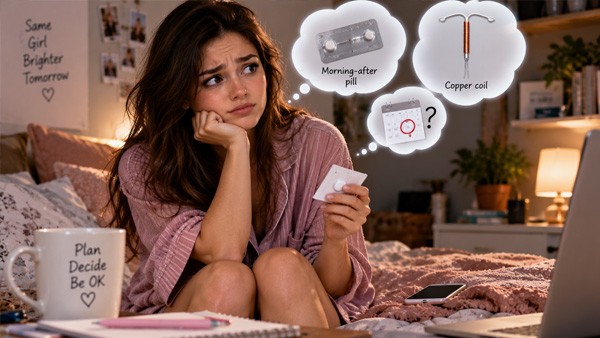

A condom split, a pill was missed, or there was no contraception at all. Emergency contraception exists for exactly these moments, and it works well when used quickly. The most important thing to know is simple: the sooner, the better.
There are three options, not one. Two are tablets, usually called morning-after pills, and the third is a copper coil fitted by a clinician. They differ in how long after sex they work, how effective they are, and who they suit. This guide explains how each one works, the mistakes that make them fail, and what to do afterwards.
⏳ The three options at a glance
| Levonorgestrel pill | Ulipristal pill | Copper coil | |
|---|---|---|---|
| Time limit after sex | Up to 72 hours (3 days) | Up to 120 hours (5 days) | Up to 5 days, sometimes later depending on the cycle |
| How effective | Good; best within 12 to 24 hours | Better than levonorgestrel, and stays effective across the 5 days | Most effective — prevents over 99 percent of pregnancies |
| Body weight | May work less well with higher body weight | May be affected, less so | Not affected |
| Ongoing contraception | No | No | Yes, for 5 to 10 years |
| How you get it | Tablet, often from a pharmacy | Tablet, pharmacy or clinic | Fitted at a clinic |
🔬 How the pills actually work
Pregnancy is only possible if sperm meet an egg. Sperm can survive in the body for up to five days, waiting for ovulation. The morning-after pills work mainly by delaying ovulation, so no egg is released while sperm are still alive.
That has two important consequences. First, timing matters because the pill has to act before ovulation begins. Second, if ovulation has already happened, a pill is much less likely to work, which is one reason the copper coil is more reliable: it works in a different way.
💡 The morning-after pill is not an abortion pill. It does not end an existing pregnancy, and current evidence shows levonorgestrel does not stop a fertilised egg from implanting. If a pregnancy has already started, the pill will not harm it. It also has no effect on future fertility.
💊 Levonorgestrel
This is the most widely available option, sold under many brand names. It is a single 1.5 mg tablet, a progestogen hormone, taken as soon as possible within 72 hours of unprotected sex. It works best in the first day and loses effectiveness as time passes.
- Body weight: it may work less well in people weighing more than about 70 kg or with a BMI over 26. Some guidelines advise a double dose in that case; ulipristal or a copper coil are often better choices
- Certain medicines reduce its effect: some epilepsy drugs, rifampicin, some HIV medicines and St John’s wort. A copper coil is preferred, or a double dose on professional advice
- Regular contraception can be started or continued straight away, with condoms for the next 7 days
- Breastfeeding is fine
💊 Ulipristal
Ulipristal acetate, a single 30 mg tablet, works up to five days after sex and is more effective than levonorgestrel, particularly on days three to five and closer to ovulation. It is often the better pill choice.
- Hormonal contraception and ulipristal interfere with each other. Wait 5 days after taking ulipristal before starting or restarting the pill, patch or ring, and use condoms until the method is working
- Breastfeeding: the usual advice is to express and discard milk for a week afterwards
- Do not take levonorgestrel within 5 days after ulipristal, as it reduces ulipristal’s effect
- Some of the same interacting medicines reduce its effect too
🔩 The copper coil
A copper intrauterine device, fitted within five days of unprotected sex, is the most effective emergency contraception available. Copper is toxic to sperm and eggs and stops fertilisation. It works even after ovulation has started, is not affected by weight or other medicines, and can stay in as reliable contraception for five to ten years.
The downsides are practical: it needs a clinic appointment and a short procedure, and periods may become heavier. For many people, being offered it is worthwhile, especially when the pills are less likely to work.
⚠️ Things that make it fail
| Situation | What to do |
|---|---|
| Waiting until the morning, or longer | Take it as soon as possible; the name is misleading, it does not need to be the morning after |
| Vomiting within 3 hours | Another dose is needed; contact a pharmacist |
| Higher body weight | Consider ulipristal or a copper coil, or ask about a double dose of levonorgestrel |
| Taking enzyme-inducing medicines | A copper coil is the preferred option |
| Unprotected sex again later in the same cycle | The pill only covers sex before it was taken. Use condoms, and take emergency contraception again if needed |
| Mixing the two pills | Do not take levonorgestrel within 5 days after ulipristal |
📅 When you need it after a missed pill
Missed contraceptive pills are one of the most common reasons for needing emergency contraception. The rules depend on the type of pill. With the combined pill, the risk is highest when two or more pills are missed in the first week of a pack, after the pill-free break. Emergency contraception is then recommended if there was unprotected sex during the break or that first week. Progestogen-only pills have much shorter safety windows. If you are unsure, ask a pharmacist; it is quicker than guessing. What happens when stopping the pill altogether is explained in our guide to stopping the pill.
🤧 Side effects
Most people have no problems, or only mild ones for a day or two: nausea, headache, tiredness, breast tenderness, stomach ache or dizziness. Light spotting is common. Serious side effects are very rare.
The main effect people notice is a change in the next period. It may come a few days early or up to a week late, and it may be lighter or heavier than usual.
🧪 After taking it: when to test
📋 Take a pregnancy test if:
- your period is more than 7 days late
- your period is unusually light or short
- it has been three weeks since the unprotected sex, whatever your period has done
A test earlier than about three weeks after sex may not detect a pregnancy.
🔴 Seek urgent help for sudden severe pain low in the abdomen, especially on one side, with bleeding or feeling faint. Emergency contraception slightly reduces but does not eliminate the chance of pregnancy, and pain like this can signal a pregnancy outside the womb, which needs emergency care.
🛡️ What to do next
Emergency contraception is a back-up, not a method. Each dose protects only against sex that has already happened, and it is less effective than regular contraception. Two steps are worth taking after using it:
- Start or review regular contraception
- Pills, patches, rings, injections, implants and coils are all far more reliable. After levonorgestrel you can usually start straight away; after ulipristal, wait 5 days for hormonal methods. Our birth control category includes combined pills such as Levlen (Levonorgestrel and Ethinyl Estradiol) and Yasmin (Drospirenone and Ethinyl Estradiol), which should be chosen with a doctor.
- Think about infection testing
- If the unprotected sex was with a new or casual partner, a test for sexually transmitted infections about two weeks later is sensible. Chlamydia is the most common and usually silent; see our guide to chlamydia.
We do not stock emergency contraceptive pills. They are widely available from pharmacies and sexual health clinics, often without a prescription, and should be obtained as quickly as possible.
❌ Myths
- "It only works the morning after." Levonorgestrel works for up to 3 days and ulipristal for up to 5. Sooner is better, but it is not too late the next evening.
- "It causes an abortion." It delays ovulation; it does not end a pregnancy.
- "It affects future fertility." It does not.
- "You can only take it once." It can be used more than once, even in the same cycle, though regular contraception is far better.
- "It protects for the rest of the month." It does not; sex after taking it needs contraception.
📞 When to see a doctor or pharmacist
- As soon as possible after unprotected sex, to choose the right option
- More than 3 days have passed — ulipristal or a copper coil may still work
- Higher body weight or taking other medicines
- Vomiting within 3 hours of the tablet
- Period more than 7 days late, or a positive test
- Severe one-sided abdominal pain — urgent
- Needing emergency contraception often — to find a regular method that suits you
❓ Frequently asked questions
How long after sex can I take the morning-after pill?
Levonorgestrel works up to 72 hours after sex and is most effective in the first 12 to 24 hours. Ulipristal works up to 120 hours and stays effective across that time. A copper coil can be fitted up to 5 days after sex and is the most effective option.
How does the morning-after pill work?
Mainly by delaying ovulation so that no egg is released while sperm are still alive. If ovulation has already happened, the pill is less likely to work, which is why the copper coil is more reliable.
Is the morning-after pill an abortion pill?
No. It prevents or delays ovulation. It does not end an existing pregnancy, and it does not harm a pregnancy that has already started.
Does weight affect the morning-after pill?
Levonorgestrel may work less well with higher body weight. Some guidelines advise a double dose; ulipristal or a copper coil are often better choices. The copper coil is not affected by weight at all.
What if I vomit after taking it?
If you vomit within 3 hours of taking the tablet, it may not have been absorbed and you will need another dose. Contact a pharmacist or clinic.
Will the morning-after pill change my period?
It often does. The next period may come a few days early or up to a week late, and may be lighter or heavier. Take a pregnancy test if it is more than 7 days late or unusually light.
Can I take the morning-after pill more than once?
Yes, including more than once in the same cycle. It does not harm fertility. But it is less effective than regular contraception, so frequent use is a reason to find a regular method.
When can I start the pill after emergency contraception?
After levonorgestrel, straight away, with condoms for 7 days. After ulipristal, wait 5 days before starting hormonal contraception, and use condoms until it is working.
When should I take a pregnancy test after the morning-after pill?
If your period is more than 7 days late, unusually light, or three weeks after the unprotected sex, whichever applies. A test earlier than about three weeks after sex may not detect a pregnancy.
Is the copper coil better than the pill for emergency contraception?
It is more effective, works up to 5 days after sex even if ovulation has started, is not affected by weight or medicines, and continues as contraception for years. It needs a clinic visit to fit.
📑 Sources and editorial
- Clinical guidance on emergency contraception, including levonorgestrel dosing with higher body weight and enzyme-inducing medicines
- Prescribing information for levonorgestrel 1.5 mg and ulipristal acetate 30 mg
- Studies of the mechanism of action of levonorgestrel emergency contraception
- Evidence on the copper intrauterine device as emergency contraception
- Guidance on starting hormonal contraception after emergency contraception
- Related reading: stopping the pill, chlamydia
- Related products: birth control category
- RXshop Editorial Team — reviewed by Anita Sharma, MD, OB-GYN
Medical Disclaimer: The information in this article is for educational and informational purposes only and is not a substitute for professional medical advice, diagnosis, or treatment. Always seek guidance from a qualified healthcare provider with any questions you may have regarding a medical condition, and before starting, stopping or changing any medication.