Osteoporosis After Menopause: Risk and Treatment

Osteoporosis produces no symptoms until a bone breaks. That single fact shapes everything about it: there is nothing to notice, nothing to prompt a visit, and the first indication for most women is a fracture that has already happened.
It also explains the strangest feature of this condition, which is that it is both extremely common and largely untreated. Most people who sustain the fracture that establishes the diagnosis are never assessed afterwards, and never started on treatment that would substantially reduce their chance of the next one.
🧠 The point that changes what people do: a broken bone after a fall from standing height, in anyone over fifty, is a fragility fracture — and it means osteoporosis regardless of what any scan shows. A wrist broken slipping on ice at sixty is not bad luck. It is the condition announcing itself, and it should trigger assessment and usually treatment. Roughly half of all hip fractures are preceded by an earlier fracture that nobody acted on.
🦴 What is happening in bone
Bone is not inert scaffolding. It is living tissue in constant turnover, with cells called osteoclasts dissolving old bone and osteoblasts building new bone in its place. In a healthy adult the two roughly balance, and the skeleton is completely renewed over a period of years.
Oestrogen restrains the demolition side of that process. When oestrogen falls at menopause, osteoclasts become more active while building does not keep pace, and the balance tips toward loss.
The rate is not gradual. Bone loss accelerates sharply in the years immediately around the final period, with women losing a substantial proportion of bone mass during that window — the fastest rate of loss most will ever experience. After that it settles to a slower ongoing decline.
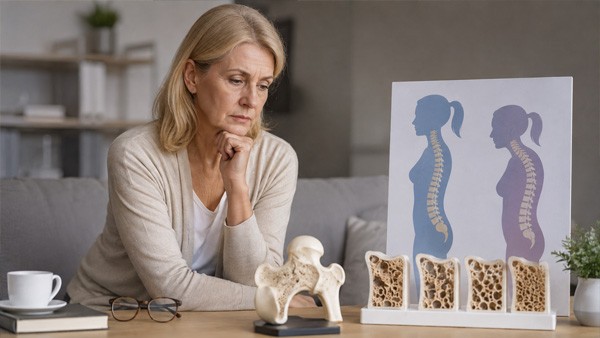
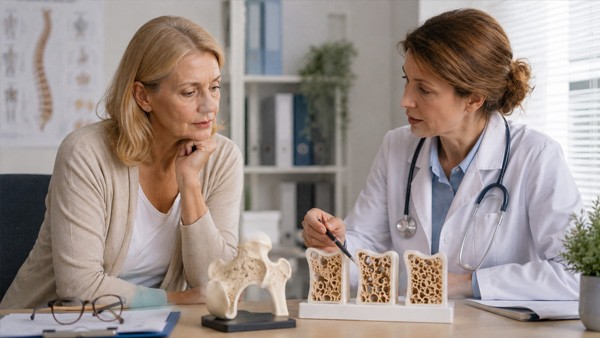
What is lost first is the internal architecture. Bone is not solid but a lattice, and the struts of that lattice thin and then break. Once a strut is gone it cannot be rebuilt, only the remaining ones thickened, which is why prevention before loss occurs is worth more than treatment afterwards.
🗂️ Who is at risk
| Cannot be changed | Can be addressed |
|---|---|
| Female sex | Smoking |
| Age | Alcohol above moderate levels |
| Family history, particularly a parental hip fracture | Low body weight and undernutrition |
| Previous fragility fracture | Physical inactivity |
| Early menopause, before forty-five | Low calcium and vitamin D intake |
| Removal of both ovaries before natural menopause | Falls risk — vision, balance, home hazards, sedating medication |
| Small frame | Untreated coeliac disease or other malabsorption |
| Certain ethnic backgrounds carry higher risk | Untreated overactive thyroid or hyperparathyroidism |
Several medications cause bone loss and are frequently overlooked. Oral corticosteroids taken for months are the most significant, and anyone on them long term should have bone protection considered from the start rather than after a fracture. Aromatase inhibitors for breast cancer, androgen deprivation therapy for prostate cancer, some anti-epileptic drugs, long-term proton pump inhibitors and long-term heparin all contribute.
It is worth noting explicitly that men develop osteoporosis too, later and less often, but with higher mortality after hip fracture. Men on androgen deprivation therapy for prostate cancer are a particularly high-risk group in whom bone density is routinely not checked, a point covered in the guide to hormone therapy for prostate cancer.
🧪 Testing, and what the numbers mean
Bone density is measured by a DEXA scan, a short painless scan of the hip and spine using a very low radiation dose. It produces a T-score comparing bone density with that of a healthy young adult.
| T-score | Meaning |
|---|---|
| Above −1.0 | Normal |
| −1.0 to −2.5 | Osteopenia — reduced density, not yet osteoporosis |
| −2.5 or below | Osteoporosis |
| −2.5 or below with a fracture | Severe or established osteoporosis |
The scan is not the whole picture, and this is where practice has changed considerably. Most fractures actually occur in women with osteopenia rather than osteoporosis, simply because far more women fall into that category. Treating on the basis of the T-score alone therefore misses a large share of the people who will break a bone.
What is used instead is a fracture risk calculator such as FRAX, which combines age, sex, weight, height, previous fracture, parental hip fracture, smoking, steroid use, rheumatoid arthritis, alcohol and other conditions, with or without a bone density result, to estimate the probability of fracture over the next ten years. Treatment decisions are then made on that estimated risk rather than on the scan number in isolation.
This matters practically. A woman told she has osteopenia and nothing more may in fact have a fracture risk warranting treatment, and the way to find out is to ask for a fracture risk assessment rather than accepting the scan category as the answer.
Blood tests are done alongside to exclude secondary causes: calcium, vitamin D, kidney and liver function, thyroid function, and further tests where the picture is unusual, since a proportion of osteoporosis has an underlying cause that is itself treatable.
💊 Treatments that reduce fractures
The measure that matters is fracture prevention rather than improvement in a density number, and treatments differ in which fractures they prevent.
| Treatment | What it does | Notes |
|---|---|---|
| Bisphosphonates (alendronate and relatives) | Slow bone breakdown; reduce spine, hip and other fractures | First-line for most; oral weekly or intravenous yearly |
| Raloxifene | Acts like oestrogen on bone; reduces spinal fractures | Does not reduce hip fracture; increases clot risk and hot flashes; also reduces breast cancer risk |
| Denosumab | Antibody blocking bone breakdown; reduces spine, hip and other fractures | Six-monthly injection; must never simply be stopped — see below |
| Teriparatide and similar | Actively builds new bone rather than slowing loss | Daily injection for a limited period; for severe disease; followed by a bisphosphonate |
| Romosozumab | Both builds bone and slows breakdown | Recent; cardiovascular caution |
| Hormone therapy | Prevents the loss driven by falling oestrogen | Effective for bone; the choice depends on age, time since menopause and other symptoms |
🔴 Denosumab carries a warning that applies to no other osteoporosis drug. If injections are stopped without follow-on treatment, bone breakdown rebounds sharply and multiple spinal fractures can occur within months. It is not a drug that can simply be discontinued, missed or allowed to lapse — stopping requires a planned switch to a bisphosphonate. Anyone on it should know their next injection date and treat it as time-critical.
🔍 Taking a bisphosphonate properly
Alendronate and its relatives are the usual first choice, and the instructions for taking them are unusually specific for a reason: absorption is very poor, and food, drink or calcium in the stomach reduces it to nearly nothing.
- First thing in the morning, on a completely empty stomach
- With a full glass of plain water — not tea, coffee, juice or mineral water
- Stay upright, sitting or standing, for at least thirty minutes, and do not lie down
- Nothing else by mouth for thirty minutes, including other medication and supplements
- Calcium supplements taken well apart, since calcium blocks absorption directly
The upright rule exists because these tablets can irritate the oesophagus if they do not pass through promptly, occasionally causing ulceration. Anyone who develops difficulty or pain on swallowing, or new heartburn, should stop and seek advice. People with certain oesophageal conditions cannot take the oral form and are given the intravenous version instead, which avoids the problem entirely and is a reasonable option for anyone who cannot manage the routine.
⚖️ The side effects people worry about
Two rare complications receive attention out of all proportion to their frequency, and they deter a great many women from treatment that would prevent fractures. Both deserve accurate rather than reassuring or alarming description.
Osteonecrosis of the jaw is an area of exposed bone in the mouth that fails to heal. It occurs overwhelmingly in cancer patients receiving high intravenous doses, and is very rare at the doses used for osteoporosis. Having a dental check before starting, and maintaining dental health during treatment, reduces the risk further. Routine dental work is not a problem; major extractions and implants are worth discussing with both dentist and prescriber.
Atypical femoral fracture is an unusual fracture of the thigh bone associated with long-term use. It is rare, and the risk rises with duration, which is why treatment length is reviewed. The warning sign is a new dull ache in the thigh or groin over weeks — this should be reported, since it can precede the fracture and is treatable at that stage.
Set against these, bisphosphonates prevent a substantial proportion of hip and spinal fractures. Hip fracture in an older woman carries a high risk of permanent loss of independence and a mortality in the following year that is considerably higher than most people realise. The balance of benefit and risk is not close.
⏸️ Treatment holidays
Bisphosphonates are unusual in that they persist in bone after treatment stops, which allows a break.
After roughly five years of oral treatment, or three of intravenous, risk is reassessed. Women whose risk has become lower may pause for a period, with reassessment after a further interval. Those still at high risk — a previous hip or spinal fracture, a very low T-score, ongoing steroid treatment — usually continue.
This applies only to bisphosphonates. Denosumab, as described above, cannot be paused, and the bone-building treatments are given for a defined period followed by something else to hold the gains.
🌸 Hormone therapy and bone
Hormone therapy prevents postmenopausal bone loss effectively, and its role deserves an accurate account, because a generation of women avoided it on the basis of headlines that were subsequently substantially reinterpreted.
The current position is that for women who start hormone therapy before sixty, or within ten years of menopause, the balance of benefit and risk is generally favourable, and bone protection is one of the benefits. It is a particularly reasonable choice for women who also have hot flashes, night sweats or genitourinary symptoms, since one treatment addresses several problems — the vaginal and urinary side of which is covered in the guide to vaginal dryness.
For women with early menopause or premature ovarian insufficiency, hormone therapy is not merely an option but is generally recommended at least until the average age of natural menopause, precisely because of the bone and cardiovascular consequences of many extra years without oestrogen.
Started for the first time many years after menopause, purely for bone protection, the calculation is different and a bisphosphonate is usually the better choice. Bone protection also ends when hormone therapy stops, so it is not a course of treatment in the way a bisphosphonate is.
🥗 Calcium and vitamin D, realistically
These are necessary and are not treatment, and the distinction is frequently blurred.
Vitamin D deficiency should be corrected, because bone cannot mineralise properly without it and because bisphosphonates work poorly in its presence. Deficiency is widespread, particularly in older people, those with limited sun exposure and those with darker skin at higher latitudes.
Calcium is best obtained from food. Dairy, tinned fish with bones, fortified plant milks, tofu set with calcium, and green vegetables all contribute. Where dietary intake is genuinely inadequate a supplement is reasonable.
What supplements do not do is prevent fractures on their own in generally healthy community-dwelling adults. Trials have been consistently disappointing on that point. They support treatment; they are not a substitute for it, and a woman with established osteoporosis taking only calcium and vitamin D is not being treated.
🚶 Exercise, and the part that gets missed
Weight-bearing exercise — walking, jogging, dancing, stair climbing, anything on the feet against gravity — stimulates bone maintenance. Swimming and cycling are excellent for other reasons and do less for bone.
Resistance training loads bone through muscle pull and is at least as important, with the additional benefit of maintaining the muscle strength that prevents falls.
Balance training is the part that gets missed, and it may matter most of all.
Almost every osteoporotic fracture requires a fall. Treating the bone while ignoring the falling addresses half the problem, and falls are more modifiable than bone density in an older person.
| Falls measure | Detail |
|---|---|
| Balance and strength exercise | Tai chi and specific balance programmes have good evidence |
| Vision check | Including caution with varifocal lenses on stairs |
| Medication review | Sedatives, sleeping tablets, some antidepressants and blood pressure drugs all increase falls |
| Home hazards | Loose rugs, trailing cables, poor lighting, missing handrails |
| Footwear | Supportive, fitted, non-slip; not backless slippers |
| Blood pressure on standing | Postural drops are a common and treatable cause of falls |
| Feet | Pain, deformity and nail problems all affect gait |
📋 What to actually do
Before and around menopause — build and protect what you have. Weight-bearing and resistance exercise, adequate calcium and vitamin D, not smoking, moderate alcohol, and maintaining a healthy weight, since being underweight is a genuine risk factor.
Around the time of menopause — if you have hot flashes or other symptoms, the discussion about hormone therapy includes bone benefit. If menopause came early, this is a stronger recommendation rather than an option.
If you have risk factors — early menopause, parental hip fracture, long-term steroids, low body weight, a condition or medication affecting bone — ask about a bone density scan and a fracture risk assessment rather than waiting.
If you have broken a bone from a minor fall after fifty — this is the most important line in the article. Ask directly whether you should be assessed for osteoporosis. Many health systems have fracture liaison services designed for exactly this, and many people who should be referred are not.
If you have been diagnosed — take the treatment as directed, since bisphosphonates in particular fail when taken incorrectly; correct vitamin D; keep up weight-bearing and balance exercise; address falls risk actively; and expect the treatment to be reviewed after a few years rather than continuing unexamined.
✅ Height loss is a symptom worth mentioning. Losing more than about four centimetres from your tallest adult height, or developing a stooped upper back, suggests spinal compression fractures — which frequently occur without any memorable event and without acute pain. They are a strong predictor of further fractures. If your height has dropped noticeably, say so, because it is a finding rather than a normal part of ageing.
Treatment is stocked in the womens health category, including Fosamax (alendronate), the usual first-line bisphosphonate, and Evista (raloxifene). Treatment should follow assessment of fracture risk, and vitamin D status needs correcting before or alongside it.
❓ Frequently asked questions
Why does bone loss speed up at menopause?
Because oestrogen restrains the cells that dissolve old bone, and when it falls those cells become more active while rebuilding does not keep pace. The loss is not gradual — it accelerates sharply in the years around the final period, the fastest rate most women will ever experience, then settles to a slower ongoing decline. What is lost first is the internal lattice structure, and broken struts cannot be rebuilt.
I broke my wrist in a fall. Does that mean anything?
A great deal. A bone broken in a fall from standing height, in anyone over fifty, is a fragility fracture and indicates osteoporosis regardless of what a scan shows. It is also the strongest single predictor of the next fracture, and roughly half of hip fractures are preceded by an earlier one nobody acted on. Ask directly whether you should be assessed — many people who should be referred are not.
My scan said osteopenia, so I do not need treatment?
Not necessarily, and this is where practice has changed. Most fractures actually occur in women with osteopenia rather than osteoporosis, simply because far more women are in that category. Decisions are now made on estimated ten-year fracture risk using a calculator such as FRAX, which combines age, weight, previous fracture, family history, steroids and other factors. Ask for a fracture risk assessment rather than accepting the scan category as the answer.
Why are the instructions for alendronate so strict?
Because absorption is very poor and almost anything in the stomach reduces it to nearly nothing. First thing in the morning, empty stomach, a full glass of plain water, nothing else by mouth for thirty minutes, and stay upright throughout. The upright rule exists because the tablet can irritate the oesophagus if it lingers. Taken incorrectly the drug simply does not work, which is a common reason treatment appears to fail.
Are bisphosphonates dangerous for the jaw?
Osteonecrosis of the jaw is very rare at osteoporosis doses — it occurs overwhelmingly in cancer patients receiving high intravenous doses. A dental check before starting and good dental health during treatment reduce the risk further. Routine dental work is not a problem; major extractions and implants are worth discussing. Set against a substantial reduction in hip and spinal fractures, the balance is not close.
What is an atypical femoral fracture?
An unusual fracture of the thigh bone associated with long-term bisphosphonate use. It is rare and the risk rises with duration, which is one reason treatment length is reviewed after several years. The warning sign is a new dull ache in the thigh or groin developing over weeks, and it should be reported because it can precede the fracture and is treatable at that stage.
Can I stop treatment after a few years?
With bisphosphonates, often yes. They persist in bone after treatment ends, so after roughly five years of oral treatment risk is reassessed and a pause may be reasonable for those whose risk has fallen. Women with a previous hip or spinal fracture, a very low T-score or ongoing steroid treatment usually continue. This applies only to bisphosphonates — denosumab cannot be paused.
Why is stopping denosumab a problem?
Because bone breakdown rebounds sharply when it is withdrawn, and multiple spinal fractures can occur within months. It is the one osteoporosis treatment that cannot simply be discontinued, missed or allowed to lapse — stopping requires a planned switch to a bisphosphonate. Anyone taking it should know their next injection date and treat it as time-critical rather than flexible.
Does HRT protect bones?
Yes, effectively. For women starting before sixty or within ten years of menopause the overall balance of benefit and risk is generally favourable, and bone protection is among the benefits — particularly reasonable where hot flashes or genitourinary symptoms are also present. For early menopause it is generally recommended at least until the average age of natural menopause. Protection ends when it stops, so it works differently from a bisphosphonate.
Are calcium and vitamin D supplements enough?
No. They are necessary rather than sufficient. Vitamin D deficiency must be corrected because bone cannot mineralise without it and because bisphosphonates work poorly in its presence, and calcium is best obtained from food. But trials have consistently found that supplements alone do not prevent fractures in generally healthy adults. Someone with established osteoporosis taking only calcium and vitamin D is not being treated.
Which exercise actually helps bone?
Weight-bearing activity on the feet against gravity — walking, jogging, dancing, stairs — and resistance training, which loads bone through muscle pull and maintains the strength that prevents falls. Swimming and cycling are excellent for other reasons and do little for bone. Balance training is the part most often missed and may matter most, since almost every osteoporotic fracture requires a fall.
I have lost height. Is that significant?
Yes, and it is worth mentioning specifically. Losing more than about four centimetres from your tallest adult height, or developing a stooped upper back, suggests spinal compression fractures — which frequently happen without any memorable event and without acute pain. They strongly predict further fractures. Height loss is a clinical finding rather than a normal part of ageing.
📑 Sources and editorial
- NICE guidance on osteoporosis assessment and on fragility fracture risk
- FRAX fracture risk assessment tool and its validation literature
- Endocrine Society and North American Menopause Society position statements on postmenopausal osteoporosis and hormone therapy
- Evidence on rebound vertebral fractures following denosumab discontinuation
- Trial and registry data on osteonecrosis of the jaw and atypical femoral fracture incidence at osteoporosis doses
- Cochrane reviews of calcium and vitamin D supplementation for fracture prevention and of exercise for falls prevention
- FDA prescribing information for alendronate, raloxifene and denosumab
- Related reading: vaginal dryness, hormone therapy for prostate cancer
- Related products: womens health category
- RXshop Editorial Team — reviewed by Anita Sharma, MD, FACOG, Obstetrics and Gynecology
Medical Disclaimer: The information in this article is for educational and informational purposes only and is not a substitute for professional medical advice, diagnosis, or treatment. Always seek guidance from a qualified healthcare provider with any questions you may have regarding a medical condition, and before starting, stopping or changing any medication.