Solar Keratoses: The Rough Patches You Feel Before You See

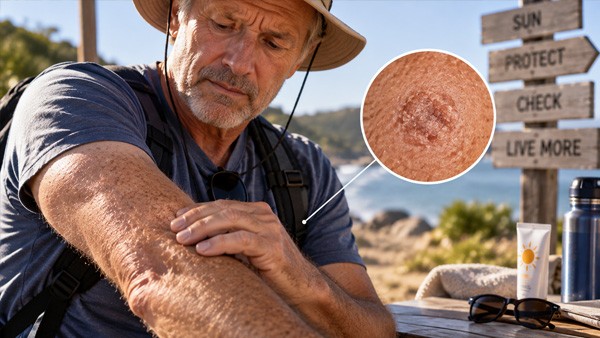
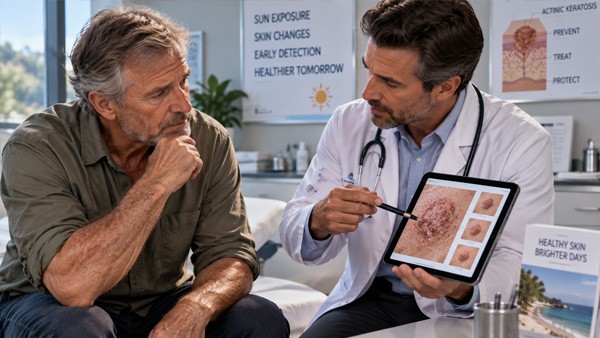
There is a small rough patch on the side of the forehead. It flakes, it comes off if you pick at it, and within a few weeks it is back in exactly the same place. It has been doing this for a year or two and nobody has looked at it, because it is small, it does not hurt, and it looks like dry skin.
It is not dry skin. It is a solar keratosis, it is the earliest visible stage of skin cancer development, and the reason to deal with it is that it is trivially treatable now and considerably less so later.
🖐️ These are found with fingertips rather than with eyes, and that is the single most useful practical fact about them.
The characteristic feature is texture. They feel rough, dry and gritty — like fine sandpaper — and very often they can be felt clearly before there is anything obvious to see. Someone examining their own skin visually in a mirror will miss most of them. Someone running fingertips slowly over the forehead, temples, ears, scalp and backs of the hands will find them.
Do that occasionally, in good light, and pay particular attention to the places people forget they have: the tops of the ears, the bald or thinning part of the scalp, the lower lip, and the back of the neck.
🔎 What they look like and where they appear
| Feature | Detail |
|---|---|
| Texture | Rough and gritty, like sandpaper. Frequently felt before seen |
| Size | Usually a few millimetres, occasionally larger |
| Colour | Skin-coloured, pink, red or brownish, sometimes with a yellowish crust |
| Behaviour | Flakes off and returns in the same place. This recurrence is characteristic |
| Sensation | Usually none, sometimes mild itching or a prickle when touched |
| Where | Face, temples, ears, bald scalp, backs of hands, forearms, lower legs, and the lower lip |
| Number | Rarely one. Where there is a single lesion there are usually others not yet visible |
The lower lip deserves separate mention. Roughness, persistent dryness, loss of the sharp border between lip and skin, or a patch that will not heal there is a form that carries a higher rate of progression than lesions elsewhere. It is frequently dismissed as chapping and treated with lip balm for years.
⚠️ Why they matter, and why one at a time is the wrong approach
Any individual lesion has only a small chance of becoming a cancer in any given year. That sounds reassuring and is misleading, because people do not have one lesion for one year — they have many, over decades. Accumulated across that, the risk becomes substantial, and a large proportion of the commonest form of skin cancer arises from or beside one of these.
Which leads to the concept that governs treatment. The visible patches are not the problem; they are the visible part of it. The surrounding skin has received the same lifetime of ultraviolet exposure and carries the same damage, with further lesions in the process of forming below the threshold of visibility.
That is why freezing off the three you can see gives a good result for six months and a disappointing one after two years. Where lesions are numerous, treating the whole area rather than the individual spots produces better long-term outcomes, and it is worth asking about specifically.
🔴 Signs that a lesion is no longer just a keratosis, and needs assessment without delay:
- Thickening — it feels firm or lumpy rather than just rough
- Tenderness or pain on pressing, where before there was none
- Bleeding, spontaneously or from minor contact
- Ulceration, or a sore that will not heal
- Rapid growth, or a clear increase in size
- Failure to respond to treatment that cleared the others
- Any lesion on the lip or ear that changes
Caught at this point the outcome is generally excellent. The problem is almost never that the cancer was untreatable; it is that nobody looked at it for two years.
💊 The medicines that raise the risk
This is the part that is genuinely under-communicated, and some of it applies to medicines taken daily by millions of people.
Hydrochlorothiazide, one of the most widely used blood pressure and fluid tablets in the world, has been linked to an increased risk of non-melanoma skin cancer, with the risk rising with cumulative dose over years. Regulators reviewed the evidence and required product information to be updated accordingly. It appears alone and inside several combination blood pressure tablets, so people often do not know they are taking it.
This is not a reason to stop a blood pressure medicine, which protects against considerably more likely harms. It is a reason to protect the skin properly and check it regularly if you take it long term, and to raise the question if you already have extensive sun damage. The article on blood pressure treatment covers the wider set of considerations with these drugs.
Drugs that make skin burn more easily compound ordinary sun exposure. The commonest are the tetracycline antibiotics, particularly doxycycline, taken for months at a time for acne; the anti-inflammatory piroxicam; retinoids; amiodarone; certain antifungals; and the herbal remedy St John of Jerusalem wort. On any of these, a sun exposure that would previously have been harmless can produce a burn.
Anything suppressing the immune system raises the risk substantially — long-term steroid tablets, as discussed in the article on cortisol, and far more so the medication taken after an organ transplant, where the increase in skin cancer risk is measured in multiples rather than percentages and lesions behave more aggressively. Anyone in that group needs regular dermatological review rather than occasional self-examination.
🧴 What treatment involves
| Approach | Where it fits |
|---|---|
| Freezing | Quick and effective for a small number of discrete lesions. Stings, then blisters and scabs, healing over a week or two. Can leave a pale mark |
| Imiquimod cream | Field treatment. Provokes the immune system to recognise and clear abnormal cells, including ones not yet visible. Applied over weeks |
| Fluorouracil cream | Field treatment that destroys rapidly dividing cells directly. Effective and produces a marked reaction |
| Diclofenac gel | Field treatment, gentler and slower, applied over two to three months. Suits people who cannot tolerate a strong reaction |
| Photodynamic therapy | A light-activated treatment applied in clinic. Good cosmetic results, and painful during the session |
| Scraping or excision | For thickened lesions, or where the diagnosis needs confirming under the microscope |
⚠️ Expect the treated area to look worse before it looks better, and know that this is the treatment working rather than a reaction to it.
With the cream treatments the area becomes red, then sore, then crusted and eroded, typically peaking around the second or third week. It can look alarming, and it frequently appears over a wider area than the lesions did — which is exactly the point, because the reaction maps out the damaged skin that was not yet visible.
People stop at this stage constantly, and stopping early means an incomplete result. It settles within a few weeks of finishing the course and the skin generally ends up better than it started. Ask beforehand what reaction to expect and at what point it would be excessive, so the decision to continue is not made in a mirror at week two.
☀️ Prevention that works after the damage is done
The natural assumption is that decades of sun exposure are already accounted for and protecting now is closing the gate too late. That assumption is wrong, and there is trial evidence against it.
Daily sunscreen use has been shown in controlled trials to reduce the number of new keratoses and the incidence of the commonest skin cancer, with benefits still detectable years after the trial ended. Protecting damaged skin reduces further damage regardless of what has already accumulated.
What that means practically: broad-spectrum protection applied daily on the face, ears, neck and hands rather than only on holidays — most cumulative exposure comes from ordinary days rather than beach days. A hat with a brim wide enough to shade the ears, since the ears are among the commonest sites and the ones people never protect. Long sleeves for outdoor work. And attention to the reflected exposure from water, snow and pale surfaces.
Sunbeds add avoidable exposure to skin that has already had enough.
🩺 When to seek help
- A sore that has not healed in a month — on sun-exposed skin, this is the single most important sign
- A lesion that has thickened, become tender, or started bleeding — prompt assessment
- Rapid growth of any skin lesion
- A rough or persistent patch on the lower lip — higher risk than elsewhere, and commonly mistaken for chapping
- Numerous rough patches across an area — ask about treating the field rather than individual spots
- Any skin change after an organ transplant or on long-term immune-suppressing medication — low threshold, and regular review
- Long-term hydrochlorothiazide with extensive sun damage — worth raising, without stopping the medicine yourself
- Burning much more easily than you used to — check whether a medicine is responsible
- A treated lesion that has come back in the same place
Field treatment is stocked as Aldara (imiquimod), which works by prompting the immune system to clear abnormal cells across an area rather than only where lesions are visible. Retin-A (tretinoin) and Tretiheal address the wider photodamage in which these lesions arise, and Actoid (acitretin) is used under specialist supervision for people at very high risk. Diagnosis should be confirmed before treating — several other conditions look similar, and anything thickened or ulcerated needs examining rather than creaming.
❓ Frequently asked questions
Is a solar keratosis cancer?
Not yet. It is the earliest visible stage of skin cancer development — abnormal cells confined to the surface layer. Any individual lesion has a small chance of progressing in a given year, which sounds reassuring but is misleading, because people have many lesions over decades and a large share of the commonest skin cancer arises from or beside one.
How do I tell one from dry skin?
By texture and behaviour. A keratosis feels rough and gritty like fine sandpaper, and it flakes off and returns in exactly the same place, repeatedly, over months. Dry skin moves around and responds to moisturiser. Run your fingertips slowly over forehead, temples, ears, scalp and the backs of the hands — these are usually felt before they can be seen.
Why treat the whole area rather than the spots?
Because the visible patches are the visible part of a larger problem. The surrounding skin has had the same lifetime of ultraviolet exposure and carries the same damage, with further lesions forming below the threshold of visibility. Freezing the three you can see works well for six months and disappoints after two years. Where lesions are numerous, treating the field produces better long-term results.
What warning signs mean it has become cancer?
Thickening so that it feels firm or lumpy rather than just rough, tenderness where there was none, bleeding, ulceration or a sore that will not heal, rapid growth, and failure to respond to treatment that cleared the others. Any lesion on the lip or ear that changes deserves particular attention. Caught at this stage the outcome is usually excellent.
Can my blood pressure tablet increase skin cancer risk?
Hydrochlorothiazide has been linked to an increased risk of non-melanoma skin cancer, rising with cumulative dose over years, and regulators required product information to be updated. It appears alone and inside several combination tablets, so many people do not know they take it. This is not a reason to stop — it is a reason to protect your skin properly and check it regularly, and to raise it if you already have extensive sun damage.
Which medicines make me burn more easily?
Tetracycline antibiotics, particularly doxycycline taken for months for acne, are the commonest. Also the anti-inflammatory piroxicam, retinoids, amiodarone, certain antifungals, thiazide diuretics and St John of Jerusalem wort. On any of these an exposure that would previously have been harmless can cause a burn, so protection needs to be more careful rather than the same as before.
The cream made my face look terrible. Should I stop?
Usually not, because that reaction is the treatment working. The area becomes red, then sore, crusted and eroded, peaking around the second or third week, and it often appears over a wider area than the lesions did — which is exactly the point, since the reaction maps the damaged skin that was not yet visible. Stopping early gives an incomplete result. Ask beforehand what reaction to expect and what would count as excessive.
Is sunscreen still worth it after decades of sun?
Yes, and this is one of the more encouraging findings here. Controlled trials show daily sunscreen use reduces the number of new keratoses and the incidence of the commonest skin cancer, with benefits still detectable years after the trial ended. Protecting damaged skin reduces further damage regardless of what has accumulated. Daily on face, ears, neck and hands matters more than holiday application.
Why do my ears keep getting them?
Because the tops of the ears receive substantial sun exposure and almost nobody protects them. The same applies to the bald or thinning scalp, the back of the neck and the lower lip. A hat needs a brim wide enough to shade the ears rather than only the face, and sunscreen needs to go on them deliberately, since it is the one spot people consistently skip.
Who is at highest risk?
People taking medication that suppresses the immune system, and organ transplant recipients most of all — their skin cancer risk is increased by multiples rather than percentages, and lesions behave more aggressively. That group needs regular dermatological review rather than occasional self-examination. Long-term steroid tablets raise the risk too, though far less.
📑 Sources and editorial
- Literature on actinic keratosis prevalence, natural history and rates of progression to squamous cell carcinoma
- Evidence on field cancerisation and comparative outcomes of lesion-directed versus field-directed treatment
- Literature on actinic cheilitis and its higher rate of malignant transformation
- Regulatory reviews concluding an association between cumulative hydrochlorothiazide exposure and non-melanoma skin cancer
- Pharmacological literature on drug-induced photosensitivity by class
- Data on skin cancer incidence in organ transplant recipients and other immunosuppressed groups
- Comparative evidence on cryotherapy, topical fluorouracil, imiquimod, diclofenac gel and photodynamic therapy
- Literature on expected local skin reactions during topical field treatment and on treatment discontinuation
- Randomised trial evidence for daily sunscreen in reducing actinic keratosis counts and squamous cell carcinoma incidence, including long-term follow-up
- Guidance on clinical features requiring biopsy or urgent referral
- Related reading: blood pressure treatment considerations, long-term steroid effects, retinoids and tetracyclines
- Related products: skin care category
- RXshop Editorial Team — reviewed by Emily Chen, MD, Internal Medicine
Medical Disclaimer: The information in this article is for educational and informational purposes only and is not a substitute for professional medical advice, diagnosis, or treatment. Always seek guidance from a qualified healthcare provider with any questions you may have regarding a medical condition, and before starting, stopping or changing any medication.