Sun Damage and Skin Cancer: How to Check a Mole, Spot Basal Cell Carcinoma and Know When to Worry

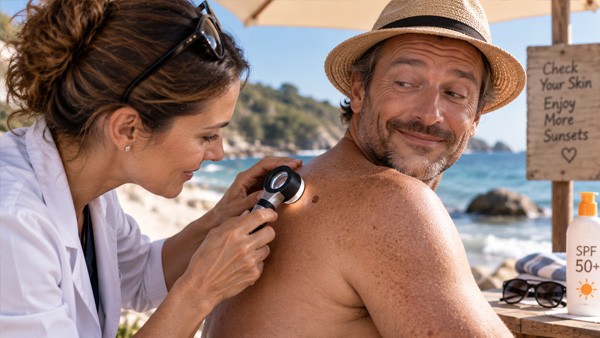

Sunlight gives us vitamin D and a good mood, but the ultraviolet part of it damages the DNA in skin cells. Most of that damage is repaired. Over years and decades, some of it is not, and the result is the most common cancer in the world: skin cancer.
The encouraging part is that skin cancer is visible. It grows on the surface, where you and your doctor can see it, and almost all skin cancers are curable when found early. Knowing what to look for is genuinely life-saving, especially for melanoma.
This guide explains the main types of skin cancer, how to check your moles and skin, what treatment involves, and how to protect yourself from further damage.

☀️ How the sun damages skin
Ultraviolet light comes in two forms that matter for skin. UVB causes sunburn and most direct DNA damage. UVA passes deeper, through clouds and window glass, and drives ageing and also contributes to cancer. Sunbeds give out mostly UVA, at doses stronger than midday sun.
Damage builds in two patterns. Years of steady exposure, such as outdoor work, is linked to basal and squamous cell cancers on the face, ears, scalp and hands. Intermittent intense exposure and blistering sunburns, especially in childhood, are strongly linked to melanoma.
| Early sign of sun damage | What it means |
|---|---|
| Freckles and sun spots | Harmless signs of exposure |
| Wrinkles, leathery texture, broken veins | Photoageing; covered in our guide to collagen and skin ageing |
| Rough, scaly patches | Actinic (solar) keratoses, which can turn into squamous cell cancer; see our solar keratoses guide |
| Rash after sun exposure | Often a sun allergy, explained in our guide to sun allergy |
🔬 The three main types of skin cancer
| Type | How common | Typical look | Behaviour |
|---|---|---|---|
| Basal cell carcinoma | The most common | A pearly or shiny bump, often with tiny blood vessels; or a sore that bleeds, scabs and never fully heals | Grows slowly and almost never spreads, but can damage surrounding tissue if left |
| Squamous cell carcinoma | Second most common | A firm, scaly, crusted lump, sometimes tender, on sun-exposed skin | Can spread if untreated, especially on the lips and ears |
| Melanoma | Less common | A new or changing mole, often dark and irregular | Can spread early; the most dangerous, but highly curable if thin when removed |
🔍 Checking moles: ABCDE
📋 See a doctor about any mole that shows one of these:
- A — Asymmetry: one half does not match the other
- B — Border: ragged, notched or blurred edge
- C — Colour: several shades of brown, black, red, white or blue
- D — Diameter: larger than about 6 mm, although melanomas can be smaller
- E — Evolving: changing in size, shape, colour or height, or new itching or bleeding
The E matters most. A mole that is changing, or a new mole that looks different from all your others, deserves a check even if it passes the other letters. Doctors call this the ugly duckling sign.
New moles are common until about 30. A new mole appearing after that age, or any mole that bleeds without injury, should be looked at.
🪞 How to check your skin
A monthly self-check takes ten minutes and works best in good light with a full-length mirror and a hand mirror.
- Look at your face, ears, lips, neck and scalp; use a hairdryer or ask someone to check the scalp
- Check your chest, abdomen and, for women, under the breasts
- Raise your arms and look at the underarms, both sides of the arms and hands, including palms and nails
- Check your back, buttocks and the backs of your legs with the hand mirror
- Look at your legs, feet, soles and between the toes
Taking phone photos of moles makes it much easier to spot change over time. Melanoma in people with darker skin often appears on the palms, soles and under the nails, so check those areas carefully.
⚠️ Who is at higher risk
- 🧑🦰 Fair skin that burns easily, red or blond hair, light eyes
- 🟤 Many moles (more than about 50) or unusual-looking moles
- 🔥 History of blistering sunburns, especially in childhood
- 🛏️ Sunbed use, particularly before 35
- 👨👩👧 Family history of melanoma
- 🏗️ Outdoor work or living in a sunny climate
- 💊 Weakened immunity, such as after an organ transplant
- 📋 A previous skin cancer
Some medicines make skin more sensitive to the sun, including doxycycline, some diuretics and certain acne treatments. People taking them need extra protection.
🏥 How skin cancer is treated
A suspicious spot is usually examined with a dermatoscope, a magnifying light, and then removed or sampled. Treatment depends on the type, size and position.
| Treatment | Used for |
|---|---|
| Surgical removal | The standard for most skin cancers and all melanomas |
| Mohs surgery | Layer-by-layer removal for cancers on the face, preserving healthy skin |
| Imiquimod cream | Superficial basal cell carcinoma and actinic keratoses, where surgery is not preferred |
| Freezing, scraping and light therapy | Small superficial cancers and pre-cancers |
| Immunotherapy and targeted drugs | Advanced melanoma and other cancers that have spread |
🧴 Imiquimod cream for superficial basal cell carcinoma
Imiquimod stimulates the skin's own immune system to destroy abnormal cells. For small superficial basal cell carcinomas, confirmed by a doctor, it is typically applied five days a week for six weeks. For actinic keratoses, a shorter or less frequent schedule is used.
- Redness, crusting and soreness at the treated area are expected and show it is working
- Flu-like symptoms occasionally occur
- Apply at bedtime and wash off after about eight hours
- Follow-up is essential to confirm the cancer has cleared
Imiquimod is available as Aldara (Imiquad). It is not suitable for melanoma, nodular or deep basal cell carcinoma, or any lesion that has not been diagnosed by a doctor.
🛡️ Protecting your skin
- Shade and timing
- Seek shade when the UV index is 3 or higher, usually from late morning to mid-afternoon. If your shadow is shorter than you are, the sun is strong.
- Clothing
- A broad-brimmed hat, sunglasses and long sleeves protect better than any cream.
- Sunscreen
- Broad-spectrum, SPF 30 or higher, applied generously 15 minutes before going out and reapplied every two hours and after swimming. Most people use about half the amount needed.
- No sunbeds
- There is no safe level of sunbed use.
- Protect children
- Babies under six months should be kept out of direct sun. Avoiding childhood sunburn has the greatest lifelong benefit.
People who spend little time outdoors and cover up may need vitamin D from food or supplements, which is safer than getting it from sunburn.
🔥 Treating sunburn
Get out of the sun, cool the skin with a cool shower or damp cloth, use a gentle moisturiser or aloe gel, drink plenty of water, and take paracetamol or ibuprofen for pain. Do not pop blisters. Seek medical help for widespread blistering, fever, chills, confusion or dehydration, especially in children. Every serious sunburn raises lifelong skin cancer risk, which is the real reason to prevent it.
📞 When to see a doctor
- A mole that is changing, bleeding, itching or looks different from the others
- A new mole after age 30
- A sore that does not heal within four weeks
- A pearly or shiny bump, or a scaly lump that grows
- A dark streak under a nail without injury
- Many moles or a family history of melanoma — ask about regular skin checks
❓ Frequently asked questions
What does skin cancer look like at first?
Basal cell carcinoma often looks like a pearly bump or a sore that does not heal. Squamous cell carcinoma looks like a firm, scaly or crusted lump. Melanoma usually appears as a new or changing mole with irregular shape or colour.
What does ABCDE mean for moles?
Asymmetry, irregular Border, several Colours, Diameter over about 6 mm, and Evolving, meaning change over time. Any of these, especially change, is a reason to see a doctor.
Is a new mole after 30 a concern?
New moles are common until about 30. A new mole appearing later, or one that looks different from your other moles, should be checked by a doctor.
Can basal cell carcinoma be treated with cream?
Small superficial basal cell carcinomas confirmed by a doctor can be treated with imiquimod cream, usually five days a week for six weeks. Deeper types and melanoma need surgery.
Does sunburn cause skin cancer?
Sunburn, especially blistering sunburn in childhood, is strongly linked to melanoma. Long-term steady sun exposure is linked to basal and squamous cell cancers.
Are sunbeds safer than the sun?
No. Sunbeds give out strong UVA and raise the risk of melanoma, particularly when used before 35. There is no safe level of sunbed use.
What SPF should I use?
A broad-spectrum sunscreen of SPF 30 or higher, applied generously and reapplied every two hours and after swimming. Shade, hats and clothing protect even better.
Can people with dark skin get skin cancer?
Yes, though less often. Melanoma in darker skin often appears on the palms, soles and under the nails, and is sometimes diagnosed later, so checking those areas matters.
Which medicines make skin more sensitive to the sun?
Examples include doxycycline and other tetracyclines, some diuretics, certain acne treatments such as retinoids, and some anti-inflammatory drugs. Extra sun protection is needed while taking them.
Is skin cancer curable?
Almost all basal and squamous cell cancers are cured by treatment, and melanoma found early, while still thin, has an excellent outlook. Early detection is what makes the difference.
📑 Sources and editorial
- Guidelines on the diagnosis and management of melanoma, basal cell carcinoma and squamous cell carcinoma
- Public health guidance on ultraviolet radiation, sun protection and sunbeds
- Prescribing information for imiquimod cream in superficial basal cell carcinoma and actinic keratosis
- Studies on sunburn history and melanoma risk
- Related reading: solar keratoses, sun allergy, collagen and skin ageing
- Related products: Aldara (Imiquad), skin care category
- RXshop Editorial Team — reviewed by Emily Chen, MD, Internal Medicine
Medical Disclaimer: The information in this article is for educational and informational purposes only and is not a substitute for professional medical advice, diagnosis, or treatment. Always seek guidance from a qualified healthcare provider with any questions you may have regarding a medical condition, and before starting, stopping or changing any medication.