Azithromycin: What It Treats and What It Does Not

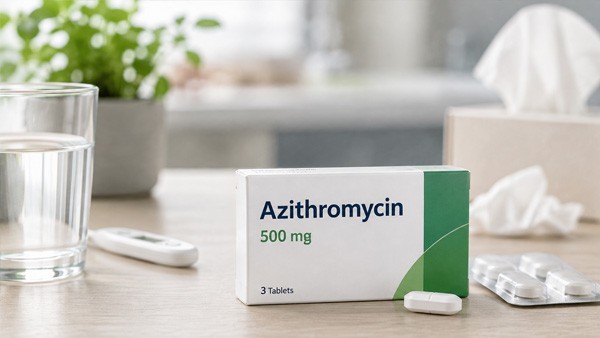

Azithromycin is unusual among antibiotics. A three-day course produces tissue levels lasting a week or more, it is taken once daily, and it covers organisms that penicillins cannot touch. Those properties made it enormously popular, and that popularity is now its main problem: it has been prescribed for a great many conditions it does not treat, and resistance has risen accordingly.
This guide sets out where it genuinely works, where better options have replaced it, and the two safety issues — cardiac and microbiological — that determine how it should be used.
🧠 Why the course is so short, which confuses almost everyone who takes it: azithromycin concentrates inside tissue and inside the white cells that migrate to infection sites, reaching levels many times higher than in the blood, and it leaves slowly — the elimination half-life is around two to three days. So a three-day course keeps working for roughly a week afterwards. Finishing the tablets does not mean the treatment has ended, and this is why it is not comparable to a ten-day course of another antibiotic.
🧬 What it is and how it works
Azithromycin belongs to the macrolide class, alongside erythromycin and clarithromycin. It binds to the bacterial ribosome and blocks protein synthesis, which stops bacteria multiplying rather than killing them outright in most situations.
It was developed from erythromycin with two modifications that changed how it behaves: far better stomach acid stability, so more survives to be absorbed, and much greater tissue penetration and persistence. That is what allows once-daily dosing and short courses.
Its spectrum covers many respiratory pathogens, several sexually transmitted organisms, and crucially the atypical bacteria — Mycoplasma, Chlamydophila and Legionella — which live inside human cells and are entirely unaffected by penicillins and cephalosporins. That gap in the beta-lactam spectrum is the main reason macrolides exist in respiratory medicine.
✅ Where it genuinely belongs
| Indication | Role |
|---|---|
| Community-acquired pneumonia | Covers atypical organisms; usually combined with a beta-lactam in moderate to severe cases rather than used alone |
| Mycoplasma and Legionella infection | A first-choice agent, since these organisms do not respond to penicillins at all |
| Whooping cough | First-line, both for treatment and for protecting close contacts |
| Travellers diarrhoea | Preferred where Campylobacter is likely, particularly in South and South-East Asia where fluoroquinolone resistance is high |
| Chlamydial infection | Still used, though doxycycline has largely replaced it as first choice — see below |
| Trachoma | Single-dose mass administration in endemic regions; a genuine public health success |
| Cholera | An option, including in children and pregnancy |
| Mycobacterium avium complex | Part of prophylaxis and treatment in advanced HIV and in some lung disease |
| Bronchiectasis and severe COPD | Long-term low-dose treatment reduces exacerbations in carefully selected patients |
| Cystic fibrosis | Long-term use improves lung function in some patients, through anti-inflammatory as well as antibacterial effects |
| Genuine penicillin allergy | An alternative for strep throat and otitis media where penicillins cannot be used |
The long-term low-dose uses are worth noting because they work differently. In bronchiectasis, COPD and cystic fibrosis, part of the benefit appears to come from anti-inflammatory and immune-modulating effects rather than from killing bacteria — macrolides reduce airway inflammation and mucus production independently of infection.
❌ Where it does not belong
This section matters more than the previous one, because inappropriate use is both common and consequential.
| Condition | Why azithromycin is not the answer |
|---|---|
| Colds, flu and most sore throats | Viral. No antibiotic helps, and side effects and resistance follow for nothing |
| Acute bronchitis | Viral in the great majority; antibiotics shorten the cough by a negligible amount |
| Helicobacter pylori | Performs poorly against this organism and appears in no standard eradication regimen. Clarithromycin is the macrolide used, and only within specific combinations |
| Streptococcal sore throat, first-line | Penicillin remains first choice; group A streptococcus has never developed penicillin resistance, while macrolide resistance is substantial in many regions |
| Acute otitis media, first-line | Amoxicillin is first choice; azithromycin is less effective against Haemophilus influenzae |
| Ordinary urinary tract infection | Wrong spectrum and wrong tissue distribution entirely |
| Gonorrhoea, alone | Resistance has made single-agent macrolide treatment unreliable; injectable ceftriaxone is the treatment |
| COVID-19 | Trialled extensively during the pandemic and found ineffective; widespread use drove resistance without benefit |
| Lyme disease, first-line | Doxycycline and amoxicillin are preferred; macrolides perform less well |
⚠️ On chlamydial infection specifically: a single dose of azithromycin was the standard treatment for years and has been superseded. Trials found higher microbiological failure with single-dose azithromycin than with a seven-day course of doxycycline, particularly for rectal infection which frequently coexists with genital infection unnoticed. Single-dose macrolide treatment also contributed to the macrolide resistance now widespread in Mycoplasma genitalium. Azithromycin retains a role, including in pregnancy where doxycycline cannot be used, but it is no longer the default.
🧫 Resistance
Macrolide resistance is not a distant theoretical concern in this case, and understanding why explains the change in prescribing.
Because azithromycin persists at low levels in tissue for a week or more after the last tablet, there is a prolonged period during which bacteria are exposed to concentrations too low to kill them but high enough to select for resistant strains. That is close to an ideal arrangement for breeding resistance, and it is a direct consequence of the pharmacology that makes short courses possible.
The results are visible. Macrolide resistance rates in Streptococcus pneumoniae and group A streptococcus are substantial in many countries, and in Mycoplasma genitalium resistance has risen to the point where treatment often requires testing for it first. In some regions macrolides are no longer relied on empirically for infections they once covered reliably.
The practical implications for an individual are straightforward: azithromycin should be used where it is indicated rather than as a general-purpose antibiotic, and repeated courses within a short period are a reason to reconsider rather than to repeat.
🫀 The cardiac question
Azithromycin can prolong the QT interval, a measure of the heart electrical recovery, and in rare cases this leads to a dangerous rhythm disturbance. Regulators issued warnings about this after studies suggested a small increase in cardiovascular deaths during treatment.
The absolute risk in a healthy person is very low. It becomes clinically relevant in specific circumstances:
- Existing QT prolongation, whether congenital or acquired
- Other QT-prolonging medication — certain antiarrhythmics, some antipsychotics and antidepressants, some antifungals and antiemetics, and other macrolides and fluoroquinolones
- Low potassium or magnesium, which frequently accompany vomiting, diarrhoea or diuretic use
- Significant heart disease, heart failure or a slow heart rate
- Older age, and being female, both of which slightly increase susceptibility
Where several of these coexist, an alternative antibiotic is usually chosen. For most people taking a short course with no cardiac history, this is a caution to be aware of rather than a reason to avoid the drug.
💊 Taking it properly
Tablets can be taken with or without food. Taking them with food reduces stomach upset and does not meaningfully reduce absorption. The oral suspension behaves differently and should follow the specific instructions supplied with it.
Antacids matter. Aluminium and magnesium-containing antacids reduce peak absorption, so they should be separated from the dose by at least two hours. Proton pump inhibitors and H2 blockers do not have the same effect.
Take it at the same time each day for the duration of the course, whether that is three days or five.
Complete the course as prescribed — and note that with azithromycin, unusually, the course is deliberately short and the drug continues working afterwards. People who feel better on day two and stop have still had most of the exposure, but people who assume three days cannot be enough and seek more are misunderstanding the pharmacology.
Do not crush or split unless the specific product is designed for it.
⚠️ Side effects
| Effect | Notes |
|---|---|
| Nausea, abdominal pain, diarrhoea | The commonest by far; taking with food helps; usually mild and self-limiting |
| Altered taste | Common and temporary |
| Headache and dizziness | Occasional |
| Rash | Usually mild; a rash with fever, blistering or mucosal involvement requires urgent assessment |
| Clostridioides difficile infection | Persistent watery diarrhoea during or after treatment, sometimes weeks later, needs prompt medical attention |
| Liver injury | Rare; jaundice, dark urine, pale stools or right-sided abdominal pain warrants stopping and being assessed |
| Hearing changes | Reported mainly with prolonged high-dose use; usually reversible on stopping |
| Heart rhythm disturbance | Rare; see the section above |
🔴 Diarrhoea during or after an antibiotic course is not always a simple side effect. Persistent watery diarrhoea, particularly with abdominal pain or fever, and particularly if it begins after the course has finished, can indicate Clostridioides difficile infection. It can appear up to a couple of months later. Do not treat it with anti-diarrhoeal medication, which makes it worse — seek medical assessment.
🔗 Interactions
Antacids containing aluminium or magnesium reduce absorption and should be separated by at least two hours.
QT-prolonging drugs combine additively, as described above. This includes some antiarrhythmics, antipsychotics, antidepressants, antifungals, antiemetics and other antibiotics.
Warfarin levels may be affected, and closer monitoring is sensible during and shortly after a course.
Statins interact less with azithromycin than with clarithromycin, which is a meaningful advantage of choosing it within the class where a statin is being taken.
Ciclosporin and digoxin levels can rise, requiring attention in transplant patients and in those on digoxin.
Azithromycin is generally cleaner in this respect than other macrolides, since it has much less effect on the liver enzyme systems that clarithromycin and erythromycin interfere with.
🤰 Specific groups
Pregnancy — azithromycin is one of the antibiotics considered acceptable in pregnancy where indicated, and it is used for chlamydial infection in pregnancy precisely because doxycycline cannot be.
Breastfeeding — generally regarded as compatible, with small amounts appearing in milk.
Children — widely used, dosed by weight, and first-line for whooping cough.
Liver disease — caution, since the liver clears it; significant impairment may make it unsuitable.
Kidney disease — less affected than many antibiotics, though caution applies in severe impairment.
Myasthenia gravis — macrolides can worsen muscle weakness and are used cautiously.
🔬 Choosing between the macrolides
| Azithromycin | Clarithromycin | Erythromycin | |
|---|---|---|---|
| Dosing | Once daily, short course | Twice daily | Up to four times daily |
| Tissue persistence | Very long | Moderate | Short |
| Stomach upset | Least | Moderate | Most |
| Drug interactions | Fewest in the class | Considerable, including statins | Considerable |
| Taste disturbance | Some | Marked metallic taste | Some |
| Role in H. pylori | None | Part of standard regimens | None |
The choice usually turns on interactions and tolerability. Azithromycin wins on convenience and on having the fewest interactions; clarithromycin is required where H. pylori eradication is the purpose; erythromycin persists mainly for specific situations and for its effect on gut motility, which is used deliberately in gastroparesis.
📋 Using antibiotics sensibly
A few points apply to azithromycin more than to most antibiotics, because of how widely it has been used.
Take it for a diagnosis, not for a symptom. Cough, sore throat and blocked sinuses are overwhelmingly viral, and an antibiotic for them delivers side effects and resistance in exchange for nothing.
Do not keep leftovers for next time. Partial courses select for resistance, and the next infection may be a different organism entirely.
Do not share it. The right antibiotic depends on the organism, the site, allergies, other medication and pregnancy status.
Mention repeated recent courses. Someone who has had azithromycin twice in six months is more likely to be carrying resistant organisms, which changes the sensible choice.
Report the full medication list, since the cardiac interaction is the one that matters and it is easy to miss.
✅ What azithromycin is genuinely good at: covering the atypical organisms that penicillins cannot reach, treating whooping cough, handling travellers diarrhoea where Campylobacter is likely, providing an option in genuine penicillin allergy, and reducing exacerbations in chronic lung disease at low long-term doses. Used for those it is an excellent drug. Used as a general-purpose antibiotic for whatever presents, it disappoints and drives resistance.
Azithromycin is stocked as Zithromax in the antibiotics category, alongside the alternatives referred to above — Amoxil, Augmentin, Vibramycin and Biaxin. Which is appropriate depends on the organism and the site, so treatment should follow diagnosis.
❓ Frequently asked questions
Why is the course only three days?
Because azithromycin concentrates inside tissue and inside the white cells that migrate to infection sites, reaching levels many times higher than in blood, and it leaves slowly with a half-life of two to three days. A three-day course therefore keeps working for roughly a week after the last tablet. Finishing the tablets does not mean the treatment has ended, which is why it is not comparable to a ten-day course of another antibiotic.
Does azithromycin treat stomach ulcers?
No. It performs poorly against Helicobacter pylori and appears in no standard eradication regimen, despite being a macrolide. The macrolide used for that purpose is clarithromycin, and only within specific combinations alongside a proton pump inhibitor and other agents. Substituting azithromycin is a genuine error that results in treatment failure.
Is it the right choice for a sore throat?
Only in genuine penicillin allergy. Most sore throats are viral and need no antibiotic at all. Where streptococcal infection is confirmed, penicillin remains first choice because group A streptococcus has never developed resistance to it in over seventy years, while macrolide resistance is substantial in many regions. Using a macrolide as a default risks treatment failure for no benefit.
Why is doxycycline now preferred for chlamydia?
Trials found higher microbiological failure with single-dose azithromycin than with a seven-day doxycycline course, particularly for rectal infection which frequently coexists with genital infection unnoticed. Single-dose macrolide treatment also contributed to the macrolide resistance now widespread in Mycoplasma genitalium. Azithromycin retains a role, notably in pregnancy where doxycycline cannot be used.
What are the atypical organisms it covers?
Mycoplasma pneumoniae, Chlamydophila pneumoniae and Legionella. These live inside human cells and are entirely unaffected by penicillins and cephalosporins, which is the main reason macrolides exist in respiratory medicine. In community-acquired pneumonia azithromycin is usually combined with a beta-lactam rather than used alone, so that both typical and atypical organisms are covered.
Is azithromycin bad for the heart?
It can prolong the QT interval, and regulators issued warnings after studies suggested a small increase in cardiovascular deaths during treatment. Absolute risk in a healthy person is very low. It becomes relevant with existing QT prolongation, other QT-prolonging medication, low potassium or magnesium, significant heart disease or a slow heart rate. Where several coexist, another antibiotic is usually chosen.
Why does this drug drive resistance so much?
Because it persists at low levels in tissue for a week or more after the last tablet, there is a prolonged period during which bacteria are exposed to concentrations too low to kill them but high enough to select resistant strains. That is a direct consequence of the same pharmacology that makes short courses possible. Resistance rates in pneumococcus, group A streptococcus and Mycoplasma genitalium are now substantial in many countries.
Can I take it with food?
Tablets can be taken either way, and taking them with food reduces stomach upset without meaningfully reducing absorption. The oral suspension behaves differently and should follow its own instructions. Antacids containing aluminium or magnesium reduce peak absorption and should be separated from the dose by at least two hours; proton pump inhibitors do not have that effect.
I have diarrhoea after finishing the course. Is that normal?
Mild short-lived diarrhoea during treatment is common. Persistent watery diarrhoea, particularly with abdominal pain or fever, and particularly beginning after the course has finished, can indicate Clostridioides difficile infection, which can appear up to a couple of months later. Do not treat it with anti-diarrhoeal medication, which makes it worse. Seek medical assessment.
How does it differ from clarithromycin?
Azithromycin is once daily with a shorter course, causes less stomach upset, and has considerably fewer drug interactions — notably with statins, where clarithromycin is a real problem. Clarithromycin is twice daily, causes a marked metallic taste, and is the macrolide required for Helicobacter pylori eradication regimens, where azithromycin has no role at all.
Can it be taken in pregnancy?
It is one of the antibiotics regarded as acceptable in pregnancy where indicated, and is specifically used for chlamydial infection in pregnancy because doxycycline cannot be. It is also generally considered compatible with breastfeeding, with small amounts appearing in milk. As always this is a decision for the prescriber with the full clinical picture.
Why is it given long term for lung disease?
In bronchiectasis, severe COPD and cystic fibrosis, low-dose long-term macrolide treatment reduces exacerbations, and part of the benefit appears to come from anti-inflammatory and immune-modulating effects rather than from killing bacteria — macrolides reduce airway inflammation and mucus production. It is used in carefully selected patients with monitoring, given the resistance and cardiac considerations.
📑 Sources and editorial
- FDA prescribing information for azithromycin, including the QT prolongation warning
- IDSA and ATS guidelines on community-acquired pneumonia
- CDC Sexually Transmitted Infections Treatment Guidelines — chlamydial infection and urethritis
- CDC recommendations for the treatment and postexposure prophylaxis of pertussis
- Trial evidence comparing doxycycline with single-dose azithromycin for chlamydial infection
- Surveillance data on macrolide resistance in Streptococcus pneumoniae, group A streptococcus and Mycoplasma genitalium
- Evidence reviews on long-term macrolide therapy in bronchiectasis, COPD and cystic fibrosis
- Related reading: pharyngitis, urethritis
- Related products: antibiotics category
- RXshop Editorial Team — reviewed by Sarah Mitchell, PharmD, Clinical Pharmacy and Antibiotic Stewardship
Medical Disclaimer: The information in this article is for educational and informational purposes only and is not a substitute for professional medical advice, diagnosis, or treatment. Always seek guidance from a qualified healthcare provider with any questions you may have regarding a medical condition, and before starting, stopping or changing any medication.