Antidepressant Side Effects: Why Week Two Feels Worse, and What Actually Changes by Week Six

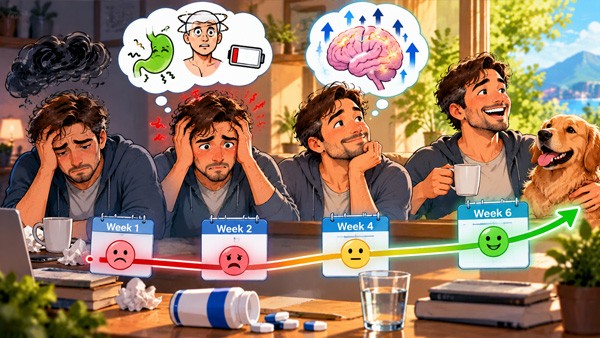

You take the first tablet expecting to feel better. Instead you feel sick, wired, unable to sleep, and by day eight considerably worse than before you started. So you conclude the drug is wrong for you and stop.
That sequence is the single commonest way a treatment that would have worked gets abandoned — usually somewhere around day ten, which is roughly three weeks before the thing would have started doing its job.
💡 Two things that almost nobody is told at the point of prescribing.
🔹 It gets worse before it gets better, and that is expected. The side effects arrive in days. The benefit arrives in weeks. For the first fortnight you are paying the cost with none of the return, and knowing that in advance is most of what gets people through it.
🔹 The real timeline is four to six weeks at a proper dose. Judging a drug at day ten is like judging a cake halfway through baking. The decision point is week four, not week one.
📅 What actually happens, week by week
The sequence is reasonably predictable, which is why it is worth writing down and keeping.
| When | What you will probably notice |
|---|---|
| Days 1–3 | Side effects only. Nausea, headache, a jittery or wired feeling, disturbed sleep, loose stools. No mood change at all |
| Days 3–10 | The worst stretch. Side effects peak. Anxiety often increases. This is the window when most people give up |
| Week 2 | Side effects start fading. The first real signs appear, and they are physical rather than emotional — sleeping better, eating again, slightly more energy. Mood still flat |
| Weeks 3–4 | Mood begins to shift. Often noticed by other people before the person taking it. Less crying, more tolerance of small irritations, the day feels shorter |
| Weeks 4–6 | The assessment point. A reasonable dose for four to six weeks with no meaningful change means a dose increase or a different drug |
| Weeks 6–12 | Continued improvement. Interest and enjoyment usually return last, well after sleep and energy |
✅ The order of recovery is the part that confuses people most.
Energy and motivation return before mood does. So there is often a stretch where you are functioning better, getting up, getting things done — and still feel wretched. That is normal progress, not failure, and it is worth knowing because it feels like the opposite.
It is also why the early weeks need watching: having the energy to act while still feeling hopeless is a specific risk period, covered below.
🤢 The early side effects, and how long each lasts
| Effect | How long | What helps |
|---|---|---|
| Nausea | Usually gone within 1–2 weeks | Take it with food. This alone solves most of it |
| Headache | First week | Paracetamol, fluids |
| Jittery, wired, restless | 1–2 weeks | A lower starting dose. Common and worst in people who already have anxiety |
| Insomnia | Variable | Move the dose to the morning |
| Drowsiness | Variable | Move the dose to the evening. Opposite problem, opposite fix |
| Loose stools, dry mouth, sweating | Often settles, sometimes persists | Usually tolerable; mention if not |
| Vivid or strange dreams | Early weeks | Harmless, usually fades |
| Sexual effects | Does not fade on its own | Its own section below |
Two things reduce almost all of the above: starting at a low dose and increasing after a week or two, and taking the tablet with food at the same time each day. If the start was rough because the full dose was given on day one, the drug may be fine and the entry point wrong.
People with existing anxiety are unusually sensitive to the first few days — the activation feels like their anxiety getting dramatically worse, which is alarming when the drug was prescribed for anxiety in the first place. See our guide to generalised anxiety.
⚠️ The one genuine danger in the early weeks
🚨 Antidepressants carry a warning about increased suicidal thoughts in the first weeks, particularly in people under 25.
This is real and it is not a reason to avoid treatment — untreated depression is considerably more dangerous. But it changes how the first month should be handled.
What it means in practice:
🔹 Someone should be checking in during the first weeks — a doctor, and someone at home who knows what to look for
🔹 Watch for new or worsening agitation, restlessness, severe anxiety, or an inability to sit still. Those are the warning signs, not just thoughts about dying
🔹 Any new or worsening thoughts of self-harm are a same-day contact, not something to wait out
🔹 The under-25 group needs the closest monitoring
If there are thoughts of acting on self-harm, contact emergency services or a crisis line immediately. This is an emergency and it is treatable.
💔 The side effect that actually makes people stop
Sexual side effects affect a large share of people on SSRIs — depending on the study and how directly the question is asked, somewhere between four and six in ten. They are also the ones least likely to be mentioned at the appointment, in either direction.
What they look like: reduced desire, difficulty reaching orgasm or inability to, reduced sensation, erectile difficulty, and reduced lubrication. Delayed orgasm is the most characteristic.
Unlike nausea and headache, these do not reliably fade with time. Waiting six months to see is not usually a good plan.
| Option | What it involves |
|---|---|
| Lower the dose | Often dose-related, so the smallest effective dose may solve it without changing drug |
| Switch to bupropion | Does not cause sexual side effects. Different mechanism entirely. Often the first move when this is the main complaint |
| Switch to mirtazapine | Also largely free of them, and helps sleep. Causes weight gain, which may be welcome or not |
| Add bupropion alongside | Sometimes used to counteract the effect while keeping the drug that is working |
| Treat the symptom | In men, an erectile dysfunction medication is sometimes added |
The reason this matters beyond the obvious: people stop the drug over it without saying why, then relapse, and the relapse gets attributed to the illness rather than to a side effect that had three straightforward solutions. If this is the problem, it is worth naming it plainly at the appointment.
⚖️ Weight, honestly
The common claim that antidepressants cause weight gain is too broad. They differ considerably, and the drug can be chosen around it.
- 📈 Mirtazapine reliably increases appetite and weight. That is sometimes exactly what is wanted — in depression with insomnia and weight loss it does two useful jobs at once
- 📈 Paroxetine is the SSRI most associated with weight gain
- ➡️ Sertraline and escitalopram are roughly weight neutral for most people, with modest gain over longer periods in some
- 📉 Bupropion is the one that does not add weight, and may reduce it slightly
Worth separating from the drug: recovering appetite is itself a sign of improvement. Someone who was not eating and starts eating again will gain weight, and that is the illness lifting rather than the tablet.
📊 The drugs, side by side
All of these treat depression. The honest basis for choosing between them is side effect profile and what else is going on.
| Drug | What distinguishes it |
|---|---|
| Lexapro (Escitalopram) | Among the best tolerated and the fewest drug interactions. A common first choice. Lexaheal is the same drug |
| Sertraline | The most widely prescribed SSRI. Safe in heart disease, widely used in pregnancy |
| Paxil (Paroxetine) | Effective and calming, useful in anxiety. More weight gain and the hardest to come off |
| Celexa (Citalopram) | Well tolerated, with a dose ceiling because of heart rhythm effects at higher doses |
| Effexor (Venlafaxine) | SNRI, often used when an SSRI has not worked. Raises blood pressure at higher doses and is difficult to stop |
| Cymbalta (Duloxetine) | SNRI that also treats nerve pain and fibromyalgia, so it does two jobs where both are present |
| Wellbutrin (Bupropion) | No sexual side effects, no weight gain, activating, also used for smoking cessation. Avoided with seizure history or eating disorders, and can worsen anxiety |
| Remeron (Mirtazapine) | Sedating, increases appetite. Good where insomnia and weight loss dominate. Taken at night |
| Desyrel (Trazodone) | Strongly sedating; at low dose used mainly for sleep. See our guide to trazodone and insomnia |
| Pamelor (Nortriptyline) | Tricyclic, the best tolerated of that older group. Also used for chronic nerve pain |
🔄 When it is not working
An important and under-stated fact: only about a third of people get full remission from the first antidepressant they try. Needing a second is ordinary, not a sign that the depression is untreatable or that the person is a difficult case.
At the four-to-six week mark on an adequate dose, the realistic options are:
- ⬆️ Increase the dose — the commonest next step, since many people are assessed while still on a starting dose that was never meant to be therapeutic
- 🔁 Switch within the same class, which works more often than it sounds like it should — people respond differently to different SSRIs
- ➡️ Switch to a different class, typically SSRI to SNRI, or to bupropion or mirtazapine
- ➕ Add a second agent alongside the first
- 🗣️ Add psychological therapy, which combined with medication outperforms either alone for most people
Before concluding a drug has failed, three things are worth checking: was the dose ever increased past the starting dose; was it actually taken every day; and was four full weeks given at that dose. A surprising share of apparent treatment failures are one of those three.
Also worth ruling out: an underactive thyroid, low B12 or iron, heavy alcohol use, obstructive sleep apnoea, and chronic pain. Each produces symptoms indistinguishable from depression and none of them responds to an SSRI.
🚫 Why stopping suddenly backfires
This is the other end of the treatment, and it causes as much trouble as the beginning.
⚠️ Stopping an antidepressant abruptly causes discontinuation symptoms in a large proportion of people.
What it feels like: dizziness, flu-like aching, nausea, irritability, vivid dreams, and the sensation described as brain zaps — brief electric-shock feelings in the head, often when moving the eyes. Distinctive, harmless, and unpleasant.
It starts two to four days after stopping or after a missed run of doses.
This is not addiction and not relapse. It is the body adjusting to the drug leaving, and it resolves — immediately if the drug is restarted, over one to three weeks if not. Knowing that it is not the depression returning saves a great deal of alarm.
Worst with paroxetine and venlafaxine, both of which leave the body quickly. Mildest with fluoxetine, which lingers and effectively tapers itself.
So: taper slowly, over weeks to months, with medical guidance, and do not let the supply run out.
The related question — when to stop at all. The usual advice is to continue for at least six to twelve months after feeling genuinely well, and considerably longer where there have been several episodes. Stopping the moment things improve is the most reliable route back to where you started, because the improvement is the drug working rather than evidence it is no longer needed.
⚡ The interactions that matter
🚨 Serotonin syndrome happens when too much serotonin activity builds up, almost always from combining two or more serotonergic drugs.
Signs: agitation and confusion, heavy sweating, shivering, tremor, muscle twitching or rigidity, fast heart rate, and fever. It can develop within hours and ranges from mild to life-threatening.
What combines badly: two antidepressants together without supervision; tramadol; triptans for migraine; St John's wort, which people add themselves believing a herbal product is neutral; lithium; linezolid; and recreational stimulants.
MAOI antidepressants must never be combined with these drugs and require a washout period between them.
Seek urgent care for the combination of agitation, fever, sweating and muscle twitching.
Three more that are less dramatic and more common:
- 🩸 Bleeding risk. SSRIs affect platelets, so combined with ibuprofen, naproxen, aspirin or an anticoagulant they raise the risk of stomach bleeding. If regular anti-inflammatories are needed, say what you are taking — stomach protection is often added
- 🧂 Low sodium. SSRIs can lower blood sodium, mainly in older adults and those on diuretics. It shows as confusion, drowsiness, unsteadiness and falls rather than anything obviously chemical, so it gets missed
- 🍺 Alcohol. It is a depressant, it worsens sleep, it amplifies sedation, and heavy use undermines the treatment entirely. Occasional moderate drinking is usually acceptable; regular heavy drinking means the medication is unlikely to work
🤰 Pregnancy and planning
This comes up constantly and the instinctive response is usually the wrong one.
Do not stop abruptly on discovering a pregnancy. Untreated depression in pregnancy carries its own substantial risks for both mother and baby, and abrupt stopping adds discontinuation symptoms to an already difficult moment. This is a conversation to have urgently, not a decision to make alone overnight.
Some antidepressants have more pregnancy data behind them than others, sertraline among them, and the usual approach is to weigh the risk of the drug against the risk of the illness rather than assuming the drug is the only risk present. Ideally the discussion happens before conceiving, which is worth raising at any appointment if pregnancy is a possibility.
📞 When to seek help
🚨 Urgent, same day: new or worsening thoughts of self-harm; severe agitation or inability to sit still; the combination of fever, sweating, confusion and muscle twitching; a seizure; or confusion and unsteadiness in an older person on an SSRI. If there are thoughts of acting on self-harm, contact emergency services or a crisis line now.
Worth an appointment:
- Four to six weeks at a steady dose with no change — the decision point for a dose increase or a switch
- Still on the starting dose after a month, which is frequently the whole explanation
- Sexual side effects — say so plainly, there are three or four workable solutions
- Unmanageable early side effects, since a slower start usually fixes it
- Insomnia or daytime drowsiness — often solved by moving the dose to the other end of the day
- Thinking of stopping, so it can be tapered rather than halted
- Discontinuation symptoms after missed doses
- Starting a triptan, tramadol or St John's wort while on an antidepressant
- Regular anti-inflammatory painkillers alongside an SSRI
- Pregnancy, or planning one
- Unusual energy, reduced need for sleep, racing thoughts or uncharacteristic risk-taking — this needs reassessment, since antidepressants can unmask bipolar disorder
- Feeling well and wanting to stop — usually too early, and worth discussing rather than acting on
❓ Frequently asked questions
How long do antidepressants take to work?
Four to six weeks at an adequate dose for the full effect. Physical signs such as sleep, appetite and energy often improve by week two, with mood shifting around weeks three to four.
Why do I feel worse in the first two weeks?
Side effects arrive within days while the benefit takes weeks, so the early period is cost without return. Nausea, jitteriness and increased anxiety peak around days three to ten and then fade.
Do antidepressant sexual side effects go away?
Unlike nausea and headache, they usually do not fade on their own. Options include lowering the dose, switching to bupropion or mirtazapine, or adding bupropion alongside the current drug.
Which antidepressants do not cause weight gain?
Bupropion does not add weight and may reduce it slightly. Sertraline and escitalopram are roughly weight neutral. Mirtazapine reliably increases appetite, and paroxetine is the SSRI most linked to gain.
What are brain zaps?
Brief electric-shock sensations in the head, often triggered by eye movement, occurring two to four days after stopping or missing doses. They are a discontinuation symptom, harmless, and resolve with a slower taper.
Can I stop an antidepressant suddenly?
No. Abrupt stopping causes dizziness, flu-like aching, irritability, vivid dreams and brain zaps. It is not addiction or relapse, but it needs a taper over weeks to months, worst with paroxetine and venlafaxine.
Medical Disclaimer: The information in this article is for educational and informational purposes only and is not a substitute for professional medical advice, diagnosis, or treatment. Always seek guidance from a qualified healthcare provider with any questions you may have regarding a medical condition, and before starting, stopping or changing any medication.