Chronic Pancreatitis: Enzyme Doses That Actually Work, Pain Control, Diabetes Risk and What You Can Eat

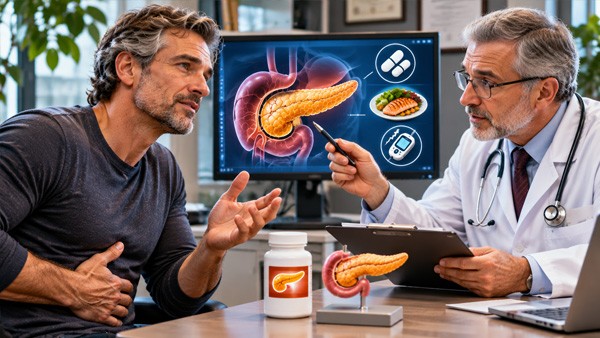
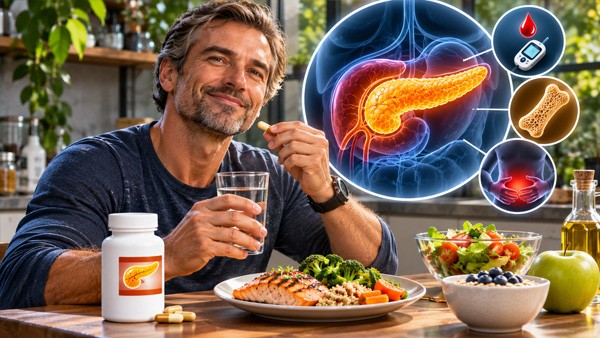
🔎 Chronic pancreatitis is long-term scarring of the pancreas, the gland behind the stomach that makes digestive enzymes and insulin. The scarring does not reverse. What you can change is how fast it progresses, how much pain it causes, and whether you actually absorb your food. Most of the day-to-day difference comes from three things people are rarely shown properly: how to take enzyme capsules, what to eat, and which checks to keep up.
🧩 What the pancreas does, and what scarring takes away
🩺 The pancreas has two separate jobs. The exocrine part makes enzymes that break down fat, protein and starch in the gut. The endocrine part makes insulin and glucagon to control blood sugar. Repeated inflammation replaces working tissue with scar, and both jobs fail gradually — usually digestion first, blood sugar later.
📌 That is why the condition has three faces that need managing separately: pain, poor digestion (called exocrine pancreatic insufficiency) and diabetes. Someone can have any one of them without the others, and treating the pain does nothing for the other two.
🚽 Fatty stools: the sign that digestion is failing
📋 Enzyme shortage shows mostly as fat not being absorbed. The stools change before anything else does, and people often put up with it for years because nobody asked.
🚽 Signs of steatorrhoea, the medical name for fatty stools
🔹 Pale, bulky, greasy stools that float and are hard to flush away, sometimes with an oily film on the water.
🔹 A particularly foul smell, urgency after meals, wind and bloating.
🔹 Weight loss despite eating normally, which is the sign that matters most.
🔹 Later: night blindness, easy bruising or bone pain, from shortage of the fat-soluble vitamins A, K and D.
💊 Enzyme capsules: how to take them so they work
❗ Pancreatic enzyme replacement is the main treatment for poor digestion. When people say enzymes “did not work”, the usual reasons are a dose that is too low, or capsules taken at the wrong moment, not a failure of the treatment itself.
🧪 Why an acid-reducing tablet is often added
📘 Enzyme capsules are coated to survive stomach acid, then release in the upper small intestine. A damaged pancreas also makes less bicarbonate, so the gut stays too acidic and the enzymes work poorly where they are released. Reducing acid helps them work.
💊 That is the job of a proton pump inhibitor such as Protonix (Pantoprazole), Nexium (Esomeprazole) or Prilosec (Omeprazole), taken before breakfast. It is added when a correct enzyme dose is still not enough, rather than started routinely, and it is reviewed if symptoms settle.
🥗 What to eat, and the advice that is out of date
🚫 The old advice was a very low-fat diet. For most people with enzyme shortage that advice is wrong now: cutting fat drives weight loss and vitamin deficiency. The aim is a normal diet with enough enzymes to digest it.
| 🍽️ Area | 📝 What works |
|---|---|
| 🧈 Fat | A normal amount, spread across the day, with enzymes matched to it. Restrict only if fatty stools persist despite an adjusted dose |
| 🍽️ Meal pattern | Five or six smaller meals instead of three large ones. Easier to digest, and pain after large meals is common |
| 🥩 Protein and calories | Enough to hold weight steady. A dietitian is worth asking for, and oral supplements where weight is falling |
| 🌾 Very high fibre | Large amounts of bran and fibre supplements can reduce how well enzymes work. Ordinary fruit and vegetables are fine |
| 💊 Vitamins A, D, E and K | Checked by blood test and replaced if low. Vitamin D is the one most often short |
| 🍷 Alcohol | None. Not a limit but a stop, whatever the original cause |
🍷 Alcohol and smoking: the steps that change the course
📉 Stopping alcohol reduces painful flare-ups and slows the loss of function, and it matters even when alcohol was not the original cause. Smoking does the same damage independently, and stopping both does more than either alone.
💬 For many people stopping drinking is the hardest part and needs support, not willpower alone. Medicines that reduce craving, such as ReVia (Naltrexone), are an option where the liver allows; the full range is in treatment for alcohol problems, and help with stopping smoking in stop-smoking medicines.
🤕 Pain: a ladder, not a single drug
📋 Pain is the symptom most people come to the doctor with — usually a deep upper abdominal ache going through to the back, often worse after eating. It is managed step by step, and long-term strong opioids are avoided where possible because they lose effect and bring dependence.
⚠️ Anti-inflammatory painkillers are not a long-term answer here, especially with stomach ulcer risk or kidney problems. Who should avoid them is covered in which painkiller to choose.
🍬 Diabetes that behaves differently: type 3c
📊 When scarring reaches the insulin-making cells, diabetes follows. It is called type 3c, or pancreatogenic diabetes, and it is often mislabelled as type 2. The difference matters: the pancreas also loses glucagon, the hormone that raises blood sugar, so lows can be sudden and deep.
| 🍬 Point | 📝 What it means in practice |
|---|---|
| 💊 First treatment | Where diabetes is mild, Glucophage (Metformin) is usually first, if weight and the gut tolerate it. Insulin is needed earlier than in type 2 for many |
| ⚠️ Hypoglycaemia | Lows can be severe, because glucagon is missing and drinking makes it worse. Always carry fast sugar if on insulin or sulfonylureas |
| 🍽️ Enzymes and sugar | Starting or increasing enzymes means you absorb more, so blood sugar can rise. Check more often for a week or two after any change |
| 📊 Mislabelling | If you were told you have type 2 but you also have chronic pancreatitis, ask whether it is type 3c. It changes the choice of drug and the warnings about lows |
🦴 The quiet complication: bones
🔎 Poor fat absorption means poor vitamin D and calcium absorption, and smoking and alcohol add to the loss. About two in three people with chronic pancreatitis have thinning bones, and most find out only after a fracture.
↳ Fracture risk is clearly raised, and bone treatment is usually offered.
↳ Bones thinner than normal. Vitamin D, calcium and exercise matter most here.
📋 The checks to keep up
| 📅 Check | 📝 How often, and why |
|---|---|
| ⚖️ Weight and stools | Every visit. The simplest test of whether the enzyme dose is right |
| 🍬 Fasting glucose or HbA1c | Every year, to catch type 3c diabetes early |
| 💊 Vitamins A, D, E, K, plus albumin and magnesium | At diagnosis, then about yearly if enzymes are needed |
| 🦴 Bone density scan | At diagnosis, then every two years or so if thinning is found |
| 🩺 Imaging | Whenever symptoms change: new jaundice, new weight loss despite enzymes, or a different pattern of pain |
⚠️ Complications worth knowing by name
Fluid collections next to the pancreas. Many settle on their own; large or painful ones are drained
Yellow skin or eyes, dark urine, pale stools, itching. Needs prompt assessment
Early fullness and vomiting after meals
Can cause bleeding from stomach veins. Black stools or vomiting blood is an emergency
Risk is raised several-fold, and highest in smokers and in inherited pancreatitis
📊 On cancer, the honest version: the relative risk is raised, but the absolute risk stays low for most people — roughly a few in a hundred over twenty years. Stopping smoking is the single most effective way to reduce it. People with inherited (hereditary) pancreatitis have a much higher lifetime risk and are usually offered a specialist surveillance programme.
🗿 Six beliefs that make things worse
| 💭 The belief | ✔️ What is actually the case |
|---|---|
| “I should eat as little fat as possible.” | That drives weight loss and vitamin deficiency. Normal fat, matched enzymes |
| “Enzymes did not work for me.” | Usually the dose was too low or the timing wrong. Taken with the first mouthful, at an adjusted dose, they work for most |
| “A drink now and then is fine.” | No amount is safe here, whatever caused the pancreatitis in the first place |
| “My pain means it is getting worse.” | Pain and progression do not move together neatly. Pain often lessens in later years even as function falls |
| “It is just type 2 diabetes.” | Often it is type 3c, with a higher risk of deep lows. Ask which type you have |
| “I only need to see someone when it hurts.” | Diabetes, bone loss and vitamin shortage are silent. The yearly checks catch them |
🚨 When to get help, and how fast
🚨 Emergency
Severe abdominal pain that does not settle, especially with vomiting or fever · vomiting blood or black, tarry stools · fainting or collapse · confusion or drowsiness with very low blood sugar
🟡 Within days
Yellow skin or eyes, dark urine or pale stools · vomiting after meals · new weight loss despite taking enzymes · a change in your usual pain pattern · frequent low blood sugars
🟢 At the next review
Fatty stools that have not settled · whether your enzyme dose can go up · yearly glucose test · vitamin D and bone scan · dietitian referral · help with alcohol or smoking · pain that limits sleep or work
❓ Frequently asked questions
Can chronic pancreatitis be cured?
No, the scarring does not reverse. Stopping alcohol and smoking slows it down, and enzymes, pain treatment and diabetes care control the effects.
When should I take pancreatic enzymes?
With the first mouthful of every meal and snack that contains fat. For a long meal, split the dose between the start and the middle.
What dose of enzymes is normal?
A common adult start is 40,000 to 50,000 lipase units with main meals and half that with snacks. Many people need more; your team adjusts it.
Why is pantoprazole prescribed with enzymes?
A damaged pancreas makes less bicarbonate, so the gut stays acidic and enzymes work poorly. Reducing acid helps them when the dose alone is not enough.
Should I follow a low-fat diet?
Usually not. A normal diet with enough enzymes is better, because cutting fat causes weight loss and vitamin shortage. Small frequent meals help.
Can I drink alcohol occasionally?
No. Any alcohol raises the risk of flare-ups and faster damage, whatever the original cause of the pancreatitis.
What is type 3c diabetes?
Diabetes caused by pancreatic damage. Glucagon is lost as well as insulin, so blood sugar lows can be sudden and severe. It is often mislabelled as type 2.
How is chronic pancreatitis pain treated?
Step by step: stopping alcohol and smoking and paracetamol first, then weak opioids, then nerve pain medicines, and endoscopy or surgery for blocked ducts.
Does chronic pancreatitis affect bones?
Yes. About two in three have thinning bones from poor vitamin D and calcium absorption. A bone density scan and vitamin D level are worth asking for.
Does it lead to pancreatic cancer?
The risk is raised, but the absolute risk stays low for most, roughly a few in a hundred over twenty years. Stopping smoking lowers it most.
📑 Sources and editorial
- 📘 European and American evidence-based guidelines on the diagnosis and management of chronic pancreatitis
- 🔎 Epidemiological studies of the causes of chronic pancreatitis, including alcohol, smoking, genetic variants, hypertriglyceridaemia and autoimmune pancreatitis
- 🚽 Guidance on exocrine pancreatic insufficiency, its clinical signs and the threshold of lost enzyme output at which steatorrhoea appears
- 🧪 Evidence on faecal elastase-1 testing, its thresholds and its limitations in watery stool samples
- 💊 Consensus recommendations on pancreatic enzyme replacement therapy, including starting lipase doses, timing with meals, dose escalation and adjunctive acid suppression
- 🥗 Clinical nutrition guidelines for chronic pancreatitis, including dietary fat, meal pattern, fibre and fat-soluble vitamin monitoring
- 🍷 Studies of the effect of alcohol and smoking cessation on recurrent pain, disease progression and pancreatic cancer risk
- 🤕 Evidence on pain management in chronic pancreatitis, including step-wise analgesia, pregabalin, and randomised trials comparing early surgery with endoscopy-first approaches
- 🍬 Studies on the incidence of pancreatogenic (type 3c) diabetes over time, the loss of glucagon and hypoglycaemia risk, and recommendations on treatment and annual screening
- 🦴 Meta-analysis of osteoporosis and osteopenia prevalence in chronic pancreatitis, and guidance on bone density screening
- ⚠️ Reviews of local complications, including pseudocysts, biliary and duodenal stricture and splenic vein thrombosis
- 🔬 Cohort studies on pancreatic cancer risk in chronic and hereditary pancreatitis
- 📖 Related reading: which painkiller to choose, IBS with diarrhoea and what is often missed, atony of the digestive tract, diabetic neuropathy
- 🛒 Related products: Protonix (Pantoprazole), Nexium (Esomeprazole), Prilosec (Omeprazole), Glucophage (Metformin), Neurontin (Gabapentin), Paracetamol, ReVia (Naltrexone)
- 🩺 RXshop Editorial Team — reviewed by Emily Chen, MD, MPH — Internal Medicine Specialist
Medical Disclaimer: The information in this article is for educational and informational purposes only and is not a substitute for professional medical advice, diagnosis, or treatment. Always seek guidance from a qualified healthcare provider with any questions you may have regarding a medical condition, and before starting, stopping or changing any medication.