Dandruff or Seborrheic Dermatitis: What Causes the Flakes, Which Medicated Shampoo Works, and How to Keep Them Away

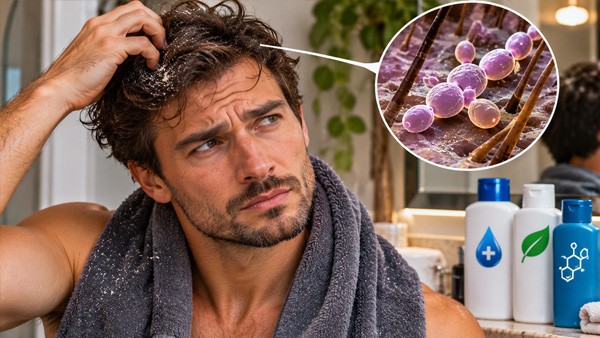

❄️ White flakes on a dark jumper, an itch that returns two days after washing, a scalp that seems to get worse every winter. Dandruff is one of the most common skin complaints there is, and one of the most often treated the wrong way: harder scrubbing, more frequent washing with ordinary shampoo, oils rubbed into the scalp. 🧫 The real driver in most people is a yeast that lives on everyone’s scalp, and the reaction some scalps have to it. 🎯 That is good news, because it means the problem responds to the right active ingredient, used the right way. This guide explains what causes the flakes, how to tell dandruff from seborrheic dermatitis, dry scalp, psoriasis and scalp ringworm, which medicated shampoo to choose, how long to leave it on, and how to stop it coming back.
🔬 What dandruff actually is
🧴 The scalp renews its surface roughly once a month, and the shed cells normally fall away unseen. In dandruff, that turnover speeds up and the cells come away in visible clumps, white or greyish and loose, often with mild itch. 💡 It is not a sign of poor hygiene and it is not contagious. It is a mild, inflammatory reaction of the scalp surface, and the same process, turned up, becomes seborrheic dermatitis: greasier, yellowish scale, visible redness, and patches that spread beyond the scalp.
📖 Doctors now see the two as one condition on a spectrum. Dandruff is the mild, scalp-only end; seborrheic dermatitis is the inflamed end that can also affect the eyebrows, the sides of the nose, behind the ears, the beard area and the centre of the chest. Treatment uses the same ingredients for both, at different intensity.
🧫 The yeast behind it: Malassezia
🔎 Everyone’s scalp carries a yeast called Malassezia, mainly the species M. globosa and M. restricta. It cannot make its own fats, so it lives on scalp oil. As it breaks down sebum it releases free fatty acids, chiefly oleic acid. ⚠️ In about half of people, the scalp barrier reacts to those fatty acids with irritation, faster cell turnover and flaking. In the other half nothing happens at all, which is why two people with the same washing habits can have completely different scalps.
🎯 This chain explains the treatments. Antifungal shampoos lower the yeast; zinc and selenium slow it and calm turnover; salicylic acid and coal tar lift scale and slow turnover; short steroid courses calm the inflammation. Breaking any link reduces flakes, and breaking two at once works best in stubborn cases.
👥 Who gets it, and when
🍂 Why it changes with the seasons
🔥 What makes it worse
| ⚠️ Trigger | 📝 Why, and what helps |
|---|---|
| 🧴 Washing too rarely | Oil and yeast build up between washes. Washing more often usually helps, not harms |
| 🧴 Rinsing too fast | Shampoo left on for 20 seconds does very little. Medicated shampoos need 3 to 5 minutes |
| 🛢️ Oils on the scalp | Olive and coconut oil can feed Malassezia. They loosen scale but often make itch worse later |
| 😰 Stress and poor sleep | Commonly reported to bring on flares. Treat the flare early when a hard period starts |
| ❄️ Cold, dry weather | The classic winter flare. Start treatment at the first itch |
| 🧢 Hats, helmets, sweat | Warm, damp, oily scalp suits the yeast. Wash after heavy sweating |
| 💊 Some medicines | Lithium, some antipsychotics and interferon are linked to flares. Do not stop them; treat the scalp |
| 🧪 Hair products | Heavy gels, waxes and dyes can irritate or cause contact dermatitis, which looks similar |
🧭 Dandruff, seborrheic dermatitis, dry scalp or psoriasis
🔍 Four conditions produce most scalp flaking. The two most useful questions are whether the flakes feel greasy or dry, and whether the skin underneath is red.
| 🔎 Feature | ❄️ Dandruff | 🔴 Seborrheic dermatitis | 🟣 Psoriasis |
|---|---|---|---|
| Scale | Loose, white | Greasy, yellowish | Thick, silvery, stuck on |
| Redness | None or faint | Clear, ill-defined | Sharp-edged plaques |
| Beyond the hairline | No | Forehead edge, face, ears | Forehead, neck, ears |
| Elsewhere on the body | No | Eyebrows, nose folds, chest | Elbows, knees, nails |
| Response to antifungal shampoo | Good | Good | Partial at best |
🌳 Working out which one you have
🧴 The medicated shampoo ingredients, compared
⚖️ Five active ingredients do almost all the work in anti-dandruff products. Ketoconazole 2% has the strongest trial evidence for both dandruff and seborrheic dermatitis, and in head-to-head studies it did better than zinc pyrithione 1%. The others remain useful, especially when rotated.
🧫 Ketoconazole 2%
🎯 Antifungal, lowers Malassezia directly
📅 Twice a week, then once a week or fortnightly
✅ Best evidence; also for face and chest as cream
⚠️ Can dry hair; rare irritation
🧪 Zinc pyrithione 1 to 2%
🎯 Mild antifungal, slows turnover
📅 Suitable for daily use
✅ Widely available, gentle
⚠️ Weaker in seborrheic dermatitis
🟠 Selenium sulfide 1 to 2.5%
🎯 Antifungal, slows turnover
📅 Twice a week
✅ Good alternative to ketoconazole
⚠️ Can tint light or dyed hair, leaves hair oily, smells
| 🧴 Other options | 📝 Where they fit |
|---|---|
| 🧴 Ciclopirox 1% | Antifungal with anti-inflammatory action. A good second antifungal to rotate with ketoconazole |
| 🪨 Coal tar | Slows turnover. Helps thick scale and psoriasis; strong smell, can stain light hair, raises sun sensitivity |
| 🧪 Salicylic acid | Lifts thick, stuck scale so other shampoos can reach the skin. Not antifungal by itself |
| 🌿 Tea tree oil 5% | One trial showed modest benefit in mild dandruff. Can cause allergy; never use the pure oil |
🧫 Ketoconazole shampoo: how it is used
💊 Fungicyte (Ketoconazole 2% shampoo) is the standard first choice for persistent dandruff and scalp seborrheic dermatitis. The result depends more on contact time and schedule than on how much shampoo is used. A coin-sized amount is enough for short hair.
📅 The first four weeks, day by day
⏳ How quickly it works
🛡️ Keeping it away: why maintenance matters
🔁 Malassezia comes back to the scalp within weeks of stopping treatment, because it is a normal resident. In one large trial of more than 500 people whose dandruff had cleared on ketoconazole 2%, once-weekly use cut relapse by more than half compared with a shampoo without the active ingredient.
🔁 Rotating shampoos when one stops working
🤔 Many people say a shampoo “stopped working” after a few months. Often the schedule slipped, the contact time shortened, or winter arrived. When the routine is right and flakes still return, alternating two different actives, for example ketoconazole one week and selenium sulfide or ciclopirox the next, is a common and reasonable approach.
🧔 Face, eyebrows, beard and chest
- 👁️ Eyebrows and nose folds: ketoconazole 2% cream once or twice daily for 2 to 4 weeks, then once or twice a week
- 🧔 Beard area: the shampoo used as a face wash, lathered and left for 3 minutes, works well; flares often settle after shaving
- 👂 Behind and inside the ears: cream, not drops into the ear canal without advice
- 👕 Chest and upper back: shampoo used as a body wash on the area, 3 to 5 minutes, twice a week
- 👀 Eyelids with scaly, red margins (blepharitis): warm compresses and lid cleaning; no steroid creams near the eyes without a doctor
💊 When a shampoo is not enough
🔥 For a red, very itchy flare, doctors often add a short course of a mild to moderate steroid scalp lotion, typically for one to two weeks, alongside the antifungal. On the face, mild steroids are used only for a few days, or a non-steroid cream such as a calcineurin inhibitor is used instead, because steroids thin facial skin and can cause rebound redness.
⛔ What not to do.
🔹 Ketoconazole tablets are not used for dandruff. Since 2013, regulators have restricted oral ketoconazole because of serious liver injury; the shampoo and cream do not carry this risk.
🔹 Do not use strong steroid lotions for weeks without review. They thin skin and the flare returns when they stop.
🔹 Do not use pure tea tree or other essential oils on the scalp; allergy is common.
🔹 Do not use adult medicated shampoos on babies without advice.
💊 In severe or widespread seborrheic dermatitis that does not respond to topical care, a doctor may occasionally prescribe a short course of an oral antifungal such as itraconazole. This is a doctor’s decision, with attention to interactions and liver health.
👶 Cradle cap in babies
🍼 Thick, yellow, greasy scale on a baby’s scalp in the first months is cradle cap, the infant form of seborrheic dermatitis. It does not itch much, does not bother the baby, and usually clears by 12 months. 🧴 Gently massage a little emollient into the scale, leave it for a while, then wash with baby shampoo and lift loose scale with a soft brush. Do not pick it off. See a doctor if it spreads widely, looks infected, weeps, or the baby seems unwell.
🧒 Scalp ringworm: the one not to miss in children
⚠️ In children, scaly patches with broken hairs, black dots or round bald areas are often a fungal infection of the hair itself, called tinea capitis. It spreads between children and needs tablets for several weeks, such as Fulvicin (Griseofulvin) or Lamisil (Terbinafine), chosen by a doctor. Medicated shampoo is used alongside to reduce spread, but it cannot cure it alone.
🧑🦲 Dandruff and hair loss
💡 Dandruff itself does not cause permanent hair loss. Heavy scratching and inflammation can increase shedding for a while, and that shedding settles once the scalp is controlled. 🔎 If the hairline is receding or the crown thinning, that is usually pattern hair loss, a separate condition. Small studies suggest ketoconazole 2% shampoo may help as an add-on to standard treatment; see androgenetic alopecia: control the pattern, keep the hair.
✅ Daily habits that help, and those that do not
✅ Do
🧴 Wash often enough to stop oil building up, daily if needed
⏱️ Count the 3 to 5 minutes on medicated days
📅 Keep a weekly maintenance wash once clear
💨 Dry the scalp after washing, not just the hair
☀️ Restart twice-weekly use at the first itch
❌ Do not
💅 Scratch or scrape the scalp with nails or combs
🛢️ Leave oils on overnight as a treatment
🔥 Use very hot water or hot air close to the scalp
🧴 Rinse medicated shampoo off straight away
⏸️ Stop completely the week the flakes go
🩺 Emily Chen, MD, MPH, on why dandruff “comes back”
When someone tells me nothing works for their dandruff, I ask two questions: how long the shampoo stays on, and what they do once it clears. Most of the time it stays on for a few seconds, and it stops completely once the flakes go. Leaving it on for the full few minutes, twice a week, then keeping one medicated wash a week, solves the problem for most people. The ones who still struggle after that are the ones I want to look at again, because some of them turn out to have psoriasis or a contact allergy.
🍽️ Does diet matter?
🥛 There is no diet proven to cure dandruff. Very low zinc or B-vitamin levels can cause scaly skin, but these are uncommon with a normal diet, and supplements do not help people who are not deficient. 🍷 Heavy alcohol use is linked to worse seborrheic dermatitis, and a generally balanced diet supports skin health, but the shampoo routine does far more than any food change.
🗿 Common beliefs about dandruff
| 💭 The belief | ✔️ What is actually the case |
|---|---|
| “Dandruff means a dirty scalp.” | It is a reaction to a normal yeast. Very clean people get it too |
| “Washing less will stop the dryness.” | For most, washing more often helps, because oil feeds the yeast |
| “Oiling the scalp treats dandruff.” | Oils loosen flakes but can feed Malassezia and worsen itch |
| “It is catching.” | Dandruff is not contagious. Scalp ringworm in children is, which is why it needs checking |
| “Once clear, it is cured.” | It is a long-term tendency. Weekly maintenance keeps it away |
| “Dandruff makes you go bald.” | It can increase shedding for a while, but does not cause permanent loss |
🚨 When to see a doctor
| ⏱️ How soon | 📝 Situation |
|---|---|
| 🔴 Within days | A child with scaly patches and hair loss · weeping, crusted, painful or swollen areas · spreading rash with fever |
| 🟡 Within weeks | No improvement after 4 weeks of correct use · thick silvery plaques · nail changes · sudden severe seborrheic dermatitis in an adult |
| 🟢 At a routine visit | Frequent relapses despite maintenance · face or eyelid involvement · questions about steroid use |
📋 Worth knowing.
🔹 Severe seborrheic dermatitis appearing suddenly in an adult can be an early sign of HIV, so doctors may suggest a test.
🔹 It is also much more common in Parkinson disease, and may be one of its earlier skin signs.
🔹 Neither link means flakes are a sign of disease in most people; they mean a sudden, severe change deserves a look.
❓ Frequently asked questions
What causes dandruff?
Mainly a reaction to Malassezia, a yeast that lives on every scalp and feeds on scalp oil. In sensitive people its by-products speed up skin turnover and cause flakes.
Is dandruff the same as seborrheic dermatitis?
They are mild and more inflamed forms of the same condition. Seborrheic dermatitis adds redness, greasy yellow scale and often patches on the face.
How do I tell dandruff from a dry scalp?
Dandruff flakes are larger and slightly oily; dry scalp flakes are small, powdery, and come with dry skin elsewhere.
How long should I leave ketoconazole shampoo on?
3 to 5 minutes on the scalp, then rinse well. Shorter contact time is a common reason it seems not to work.
How often should I use ketoconazole 2% shampoo?
Twice a week for 2 to 4 weeks, then once a week or every two weeks to stop the flakes returning.
Can I use ordinary shampoo on the other days?
Yes. Wash as often as you like with a mild shampoo; the medicated shampoo is only needed on the scheduled days.
Why does dandruff come back?
The yeast is a normal resident and returns within weeks of stopping. Once-weekly maintenance cuts relapse by more than half.
Does dandruff cause hair loss?
Not permanent loss. Itching and inflammation can increase shedding for a while, which settles once the scalp is treated.
Are ketoconazole tablets used for dandruff?
No. Oral ketoconazole is restricted because of liver injury. Dandruff is treated with the shampoo or cream.
When should I see a doctor about scalp flakes?
If there is no improvement after 4 weeks of correct use, if plaques are thick and silvery, or if a child has scaly patches with hair loss.
📑 Sources and editorial
- 📘 Dermatology reviews of seborrheic dermatitis and dandruff: epidemiology, Malassezia and the scalp barrier
- 🧫 Studies of Malassezia globosa and M. restricta and the role of oleic acid in scalp irritation
- 📊 Randomised trials of ketoconazole 2% shampoo for treatment and once-weekly or fortnightly prophylaxis of dandruff
- 🧪 Comparative trials of ketoconazole, zinc pyrithione, selenium sulfide and ciclopirox shampoos
- 🌿 A randomised trial of 5% tea tree oil shampoo in mild to moderate dandruff
- ⛔ Regulatory safety communications (2013) restricting oral ketoconazole due to liver injury
- 👶 Guidance on infantile seborrheic dermatitis (cradle cap) and on tinea capitis in children
- 📖 Related reading: androgenetic alopecia, nail fungus treatment, athlete’s foot
- 🛒 Related products: Fungicyte (Ketoconazole 2% shampoo), Fulvicin (Griseofulvin), Lamisil (Terbinafine)
- 🩺 RXshop Editorial Team — reviewed by Emily Chen, MD, MPH — Internal Medicine
Medical Disclaimer: The information in this article is for educational and informational purposes only and is not a substitute for professional medical advice, diagnosis, or treatment. Always seek guidance from a qualified healthcare provider with any questions you may have regarding a medical condition, and before starting, stopping or changing any medication.