Leg Pain When You Walk: Why It Is Usually the Arteries Rather Than the Veins, and the Pain That Cannot Wait

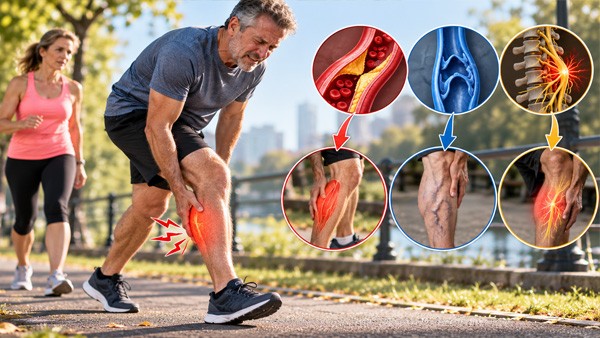

Leg pain that comes on when you walk has a handful of causes, and they get confused with each other constantly. People worry about a clot, get told it is their age, buy insoles, or wait years before anyone takes a pulse in their foot.
The thing is, these causes can be separated at the kitchen table, without a single test, because each one has its own pattern. Not the location of the pain and not its severity — the pattern: what brings it on, what makes it stop, and whether the distance is the same every time.
🚶 The three questions that sort it out.
🔹 Does it come on at the same distance every time? If you can predict it — roughly two hundred metres, or one particular hill — that reproducibility points at the arteries. A muscle or a joint problem is not that consistent.
🔹 Does standing still make it go away? Arterial pain settles in two to five minutes of simply standing. You do not need to sit down. That detail matters more than it sounds, because the nerve cause needs you to sit or bend forward before it eases.
🔹 Does it come back at the same distance when you start again? Arterial pain does, every time, like a meter resetting.
That combination — predictable distance, relief from standing, repeats identically — has a name. It is intermittent claudication, and it means the arteries supplying the leg are narrowed.
🧭 The same symptom, five different causes
| Cause | What brings it on | What relieves it |
|---|---|---|
|
Arteries claudication |
A predictable walking distance. Sooner uphill, sooner in cold weather, sooner walking fast or carrying shopping | Standing still, within a few minutes. No need to sit |
|
Nerve spinal canal narrowing |
A variable distance, and standing alone can do it. Often worse walking downhill, better uphill, which is the reverse of the arterial pattern | Sitting down, or leaning forward over a trolley. Standing upright does not help |
|
Veins chronic venous insufficiency |
Standing for a long time, and the end of the day. Heaviness, aching, bursting rather than cramping | Elevating the leg. Worse in heat, better in the morning |
|
Joints hip or knee arthritis |
Movement of that joint, often worst in the first few minutes and easing as you warm up | Rest, and it is the joint itself that hurts, not the muscle |
|
A clot deep vein thrombosis |
Nothing. It hurts whether you walk or not, in one leg, with swelling that stays | Nothing — and this one needs assessing now, not next week |
The nerve and artery patterns are the two most often mixed up, and the detail that separates them is worth repeating: arterial pain eases while you stand there; nerve pain needs you to bend or sit. Someone who has to lean on a wall for three minutes and can then walk on is describing arteries. Someone who has to find a bench is describing a spine.
If the pain is constant rather than brought on by walking, and one leg is swollen, that is a different article: thrombosis and embolism, including what a leg clot actually feels like.
🩸 What is happening in the artery
Fatty deposits narrow the arteries feeding the leg. At rest the narrowed vessel delivers enough. Walking raises the muscle demand several times over, the supply cannot keep up, and the muscle produces pain for exactly as long as the mismatch lasts. Stop, demand falls, pain clears. That is the whole mechanism, and it explains every part of the pattern.
Where the narrowing sits determines where it hurts.
- 🦵 Calf pain is the commonest, from narrowing in the thigh artery
- 🦵 Thigh and buttock pain points higher, to the arteries in the pelvis
- ⚠️ Buttock pain on both sides, together with erectile difficulty and weak pulses in both groins, is a recognised pattern from narrowing where the main abdominal artery divides. It gets attributed to age for years, and it is a vascular diagnosis
- 🦶 Foot pain on walking suggests disease further down, which is more common in diabetes
📌 Why this is never only a leg problem.
Narrowed leg arteries are not a local plumbing fault. They are evidence of the same process running in the arteries of the heart and the brain, because atherosclerosis does not confine itself to one vessel.
🔹 Someone with claudication carries a materially raised risk of heart attack and stroke, and over the following years that risk is a bigger threat to them than the leg is.
🔹 Which is why treatment has two separate aims that people often conflate: one set of measures protects the heart and brain, another improves walking distance. The first matters more. The second is what the patient notices.
🔹 It also means the diagnosis should trigger a check of blood pressure, cholesterol and glucose — see arterial hypertension and target numbers.
🚨 The pain that is not claudication any more
🚨 Pain in the foot at rest, especially at night, means the supply is no longer enough even when the leg is doing nothing.
🔹 The giveaway: it wakes you, and it is relieved by hanging the leg out of bed or getting up and standing. Gravity buys a little more flow. People discover this by themselves and end up sleeping in a chair.
🔹 With it: a foot that is cold and pale, or dusky red when dependent; skin that is shiny with hair loss; toenails that thicken; a sore or ulcer on the toes, heel or ankle that will not heal.
🔹 What it means: this is critical limb ischemia, and it is a referral measured in days, not months. Untreated, it is how legs are lost. Treated in time, most are not.
🔹 Any new wound or ulcer below the knee in someone with these symptoms is urgent, however small it looks, and however little it hurts.
🚨 And the emergency version. If a leg becomes suddenly painful, pale, cold and numb over minutes to hours, that is an arterial blockage happening now.
Pain, pallor, no pulse, perishing cold, pins and needles, then weakness. Muscle starts dying within hours, so this is an ambulance, not an appointment. It happens most often in people with an irregular heart rhythm, where a clot has travelled.
🔍 How it gets confirmed
The examination does most of the work, and it is quick.
| Step | What it shows |
|---|---|
| Feeling the pulses in both feet and groins | Absent or weak foot pulses alongside the right history is close to diagnostic. This is the examination most often skipped |
| Ankle-brachial index | Blood pressure at the ankle divided by pressure at the arm. Above 0.9 is normal; 0.4 to 0.9 fits claudication; below 0.4 is severe. Takes ten minutes and needs no needles |
| The same index after walking | Catches people whose resting figure looks acceptable but drops with exertion |
| Toe pressures | Used when the ankle index is unreliable |
| Ultrasound, then CT or MR angiography | Maps where the narrowing is, and is done when a procedure is being considered rather than to make the diagnosis |
One trap worth knowing about. In long-standing diabetes and in kidney disease the artery walls stiffen with calcium, so the cuff cannot compress them and the ankle index comes back normal or even high while the arteries are badly diseased. A reassuring number in those two groups does not settle the question, and toe pressures are used instead.
🚭 The one change that outweighs everything else
There is no diplomatic way to put this, so here is the plain version: in peripheral arterial disease, stopping smoking does more than every medication on the list combined.
- 📉 It is the strongest predictor of whether the disease progresses from claudication to rest pain and limb loss
- 🔧 It determines whether procedures hold. Stents and bypass grafts fail far more often in people who continue smoking, which is why surgeons raise it before operating
- 🚶 Walking distance improves after stopping, which is the part people do not expect
- ❤️ It cuts the heart attack and stroke risk that is the bigger danger here
- 🚭 Vaping is not established as safe in this context, and the honest position is that it is better than smoking and not known to be harmless
Practical support is in smoking cessation and what helps. If nothing else in this article gets acted on, this is the item worth taking.
🏃 Walking into the pain, which sounds wrong
The intuitive response to pain on walking is to walk less. In claudication that is the wrong move, and structured exercise improves walking distance more reliably than any tablet.
The protocol is specific, and the specifics are why it works.
- 🚶 Walk until the pain is moderate — not until it is unbearable, and not stopping at the first twinge
- ⏸️ Stand and rest until it clears, then start again
- ⏰ Repeat for thirty to forty-five minutes, three times a week
- 📅 Give it twelve weeks before judging it. Improvement is gradual and it is cumulative
- 💪 It works by building collateral vessels and improving how efficiently the muscle uses what it gets. The narrowing itself does not change, which is why this takes weeks rather than days
- 👥 Supervised programmes outperform being told to walk more, by a wide margin, mostly because the intensity is right
Cycling and swimming are good for the heart and do much less for claudication specifically, because the benefit is tied to loading the affected muscles.
💊 What the medicines do, and what they do not
The two aims mentioned earlier are easiest to see laid out side by side. Most of the prescription is protecting the heart and brain, and only one part of it addresses the walking.
| Treatment | What it is for |
|---|---|
| Antiplatelet — aspirin, or clopidogrel | Reducing heart attack and stroke. It does not lengthen your walking distance, and people stop it in disappointment for that reason |
| A statin | Given regardless of what the cholesterol number is, because the benefit here is stabilising the plaque rather than hitting a target |
| Blood pressure treatment | Slows progression across every artery. Worth noting that beta-blockers were long avoided in claudication and the evidence has not supported that caution |
| Glucose control | Particularly where the disease is in the smaller arteries below the knee |
| Pletal (Cilostazol) | The one aimed at the symptom. It widens vessels and reduces platelet clumping, and it improves pain-free walking distance. Given a trial of around three months, and judged on whether walking actually improved |
| Persantine (Dipyridamole) | An antiplatelet used mainly in stroke prevention, generally combined with aspirin |
| Coumadin (Warfarin) | An anticoagulant, which is a different job — for clots and for irregular heart rhythm, not for claudication. See warfarin, INR and bleeding risk |
💡 Two things about cilostazol worth knowing before starting it.
🔹 It must not be used in heart failure. That is a firm contraindication, not a caution, so the heart gets checked first.
🔹 Headache in the first week or two is common and usually settles. Knowing that in advance is the difference between pushing through a fortnight and abandoning a treatment that would have worked. Palpitations and loose stools also occur early.
🔹 It is an addition to the exercise and the risk-factor treatment, never a replacement for them. On its own it does much less.
🦶 Feet, which is where limbs are actually lost
A leg with poor arterial supply heals badly, and a small injury that would be nothing on a healthy foot can become the start of a long problem. This is more important in diabetes, where reduced sensation means the injury is not felt.
- 👀 Look at both feet daily, including between the toes and the soles. A mirror on the floor works if bending is hard
- 👟 Never walk barefoot, indoors included, and check inside shoes before putting them on
- 📏 Get shoes fitted properly and buy them late in the day when feet are at their largest
- 🌡️ Test bath water with an elbow, and keep hot water bottles and heat pads away from the feet entirely. Burns on numb feet are common and serious
- ✂️ Cut nails straight across, and leave corns, calluses and ingrown nails to a podiatrist rather than treating them yourself
- 🧴 Moisturise the skin but not between the toes, where damp encourages fungal breakdown
- 🩹 Any wound, blister, crack or colour change gets seen promptly. Promptly means this week, and sooner if it is spreading or discharging
🛠️ When a procedure comes into it
Opening or bypassing the narrowed segment is considered when symptoms are genuinely limiting daily life after a proper attempt at exercise and medical treatment, and it is considered urgently in critical limb ischemia.
Angioplasty, sometimes with a stent, is done through a small puncture in the groin and suits shorter narrowings. Bypass surgery routes blood around a long blocked segment using a vein or a graft, and is a bigger undertaking with a longer recovery.
Neither is a cure. The underlying disease continues, so the risk-factor treatment carries on afterwards, and continued smoking is the strongest reason these procedures fail — which is why the conversation about it comes before the operation rather than after.
❄️ What makes a given day worse
- ❄️ Cold weather, which narrows the vessels further. Many people notice their walking distance halves in winter
- ⛰️ Hills and stairs, and walking faster than usual
- 🛍️ Carrying anything, which raises the demand
- 🍴 Walking soon after a large meal, when blood is diverted to the gut
- 🪸 Anemia, which reduces how much oxygen the available blood can carry. Worth checking if things have worsened without explanation
- 😴 Untreated sleep apnea and poorly controlled blood pressure, both of which push the whole process along
- 📉 Dehydration, and being unwell with anything
📞 When to seek help
🚨 Emergency, same hour: a leg that has become suddenly painful, pale, cold or numb; or sudden weakness in a leg that was fine.
🚨 Urgent, within days: pain in the foot at rest or at night; relief from hanging the leg out of bed; any ulcer, sore or black area on the foot or toes; a foot wound that is not healing.
Book an appointment if:
- Walking brings on predictable leg pain that stops when you stand still — ask specifically for the pulses in your feet to be checked and for an ankle-brachial index
- The distance you can manage is shortening over weeks or months
- One leg feels colder than the other, or the skin has changed colour or lost hair
- Toenails have thickened and slowed alongside any of the above
- You have diabetes and any new foot symptom at all, including numbness without pain
- Buttock or hip pain on walking, with erectile difficulty — a specific pattern that deserves a vascular assessment
- You are already diagnosed and have not been offered a supervised exercise programme, which is the treatment with the best evidence for walking distance
- You are on cilostazol and walking has not improved after three months, or you have become breathless or swollen on it
- You have claudication and have never had cholesterol, blood pressure and glucose reviewed — the leg is the warning, and the heart is the thing being warned about
- One leg has become swollen and painful at rest rather than on walking, which is a clot question and not this one
❓ Frequently asked questions
How do I know if my leg pain is arteries or a trapped nerve?
Arterial pain comes at a predictable distance and eases while you stand still. Nerve pain from a narrowed spinal canal varies in distance and needs you to sit or lean forward.
Is leg pain when walking a blood clot?
Usually not. A clot hurts whether you walk or not, in one leg, with swelling that persists. Pain that appears on walking and clears on stopping points at narrowed arteries.
What is the ankle-brachial index?
Ankle blood pressure divided by arm pressure. Above 0.9 is normal, 0.4 to 0.9 fits claudication, below 0.4 is severe. It can read falsely normal in diabetes and kidney disease.
Should I rest or keep walking with claudication?
Keep walking. Walk to moderate pain, stand until it clears, then continue, for thirty to forty-five minutes three times a week. It improves distance more than medication does.
Why does my foot hurt at night and feel better hanging out of bed?
Gravity improves what little flow there is. Rest pain relieved by dependency indicates critical limb ischemia and needs assessment within days, not months.
How long does cilostazol take to work?
Give it around three months and judge it on walking distance. Headache in the first week or two is common and usually settles. It must not be used in heart failure.
Does aspirin improve walking distance?
No. Antiplatelet treatment is there to reduce heart attack and stroke risk. People stop it when their walking does not improve, which misses the point of taking it.
Why is my walking distance shorter in winter?
Cold narrows the arteries further, so the mismatch between supply and demand arrives sooner. Many people find their distance roughly halves in cold weather.
Does claudication mean my heart is at risk?
Yes. Narrowed leg arteries indicate the same process in the heart and brain, and over the following years that carries more risk than the leg itself does.
What does buttock pain with erectile difficulty suggest?
Narrowing where the main abdominal artery divides, affecting both legs and the pelvic supply. Weak pulses in both groins complete the pattern, and it needs a vascular assessment.
📑 Sources and editorial
- Clinical guidance on the diagnosis and management of peripheral arterial disease, including the characteristic features of intermittent claudication and the indications for vascular referral
- Guidance distinguishing vascular from neurogenic claudication, including the relief of arterial pain by standing versus the requirement for lumbar flexion in spinal canal stenosis
- Literature on the anatomical correlation between the level of arterial narrowing and the distribution of claudication pain, including the aortoiliac pattern of bilateral buttock claudication with erectile dysfunction and absent femoral pulses
- Guidance on ankle-brachial index measurement and interpretation, including post-exercise testing, and on falsely elevated indices from medial arterial calcification in diabetes and chronic kidney disease with the use of toe-brachial index instead
- Clinical guidance on chronic limb-threatening ischemia, including rest pain relieved by dependency, trophic skin changes, non-healing ulceration, and the urgency of specialist assessment
- Guidance on acute limb ischemia, including the recognised clinical features, the association with atrial fibrillation and cardiac embolism, and the time-critical nature of revascularisation
- Evidence on peripheral arterial disease as a marker of systemic atherosclerosis and on the associated cardiovascular and cerebrovascular event rates
- Evidence on smoking cessation in peripheral arterial disease, including its effect on disease progression, amputation risk, graft and stent patency, and walking distance
- Trial evidence on supervised exercise therapy in intermittent claudication, including the walk-to-moderate-pain protocol, session duration and frequency, the twelve-week assessment interval, and comparative benefit against unsupervised advice and against pharmacotherapy
- Guidance on antiplatelet therapy and lipid-lowering therapy in peripheral arterial disease, including statin use independent of baseline cholesterol
- Evidence on beta-blocker use in peripheral arterial disease and the absence of support for the historical avoidance of this class in claudication
- Prescribing information for cilostazol, including mechanism, effect on pain-free walking distance, the contraindication in heart failure, and the early adverse effect profile of headache, palpitations and diarrhoea
- Prescribing information for dipyridamole, including its role in secondary stroke prevention in combination with aspirin
- Guidance on diabetic and ischemic foot care, including daily inspection, footwear, avoidance of thermal injury in neuropathic feet, professional management of callus and nail disorders, and prompt assessment of any wound
- Guidance on revascularisation in peripheral arterial disease, including the respective roles of endovascular treatment and surgical bypass and the determinants of long-term patency
- Related reading: thrombosis and embolism, warfarin, INR and bleeding risk, arterial hypertension, smoking cessation, restless legs syndrome
- Related products: Pletal (Cilostazol), Persantine (Dipyridamole), Coumadin (Warfarin), Lanoxin (Digoxin), cardiovascular medications category
- RXshop Editorial Team — reviewed by Robert Hayes, MD, FACC — Cardiologist and Cardiovascular Disease Specialist
Medical Disclaimer: The information in this article is for educational and informational purposes only and is not a substitute for professional medical advice, diagnosis, or treatment. Always seek guidance from a qualified healthcare provider with any questions you may have regarding a medical condition, and before starting, stopping or changing any medication.