Androgenic Alopecia in Men: The Pattern, the Treatment Doses and the Real Timeline

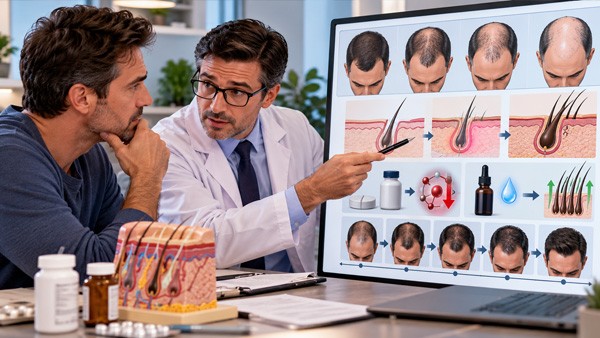

Male pattern hair loss is not hair falling out. It is hair getting smaller. Each time a susceptible follicle cycles, it produces a shorter, finer, less pigmented hair than the time before, until what grows there is a colourless wisp and then nothing. The process is called miniaturisation, and it runs over years.
The mechanism is dihydrotestosterone, or DHT, converted from testosterone by an enzyme called 5-alpha reductase. Follicles on the top of the scalp inherit a sensitivity to it; follicles at the sides and back do not. That difference explains the pattern, why it repeats through families, and why transplanted hair from the back keeps growing when moved to the front.
Two consequences follow, and they shape everything below. Treatment protects what is there far better than it recovers what is gone, because a follicle that has fully scarred over cannot be restarted. And treatment is permanent: stop it and the clock resumes where it left off, usually with visible loss within six to twelve months.
📏 The Norwood scale: knowing your stage
Dermatologists classify male pattern loss on the Hamilton-Norwood scale. Knowing the stage matters because it predicts what treatment can realistically achieve.
| Stage | What it looks like | What treatment can do |
|---|---|---|
| I | No meaningful recession | Nothing needed |
| II | Slight recession at the temples | Excellent prospects; this is the best time to start |
| III | Deeper M-shaped temple recession | Good stabilisation, some regrowth |
| III vertex | Temple recession plus a thinning crown | Good stabilisation, crown responds better than temples |
| IV to V | Widening bald areas, a narrowing bridge of hair across the top | Stabilisation realistic, significant regrowth unlikely |
| VI to VII | Bridge gone; hair only at the sides and back | Medication preserves the remaining fringe; transplantation is the option for coverage |
📸 Photograph before you start. Front, both temples and the crown, in the same light, roughly every three months. Hair changes too slowly for the mirror to register, and the honest comparison at month nine is the difference between staying on a treatment that is working and abandoning it out of impatience.
🔍 Confirming it is actually pattern loss
Not all thinning is androgenic. The distinction changes the treatment completely.
| Condition | Pattern | Clue |
|---|---|---|
| Androgenic alopecia | Temples and crown, sides spared | Gradual over years; hairs of mixed thickness side by side |
| Telogen effluvium | Diffuse over the whole scalp | Sudden heavy shedding, 2 to 3 months after illness, surgery, crash dieting or severe stress. Reverses on its own |
| Alopecia areata | Sharply defined round patches | Completely smooth bald areas, sometimes with short broken hairs at the edge |
| Traction alopecia | Along the hairline | Tight ponytails, braids or turbans |
| Scarring alopecia | Patchy, shiny skin | Itching, burning, scaling, no visible follicle openings. Needs urgent dermatology |
Worth checking with blood tests if shedding is diffuse or rapid: thyroid function, ferritin and vitamin D. Low iron stores in particular cause diffuse thinning that responds to correction and has nothing to do with DHT.
⚠️ See a dermatologist promptly, not eventually, if the scalp itches, burns, stings or scales, if there are smooth round patches, if hair comes out in clumps over weeks rather than thinning over years, or if the skin looks shiny with no visible pores. Scarring alopecias destroy follicles permanently, and the window to stop them is short.
💊 Finasteride: the DHT side of the problem
Finasteride blocks type II 5-alpha reductase, cutting scalp and serum DHT by roughly 60 to 70 percent. That removes most of the pressure driving miniaturisation. In the pivotal trials, around 83 percent of men had no further loss over two years and about two thirds saw some increase in count, against continued loss in nearly everyone on placebo.
It is available here as Propecia (Finasteride 1 mg), the original Merck brand, and as the generics Finpecia (Finasteride 1 mg) and Finax (Finasteride 1 mg).
📋 How it is taken
- 💊 1 mg once daily, with or without food, at any time of day that is easy to remember
- 📅 Expect nothing for three months. Shedding usually slows first, at three to six months. Visible density change is judged at nine to twelve months
- 📉 A temporary increase in shedding in the first weeks is common and is follicles entering a new cycle, not the drug failing
- ♾️ It is indefinite. Benefit is lost within six to twelve months of stopping, and the loss that was prevented then arrives
- 🚫 Higher doses do not work better for hair. The 5 mg tablet exists for prostate enlargement, and cutting one into pieces gives an inconsistent dose
⚠️ Side effects, stated honestly
In the trials, sexual side effects, meaning reduced libido, erectile difficulty or reduced ejaculate volume, occurred in roughly 2 to 4 percent of men, against about 2 percent on placebo. Most resolved either on continuing or on stopping. A minority of men report symptoms persisting after stopping, which has been debated for years and is not settled; it is uncommon, and it is a reason to discuss the decision rather than to dismiss the concern.
Other effects to know about: breast tenderness or enlargement, which needs assessment rather than waiting, and mood change and depression, which regulators have added to the labelling and which is a reason to stop and seek advice rather than push through.
🩸 Two facts every man on finasteride must know.
1. It halves your PSA. Finasteride reduces prostate specific antigen by about 50 percent. Any PSA measured while taking it must be doubled for interpretation, and the doctor ordering the test has to know you are on it. Otherwise a rising PSA can look normal and prostate cancer can be missed.
2. Pregnant women must not handle broken tablets. Finasteride can interfere with the development of the male fetal genitalia. Whole tablets are coated and safe to handle; crushed or split ones are not. Store them where a pregnant partner will not sort them into a pill organiser.
Finasteride does not affect fertility in most men, though it can reduce sperm parameters in a small number. Blood donation is avoided during treatment and for a month afterwards.
💧 Minoxidil: the growth side of the problem
Minoxidil works through a completely different route. It opens potassium channels, widens the small vessels feeding the follicle, and lengthens the growth phase of the hair cycle. It does nothing to DHT, which is exactly why the two combine well: finasteride plus minoxidil outperforms either one alone, and using both is the standard approach for men who want the most from medical treatment.
🧴 Topical
Morr (Minoxidil 12.5%) is the topical solution. The conventional strength is 5 percent applied twice daily, and higher-strength preparations are used where tolerated.
- 💧 1 mL to the affected area, twice daily, onto a dry scalp, not onto hair
- 🚿 Leave it four hours before washing or swimming
- 📉 Shedding at weeks 2 to 8 is expected and is the most common reason men quit. Old hairs are pushed out as follicles shift into a new growth phase. It settles
- 📅 Judge at four months minimum, properly at a year
- ♾️ Also indefinite. Gains reverse within three to six months of stopping
- 😶 Avoid the forehead and face, where the solution runs. Unwanted hair growth follows wherever it lands
Irritation, dryness and flaking are common, usually from the propylene glycol in the solution rather than the drug. It works better on the crown than at the temples.
💊 Oral, low dose
Low-dose oral minoxidil has become a widely used off-label option, particularly for men who cannot tolerate the solution or will not persist with a twice-daily routine. It is available here as Lonitab (Minoxidil 2.5 mg) and Minoxiboon (Minoxidil 10 mg).
🩺 Oral minoxidil needs medical supervision, and here is why. The doses used for hair are small, typically 1.25 to 5 mg daily, and were derived from a blood pressure medicine used at 10 to 40 mg. Even at low doses it can cause ankle swelling, a faster heart rate, light-headedness and unwanted hair growth on the face, arms and back, which is the commonest reason men stop. Blood pressure and heart rate are checked before starting and during treatment. It is not suitable alongside significant heart disease, and it is not a medicine to self-dose upward.
🔬 Dutasteride and the other options
Dutasteride blocks both type I and type II 5-alpha reductase and lowers DHT by over 90 percent, compared with 60 to 70 percent for finasteride. Trials in male pattern loss show it outperforms finasteride. It is approved for hair loss in some countries and used off-label in others, and it has a much longer half-life, which means side effects take longer to clear if they occur. We stock it as Avodart (Dutasteride 0.5 mg) and Avosteride (Dutasteride 0.5 mg). It is usually considered after an adequate trial of finasteride rather than instead of it.
The remaining options in brief:
- Microneedling
- Small studies show a clear added benefit when combined with topical minoxidil, better than minoxidil alone. Cheap and reasonable as an add-on.
- Low-level laser devices
- Caps and combs have modest evidence. Not harmful, not a substitute for medication, and the price rarely matches the effect.
- Platelet-rich plasma
- Injected in a series of sessions. Results vary widely between studies and between providers, and it needs repeating.
- Ketoconazole shampoo
- Weak evidence for a small additional benefit, useful anyway if there is dandruff, since scalp inflammation adds to shedding.
- Transplantation
- The only way to restore coverage where follicles are gone. Requires a stable pattern and an adequate donor area, and medical treatment continues afterwards to protect the native hair around the grafts.
- Supplements
- Correcting a proven deficiency in iron or vitamin D helps. Biotin does nothing unless you are deficient, which is rare. Saw palmetto is far weaker than finasteride and poorly standardised.
🗓️ What the first year actually looks like
| Period | What to expect |
|---|---|
| Weeks 1 to 8 | Possibly increased shedding. Nothing visible improves. This is normal and is where most people quit |
| Months 3 to 4 | Shedding slows. Hair may feel slightly thicker when styling |
| Months 6 to 9 | Photographs start to show a difference; miniaturised hairs thicken |
| Months 9 to 12 | The point at which the treatment is properly judged |
| Beyond a year | Maintenance. Holding the same density at year five is a success, not a plateau |
One reframing worth carrying: in a condition that gets worse every year without treatment, no change is the win. Men who expect a thicker head of hair than they had at twenty abandon treatments that were working perfectly.
❌ Myths that cost money
- 🎩 Hats do not cause it. Neither do helmets, gel or frequent washing
- 💪 Massage and scalp brushes do not remove DHT sensitivity
- 💊 Biotin helps only in the rare case of deficiency
- 👨🦰 Inheritance is not only from the mother. Multiple genes from both sides contribute
- 🚿 Shampoos claiming to block DHT have contact times measured in seconds and negligible effect
- 📉 Nothing regrows hair from smooth scalp that has been bald for years. No product, no device, no oil
❓ Frequently asked questions
What is the dose of finasteride for hair loss?
One milligram once daily, with or without food. The 5 mg tablet is for prostate enlargement and higher doses do not improve hair results, so there is no benefit in taking more.
How long does finasteride take to work?
Shedding usually slows at three to six months, and visible density changes are judged at nine to twelve months. Nothing meaningful happens in the first three months, and a temporary increase in shedding early on is normal.
Does finasteride affect the PSA test?
Yes. It lowers PSA by roughly 50 percent, so any result must be doubled for interpretation. Always tell the doctor ordering the test that you take finasteride, otherwise a rising PSA can look falsely normal.
What happens if I stop treatment?
The loss resumes. Finasteride benefit is lost within six to twelve months of stopping and minoxidil gains within three to six months, at which point the hair that was preserved is also lost. Both treatments are indefinite.
How common are sexual side effects with finasteride?
In trials, roughly 2 to 4 percent of men reported reduced libido, erectile difficulty or reduced ejaculate volume, against about 2 percent on placebo. Most resolved on continuing or on stopping. A minority report persistent symptoms, which remains debated.
Why is my hair falling out more since starting minoxidil?
That is the expected shedding phase at weeks two to eight, when old hairs are pushed out as follicles enter a new growth cycle. It settles, and it is the most common reason men stop a treatment that was about to work.
How do I apply minoxidil correctly?
One millilitre to the thinning area twice daily, onto a dry scalp rather than onto hair, left at least four hours before washing. Keep it away from the forehead and face, because unwanted hair grows wherever it runs.
Can I take finasteride and minoxidil together?
Yes, and the combination works better than either alone because they act on different mechanisms: finasteride reduces DHT while minoxidil lengthens the growth phase. Using both is the standard approach for men wanting maximum benefit from medication.
Is oral minoxidil safe?
It is widely used off-label at low doses but requires supervision. Even small doses can cause ankle swelling, a faster heart rate, light-headedness and unwanted body and facial hair, so blood pressure and heart rate are monitored and it is unsuitable alongside significant heart disease.
Can hair grow back from a fully bald area?
No. Once a follicle has scarred over it cannot be restarted by any medicine or device. Treatment protects and thickens what is still present, and transplantation is the only route to coverage where hair is gone.
📑 Sources and editorial
- Dermatology guidelines on the diagnosis and management of androgenetic alopecia
- Prescribing information for finasteride, including the PSA effect, pregnancy handling precautions and labelled mood warnings
- Pivotal finasteride trials in male pattern hair loss and their two-year and five-year follow-up data
- Trials of topical minoxidil, and published series on low-dose oral minoxidil with reported adverse effects
- Comparative trials of dutasteride against finasteride in androgenetic alopecia
- Studies of microneedling combined with topical minoxidil
- Related products: Propecia (Finasteride 1 mg), Finpecia (Finasteride), Morr (Minoxidil), Lonitab (Minoxidil 2.5 mg), Avodart (Dutasteride), hair care category
- RXshop Editorial Team — reviewed by Michael Reeves, MD, FACS — Urologist & Men's Health Specialist
Medical Disclaimer: The information in this article is for educational and informational purposes only and is not a substitute for professional medical advice, diagnosis, or treatment. Always seek guidance from a qualified healthcare provider with any questions you may have regarding a medical condition, and before starting, stopping or changing any medication.