Cerebral Palsy: Types, Causes and How It Is Managed

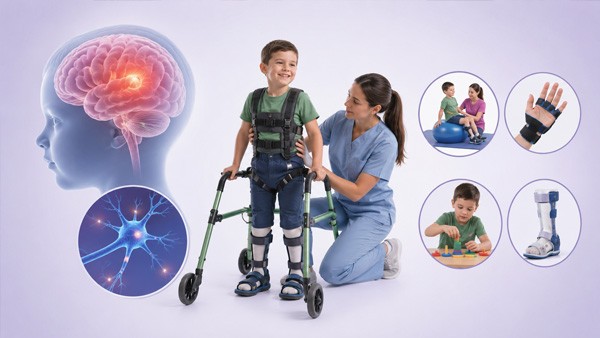

Cerebral palsy is not a single disease, not progressive, and not a measure of intelligence. It is a group of permanent conditions affecting movement and posture, caused by an injury or abnormality in the developing brain — and the injury itself does not worsen over time, even though its consequences for the body change considerably as a person grows.
It affects roughly two to three children per thousand born, making it the commonest physical disability of childhood. This guide covers what causes it, how the types differ, why early diagnosis has become possible far sooner than it once was, which treatments genuinely improve function, and the aspects of care — pain and hip surveillance in particular — that are most often neglected.
🧠 The distinction that matters most: the brain injury is static, but the musculoskeletal consequences are not. Muscles that receive abnormal signals grow differently from bones, joints deform under uneven pull, and a child who walks comfortably at six may struggle at fourteen. Management is therefore about anticipating and preventing those secondary changes rather than treating the original injury.
🧬 What causes it
The most persistent myth about cerebral palsy is that it results from something going wrong during delivery. Birth asphyxia does account for some cases, but it is a minority — the majority of causes operate before labour begins.
| Timing | Causes |
|---|---|
| Before birth | Abnormal brain development, fetal stroke, intrauterine infection, genetic factors, placental problems, multiple pregnancy |
| Around birth | Severe oxygen deprivation, complications of extreme prematurity, severe untreated jaundice |
| Prematurity specifically | Damage to white matter around the ventricles, the commonest pattern in babies born very early |
| After birth, in infancy | Meningitis, encephalitis, head injury, near-drowning, stroke |
Prematurity is the single largest risk factor. The very preterm brain is vulnerable in a specific way: the white matter tracts carrying signals to the legs run close to the ventricles, which is why injury there produces the pattern of leg-dominant spasticity seen so often in children born extremely early.
In a substantial number of cases no single cause is identified, and genetic contributions are increasingly recognised. That uncertainty is worth stating plainly, because parents frequently spend years searching for a preventable error that was never there.
🗂️ The types
Classification works on two axes: the kind of movement disorder, and how much it limits function.
| Type | Movement pattern | Notes |
|---|---|---|
| Spastic | Stiff muscles, increased tone, exaggerated reflexes | By far the commonest, around four in five cases |
| Dyskinetic | Involuntary movements — twisting dystonia or writhing athetosis | Movements increase with effort and emotion, disappear in sleep |
| Ataxic | Poor coordination, tremor, unsteady balance | Least common; affects precision of movement |
| Mixed | Features of more than one type | Spastic with dystonic elements is a frequent combination |
Spastic forms are described further by which limbs are affected: hemiplegia involves one side of the body, diplegia mainly the legs, and quadriplegia all four limbs, usually with the greatest overall impact.
Alongside that sits the Gross Motor Function Classification System, which describes what a person can actually do on a five-level scale — from level I, walking without limitation, to level V, transported in a wheelchair with limited head and trunk control. It has become the standard shorthand in clinics because it predicts needs and outcomes better than the anatomical labels do, and because it stays broadly stable as a child grows.
👶 Recognising it early
Cerebral palsy was traditionally diagnosed around age two. It can now be identified reliably far earlier — frequently before six months corrected age — and that shift matters enormously, because the infant brain is at its most adaptable precisely during the period once spent waiting.
Three tools do most of the work in high-risk infants: MRI of the brain, the General Movements Assessment, which analyses the quality of spontaneous movement in early infancy, and a standardised neurological examination. Used together in babies with risk factors, they identify most cases early.
Signs that prompt assessment include persistent stiffness or floppiness, strong hand preference before twelve months, failure to reach motor milestones, difficulty feeding, and asymmetry of movement. None is diagnostic alone, and many children with one of them turn out to have nothing wrong.
✅ Why earlier matters: intervention during the period of greatest neuroplasticity produces better motor outcomes than the same intervention started later, and it gives families access to support during the phase when they are most isolated. Waiting to be certain, once the standard practice, is no longer regarded as harmless.
🏥 What comes with it
Cerebral palsy is defined by its motor features, but associated conditions frequently affect daily life more than the movement disorder itself, and several are under-treated.
- Pain — reported by a large proportion of both children and adults, from muscle spasm, hip problems, constipation and positioning. It is the most under-recognised issue in the whole condition, particularly in people who cannot describe it verbally.
- Epilepsy in roughly a third, more often in quadriplegic and hemiplegic forms.
- Feeding and swallowing difficulty, with risks of aspiration and poor nutrition; some children need gastrostomy feeding.
- Constipation and reflux, extremely common and a frequent hidden cause of distress and irritability.
- Vision and hearing impairment, both commoner than in the general population.
- Communication difficulty — which is not the same as absence of understanding, a distinction people get wrong constantly.
- Hip displacement and scoliosis, progressive and preventable if monitored.
- Sleep disturbance, often from pain, spasm or difficulty changing position.
- Learning difficulty in a proportion — but many people with cerebral palsy have entirely typical intelligence, including some with the most severe physical involvement.
🔴 Hip surveillance deserves its own paragraph. In children with limited walking ability, the hip can gradually displace from its socket, and once dislocation occurs it causes severe pain and requires major surgery. Programmes of regular hip X-rays at intervals determined by GMFCS level detect displacement while it is still correctable, and in countries where such programmes are standard, painful dislocation has become rare. Ask specifically whether hip surveillance is in place.
🧑⚕️ The therapies that build function
The core of management is not pharmacological. Physical, occupational and speech therapies address the actual goals — moving, managing daily tasks, communicating — and the evidence has moved decisively toward specific, goal-directed, high-repetition approaches over general handling.
Goal-directed training works on tasks the person actually wants to do, practised intensively, rather than on abstract movement patterns. Constraint-induced movement therapy, in which the stronger arm is restrained while the affected one is used intensively, has solid evidence in hemiplegia, as does bimanual training. Speech and language therapy covers both communication and, separately, safe swallowing.
Equipment is part of therapy rather than an admission of defeat: orthoses to maintain joint position, standing frames, walkers, wheelchairs that restore independent movement, and communication devices. A powered wheelchair for a child who cannot walk independently expands their world rather than limiting it, and delaying it out of hope for walking costs years of autonomy.
💊 Treating spasticity
Where increased muscle tone limits function or causes pain, several options exist, chosen according to whether the problem is focal or generalised.
| Approach | Best suited to | Notes |
|---|---|---|
| Botulinum toxin injection | Focal spasticity in specific muscles | Effect lasts a few months; combined with therapy and casting to gain function |
| Oral baclofen | Generalised spasticity | Sedation and weakness limit the dose; never stopped abruptly |
| Oral tizanidine | Generalised spasticity, alternative or adjunct | Sedation and low blood pressure; liver monitoring |
| Intrathecal baclofen pump | Severe generalised spasticity or dystonia | Delivers drug directly to the spinal cord at far lower doses, avoiding sedation |
| Selective dorsal rhizotomy | Carefully selected children with spastic diplegia | Permanently reduces spasticity; requires intensive rehabilitation afterwards |
| Orthopaedic surgery | Established contractures, bony deformity, hip displacement | Often performed as a single multilevel procedure to avoid repeated operations |
Two cautions apply throughout. Spasticity is not always the enemy: some people rely on increased tone to stand or transfer, and reducing it can remove a function they were using. And abrupt withdrawal of baclofen, particularly from an intrathecal pump, can produce a dangerous syndrome with fever, rigidity and altered consciousness — which is why continuity of supply and awareness of the risk matter.
For dystonic movement, the drug options differ from those for spasticity, and deep brain stimulation is used in selected cases. Distinguishing spasticity from dystonia is therefore a practical necessity rather than a semantic point, and it is not always straightforward.
🎓 Beyond the clinic
Most of what determines quality of life happens outside medical appointments, and the framework used internationally reflects that: the aim is participation, not normalisation of gait.
Education requires appropriate assessment of ability, which depends on being able to communicate. Children with severe speech impairment and typical cognition are still routinely underestimated, and augmentative communication devices are the difference between being assumed unable and being able to demonstrate otherwise.
Physical activity and sport matter for the same reasons as in anyone else, plus specific benefits for bone density and cardiovascular health, both of which are compromised in people with limited mobility. Adapted sport exists at every level.
Family support is not peripheral. Parental mental health, respite provision and practical help with equipment and housing adaptation determine how sustainable care is over decades, and services routinely underestimate this.
👨🦰 Adults with cerebral palsy
Cerebral palsy is usually discussed as a childhood condition, yet most people with it are adults, and adult services are considerably thinner than paediatric ones.
Several issues emerge with age. Musculoskeletal wear accumulates from years of altered biomechanics, producing early arthritis and increasing pain. Walking ability can decline in adulthood, sometimes substantially, and the loss is frequently attributed to lack of effort rather than to the mechanical reality. Fatigue is common, reflecting the greater energy cost of movement. Osteoporosis and fracture risk rise with reduced weight-bearing.
The transition from paediatric to adult care is a recognised weak point in most health systems. What helps is a named coordinating clinician, a written summary of the person history and current needs, and continuity of the therapies and equipment that were maintaining function — all of which frequently lapse at eighteen precisely when they should not.
⚠️ A note on language and assumptions: cerebral palsy affects movement, not necessarily thinking. Speaking to a companion instead of the person, raising one voice, or assuming that difficulty speaking means difficulty understanding are everyday experiences reported by people with this condition. Where communication is difficult, the answer is a communication method, not a lowered expectation.
📈 What the outlook is
Prognosis varies as widely as the condition itself. Most children with mild involvement walk independently and live typical lifespans with typical educational and occupational outcomes. Those with severe quadriplegic involvement, epilepsy and feeding difficulty face greater medical complexity and shorter life expectancy, though survival has improved substantially with better respiratory and nutritional care.
Motor function generally improves through childhood, plateaus in adolescence and may decline in adulthood without maintenance — a trajectory that argues for continued therapy and activity through the years when services typically withdraw.
The framing that best matches evidence is functional rather than curative: cerebral palsy is not reversible, and treatment that maximises independence, prevents secondary deformity, controls pain and supports participation delivers more than any attempt to normalise movement for its own sake.
The muscle relaxant options discussed above are in the muscle relaxer category, prescribed and titrated by the treating team.
❓ Frequently asked questions
Does cerebral palsy get worse over time?
The brain injury itself does not progress. What can worsen are the secondary musculoskeletal consequences: muscles grow differently from bones, joints deform under uneven pull, and contractures develop. That is why monitoring and preventive management matter, and why a person may need more support at fifteen than at six despite an unchanged underlying injury.
Is it caused by problems during birth?
In a minority of cases. The majority of causes operate before labour begins — abnormal brain development, fetal stroke, intrauterine infection, genetic factors and the complications of extreme prematurity. Prematurity is the single largest risk factor. In many cases no single cause is identified, and parents frequently spend years looking for a preventable error that did not occur.
Does cerebral palsy affect intelligence?
Not necessarily. Learning difficulty occurs in a proportion of people, but many have entirely typical intelligence, including some with the most severe physical involvement. Difficulty speaking is not evidence of difficulty understanding. Where communication is impaired, an augmentative communication method is what allows ability to be demonstrated rather than assumed.
How early can it be diagnosed?
Frequently before six months corrected age in high-risk infants, using brain MRI, the General Movements Assessment and a standardised neurological examination together. That is far earlier than the traditional age of around two, and it matters because intervention during the period of greatest brain plasticity produces better motor outcomes than the same intervention started later.
What is GMFCS and why is it used?
The Gross Motor Function Classification System, a five-level description of what a person can actually do — from walking without limitation at level I to being transported with limited head and trunk control at level V. It is used because it predicts needs and outcomes better than anatomical labels, stays broadly stable as a child grows, and guides decisions such as how often hip surveillance is needed.
Why is hip surveillance important?
Because in children with limited walking ability the hip can gradually displace from its socket, and once dislocated it causes severe pain and requires major surgery. Regular X-rays at intervals set by GMFCS level detect displacement while it is still correctable. In health systems where surveillance programmes are standard, painful dislocation has become rare.
Is pain common in cerebral palsy?
Very, and it is the most under-recognised aspect of the condition. Sources include muscle spasm, hip problems, constipation, reflux and prolonged positioning. It is missed most often in people who cannot report it verbally, where irritability, poor sleep or behaviour change may be the only signals. Any unexplained change in behaviour deserves a search for a physical cause.
What do baclofen and tizanidine do?
Both reduce muscle tone in generalised spasticity. Their limitation is that useful doses often cause sedation and weakness, which is why an intrathecal pump is used in severe cases — it delivers the drug directly to the spinal cord at far lower doses. Baclofen must never be stopped abruptly, particularly from a pump, because withdrawal can cause a dangerous syndrome with fever and rigidity.
Is reducing spasticity always beneficial?
No, and this surprises people. Some individuals rely on increased tone to stand, transfer or bear weight, and reducing it can remove a function they were actively using. Treatment decisions therefore start from what the person wants to be able to do, not from the degree of spasticity measured on examination.
Which therapies have the best evidence?
Goal-directed training on tasks the person actually wants to perform, practised intensively; constraint-induced movement therapy and bimanual training in hemiplegia; and speech and language therapy for both communication and safe swallowing. The shift in evidence has been away from general handling toward specific, high-repetition, functionally meaningful practice.
Will a wheelchair stop a child learning to walk?
No. Providing appropriate mobility equipment expands independence, participation and social development, and does not remove motivation to walk where walking is achievable. Delaying it in the hope of walking commonly costs years of autonomy during exactly the period when a child is forming relationships and learning about the world.
What changes in adulthood?
Musculoskeletal wear accumulates from years of altered biomechanics, producing early arthritis and increasing pain. Walking ability can decline, fatigue is common because movement costs more energy, and bone density falls with reduced weight-bearing. Adult services are thinner than paediatric ones, so continuity of therapy and equipment through the transition at eighteen matters considerably.
📑 Sources and editorial
- International consensus definition and classification of cerebral palsy, and the Gross Motor Function Classification System
- Novak I et al. — systematic reviews of early diagnosis and of interventions in cerebral palsy
- Clinical guidance on hip surveillance programmes and on spasticity management including botulinum toxin and intrathecal baclofen
- FDA prescribing information for baclofen and tizanidine, including withdrawal warnings
- Related products: muscle relaxant medications
- RXshop Editorial Team — reviewed by James Carter, MD, Neurologist
Medical Disclaimer: The information in this article is for educational and informational purposes only and is not a substitute for professional medical advice, diagnosis, or treatment. Always seek guidance from a qualified healthcare provider with any questions you may have regarding a medical condition, and before starting, stopping or changing any medication.