Muscle Spasticity: Causes, Assessment and Treatment Options


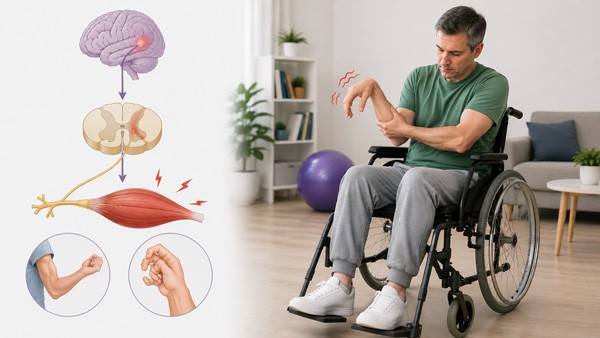
Spasticity is a velocity-dependent increase in muscle tone: the faster a limb is moved, the harder it resists. It is not the same as stiffness, not the same as a cramp, and not the same as weakness, although all three frequently accompany it. It arises when the pathways running from the brain down the spinal cord are damaged and the reflexes they normally restrain become disinhibited.
It follows stroke, spinal cord injury, traumatic brain injury, multiple sclerosis and cerebral palsy, and it ranges from a barely noticeable catch in one ankle to whole-body rigidity that makes dressing and seating impossible. This guide covers what produces it, how it is assessed, the triggers that make it flare unexpectedly, and how the treatments are layered from physical management through oral medicines to injections and pumps.
🧠 The single most useful idea in this article: spasticity is often not the primary problem. A sudden worsening in someone whose tone was previously stable is usually caused by something else entirely — a urinary infection, constipation, a pressure sore, an ingrown toenail — and finding that cause resolves the spasticity far more effectively than increasing the dose of anything.
🧬 What is actually happening
Movement is controlled by two layers. Upper motor neurons run from the brain down the spinal cord; lower motor neurons run from the cord out to the muscles. The upper layer does not only send commands to move — a large part of its job is inhibition, continuously damping the spinal reflexes so that muscles do not respond to every small stretch.
When the upper layer is damaged, that inhibition is lost. The stretch reflex becomes exaggerated, muscles contract in response to being lengthened, and tone rises. Because the reflex is sensitive to the speed of stretch, resistance increases the faster the limb is moved — the defining characteristic that separates spasticity from other causes of a stiff limb.
Clinicians describe the result as upper motor neuron syndrome, and it has two sides that are easy to confuse:
| Positive features (things added) | Negative features (things lost) |
|---|---|
| Increased muscle tone | Weakness |
| Exaggerated tendon reflexes | Loss of dexterity and fine control |
| Clonus — repetitive rhythmic beating | Fatigue on sustained effort |
| Flexor and extensor spasms | Poor selective muscle activation |
| Associated reactions during effort | Slowed movement initiation |
This distinction has direct practical consequences. Drugs reduce the positive features; nothing reduces the negative ones. A person whose main problem is weakness rather than tone will feel worse on a muscle relaxant, not better — which is why the assessment before treatment matters more than the choice of drug.
Over months, a second process compounds the first. A muscle held permanently in a shortened position undergoes structural change: it loses sarcomeres, connective tissue proliferates, and the muscle physically shortens. That is contracture, and it does not respond to any medication because it is no longer a neurological problem. Preventing it is the main reason positioning and stretching are pushed so hard early on.
🏥 What causes it
Any lesion of the descending motor pathways can produce spasticity. What differs between causes is the timing, the distribution and the trajectory.
| Cause | Typical pattern | Course |
|---|---|---|
| Stroke | One side; flexed arm, extended leg | Appears over weeks to months, then stabilises |
| Spinal cord injury | Below the level of injury, both sides | Emerges after the initial flaccid phase; prone to spasms |
| Multiple sclerosis | Legs predominantly | Fluctuates with relapses and heat; may progress |
| Traumatic brain injury | Variable, often widespread | Evolves during recovery |
| Cerebral palsy | Present from early childhood | Static lesion, but deformity progresses with growth |
| Hereditary spastic paraplegia | Legs, symmetrical | Slowly progressive over years |
Roughly seven in ten people with cerebral palsy have spasticity, and it is likewise very common after spinal cord injury and in progressive multiple sclerosis. After stroke the figure is lower overall but the impact is high, because the affected arm often becomes the limiting factor in independence. The childhood presentation is covered separately in the guide to cerebral palsy, where growth adds complications that do not arise in adults.
📏 How it is assessed
Measuring tone objectively is harder than it sounds, and the scales in routine use are all imperfect.
The Modified Ashworth Scale grades resistance felt during a passive movement from 0 to 4. It is quick and universal, which is why it survives, but it does not separate neurological tone from mechanical stiffness, and agreement between examiners is only moderate. The Tardieu Scale attempts to correct this by comparing resistance at slow and fast speeds, which isolates the velocity-dependent component — the part that is genuinely spastic and therefore genuinely treatable.
Alongside these sit measures of what actually matters to the person: spasm frequency counts, pain scores, range of motion, and functional measures such as walking speed or the ability to open a hand for washing.
✅ Goal setting is the assessment that counts. Before any treatment, the question is what specific outcome is wanted: a hand that opens enough to clean the palm, a foot that clears the ground when walking, comfortable sitting, easier dressing, less night-time spasm, reduced pain. A defined goal makes it possible to tell whether a treatment worked. Aiming vaguely at "less spasticity" makes it impossible.
⚖️ When treating is the wrong move
Spasticity is not automatically harmful, and this is the point most commonly missed. Increased extensor tone in the legs allows many people to stand, transfer between chair and bed, and bear weight during care. Reduce it, and that capacity can disappear.
Other people rely on it less obviously. Tone helps maintain muscle bulk, may reduce the risk of deep vein thrombosis through repeated contraction, and can support circulation in a limb that would otherwise be entirely still.
Treatment is indicated when spasticity causes one of the following, not when it merely exists:
- Pain from sustained contraction or spasm
- Interference with function — walking, reaching, grasping, transferring
- Difficulty with care — washing, dressing, catheterisation, positioning
- Risk of contracture from a joint held permanently in one position
- Skin breakdown where limbs press together or against a surface
- Sleep disruption from night-time spasms
Where none of these applies, observation and prevention are the correct approach, and adding a sedating drug to a person who was managing fine is a net loss.
🔍 The triggers people miss
Spasticity is dynamic. It responds to anything the nervous system perceives as noxious, even when the person cannot feel the stimulus consciously — in spinal cord injury especially, a problem below the level of injury announces itself through a sharp increase in tone rather than through pain.
| Trigger | How it shows up |
|---|---|
| Urinary tract infection | The commonest cause of sudden unexplained worsening |
| Constipation or full bladder | Generalised increase, often at predictable times of day |
| Pressure sore, even early | Persistent increase that does not settle |
| Ingrown toenail, fracture, injury | Localised then generalised spasm |
| Tight clothing, poorly fitting brace or seating | Worse in a specific position or after transfer |
| Cold, and heat in multiple sclerosis | Seasonal or environmental fluctuation |
| Anxiety, pain, fatigue | Worse at the end of the day or under stress |
| Missed doses of an existing drug | Rebound increase, sometimes severe |
🔴 Before escalating any treatment, look for a trigger. A person whose tone has been steady for months and suddenly worsens has almost always developed a new problem elsewhere. Treating the infection or clearing the bowel resolves the spasticity; increasing the drug dose treats the symptom while the underlying problem continues to develop.
🤸 Physical management is the foundation
No drug replaces physical management, and drugs work considerably better alongside it than instead of it.
Stretching and positioning maintain muscle length and delay contracture. What matters is duration rather than force — a sustained hold over minutes achieves more than repeated brief pulls, and prolonged positioning through the day and night achieves more still. Standing frames provide extended stretch through the hips, knees and ankles simultaneously, with additional benefit for bone density and bowel function.
Splinting, orthoses and serial casting hold joints in a lengthened position between sessions. Serial casting, in which a cast is applied and progressively adjusted, can recover range in a joint that has already begun to tighten — and it works best combined with botulinum toxin, which reduces the tone pulling against the cast.
Active exercise and strengthening were once avoided on the theory that effort worsens spasticity. That view has not held up: strengthening the weak antagonist muscles improves function without increasing tone, and weakness rather than tone is frequently the greater limitation.
Seating and equipment deserve more attention than they usually receive. A badly configured wheelchair drives abnormal tone all day, every day, and no medication compensates for it. Postural assessment is a treatment, not an accessory.

💊 Oral medications
Oral drugs act on the whole body, which makes them appropriate for widespread spasticity and inappropriate for a problem confined to one limb. All of them share the same fundamental limitation: the dose that meaningfully reduces tone is frequently the dose that causes drowsiness and weakness.
| Drug | How it works | Main limitations |
|---|---|---|
| Tizanidine (Zanaflex, Tizan) | Alpha-2 agonist acting centrally to reduce excitatory transmission | Drowsiness, dry mouth, low blood pressure; liver enzymes need monitoring |
| Baclofen (Lioresal, Baclof) | GABA-B agonist acting on the spinal cord | Sedation, weakness, confusion in older people; never stopped abruptly |
| Diazepam and other benzodiazepines | GABA-A enhancement | Strong sedation, tolerance, dependence; mainly for night-time spasm |
| Dantrolene | Acts on the muscle itself rather than the nervous system | Marked weakness; risk of liver toxicity requiring monitoring |
| Gabapentin | Reduces neuronal excitability | Modest effect on tone; useful where neuropathic pain coexists |
Tizanidine and baclofen are the two first-line choices, and the decision between them is usually made on side effect profile rather than efficacy, since head-to-head evidence shows little difference in tone reduction. Tizanidine causes less weakness, which matters for someone still walking; baclofen tends to be better tolerated over long periods and can be escalated further. Both are started low and increased slowly, and both are often given in divided doses timed around when spasticity interferes most — a larger evening dose for someone whose main problem is night-time spasm, for instance.
Dantrolene occupies a different position because it acts peripherally, at the muscle. That avoids the sedation of the central drugs but produces generalised weakness, so it is reserved for people who are not relying on their muscles for standing or transferring.
⚠️ Baclofen withdrawal is a genuine emergency. Stopping it suddenly — a missed prescription, a hospital admission where it is not continued, a failing intrathecal pump — can cause fever, severe rebound spasticity, confusion and, rarely, life-threatening complications. It must always be tapered, and anyone taking it should ensure it appears on every medication list they hand over.

💉 Focal treatment with injections
Where the problem is confined to particular muscles — a clenched hand, a foot turning inward, a thumb pulled into the palm — treating the whole body with an oral drug is the wrong instrument. Injections deliver the effect precisely where it is needed.
Botulinum toxin blocks the signal at the junction between nerve and muscle, weakening the injected muscle specifically. The effect begins within days, peaks at a few weeks and wears off over roughly three to four months, after which repeat injection is needed. It is generally well tolerated, with the main risk being unwanted weakness if too much diffuses into neighbouring muscles.
The important point is that the injection is not the treatment on its own. Its value lies in the window it creates: a period of reduced tone during which stretching, casting, splinting and task practice can achieve range and function that were impossible before. Injection without a rehabilitation plan attached wastes most of the benefit.
Phenol and alcohol nerve blocks are an older alternative, chemically disrupting the nerve. They are cheaper and longer lasting but less selective, with a risk of painful sensory side effects, and they are now used mainly for large muscles or where botulinum toxin is unavailable or has stopped working.
🔧 Intrathecal baclofen
For severe generalised spasticity that oral drugs cannot control without unacceptable sedation, baclofen can be delivered directly into the fluid around the spinal cord through an implanted pump.
The logic is one of concentration. Because the drug is placed where it acts, the dose required is a small fraction of the oral equivalent, and very little reaches the brain — which is why the sedation that limits oral baclofen largely disappears. A test dose is given first to confirm response before the pump is implanted.
It is an effective option, and it is also a commitment. The reservoir requires refilling at intervals, the catheter can kink or disconnect, the pump has a finite battery life, and pump failure produces abrupt withdrawal — the dangerous scenario described above. It suits people with severe, stable, generalised spasticity who have access to a centre that manages pumps properly, and it does not suit those who cannot attend for refills reliably.
🔬 Surgical options
Surgery addresses two different problems, and confusing them leads to disappointment.
Selective dorsal rhizotomy targets the neurological problem. Sensory nerve rootlets entering the spinal cord are tested during the operation and the abnormally responsive ones are divided, permanently reducing the reflex loop that drives spasticity. It is used mainly in carefully selected children with spastic diplegia who have good underlying strength, and it demands intensive rehabilitation afterwards, because the tone that was partly holding the child up is gone and the muscles beneath it must take over.
Orthopaedic surgery addresses the mechanical consequences: tendon lengthening for established contracture, tendon transfer to rebalance a joint, osteotomy to correct bony deformity, and hip reconstruction where displacement has progressed. It is often performed as a single multilevel procedure so that one recovery period covers several problems rather than a child facing repeated operations across childhood.
Neither reverses the underlying injury. Both change the mechanics so that whatever movement is available can be used more effectively.
📅 Day to day
Between appointments, several things reliably help.
Keep a pattern record. Noting when spasticity is worst — time of day, position, activity, relation to doses — produces more useful information for a clinic visit than any scale, and often reveals a trigger nobody had considered.
Treat the ordinary problems promptly. Bladder and bowel management, skin checks, nail care and well-fitting footwear prevent most of the sudden flares described earlier. This is unglamorous and it is the highest-yield intervention available.
Keep moving. Regular movement through available range, whether active or assisted, preserves length better than anything done occasionally and intensively.
Watch the sleep and mood side. Pain, poor sleep and anxiety all raise tone directly, and treating them frequently improves spasticity without touching the muscle relaxants at all.
Do not adjust doses alone. Both directions carry risk — increases bring sedation and falls, and abrupt reductions in baclofen bring withdrawal.

📊 What to expect from treatment
Realistic expectations prevent most of the disappointment around spasticity management.
Tone can be reduced; the underlying nerve damage cannot be repaired. Weakness beneath the spasticity will still be there once the tone is gone, and sometimes becomes more obvious. Established contracture will not respond to any drug. And the treatment that works this year may need adjusting next year as circumstances, activity levels and other conditions change.
What treatment does deliver, reliably, is comfort, easier care, preserved range, prevention of deformity, and in many cases a specific functional gain that was the goal from the start. Measured against those aims rather than against a return to normal movement, the results are good.
The oral options discussed here are stocked in the muscle relaxer category, with Zanaflex (tizanidine) and Lioresal (baclofen) being the two first-line agents. Both require a prescription and dose titration supervised by the treating clinician.
❓ Frequently asked questions
What is the difference between spasticity and a muscle cramp?
A cramp is a temporary involuntary contraction in an otherwise normal muscle, usually related to fatigue, dehydration or electrolyte imbalance, and it resolves on its own. Spasticity is a permanent change in how the nervous system regulates tone following damage to the pathways from brain to spinal cord. It is velocity-dependent, present continuously rather than in episodes, and it does not resolve without treatment of the underlying tone.
Why did my spasticity suddenly get worse?
Almost always because of a new problem elsewhere in the body. Urinary tract infection is the commonest culprit, followed by constipation, a full bladder, an early pressure sore, an ingrown toenail, a fracture, or badly fitting clothing or seating. The nervous system responds to noxious input by raising tone, even when the stimulus itself cannot be felt. Search for the trigger before increasing any dose.
Should all spasticity be treated?
No. Many people use increased extensor tone in the legs to stand, transfer and bear weight, and reducing it removes that capacity. Treatment is indicated when spasticity causes pain, limits function, makes personal care difficult, threatens the skin, disrupts sleep, or risks contracture. Where none of those applies, monitoring and prevention are the right approach.
Tizanidine or baclofen, which is better?
Comparative studies show little difference in how much tone they reduce, so the choice is usually made on side effects. Tizanidine causes less muscle weakness, which matters for someone still walking, but causes more dry mouth and low blood pressure and requires liver monitoring. Baclofen is often better tolerated long term and can be escalated further, but causes more weakness and confusion, particularly in older people. Some people take both.
Can baclofen be stopped suddenly?
No, and this is one of the few genuine emergencies in spasticity care. Abrupt withdrawal can cause fever, severe rebound spasticity, confusion and rarely life-threatening complications. The risk applies to oral baclofen and even more to intrathecal pumps, where a mechanical failure produces sudden loss of supply. Baclofen must be tapered, and it should appear on every medication list handed to any healthcare provider.
How long does botulinum toxin last?
The effect starts within a few days, peaks at around two to four weeks and wears off over roughly three to four months, after which repeat injection is needed. The injection is not the whole treatment: its value lies in the window of reduced tone, during which stretching, casting, splinting and task practice can achieve range and function that were not previously possible. Without that rehabilitation attached, most of the benefit is lost.
What is an intrathecal baclofen pump?
An implanted device that delivers baclofen directly into the fluid around the spinal cord. Because the drug is placed where it acts, the dose required is a small fraction of the oral equivalent and very little reaches the brain, so the sedation that limits oral baclofen largely disappears. It suits severe generalised spasticity, requires regular refills and specialist follow-up, and carries the risk of withdrawal if the pump or catheter fails.
Does exercise make spasticity worse?
It was once believed so, and that belief kept people inactive for decades. It has not held up. Strengthening the weak opposing muscles improves function without increasing tone, and inactivity does far more harm through contracture, deconditioning and bone loss. Effort can produce a transient increase in tone during the activity itself, but this settles and does not represent worsening of the underlying condition.
What is a contracture and can medication fix it?
A contracture is permanent shortening of a muscle and its surrounding tissue after being held in one position for a long period. The muscle loses sarcomeres and connective tissue proliferates, so the limitation becomes mechanical rather than neurological. No medication reverses it, which is why stretching, positioning and splinting are pushed so hard from the beginning. Established contracture requires serial casting or surgical release.
Why do I feel weaker after starting a muscle relaxant?
Because the weakness was already present, masked by the tone. Damage to the motor pathways produces both increased tone and reduced strength, and removing the tone reveals what lies underneath. This is also why the dose has to be titrated carefully: the level that reduces tone usefully is often close to the level that removes function the person was relying on.
Does spasticity get worse over time?
It depends on the cause. After stroke or traumatic brain injury it typically develops over weeks to months and then stabilises. After spinal cord injury it emerges once the initial flaccid phase passes and remains fairly steady. In progressive multiple sclerosis and hereditary spastic paraplegia it can worsen as the disease advances. What tends to progress in all of them is the secondary musculoskeletal change, which is preventable.
What does the Ashworth scale measure?
Resistance felt by an examiner during passive movement of a limb, graded from 0 to 4. It is quick and used everywhere, but it does not separate neurological tone from mechanical stiffness, and agreement between different examiners is only moderate. The Tardieu Scale addresses this by comparing resistance at slow and fast speeds, isolating the velocity-dependent component that is genuinely spastic and therefore genuinely treatable.
📑 Sources and editorial
- Clinical guidance on the management of spasticity in adults, including botulinum toxin and intrathecal baclofen protocols
- Lance JW — original definition of spasticity as velocity-dependent increase in tonic stretch reflexes
- Modified Ashworth Scale and Tardieu Scale validation literature
- FDA prescribing information for tizanidine, baclofen, dantrolene and diazepam, including the baclofen withdrawal warning
- Related reading: cerebral palsy
- Related products: Zanaflex tizanidine, muscle relaxant category
- RXshop Editorial Team — reviewed by James Carter, MD, Neurologist
Medical Disclaimer: The information in this article is for educational and informational purposes only and is not a substitute for professional medical advice, diagnosis, or treatment. Always seek guidance from a qualified healthcare provider with any questions you may have regarding a medical condition, and before starting, stopping or changing any medication.