Anxiety Medication Compared: Which Drug Suits Which Symptom, and Why None of Them Is a Benzodiazepine

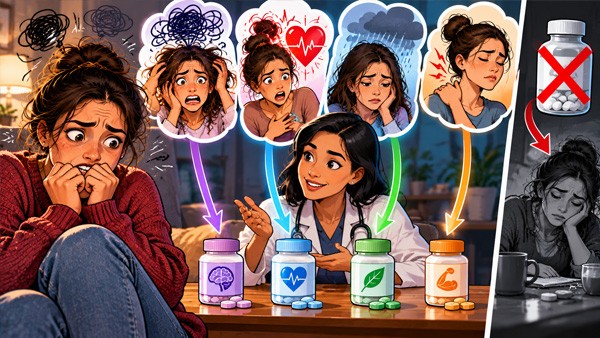

Two questions come up at every appointment about anxiety, and neither tends to get a straight answer. Which one of these actually suits me. And will I end up unable to stop it.
Both have clear answers. The second one in particular, because the drugs that cause dependence are not the drugs used for ongoing anxiety in the first place.
💡 Two things that make the choice much simpler.
🔹 The drug is picked by which symptom dominates. Relentless worrying, a pounding heart before a presentation, and panic that needs something within the hour are three different problems with three different answers — and the wrong match is usually why a medicine "did not work".
🔹 The main options carry no dependence risk at all. SSRIs, buspirone, hydroxyzine and propranolol are not habit-forming. The class people are afraid of, benzodiazepines, is a short-term tool, and there is a good case for not reaching for it — set out below.
🧭 Matching the drug to the problem
| What dominates | Usual choice | How fast |
|---|---|---|
| Constant worrying, mind never switching off | An SSRI, or buspirone | Weeks |
| Panic attacks | An SSRI as the base treatment | Weeks, and it genuinely works |
| Social anxiety | An SSRI, fluvoxamine or paroxetine among the better studied | Weeks |
| Pounding heart, shaking, sweating before a specific event | Propranolol, taken beforehand | About an hour |
| Anxiety with insomnia, or needing something short-term now | Hydroxyzine | 30–60 minutes |
| Anxiety with depression | An SSRI or SNRI, treating both at once | Weeks |
| Anxiety where antidepressants were not tolerated | Buspirone or hydroxyzine | Weeks / hours |
🧠 SSRIs and SNRIs: the backbone
These are first-line for generalised anxiety, panic disorder and social anxiety, and the evidence behind them is the strongest of anything here. They are not being prescribed because a doctor thinks the problem is depression — they treat anxiety in their own right, and often better than they treat low mood.
📌 The paradox that makes people stop in week one.
For the first week or two these commonly make anxiety worse — more jittery, more wired, worse sleep. Someone taking a tablet for anxiety, who then feels more anxious, reasonably concludes it is the wrong drug.
It is expected, it is temporary, and it is largely avoidable: in anxiety these are started at around half the dose used for depression and built up slowly. If the start was rough, the entry dose was probably too high rather than the drug being wrong.
The useful effect takes four to six weeks, and in anxiety sometimes eight to twelve. Judging at day ten is judging it before it has begun.
Side effects, timing, the sexual effects and how to stop them safely are covered in our guide to what to expect from this class. One point from it bears repeating here: they are not addictive, but they must be tapered rather than stopped abruptly — those are different things, and the confusion between them keeps people off a treatment that would help.
💚 Buspirone: the one nobody has heard of
Buspar (Buspirone) is licensed specifically for generalised anxiety and sits in a class of its own. It acts on serotonin receptors without touching the system benzodiazepines use, which gives it an unusual profile.
- ✅ No dependence, no tolerance, no withdrawal
- ✅ Not sedating, and it does not impair concentration or driving the way sedatives do
- ✅ No interaction with alcohol in the way sedatives have
- 📈 Started around 5 mg two or three times daily, building to 20–30 mg a day in divided doses
- ⏳ Takes two to four weeks to do anything
⚠️ The single most common reason buspirone fails.
It does not work taken when you feel anxious. It has to be taken on a fixed schedule, every day, whether or not the day is a bad one — like an SSRI, not like a sedative.
People prescribed it after a benzodiazepine often expect the same immediate calming, feel nothing, and abandon it within a week. It is a maintenance drug that happens to be fast to tolerate, not a rescue one.
Two practical notes: avoid grapefruit juice, which raises its levels considerably, and tell the prescriber about any antifungal or macrolide antibiotic for the same reason.
Its own side effects are usually mild and early — dizziness, light-headedness, headache, nausea — and settle within the first week or two.
🌙 Hydroxyzine: fast, and not habit-forming
Atarax (Hydroxyzine) is an antihistamine with a genuine licensed use in anxiety, and it fills the gap that otherwise gets filled by a benzodiazepine.
- ⚡ Works within 30 to 60 minutes, which is the point of it
- ✅ No dependence and no tolerance
- 😴 Sedating — useful when anxiety is wrecking sleep, awkward during the working day
- 📈 Typically 25–50 mg, as needed or at night
That combination — fast acting and non-addictive — makes it the sensible choice for a difficult fortnight, for the wait while an SSRI starts working, or for anxiety that mostly shows up at bedtime.
Downsides are the antihistamine ones: drowsiness, dry mouth, and impaired driving. It is used cautiously in older adults, and high doses can affect heart rhythm, so it is avoided with other drugs that do the same. Atarise is the same drug.
💓 Propranolol: for the body, not the mind
Ciplar-LA (Propranolol) does something the others do not. It blocks the adrenaline effects — racing heart, shaking hands, trembling voice, sweating — without touching the thoughts at all.
That sounds limited and is often exactly right, because in performance situations the physical symptoms are what sabotage things, and they feed the fear in a loop: hands shake, you notice, you panic, they shake more.
- 🎤 Classic use is performance anxiety — presentations, interviews, exams, musicians and public speakers
- ⏱️ Taken 30 to 60 minutes beforehand, typically 10 to 40 mg
- ✅ Not addictive, not sedating, and does not blunt thinking
- ❌ Does nothing for worrying itself, so it is a poor choice for generalised anxiety
⚠️ Propranolol must not be used in asthma.
It blocks receptors in the airways as well as the heart and can trigger severe bronchospasm. This applies to anyone with asthma or a history of wheezing, and it is not a small risk.
Also caution with: diabetes, because it masks the warning signs of a low blood sugar; a slow heart rate or low blood pressure; and heart failure. And if taken regularly rather than occasionally, it must not be stopped abruptly.
🚫 Why benzodiazepines are not on this list
Diazepam, alprazolam and lorazepam work. They work within half an hour, reliably, and that is precisely the problem.
| Issue | What happens |
|---|---|
| Tolerance | The anxiety-reducing effect fades within weeks. The same dose does less, so the dose climbs |
| Dependence | Physical dependence develops quickly, and coming off needs a slow, supervised taper |
| Rebound anxiety | Anxiety on stopping is frequently worse than it was before starting, which reads as proof the drug was needed |
| Cognition | Memory and concentration are affected, and the person taking them is usually the last to notice |
| Falls | Significant cause of falls and fractures in older adults |
| With alcohol or opioids | Dangerous combination affecting breathing |
📌 The less obvious reason, and arguably the more important one.
Recovery from anxiety depends on the brain learning that the feared situation is survivable. That learning only happens by going through the anxiety and finding out.
A benzodiazepine taken beforehand removes the experience the learning depends on. The lesson becomes "I got through it because of the tablet" rather than "I got through it", and the fear is preserved rather than reduced.
Which is why they can make long-term outcomes worse even when each individual dose works perfectly.
They retain a legitimate place — a few days during an acute crisis, or a single dose for a scan in someone claustrophobic. That is a different thing from ongoing treatment of an anxiety disorder, and it is the ongoing use that causes the harm.
⏱️ How fast each one works
| Timeframe | What acts in it |
|---|---|
| Under an hour | Hydroxyzine; propranolol for physical symptoms; slow breathing, which costs nothing |
| 1–2 weeks | Sleep and appetite often improve first on an SSRI, before mood or worry do |
| 2–4 weeks | Buspirone begins to work |
| 4–6 weeks | SSRIs reach useful effect — the point at which the decision to continue or change is made |
| 8–12 weeks | Full benefit in anxiety, which takes longer than in depression |
| Ongoing | Therapy, whose advantage over medication grows after treatment stops |
That bottom row matters. Cognitive behavioural therapy performs about as well as medication while it is happening, and better afterwards, because the skills remain. Combining the two is generally more effective than either alone, and anyone offered only tablets is being offered half the treatment.
☕ What makes anxiety worse regardless of treatment
- ☕ Caffeine. It produces the exact physical state of anxiety and can trigger panic attacks outright in susceptible people. Worth a genuine trial of cutting it, counting energy drinks, green tea and cola
- 🍷 Alcohol. It calms for two hours and produces rebound anxiety as it clears, which is why anxiety is often worst the morning after
- 🚬 Nicotine, including vaping. The calm between cigarettes is relief of withdrawal, not reduction of anxiety
- 🌿 Cannabis, which worsens anxiety in many people and can precipitate panic
- 😴 Short sleep, which lowers the threshold for everything
- 💨 Salbutamol inhalers, which cause tremor and palpitations indistinguishable from anxiety
- 💊 Decongestants containing pseudoephedrine
- 💊 Steroid tablets
- 🦋 Too much thyroid hormone, or an overactive thyroid — see an overactive thyroid
🫁 The physical symptoms, and where they come from
Chest tightness, a pounding heart, breathlessness, dizziness, tingling in the fingers and lips, a sense of unreality. These are frightening precisely because they feel physical, and they send a great many people to emergency departments.
Most of them come from one thing: over-breathing. Anxiety speeds up breathing, which blows off carbon dioxide, which narrows blood vessels to the brain and alters nerve excitability — producing the dizziness, the tingling and the unreality. The chest tightness is the breathing muscles working harder than usual.
Which is why slow breathing works and works quickly: breathe out for longer than you breathe in, four counts in and six or more out, for a couple of minutes. It is not a relaxation suggestion; it reverses the chemistry causing the symptoms.
⚠️ Never assume anxiety for chest pain the first time it happens.
A first episode of chest pain needs proper assessment, whatever the explanation turns out to be. The same applies to chest pain that is new, different from your usual pattern, comes on with exertion, spreads to the jaw or arm, or arrives with sweating and nausea.
Panic attacks are diagnosed after the dangerous things have been excluded, not instead of excluding them.
📞 When to seek help
🚨 Emergency: thoughts of harming yourself; a first episode of chest pain, or chest pain that is new or different; breathlessness with blue lips; or severe wheezing after taking propranolol.
Worth an appointment:
- Anxiety affecting work, sleep or relationships for more than a few weeks
- An SSRI stopped in the first fortnight because it made things worse — that phase was expected and a lower start usually fixes it
- Four to six weeks on a steady dose with no change, which is the point to adjust or switch
- Buspirone taken only on bad days — it does not work that way
- Asthma and a propranolol prescription — raise it before taking any
- Taking a benzodiazepine for more than two to four weeks, which needs a planned taper rather than sudden stopping
- Only medication offered, with no therapy — ask about it
- Thyroid never checked, since an overactive thyroid mimics this exactly
- Heavy caffeine or alcohol use alongside anxiety treatment
- Using alcohol to manage the symptoms
- Panic attacks stopping you leaving the house, which needs treating early before avoidance sets
- Pregnancy, or planning one
❓ Frequently asked questions
Which anxiety medications are not addictive?
SSRIs and SNRIs, buspirone, hydroxyzine and propranolol all carry no dependence risk. Benzodiazepines are the class that does, and they are intended for short-term use only.
Why did my anxiety get worse when I started an SSRI?
Early increased jitteriness is expected in the first one to two weeks. In anxiety these are started at around half the dose used for depression precisely to limit it, and it settles.
How long does buspirone take to work?
Two to four weeks, and only if taken on a fixed daily schedule. It does nothing taken as needed on bad days, which is the commonest reason people conclude it failed.
What works fastest for anxiety?
Hydroxyzine within 30 to 60 minutes, and propranolol within about an hour for the physical symptoms. Slow breathing with a longer out-breath works within minutes and costs nothing.
Does propranolol help with worrying?
No. It blocks the physical effects of adrenaline such as racing heart, shaking and sweating, but leaves the thoughts untouched. That makes it good for performance anxiety and poor for generalised anxiety.
Can I take propranolol if I have asthma?
No. It blocks receptors in the airways as well as the heart and can trigger severe bronchospasm. This applies to anyone with asthma or a history of wheezing.
Why are benzodiazepines avoided for ongoing anxiety?
Tolerance develops within weeks, dependence follows, and rebound anxiety on stopping is often worse than the original. They also prevent the brain learning that feared situations are survivable.
Are SSRIs addictive?
No. They must be tapered rather than stopped abruptly, which is a different thing from dependence. Confusing the two keeps many people off a treatment that would help them.
Why does anxiety cause chest pain and tingling?
Mostly from over-breathing, which lowers carbon dioxide and alters nerve excitability, producing dizziness, tingling and unreality. Breathing out for longer than you breathe in reverses it within minutes.
Is medication or therapy better for anxiety?
They perform similarly during treatment, but cognitive behavioural therapy does better afterwards because the skills remain. Combining both is generally more effective than either alone.
📑 Sources and editorial
- Clinical guidelines on the management of generalised anxiety disorder, panic disorder and social anxiety disorder, including first-line pharmacological and psychological treatment
- Guidance on initiating selective serotonin reuptake inhibitors at reduced starting doses in anxiety disorders and on expected early symptom exacerbation
- Evidence on time to therapeutic response for antidepressants in anxiety disorders, including the longer latency compared with depression
- Prescribing information for buspirone, including dosing schedule, latency to effect, absence of dependence and sedation, reduced response in patients previously treated with benzodiazepines, and interaction with cytochrome P450 3A4 inhibitors and grapefruit juice
- Prescribing information for hydroxyzine in anxiety, including onset of action, sedative effects, cautions in older adults and QT interval considerations at higher doses
- Evidence and prescribing guidance for propranolol in performance anxiety, including dosing before events, contraindication in asthma and bronchospastic disease, masking of hypoglycaemia, and avoidance of abrupt withdrawal in regular users
- Guidance limiting benzodiazepine use in anxiety disorders, including tolerance, dependence, rebound anxiety, cognitive impairment, fall and fracture risk in older adults, and combined respiratory depression with opioids and alcohol
- Literature on benzodiazepine interference with extinction learning and the implications for exposure-based psychological treatment
- Comparative evidence on cognitive behavioural therapy versus pharmacotherapy in anxiety disorders, including durability of benefit after treatment ends and outcomes of combined treatment
- Literature on caffeine-induced anxiety and panic in susceptible individuals, and on alcohol-related rebound anxiety
- Guidance on substances and medicines that mimic or exacerbate anxiety, including beta-agonist inhalers, systemic corticosteroids, pseudoephedrine-containing decongestants and excess thyroid hormone
- Physiology of hyperventilation and hypocapnia, and the resulting paraesthesia, dizziness and derealisation in panic
- Guidance on assessment of chest pain and the requirement to exclude cardiac causes before attributing symptoms to panic
- Related reading: antidepressant side effects, generalised anxiety disorder, an overactive thyroid, what works for insomnia, major depressive disorder
- Related products: Buspar (Buspirone), Atarax (Hydroxyzine), Ciplar-LA (Propranolol), Lexapro (Escitalopram), anti-anxiety category
- RXshop Editorial Team — reviewed by Thomas Walsh, MD — Psychiatrist & Mental Health Specialist
Medical Disclaimer: The information in this article is for educational and informational purposes only and is not a substitute for professional medical advice, diagnosis, or treatment. Always seek guidance from a qualified healthcare provider with any questions you may have regarding a medical condition, and before starting, stopping or changing any medication.