Atrial Fibrillation: Why Stroke Prevention Matters More Than Getting the Rhythm Back to Normal
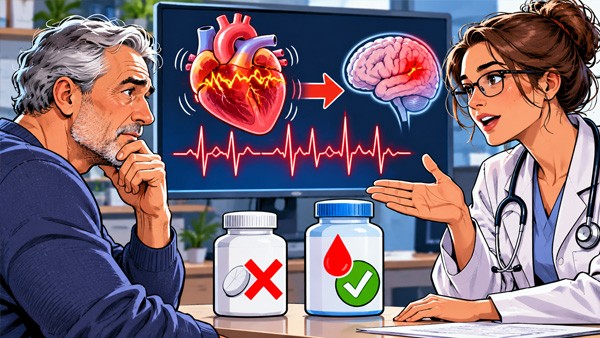

💓 An irregular pulse found at a routine check, with no symptoms at all. That is how a large share of atrial fibrillation is discovered, and it is the version that matters most, because the danger here is not how the heart feels. It is what a stagnant pocket of blood inside it can do to a brain.
📌 Those middle two numbers are the whole argument of this page, and they are the thing most often got wrong. Aspirin is not a weak anticoagulant. It is a different class of drug doing a different job, and in atrial fibrillation it leaves most of the risk on the table while still causing bleeding.
🔌 What is actually happening in the heart
💡 Normally the top chambers contract first and squeeze blood down into the bottom chambers. In atrial fibrillation the electrical signal in the top chambers breaks into chaos, so they stop contracting and start quivering instead. Two consequences follow, and they are entirely separate problems.
🧠 Problem one: a clot forms
🚫 Blood stops moving properly in a small pouch in the left atrium, and still blood clots.
💥 If a piece breaks off it goes to the brain, because the next stop after the left atrium is the circulation to the head.
❗ This is the part that kills and disables, and it is unrelated to whether you feel anything.
🛡️ Treated with an anticoagulant, and nothing else treats it.
💓 Problem two: the pulse misbehaves
🏃 The lower chambers get bombarded with signals and beat fast and irregularly.
😮💨 This is what you feel: palpitations, breathlessness, fatigue, poor exercise tolerance.
📉 Over months a persistently fast rate weakens the heart muscle, which is reversible once the rate is controlled.
💊 Treated with rate or rhythm control, which does nothing at all for the stroke risk.
⚠️ The single most important misunderstanding about this condition.
🔹 Feeling better does not mean the stroke risk has gone. Controlling the rate fixes the symptoms and leaves the clot risk exactly where it was.
🔹 Being back in normal rhythm does not mean it either. Atrial fibrillation comes and goes, often without being felt, and the decision about anticoagulation is based on the risk score, not on what the rhythm is doing today.
🔹 So anticoagulation is usually continued even after the rhythm is restored, and that surprises people who assume the treatment ends when the symptoms do.
📊 How the risk is actually calculated
🧮 Nobody guesses at this. There is a points score, it is used everywhere, and it is worth knowing your own number because it decides whether you need an anticoagulant at all.
| 📋 Factor | 🔢 Points |
|---|---|
| 🫁 Heart failure or reduced pumping function | 1 |
| 📈 High blood pressure, treated or untreated | 1 |
| 👴 Age 75 or over | 2 |
| 🍬 Diabetes | 1 |
| 🧠 Previous stroke, mini-stroke or clot elsewhere | 2 — the heaviest single factor |
| 🩸 Vascular disease — previous heart attack, narrowed leg arteries, plaque in the aorta | 1 |
| 📅 Age 65 to 74 | 1 |
| ♀️ Female sex | 1, and it only counts alongside at least one other factor |
🔎 Add them up, and the total maps onto a real annual stroke risk. The jump across the range is large, which is why the score decides the treatment.
🛡️ Why aspirin does not do this job
🔬 The two drug classes work on different parts of clotting. Antiplatelets stop platelets sticking together, which is what matters in the fast-flowing arteries of the heart and brain. Anticoagulants interrupt the clotting cascade, which is what matters in still, pooled blood. The clot in atrial fibrillation forms in still blood, so the second class is the one that works.
🚨 The same applies to Plavix (Clopidogrel), and this matters because people assume one blood thinner substitutes for another. Clopidogrel is an antiplatelet. It is the right drug after a stent or certain strokes, and it is not a replacement for anticoagulation in atrial fibrillation. Combining aspirin and clopidogrel gets closer but still falls short of anticoagulation, while roughly matching it for bleeding — the worst of both.
👴 Who gets it, and why the age curve is so steep
📌 But age is only the background. Several of the drivers are treatable, and treating them reduces how often episodes happen — which is the part of this condition a person can actually act on.
| 🎯 Driver | 🔧 What changes if it is dealt with |
|---|---|
| 📈 High blood pressure | The commonest treatable driver of all. Controlling it reduces episodes and also removes a point from the stroke score |
| 😴 Obstructive sleep apnoea | Strongly linked and routinely missed. Untreated apnoea makes episodes far more frequent and makes rhythm treatments fail. Worth reading the screening questions for sleep apnoea if you snore and wake unrefreshed |
| 🍺 Alcohol | A direct, dose-related trigger. A heavy weekend classically produces an episode on the Sunday, and cutting alcohol measurably reduces recurrence. One of the few lifestyle changes here with trial evidence behind it |
| ⚖️ Excess weight | Sustained weight loss reduces episode frequency and burden, and improves the odds that rhythm treatment holds |
| 🦋 Overactive thyroid | Checked in everyone at diagnosis, because treating it can resolve the fibrillation entirely |
| 🍬 Diabetes | Raises risk independently and adds a point to the score |
| ☕ Caffeine | Largely exonerated. Moderate coffee does not trigger episodes in most people, despite the reputation. Energy drinks are a different matter |
| 🏊 Endurance sport over many years | A genuine association in long-term high-volume athletes, which is a different situation from ordinary exercise. Ordinary exercise is protective |
😤 What it feels like, and what it feels like when it is nothing
| 🌡️ Symptom | 📝 What it means here |
|---|---|
| 💓 Palpitations — fluttering, thumping, or a sense the heart is stumbling | The classic complaint. Irregularly irregular rather than fast-but-steady, which is what distinguishes it at the wrist |
| 😮💨 Breathlessness on effort | Often the only symptom, and usually blamed on being unfit or getting older |
| 😴 Fatigue out of proportion | Because the top chambers no longer help fill the bottom ones, output drops by roughly a fifth |
| 🥵 Dizziness or lightheadedness | Common when the rate swings widely |
| 🤐 Nothing at all | About a third of people, and this group is not at lower risk. Silent fibrillation causes the same strokes |
| 🚨 Chest pain, fainting, or breathlessness at rest | Emergency. Suggests the rate is compromising the circulation |
| 🧠 Face drooping, arm weakness, slurred speech | Stroke. Call an ambulance immediately — see why every minute counts in stroke |
💡 How to check your own pulse properly, since this is how most cases are found.
🔹 Two fingers on the wrist, thumb side, and sit still for a full 30 seconds — not ten.
🔹 You are listening for the pattern, not the speed. A normal pulse is even, like a metronome. This one has no pattern: gaps of different lengths, beats of different strength, no rhythm you could tap along to.
🔹 Doing this once a month over 65 is a reasonable habit, and it is how a great many silent cases get caught before the stroke rather than after it.
🔹 Smartwatch alerts are worth acting on but not worth trusting alone. They need confirming with a proper tracing.
📅 The four patterns, defined purely by how long it lasts
❗ That last line is the one worth keeping. Occasional episodes carry the same stroke risk as constant fibrillation, because a clot needs hours, not months, and nobody can say how many silent episodes happened between the felt ones.
💊 The drugs, and which of the two problems each one treats
| 💊 Medicine | 🎯 Which problem, and the practical detail |
|---|---|
| Coumadin (Warfarin) | Stroke prevention. Cuts stroke by roughly two thirds. Needs regular INR blood tests, and the benefit depends almost entirely on staying in range — poorly controlled warfarin gives up much of its advantage. Vitamin K in food has to be steady rather than avoided. The detail is in warfarin, INR and what to eat |
| Lopressor (Metoprolol) | Rate control, usually first choice. Slows the conduction so the lower chambers are not bombarded. Also the option that suits people with coexisting angina or heart failure. Does nothing for stroke risk |
| Cardizem (Diltiazem) and Calan (Verapamil) | Rate control, and often better tolerated than a beta blocker for tiredness and exercise capacity. Avoided when the heart muscle is weakened, because they reduce pumping strength. Not combined with a beta blocker without supervision |
| Lanoxin (Digoxin) | Rate control, mostly for people who are inactive or in heart failure. Controls the resting rate well and the exercising rate poorly. Narrow margin between a working dose and a toxic one, so levels and kidney function are monitored. Nausea, visual changes and confusion are the warning signs |
| Plavix (Clopidogrel) | An antiplatelet, not an anticoagulant. Its place is after stents and in arterial disease. Not a substitute here, as the chart above shows |
| Persantine (Dipyridamole) | Also an antiplatelet, used in certain stroke prevention after a brain-artery event. Same point: a different job from anticoagulation |
| ⚡ Rhythm drugs and ablation | Attempt to restore normal rhythm rather than just slow it. Specialist territory, and most valuable when started within the first year of diagnosis. Anticoagulation usually continues regardless of success |
⚖️ Chasing the rhythm, or living with it
🤔 This is the decision people expect to be about willpower and find is mostly about timing. For decades the trials showed no survival advantage to restoring rhythm over simply controlling the rate. More recent evidence changed that in one specific situation: starting rhythm treatment early, within about a year of diagnosis, does improve outcomes. Late in the course, it mostly does not.
🟢 Rate control makes sense when
👴 Older, few symptoms, and the rate settles easily on one tablet
📅 Been in fibrillation for years, where attempts to restore rhythm rarely hold
💓 The heart is structurally changed with an enlarged atrium
😌 Life is unaffected once the rate is under control
🔵 Chasing rhythm makes sense when
🆕 Diagnosed within the last year — the strongest single factor
😢 Symptoms persist despite good rate control
🏃 Younger and active, where exercise capacity matters
🫁 The heart has weakened because of the fibrillation, which often recovers once rhythm returns
📋 What the first weeks after diagnosis involve
⚠️ About bleeding risk, because it is the reason people refuse treatment.
🔹 A high bleeding score is not a reason to withhold anticoagulation. It is a reason to fix what is driving it, and the major factors are usually modifiable.
🔹 What gets fixed: uncontrolled blood pressure, heavy alcohol, anti-inflammatory painkillers taken regularly, and unnecessary antiplatelets taken alongside.
🔹 Falls are the commonest reason given, and the arithmetic does not support it. The stroke prevented is, on average, far more damaging than the bleed risked.
🔹 Report anything unusual early: black stools, blood in urine, a nosebleed that will not stop in 15 minutes, or any head injury, which needs assessment even when you feel fine.
🚨 When to act immediately
🚨 Ambulance now
Face drooping, arm weakness or slurred speech · sudden loss of vision or severe sudden headache · chest pain with the palpitations · fainting · breathlessness lying flat or at rest · a cold, painful, pale leg or arm, which can be a clot lodged in a limb artery
🟡 Same day
A first episode of a fast irregular pulse · a resting rate persistently over 110 · a new episode that has not stopped within a day · worsening breathlessness or swelling ankles · any bleeding that will not stop · a head injury while on an anticoagulant, even without symptoms
🟢 Next appointment
Episodes becoming more frequent · never been told your stroke score · on aspirin alone for atrial fibrillation · snoring with unrefreshing sleep, which means an apnoea assessment · INR readings swinging widely · want to discuss rhythm treatment, particularly if diagnosed within the last year
🗿 Four things people believe that are not so
| 💭 The belief | ✔️ What is actually the case |
|---|---|
| "No symptoms means low risk." | About a third have no symptoms, and their stroke risk is the same. Silence here is the dangerous version, not the mild one |
| "I take aspirin, so I am covered." | Aspirin prevents roughly a fifth of these strokes against roughly two thirds for anticoagulation, while still causing bleeding |
| "My rhythm is back to normal, so I can stop the blood thinner." | The decision follows the risk score, not today rhythm. Episodes recur silently, and stopping on that basis is a common route to a preventable stroke |
| "Blood thinners are too dangerous at my age." | Age raises stroke risk faster than it raises bleeding risk, so the net benefit of treatment is largest in the oldest patients. The intuition runs backwards here |
❓ Frequently asked questions
How much does atrial fibrillation raise stroke risk?
About fivefold on average, though the real figure depends on your risk score and ranges from under 1 percent a year to over 10 percent. Anticoagulation removes roughly two thirds of it.
Does aspirin prevent stroke in atrial fibrillation?
Only slightly. Aspirin cuts these strokes by roughly 22 percent against roughly 64 percent for an anticoagulant, and it still causes bleeding. It is not a substitute.
Can I stop the blood thinner if my rhythm goes back to normal?
Usually not. The decision is based on the stroke risk score rather than the current rhythm, because episodes recur without being felt. That decision belongs to your doctor.
Is occasional atrial fibrillation safer than constant?
No. The stroke risk is the same across all patterns. A clot forms in hours, and nobody can count the silent episodes between the ones you notice.
What is the CHA2DS2-VASc score?
A points total from heart failure, high blood pressure, age, diabetes, previous stroke, vascular disease and sex. Two points or more usually means anticoagulation is recommended.
Does coffee cause atrial fibrillation?
Moderate coffee does not trigger episodes in most people, despite its reputation. Alcohol genuinely does, in a dose-related way, and energy drinks are a separate concern.
Why does my doctor keep asking about snoring?
Because obstructive sleep apnoea is strongly linked to atrial fibrillation, is frequently missed, and makes episodes more frequent and rhythm treatments more likely to fail.
What is the difference between rate and rhythm control?
Rate control slows a fibrillating heart to a comfortable speed. Rhythm control tries to restore the normal pattern. Neither reduces stroke risk, which is a separate treatment.
Am I too old for a blood thinner?
Age raises stroke risk faster than bleeding risk, so the net benefit is greatest in the oldest patients. A history of falls is rarely a sufficient reason to go without.
How do I check my own pulse for it?
Two fingers on the wrist, thumb side, for a full 30 seconds. Listen for the pattern rather than the speed: this rhythm has no pattern you could tap along to.
📑 Sources and editorial
- 📘 Clinical practice guidelines on the diagnosis and management of atrial fibrillation, including risk stratification, anticoagulation thresholds, rate control targets and the role of rhythm control
- 🧮 The CHA2DS2-VASc risk score, its component factors and published annual stroke rates by total score
- 📊 Meta-analyses of antithrombotic therapy in atrial fibrillation, including the relative stroke reduction achieved by adjusted-dose warfarin and by aspirin against control
- 💊 Trial evidence on the inadequacy of antiplatelet therapy, alone or in combination, as a substitute for oral anticoagulation in atrial fibrillation
- 👴 Epidemiological data on the prevalence of atrial fibrillation by age band and on the proportion of cases that are asymptomatic
- 📅 Definitions of paroxysmal, persistent, long-standing persistent and permanent atrial fibrillation by episode duration, and evidence that stroke risk does not differ by pattern
- ⚖️ Trials comparing rate control with rhythm control strategies, and subsequent evidence on early rhythm control initiated within approximately one year of diagnosis
- 🎯 Trial and cohort evidence on modifiable drivers of atrial fibrillation, including hypertension, obstructive sleep apnoea, alcohol consumption, excess weight, diabetes and thyroid disease, and on the effect of alcohol reduction on recurrence
- 🏊 Studies on long-term high-volume endurance exercise and atrial fibrillation risk, contrasted with the protective effect of moderate physical activity
- ☕ Evidence on caffeine consumption and atrial fibrillation risk
- 🩸 Guidance on bleeding risk assessment in atrial fibrillation, including the principle that a high bleeding score indicates modification of risk factors rather than withholding anticoagulation, and data on net clinical benefit in older patients
- 🧪 Evidence on time in therapeutic range with warfarin and its relationship to stroke and bleeding outcomes
- 💊 Prescribing information for warfarin, metoprolol, diltiazem, verapamil, digoxin, clopidogrel and dipyridamole, including monitoring requirements, contraindications in reduced ejection fraction and digoxin toxicity
- 📟 Guidance on opportunistic pulse palpation for case finding, and on the use and limitations of consumer wearable rhythm notifications
- 📖 Related reading: warfarin, INR, diet and bleeding risk, thrombosis and embolism, the symptoms that need hospital, the four types of stroke, obstructive sleep apnoea screening and CPAP, leg pain when you walk
- 🛒 Related products: Coumadin (Warfarin), Lanoxin (Digoxin), Lopressor (Metoprolol), Cardizem (Diltiazem), Calan (Verapamil), Plavix (Clopidogrel), cardiovascular range
- 👩⚕️ RXshop Editorial Team — reviewed by Robert Hayes, MD, FACC — Cardiologist
Medical Disclaimer: The information in this article is for educational and informational purposes only and is not a substitute for professional medical advice, diagnosis, or treatment. Always seek guidance from a qualified healthcare provider with any questions you may have regarding a medical condition, and before starting, stopping or changing any medication.