COPD Flare-Ups: The Early Signs Most People Miss, and Why Acting on Day One Changes the Outcome

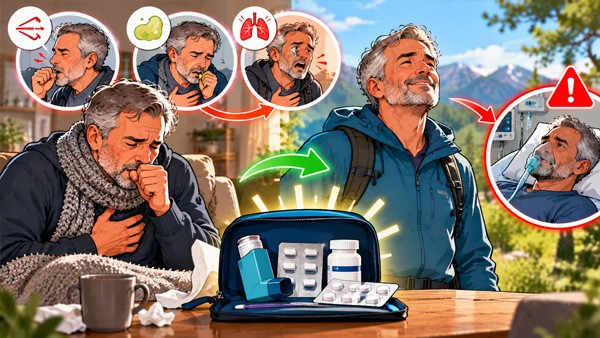

It never starts dramatically. The stairs take one more pause than usual. The cough is a bit wetter. You sleep badly and put it down to a bad night.
Three days later you cannot finish a sentence and someone is calling an ambulance. The window in which this could have been turned around was back at the stairs.
💡 Two things that make this worth reading before you need it.
🔹 Each flare-up takes lung function permanently. Breathing usually recovers, but not all the way — the baseline resets slightly lower every time, and the drop is steepest in people who flare often. So preventing and shortening them is not about comfort, it is about how much lung you still have in five years.
🔹 Three symptoms define a flare, and you can check them yourself. More breathless, more phlegm, phlegm changed colour. Knowing those three means you can act on day one instead of day four.
🚩 The three signs that define a flare-up
Doctors assess exacerbations on exactly these three. There is no test involved, and you can run the check yourself every morning.
| Sign | What to look for |
|---|---|
| More breathless | The same walk, the same stairs, the same task — now needing a pause where it did not. This is the most reliable of the three |
| More phlegm | A clear increase in how much you are bringing up compared with your normal |
| Phlegm changed colour | From clear or white to yellow, green or brown. This is the one that most often points to a bacterial infection |
All three together is a definite flare. Two of three is a flare. One of three, together with a cold, a sore throat, fever, wheeze or an unexplained rise in heart rate, counts too.
Other early signals worth noticing: sleeping propped up or waking breathless, a rescue inhaler being used far more than usual, unusual tiredness, ankle swelling, and confusion or drowsiness in older people — which can be the first sign in someone who does not report breathlessness well.
✅ Know your own normal, in writing.
The three signs only work as a comparison. So it is worth having a note of your baseline somewhere you can find it: how far you normally walk before stopping, how many stairs, how much phlegm on an ordinary morning and what colour, and how often you normally use the blue inhaler.
Written down when you are well, that takes two minutes and makes the difference between noticing a change on day one and arguing with yourself about it on day four.
📉 Why day one matters more than it sounds
The reason for all this urgency is specific.
Lung function in COPD declines gradually anyway. Exacerbations accelerate that decline, and the loss is not recovered. Someone who flares three times a year loses ground considerably faster than someone who flares once.
Beyond that, flares feed on themselves. Each one leaves the airways more inflamed and more vulnerable, so the next one comes sooner. People move from one a year to three a year without the underlying disease changing much.
And recovery takes longer than anyone expects. Symptoms often take four to six weeks to settle, and a meaningful share of people never quite get back to where they were. A flare treated on day one is frequently a mild week. The same flare treated on day four is often a hospital admission.
🦠 What sets them off
- 🤧 Viral infections — the commonest trigger by a long way. An ordinary cold that would be nothing in someone else
- 🦠 Bacterial infection, often on top of the virus. This is where the phlegm colour change comes from
- 🌡️ Cold air, damp, fog and sudden weather changes
- 🏭 Air pollution, smoke, dust, strong fumes — including cleaning products and aerosols indoors
- 💨 Missed maintenance doses, which is a far bigger cause than people realise. The preventive inhaler is doing its job invisibly, so stopping it feels harmless
- 🚬 Smoking, including passive
- 🫀 Other illness — heart failure, a chest infection, reflux, or a clot on the lung, each of which can masquerade as a flare
- 💊 Sedating medicines which suppress breathing drive
That last point about other illnesses matters. Not every episode of worsening breathlessness is a COPD flare, and the alternatives need different treatment — which is why a sudden, severe episode with chest pain deserves assessment rather than a rescue pack.
📋 The rescue pack and the action plan
This is the single most useful thing a person with COPD can arrange, and many people have never been offered one.
A rescue pack is a course of antibiotics and a course of steroid tablets, prescribed in advance and kept at home, together with a written plan saying exactly when to start them. The point is to remove the delay between noticing a flare and treating it.
| What is in it | Typical course | When to start it |
|---|---|---|
|
Steroid tablets usually prednisolone |
Around 30–40 mg once daily for about 5 days, in the morning with food. Short courses do not usually need tapering | When breathlessness is clearly worse than your normal |
| Antibiotics | Usually a 5 day course | When the phlegm has changed colour or increased markedly. Colour change is the main indication — antibiotics do little for a flare without it |
|
Rescue inhaler salbutamol or ipratropium |
Used more frequently during a flare, as advised | Straight away, alongside the above |
📌 Four rules that go with a rescue pack.
🔹 Tell someone you have started it. A rescue pack is permission to begin treatment immediately, not permission to manage a flare alone. Contact your practice the same day or the next
🔹 Replace it as soon as you use it. A rescue pack sitting empty is worse than not having one, because you believe you are covered
🔹 Keep taking your usual inhalers. The maintenance treatment continues through a flare, it does not pause
🔹 If there is no improvement in 48 hours, that is a reason to be seen, not a reason to wait longer
Steroid tablets are worth two specific notes. They commonly cause raised blood sugar, so anyone with diabetes should expect higher readings during the course and may need adjustment. And they can cause difficulty sleeping, increased appetite, mood changes and indigestion — all temporary, and all worth expecting rather than being surprised by.
💨 The inhalers that stop flares happening
Rescue treatment handles the flare in front of you. Maintenance treatment decides how many of them you get.
| Type | What it does | In the range |
|---|---|---|
|
LAMA long-acting anticholinergic |
Once daily, and specifically reduces how often flares happen. A cornerstone of COPD maintenance | Tiova, Spiriva (tiotropium) |
|
ICS + LABA steroid plus long-acting reliever |
Reduces inflammation and keeps airways open for twelve hours. Added where flares are frequent | Advair Diskus |
|
SABA short-acting reliever |
Rapid relief, used as needed and more often during a flare | Ventolin, Asthalin |
|
SAMA short-acting anticholinergic |
An alternative or addition to the above for quick relief | Atrovent |
| Nebulised combination | For more severe flares, where an inhaler is hard to use effectively | Budesal Respules |
| Mucolytic | Thins phlegm, making it easier to clear. May modestly reduce flare frequency in people with a lot of sputum | Mucolite (ambroxol) |
| Theophylline | An older option, used less now because the effective dose sits close to the toxic one and it interacts with many drugs | Theo-24 |
None of this works if the inhaler is being used wrongly, which is extremely common — see our guide to inhaler technique and what each inhaler does. A maintenance inhaler used with poor technique delivers a fraction of the dose and looks exactly like a drug that does not work.
🚨 When home treatment stops
🚨 Call emergency services for any of these.
🔹 Breathless at rest, or unable to finish a sentence
🔹 Blue or grey lips, tongue or fingers
🔹 Confusion, unusual drowsiness, or difficulty staying awake
🔹 The rescue inhaler not working, or needing it every hour or two
🔹 Chest pain, or coughing up blood
🔹 Getting worse despite the rescue pack, or no improvement after 48 hours
🔹 New or rapidly worsening ankle swelling with breathlessness
🔹 A high fever you cannot bring down
🔹 Oxygen levels falling below your usual reading, if you measure at home
🔹 You cannot manage at home, or there is nobody with you and you are frightened. That is a legitimate reason on its own
📌 One thing about oxygen that is widely misunderstood.
In some people with COPD, giving too much oxygen is harmful rather than helpful — it can suppress breathing drive and allow carbon dioxide to build up dangerously. For that reason target oxygen levels in COPD are often deliberately set lower than in other patients.
This is why home oxygen is prescribed at a specific rate and the rate must not be increased because breathing feels difficult. If you have been told you are at risk of this, carry that information, because it changes how ambulance crews treat you.
🫁 Techniques that help while you wait
These cost nothing, work within minutes, and are rarely taught.
- 👅 Pursed-lip breathing. Breathe in through the nose for about two counts, then out slowly through pursed lips, as if blowing out a candle, for roughly four. The back-pressure holds the airways open so trapped air can escape. This is the single most useful one and it genuinely works
- 🪑 Lean forward with your arms supported — on a table, on your knees, against a wall. It lets the breathing muscles work more efficiently than sitting upright or lying back
- 💨 A handheld fan directed at the face. It sounds trivial and it reliably reduces the sensation of breathlessness. Keep one within reach
- 🚪 Cool moving air — open a window, lower the room temperature
- 🚶 Pace yourself deliberately. Breathe out on the effortful part of a movement, and plan rests before you need them rather than after
- 🧘 Try not to fight the panic. Breathlessness causes fear, fear increases breathing rate, and faster breathing traps more air. Slow breathing out is what breaks that loop
🛡️ What actually reduces how often you flare
In order of how much difference each makes.
- 🚭 Stopping smoking. The only intervention that changes the rate of lung function decline itself, at any stage and any age. Everything else treats symptoms; this changes the disease. See our guide to stopping smoking
- 💉 Vaccination. Annual flu, plus pneumococcal and COVID as advised. Measurably fewer flares and fewer admissions
- 🏃 Pulmonary rehabilitation. A structured exercise and education programme with strong evidence behind it — better breathlessness, better exercise capacity, fewer admissions. One of the most underused treatments in respiratory medicine, and worth asking for by name
- 💨 Taking the maintenance inhaler every day, and using it correctly
- 📋 Having a written action plan and a rescue pack
- 🧼 Avoiding triggers — crowds during flu season, smoke, aerosols, very cold air. A scarf over the mouth in cold weather genuinely helps
- 🥗 Keeping weight and muscle up. Being underweight with COPD carries a worse outlook, and breathing itself burns energy
- 🛏️ Treating what travels alongside it — heart failure, reflux, anxiety, depression and sleep apnoea are all common in COPD and all make breathlessness worse
🏠 Afterwards
Recovery is slower than people expect, and that expectation gap causes a lot of unnecessary worry.
Breathlessness and cough commonly take four to six weeks to settle, and tiredness often lasts longer. Appetite and strength return last. It is also normal to feel low afterwards, partly from the steroids and partly from the fright.
Two things worth doing once the acute phase passes: a review of the maintenance treatment, since a flare is evidence the current regime was not quite holding, and a referral to pulmonary rehabilitation, which has its strongest effect in the weeks after an exacerbation.
And if a flare followed a chest infection, it is worth distinguishing what actually happened — see our guide to pneumonia, bronchitis and when to go in.
📞 When to seek help
🚨 Emergency: breathless at rest or unable to speak in sentences, blue lips, confusion or drowsiness, rescue inhaler not working, chest pain, or coughing blood.
Contact your practice the same day:
- Two or more of the three cardinal signs, especially a colour change in phlegm
- You have started a rescue pack — always tell someone
- No improvement after 48 hours of treatment
- Using the rescue inhaler far more than usual
- New ankle swelling with worsening breathlessness
- Fever, or feeling significantly unwell beyond the breathing
- Diabetes and taking steroid tablets, since blood sugar will rise
Worth an appointment:
- You do not have a written action plan or a rescue pack — ask for both
- Two or more flares in the past year, which usually means the maintenance treatment needs changing
- Never been offered pulmonary rehabilitation
- Vaccinations not up to date
- Still smoking, at any stage of the disease
- Inhaler technique never checked, or checked years ago
- Breathlessness worsening steadily rather than in flares, which is a different problem
- Low mood or anxiety about breathing, both common and both treatable
- Losing weight without trying
❓ Frequently asked questions
What counts as a COPD flare-up?
Worsening beyond your normal day-to-day variation, judged on three signs: more breathlessness, more phlegm, and phlegm changing colour. Two of the three, or one plus a cold or fever, counts as a flare.
Does phlegm colour matter?
Yes. A change from clear or white to yellow, green or brown is the main indicator that bacteria are involved, and it is the usual trigger for starting antibiotics. Without a colour change antibiotics do much less.
What is a COPD rescue pack?
A course of steroid tablets and antibiotics prescribed in advance and kept at home with a written plan stating when to start them, so treatment begins on day one rather than after an appointment.
How long is a steroid course for a flare?
Usually around 30 to 40 mg of prednisolone once daily for about five days, taken in the morning with food. Short courses of this length do not normally need to be tapered.
Do flare-ups cause permanent damage?
Yes. Exacerbations accelerate the decline in lung function and the loss is not fully recovered, with people who flare frequently losing ground faster. That is why early treatment matters beyond comfort.
When should I go to hospital with COPD?
Breathlessness at rest, inability to finish a sentence, blue lips, confusion or drowsiness, a rescue inhaler that is not working, chest pain, or no improvement after 48 hours of treatment.
Can too much oxygen be harmful in COPD?
In some people with COPD, yes. High oxygen levels can suppress breathing drive and allow carbon dioxide to build up, so target levels are set deliberately lower and the prescribed flow rate should not be increased.
What is pursed-lip breathing?
Breathing in through the nose for about two counts and out slowly through pursed lips for about four, as if blowing out a candle. The back-pressure keeps airways open so trapped air can escape.
How long does recovery take after a flare?
Breathlessness and cough commonly take four to six weeks to settle, with tiredness lasting longer. A proportion of people do not return fully to their previous baseline, which is why prevention matters.
What reduces how often flare-ups happen?
Stopping smoking above all, then vaccination, pulmonary rehabilitation, taking maintenance inhalers daily with correct technique, and having a written action plan with a rescue pack at home.
📑 Sources and editorial
- International strategy documents on the diagnosis, management and prevention of chronic obstructive pulmonary disease, including definitions and severity classification of exacerbations
- Classical criteria defining exacerbation by increased dyspnoea, increased sputum volume and increased sputum purulence, and their relationship to antibiotic benefit
- Evidence on the impact of exacerbations on long-term decline in forced expiratory volume, exacerbation frequency phenotypes and post-exacerbation recovery times
- Clinical guidance on short courses of systemic corticosteroids in acute exacerbations, including typical dose, duration and the absence of a tapering requirement
- Guidance on antibiotic use in exacerbations, including sputum purulence as the principal indication and typical course length
- Guidance on self-management plans and standby rescue medication packs in chronic obstructive pulmonary disease, including the requirement for accompanying written plans and clinical contact
- Trial evidence for long-acting muscarinic antagonists, long-acting beta agonists and inhaled corticosteroid combinations in reducing exacerbation frequency
- Prescribing information for tiotropium, salbutamol, ipratropium, fluticasone with salmeterol, budesonide with levosalbutamol, ambroxol and theophylline, including the narrow therapeutic index and interaction profile of theophylline
- Guidance on controlled oxygen therapy in chronic obstructive pulmonary disease, target saturation ranges and the risk of hypercapnic respiratory failure
- Evidence for pulmonary rehabilitation in chronic obstructive pulmonary disease, including effects on breathlessness, exercise capacity and hospital admission, and the benefit of early post-exacerbation referral
- Evidence on influenza and pneumococcal vaccination in reducing exacerbations and hospitalisation
- Evidence on smoking cessation as the only intervention shown to alter the rate of lung function decline
- Literature on non-pharmacological management of breathlessness, including pursed-lip breathing, positioning and handheld fan therapy
- Guidance on comorbidity in chronic obstructive pulmonary disease, including cardiovascular disease, anxiety, depression, nutritional depletion and sleep-disordered breathing
- Related reading: inhaler technique and what each inhaler does, how airflow becomes limited in COPD, pneumonia, bronchitis and when to go in, stopping smoking
- Related products: Tiova (Tiotropium), Spiriva (Tiotropium), Advair Diskus, Ventolin (Albuterol), respiratory category
- RXshop Editorial Team — reviewed by Emily Chen, MD, MPH — Internal Medicine Specialist
Medical Disclaimer: The information in this article is for educational and informational purposes only and is not a substitute for professional medical advice, diagnosis, or treatment. Always seek guidance from a qualified healthcare provider with any questions you may have regarding a medical condition, and before starting, stopping or changing any medication.