Fear of Blushing, Shaking and Being Watched: Why Visible Anxiety Feels Worse Than It Looks and Which Treatments Help
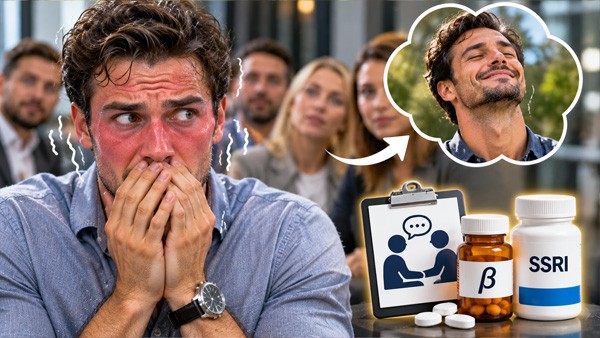

😳 For many people with social anxiety, the worst fear is not the meeting or the presentation itself. It is the thought that everyone will see the anxiety: the face turning red, the shirt showing sweat, the hand shaking while holding a cup, the voice wobbling halfway through a sentence, or the feeling of every eye in the room fixed on them. 🔍 These fears have names (erythrophobia for blushing, scopophobia for being stared at), and they share one surprising feature: the symptoms are far less visible to others than they feel from the inside. This guide explains why blushing, sweating and shaking happen, why trying to hide them makes them stronger, how to tell anxiety from a medical cause, and which treatments help each symptom, from video feedback therapy and exposure to propranolol, antidepressants and direct treatment for sweating.
👀 When the fear is of being seen anxious
🧠 Social anxiety disorder is a lasting fear of being judged, embarrassed or rejected in social situations. In a large group of sufferers, the fear centres on the body giving them away. The worry runs like this: if they see me blush or shake, they will know I am nervous, think I am weak or odd, and I will be humiliated. The physical symptoms then become the threat. 📖 For a full overview of social anxiety, its causes and the main treatments, see social anxiety disorder: why avoidance keeps it alive. This article focuses on the visible symptoms and the fears built around them.
🔭 Others notice far less than you think
🧪 Psychologists call it the illusion of transparency: people believe their inner state is much more obvious to others than it really is. In classic experiments, speakers who felt nervous rated themselves as looking clearly anxious, while the audience rated them as only slightly nervous. A close cousin, the spotlight effect, makes us overestimate how many people notice us at all.
😳 Fear of blushing (erythrophobia)
🔥 Blushing is a sudden reddening of the face, ears and neck, often with a feeling of heat. Everyone blushes, but people with erythrophobia live in dread of it: they avoid speaking up, turn down dates, choose jobs with little contact, wear heavy make-up or high collars, and replay every blush for hours. Interestingly, laboratory studies often find that people who fear blushing do not blush much more than others when measured with sensors. What differs is how strongly they feel it, how much attention they pay to it, and how catastrophic they believe it is.
- 📌 Common triggers: being the centre of attention, being praised or teased, speaking to someone attractive or senior, being asked a direct question
- 📌 Typical thought: “They can see it, and they think something is wrong with me”
- 📌 Often begins in the teenage years, after being teased about blushing
- 📌 The fear of the blush can trigger the blush itself, which closes the loop
🧬 Why blushing happens
🧪 The skin of the cheeks has more and wider blood vessels near the surface than most of the body, which is why the face shows it first. A blush is an automatic reflex, so trying to stop it by willpower does not work; the effort raises arousal and often makes it last longer. People with fair skin show it more, but the feeling of heat is the same in every skin tone.
🤝 What others actually think of a blush
📖 Studies of how observers judge blushing give a reassuring picture. When someone blushes after a small mistake or awkward moment, observers tend to rate them as more trustworthy, likeable and sincere, not less. The blush works as a signal that the person cares about the situation and about other people. It is a social repair signal, and humans are the only species that has it.
💧 Fear of sweating
💦 Anxiety sweating appears on the palms, armpits, forehead and upper lip, the areas controlled by the same stress-driven nerves. The fear is of wet patches on clothes, a damp handshake or shiny skin. About 2 to 5% of people also have primary focal hyperhidrosis, a separate condition where the sweat glands overreact even at rest, in cool rooms and when calm. The two often overlap, and they need different help: anxiety treatment for the fear, and direct treatment for the sweat itself.
✋ Fear of shaking and a trembling voice
💥 Adrenaline released under stress makes muscles twitch faster, which shows as a fine tremor in the hands, a wobbling cup or a voice that cracks. This is the symptom where beta blockers work best, because adrenaline acts on the muscles and heart through beta receptors. People who fear shaking often avoid writing in front of others, signing documents, carrying drinks, eating soup in public or holding notes during a talk.
👁️ Fear of being stared at (scopophobia)
🙈 Scopophobia is an intense fear of being looked at. It is not listed as a separate diagnosis and is usually understood as part of social anxiety. The person feels watched even when others are busy with their own things, avoids eye contact, keeps to the back of rooms, and may struggle to walk past a group, ride public transport or enter a restaurant alone. Eye-tracking studies show that socially anxious people first scan faces for signs of judgement and then look away from eyes quickly, so they never collect the evidence that most looks are neutral or friendly.
🔄 The vicious circle
A question in a meeting
“I am going to go red”
Heat, heartbeat, tremor
Checking the face, the hands
Looking down, rushing, leaving
“I only got through because I hid it”
🎭 Hiding strategies that backfire
🛡️ Therapists call these safety behaviours. They feel protective but keep the fear alive, because the person never learns that nothing terrible happens without them. Some even make the symptom more noticeable.
🩺 Is it anxiety or a medical cause?
🔍 Before blaming anxiety, it is worth ruling out conditions that cause the same signs. A doctor can usually sort this out with a short examination and a blood test.
| 🔎 Condition | 📋 Clues | 🧪 Usual check |
|---|---|---|
| Overactive thyroid | Tremor, sweating, fast pulse, weight loss, heat intolerance, even when calm | Thyroid blood test |
| Rosacea | Persistent central facial redness, visible vessels, pimples, triggered by heat, spicy food, alcohol | Skin examination |
| Essential tremor | Hand tremor when holding or reaching, family history, eases with alcohol | Neurological examination |
| Menopause | Hot flushes spreading over the chest and face, night sweats | Age, cycle history |
| Medicines and caffeine | Asthma inhalers, some antidepressants, niacin, high caffeine intake | Medicine review |
📖 More on the thyroid as a cause of tremor and sweating: overactive thyroid and Graves disease.
📝 A quick self-check
🎯 Matching the treatment to the symptom
| 😳 Main problem | ✅ Works best | ➕ May add |
|---|---|---|
| Fear of blushing | CBT with video feedback, task concentration training | SSRI if broad social anxiety |
| Shaking, racing heart before an event | Propranolol as needed | Exposure practice |
| Visible sweating | Antiperspirant, hyperhidrosis treatment | CBT for the fear |
| Fear of being stared at | CBT, attention training, exposure | SSRI if severe |
| Fear in most social situations | CBT and/or SSRI or SNRI | Propranolol for specific events only |
🎥 CBT with video feedback
📹 Cognitive behavioural therapy for social anxiety uses a simple but powerful step: the person gives a short talk or has a conversation on camera, predicts how red, sweaty or shaky they looked, then watches the recording. Almost everyone looks calmer on screen than they felt. Seeing it with their own eyes corrects the inside-out picture far better than reassurance from others. Therapy also includes dropping safety behaviours one by one and testing feared predictions in real situations.
🎯 Task concentration training
👁️ Developed specifically for fear of blushing, sweating and trembling, this method teaches people to move their attention away from the body and onto the task and the people in front of them. Practice starts with non-threatening exercises, such as listening to a story and summarising it, then moves to real social situations. Studies found it helped people with fear of blushing at least as much as applied relaxation, with improvement lasting at follow-up. 🎧 A simple daily version: in each conversation, notice three details about the other person, such as eye colour, a word they repeat, or what they do with their hands.
🪜 Exposure: letting the symptom happen on purpose
🔥 The most effective long-term step is often the most counterintuitive one: deliberately bringing on the feared symptom in public and staying until the fear drops. Therapists call this paradoxical intention. It teaches that a red face or shaky hand is survivable and usually goes unremarked.
💊 Propranolol for shaking and a racing heart
💓 Propranolol is a beta blocker that blocks the effect of adrenaline on the heart and muscles. It reduces tremor, pounding heart and a shaky voice within about an hour, while leaving thinking clear. It does not reduce the fear itself, and its effect on blushing is inconsistent, because facial flushing is driven by several nerve pathways. It suits predictable, one-off situations: a presentation, an exam, an interview, a wedding speech, a concert.
📋 How it is commonly used
💊 10 to 40 mg, taken 60 to 90 minutes before the event
⏱️ Lasts about 3 to 4 hours
🏠 First dose tried at home on an ordinary day
📊 What it changes
✅ Hand tremor: clearly reduced
✅ Racing heart: clearly reduced
✅ Shaky voice: often reduced
➖ Blushing, sweating: inconsistent
❌ Fear, worry: not directly
📖 How beta blockers compare with other anxiety medicines: anxiety medication compared, and which ones are non-addictive.
⚠️ Who should not take propranolol
| 🚫 Situation | 📝 Why |
|---|---|
| Asthma or COPD with wheeze | Can trigger serious narrowing of the airways |
| Slow pulse or heart block | Slows the heart further |
| Low blood pressure | Dizziness and fainting |
| Diabetes on insulin or sulfonylureas | Hides warning signs of low blood sugar |
| Taking verapamil or diltiazem | Dangerous slowing of the heart |
| Raynaud phenomenon | Colder hands and fingers |
💡 Common side effects are tiredness, cold hands and vivid dreams. Propranolol should not be shared with others, and a doctor should confirm it is safe before the first dose.
💊 Antidepressants when the fear is broad
📆 When fear of visible symptoms spreads to most social situations, daily treatment works better than a pill before each event. SSRIs and the SNRI venlafaxine are first-line medicines for social anxiety disorder. They take 4 to 6 weeks to start working and 10 to 12 weeks for a full effect, and are usually continued for at least 6 to 12 months after improvement.
⚠️ SSRIs and venlafaxine can themselves increase sweating in some people. If that happens, tell the prescriber: a dose change or a different medicine often helps.
💧 Treating sweating directly
🔪 Surgery for blushing: why it is a last resort
✂️ Endoscopic thoracic sympathectomy cuts or clamps the nerve chain that controls facial blushing and hand sweating. It reduces blushing in many people, but a large share develop compensatory sweating on the back, chest or legs, sometimes severe, and the operation is hard or impossible to reverse. Some patients regret it. Guidelines reserve it for severe, long-standing cases after psychological treatment and medicines have been tried properly, and after a frank discussion of the risks.
Less facial blushing and dry palms
New heavy sweating elsewhere on the body
The fear of being judged
📅 What recovery usually looks like
Map triggers and safety behaviours
Video feedback, first exposures
Harder steps, less avoidance
Practice in daily life, relapse plan
🗿 Myths about blushing, sweating and shaking
🚨 When to get help
⛔ Talk to a doctor soon if:
🔹 Fear of being seen has made you leave a job, school or relationship, or stay at home.
🔹 You use alcohol or sedatives regularly to face people.
🔹 Sweating, tremor or flushing also happen when you are calm and alone, or come with weight loss or palpitations.
🔹 You feel hopeless or have thoughts of harming yourself. In that case, contact emergency services or a crisis line now.
📖 Sudden waves of fear with chest pain and breathlessness may be panic attacks rather than social anxiety; see panic disorder: when fear hits fast. Constant worry about many everyday things is covered in generalized anxiety.
❓ Frequently asked questions
What is erythrophobia?
It is an intense fear of blushing. It is usually part of social anxiety and leads people to avoid situations where they might go red.
What is scopophobia?
Scopophobia is a strong fear of being stared at or watched. It is not a separate diagnosis and is usually treated as part of social anxiety.
Can I stop blushing?
Not by willpower, since it is a reflex. Therapy that reduces the fear and shifts attention outward makes blushing less frequent and far less distressing.
Does propranolol stop blushing?
Its effect on blushing is inconsistent. It works well for shaking hands, a racing heart and a trembling voice before an event.
How long before an event should propranolol be taken?
Usually 60 to 90 minutes before, at a dose agreed with a doctor, after trying a first dose at home on an ordinary day.
Do other people really notice when I blush or shake?
Much less than you think. Studies show observers rate visible nervousness far lower than the anxious person does.
Why do my hands shake when people watch me?
Adrenaline released under stress makes muscles twitch faster, causing a fine tremor. Tension from trying to hold still makes it stronger.
Is anxiety sweating the same as hyperhidrosis?
No. Anxiety sweating happens in stressful moments; hyperhidrosis also happens when calm and alone. Many people have both.
Which antidepressant is best for social anxiety?
SSRIs such as escitalopram, sertraline and paroxetine, or venlafaxine, are first-line. The choice depends on side effects and other health factors.
Is surgery a good option for blushing?
Only as a last resort. Sympathectomy often causes heavy sweating elsewhere and cannot easily be reversed.
📑 Sources and editorial
- 📘 Clinical guidelines on recognition and treatment of social anxiety disorder
- 🧠 Cognitive models of social anxiety and trials of CBT with video feedback
- 🎯 Trials of task concentration training for fear of blushing, sweating and trembling
- 🔬 Experimental studies of the illusion of transparency and of how observers judge blushing
- 💊 Reviews of beta blockers in performance anxiety and of SSRIs and SNRIs in social anxiety
- 💧 Dermatology guidance on primary focal hyperhidrosis
- ✂️ Follow-up studies of thoracic sympathectomy and compensatory sweating
- 📖 Related reading: social anxiety disorder, anxiety medication compared, panic disorder, generalized anxiety
- 🛒 Related products: Inderal (Propranolol), Paxil (Paroxetine), Lexapro (Escitalopram), Sertafine (Sertraline), Effexor (Venlafaxine), Ditropan (Oxybutynin)
- 🩺 RXshop Editorial Team — reviewed by Thomas Walsh, MD — Psychiatrist
Medical Disclaimer: The information in this article is for educational and informational purposes only and is not a substitute for professional medical advice, diagnosis, or treatment. Always seek guidance from a qualified healthcare provider with any questions you may have regarding a medical condition, and before starting, stopping or changing any medication.