Testicle Pain and Lumps: Which Ones Mean Hospital Within Hours, and Which Ones Are Harmless

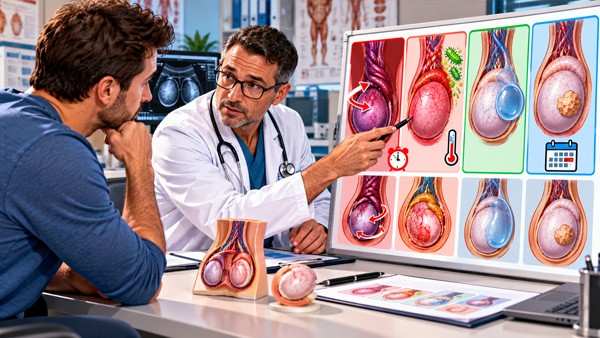
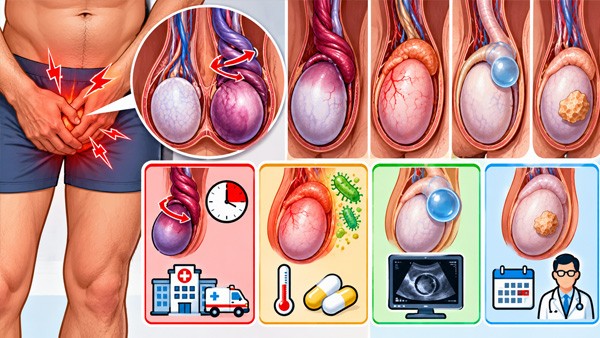
⚡ Two questions sort almost every scrotal problem. Did it come on suddenly and does it hurt badly? That is a surgical emergency measured in hours. Is it a lump that does not hurt at all? That is the one people ignore for months, and it is the one that needs checking the same week.
🌀 Torsion: the whole story is the clock
🔗 The testicle hangs on a cord carrying its own blood supply. If it rotates, that cord twists shut, and from that moment the tissue is living on nothing. ⏳ Everything about the outcome is decided by how long the twist lasts, which is why this is one of the few conditions where the clock matters more than the examination.
🚨 Go to an emergency department now, not to a pharmacy and not to a morning appointment, if:
🔹 Sudden severe pain in one testicle, often waking someone from sleep or starting during activity
🔹 Vomiting with the pain. Nausea alongside testicular pain is a classic feature and it is frequently misread as a stomach problem
🔹 The testicle sits higher than the other one, or lies sideways
🔹 A swollen, red, exquisitely tender scrotum in a boy or young man
🔹 Pain that eased and came back. Intermittent torsion is real, and a settled episode does not make the next one safe
🔹 A newborn or infant with a firm, discoloured scrotum
⚠️ No scan, no test and no cream changes this. Where torsion is suspected, surgeons explore the scrotum rather than wait for imaging, because waiting for the ultrasound is itself how testicles are lost.
📅 Who it happens to
📈 Torsion is most common between 12 and 18 years, with a second smaller cluster in newborns, and roughly one in four thousand males under 25 is affected each year. 🏃 It can follow exercise or trauma, but it very often happens at rest or during sleep, so the absence of an obvious trigger argues for nothing at all. Around a third of men who have it describe earlier short-lived episodes that settled on their own.
⚖️ Torsion or infection: the split that matters
These are the two conditions that account for most acute scrotal pain, and they are managed in opposite ways: one goes straight to surgery, the other goes home with antibiotics. The distinction is not always clean, which is why uncertainty is resolved in favour of surgery.
🌀 Points to torsion
⏰ Onset in minutes. People can usually name the hour
🤕 Vomiting early
⬆️ The testicle rides high or lies horizontally
🌡️ No fever in the first hours
🚶 Lifting the testicle does not help, and often makes it worse
👶 Teenager or young man, or a newborn
🦠 Points to epididymo-orchitis
📆 Onset over a day or two, building rather than sudden
🌡️ Fever and feeling unwell
📍 Tenderness starts behind the testicle and spreads forward
🚽 Burning on urinating, frequency or discharge
⬆️ Lifting the scrotum eases it
👨 Any age, and more common after 18
🔎 One more sign is worth knowing because it is quick and specific: stroking the inner thigh normally makes the testicle on that side rise slightly. That reflex disappears in torsion. Its absence is a strong pointer; its presence is reassuring but not proof.
🦠 Epididymo-orchitis, and why it splits at 35
This is the commonest cause of scrotal pain that is not an emergency, and the organism behind it depends almost entirely on age and exposure. That is the single fact that determines the antibiotic.
🧬 Under about 35, or any age with a new partner
🦠 Usually sexually transmitted — chlamydia most often, gonorrhoea next
💊 Treated with doxycycline, with an injected cephalosporin added if gonorrhoea is suspected
👫 Partners need treating too, or it returns. This is the step most often skipped
🧪 Testing for the organism is done even when treatment starts immediately
🚽 Over about 35, or after urinary problems
🦠 Usually bowel organisms such as E. coli, arriving from the urinary tract
💊 Treated with ofloxacin or a similar agent that reaches the epididymis
🔁 An enlarged prostate or a catheter is often behind it, and that needs attention too
🧴 A repeat episode calls for a look at the urinary tract rather than another course
⏳ Recovery is slower than people expect, and that mismatch is the usual reason a working treatment gets abandoned. Pain settles quickly, swelling does not.
💊 The antibiotics, and what they are chosen for
| 💊 Medicine | 🎯 Where it fits |
|---|---|
| Doxycycline | The standard choice in suspected sexually transmitted epididymitis, typically for ten to fourteen days. Penetrates the epididymis well and covers chlamydia reliably. Take it with food and stay out of strong sun |
| Floxin (Ofloxacin) | Used where bowel organisms are the likely cause — older men, urinary symptoms, after instrumentation. This is one of the few settings where a fluoroquinolone is genuinely the right class, because it reaches the epididymis and prostate as few others do |
| Suprax (Cefixime) | An oral cephalosporin used in some gonorrhoea regimens, although injected ceftriaxone is preferred where it is available |
| Zithromax (Azithromycin) | An alternative for chlamydia when doxycycline cannot be taken, though doxycycline clears it more reliably |
| Naprosyn (Naproxen) and Paracetamol | Pain and swelling. An anti-inflammatory plus paracetamol together outperforms either alone, and the comparison across painkillers is in which painkiller to take |
| Amoxicillin alone, cephalexin alone | Poor choices here. They do not cover chlamydia and they do not reach the epididymis well |
🛏️ The three non-drug measures that do most of the work.
🔹 Support and elevate. Snug underwear or a folded towel under the scrotum while lying down reduces the ache considerably, and it is the measure people are least often told about.
🔹 Rest for the first few days. Walking and standing all day keeps the swelling up.
🔹 Cold, briefly and wrapped. Ten minutes at a time through cloth, never directly on the skin.
🔵 The blue dot, and other problems of boyhood
👶 Not every acutely painful scrotum in a boy is torsion of the testicle itself. A small remnant of embryonic tissue sitting at the top of the testicle, the appendix testis, can twist on its own. It hurts, it swells, and it is harmless — the whole difficulty is that it imitates the emergency.
- 🔵 The blue dot sign — a small dark spot visible through thin scrotal skin at the upper pole. When present it is reassuring, though it is often absent
- 📍 Tenderness localised to one tiny point at the top, with the rest of the testicle comfortable
- 📆 Onset over hours rather than minutes, and less severe than true torsion
- 🛋️ Treatment is rest and an anti-inflammatory, and it settles in a week or two
- ⚠️ It is still assessed in person, because the cost of calling torsion a blue dot is a lost testicle
🧩 The painless lump: working out what it is
🚭 Most scrotal lumps are not in the testicle. Working out whether a lump is part of the testicle itself or sitting next to it separates almost everything serious from almost everything harmless, and it is something anyone can do with clean hands and two minutes.
🎯 Testicular cancer: the numbers that make early action worth it
📊 This is the argument for acting on a lump within days instead of months, and it is unusually clear-cut. Few cancers reward early detection as strongly, and few are as curable when caught late either — which is exactly why the gap between stages is worth looking at.
📉 The disease is also unusual in who it picks. Most cancers climb steadily with age. This one peaks in men who feel invincible and then falls away, which is a large part of why it gets ignored.
📋 What it feels like, in the words men actually use: a firm painless lump or a feeling that one testicle has become heavier or harder than the other. Pain is present in only a minority, so waiting for it to start hurting is the single most common reason a diagnosis is late. Less often it announces itself through a dull ache in the groin, a sudden fluid collection, back pain from enlarged nodes, or breast tenderness from hormone production by the tumour.
📈 Who carries more risk
🤔 Note what is not on that chart. Injury does not cause it, cycling does not cause it, a vasectomy does not cause it, and neither do tight underwear or laptops. An injury sometimes draws attention to a lump that was already there, which is how the myth took hold.
🖐️ Checking yourself, properly and in two minutes
Once a month is plenty, and it is worth doing correctly rather than vaguely, because the point is to learn what normal feels like for you. Familiarity is what makes a change obvious later.
🏥 What actually happens when you go in
Knowing the sequence removes most of the reason people put it off. For a painless lump, nothing on this path is uncomfortable, and the first two steps usually answer the question.
💡 Two things worth knowing in advance.
🔹 A needle biopsy through the scrotum is not how this is diagnosed. If imaging and markers point to a tumour, the testicle is removed through a groin incision, because sampling it through the scrotum can spread disease along a different set of lymphatics.
🔹 One testicle is enough for normal hormone levels and normal fertility in most men, and a prosthesis can be fitted at the same operation or later. Sperm storage is still offered first, because chemotherapy afterwards is what affects fertility more than the surgery.
🫧 The benign four, and how each behaves
| 🧩 What it is | 🖊️ How it feels | 🔧 What is done |
|---|---|---|
|
💧 Hydrocele fluid around the testicle |
Soft, heavy, light passes through it, grows slowly, painless | Left alone unless it is uncomfortable or large. Repaired surgically if it is. A new one in an adult is scanned, because occasionally a tumour causes it |
|
🪱 Varicocele dilated veins |
A bag of worms above the testicle, usually on the left, dull ache after standing, flattens when lying down | Treated if it aches or affects fertility. A right-sided one appearing suddenly in an older man is investigated, since it can signal something pressing on a vein |
|
🌀 Epididymal cyst fluid in the epididymis |
A firm pea-sized lump above and behind the testicle, mobile, painless | Nothing, once confirmed. Very common and harmless |
|
🥚 Spermatocele a cyst containing sperm |
Similar, sometimes larger, still separate from the testicle | Nothing, unless size becomes a nuisance |
📌 The thread running through all four: they sit beside the testicle rather than within it, and that is why the lump test in the decision above does so much work. All four are confirmed once by ultrasound and then forgotten.
🌡️ Mumps, and a reminder about vaccination
🩹 Mumps causes inflammation of the testicle itself in roughly a quarter of men who catch it after puberty, usually four to eight days after the glands in the face swell. 📉 It is painful, it settles over one to two weeks, and antibiotics do nothing because it is a virus. Where it matters is afterwards: a proportion of men are left with a smaller testicle on that side, and when both are involved, fertility can be affected permanently.
💉 This is one of the clearer arguments for the childhood vaccine reaching adulthood intact, and outbreaks in unvaccinated young adults are where these cases now come from.
🕵️ When the pain is chronic and nothing shows up
Pain lasting more than three months with normal examination and normal imaging is its own problem, and it is genuinely hard. Three honest points about it:
- 🔎 The source is often not the testicle. A trapped nerve in the groin, a hernia, a back problem or scar tissue from earlier surgery all refer pain there
- ❌ Repeated courses of antibiotics do not help once infection has been excluded, and each one carries its own cost
- 🛠️ Treatment is usually a combination — nerve-targeting medication, physiotherapy, sometimes a nerve block — rather than a single answer, and it works better when managed by one clinician over time rather than restarted by several
👶 Boys and babies
- 🔎 An undescended testis is corrected in infancy. It improves later fertility and makes examination possible, which is the part that matters for the rest of his life
- 🏃 A retractile testis slides up and down and is normal. It is not the same thing, and it needs no surgery
- 🚨 A newborn with a firm, dark, swollen scrotum is assessed immediately. Torsion in this period is usually already established before birth, but it is still treated as urgent
- 💧 A hydrocele in a baby very often closes by itself in the first year
- 🫧 A swelling that comes and goes with crying or standing is more likely a hernia, and hernias get fixed because they can trap
- 📝 Teenagers need to be told the six-hour rule plainly. Embarrassment is the main reason boys of this age arrive late, and it is the age group torsion targets
❌ What does not cause what
🚫 Claims that come up constantly and are not true.
🔹 A vasectomy does not cause cancer and does not cause lasting pain in the great majority of men. A small firm lump at the site afterwards is scar tissue
🔹 An injury does not cause testicular cancer. It sometimes makes someone notice a lump that was there already
🔹 Tight underwear, cycling and laptops do not cause cancer. Heat can lower sperm count temporarily, which is a different question entirely
🔹 One testicle sitting lower or being slightly bigger is normal anatomy, not a warning sign
🔹 Pain is not the test. Hard and painless is the presentation that matters most, and that is exactly backwards from what people expect
🧪 Fertility: what genuinely threatens it
💡 Worry about fertility is a large part of why men delay, so it is worth being precise. 🟢 Losing one testicle leaves most men with normal hormone levels and normal fertility. 🟡 What affects it more is chemotherapy or radiotherapy afterwards, which is exactly why sperm storage is offered before treatment starts rather than after. 🔴 And the thing that reliably damages fertility is untreated infection and delayed torsion — the scarring left by an epididymal infection that was never properly treated, and the loss of a testicle that arrived at hospital on day two instead of hour four.
📞 When to seek help, and how fast
🚨 Tier 1 — emergency department now, within the hour
Sudden severe pain in one testicle · vomiting with the pain · the testicle sitting high or sideways · a swollen tender scrotum in a boy or young man · a newborn with a firm discoloured scrotum · pain after a significant injury with marked swelling or bruising
🟡 Tier 2 — same day or next day
Building pain with fever · discharge, or burning on urinating, alongside scrotal pain · a scrotum that is red and hot · no improvement after 72 hours of antibiotics · a sudden new fluid collection
🟢 Tier 3 — book an appointment this week
Any hard painless lump in the testicle · one testicle becoming heavier, firmer or larger · a dull groin ache that will not settle · a new varicocele, especially on the right · breast tenderness or enlargement · a lump you have been watching and hoping about for weeks
📌 If one line from this page is worth keeping, it is this: sudden and severe means hours, and hard and painless means days. Those two sentences cover nearly everything.
❓ Frequently asked questions
How long do I have if my testicle is twisted?
Surgery within six hours saves the testicle in 90 to 100 percent of cases. By 12 hours it is about half, and after 24 hours it is usually lost. Go to hospital immediately.
Is a lump on my testicle always cancer?
No. Most scrotal lumps sit beside the testicle and are harmless cysts, fluid or veins. A hard lump within the testicle itself is the one that needs checking this week.
Does testicular cancer hurt?
Usually not. Pain occurs in only a minority, and waiting for a lump to start hurting is the commonest reason diagnosis is delayed. Hard and painless is the typical presentation.
How is epididymitis treated?
Doxycycline for ten to fourteen days when it is sexually transmitted, ofloxacin when bowel organisms are likely. Support, elevation and an anti-inflammatory help considerably.
Why is my testicle still swollen after antibiotics?
Pain settles in days but swelling takes two to four weeks and firmness can linger for three months. That is normal recovery. No improvement in pain or fever by 72 hours is not.
Can I lose fertility if I lose one testicle?
Most men keep normal hormone levels and normal fertility with one testicle. Chemotherapy afterwards affects it more, which is why sperm storage is offered before treatment.
What is the lump behind my testicle?
A soft ridge behind the testicle is the epididymis and belongs there. A small firm mobile pea above it is usually an epididymal cyst, which is harmless once confirmed by ultrasound.
Does an injury to the testicle cause cancer?
No. An injury sometimes draws attention to a lump that was already present, which is how the belief started. Cycling, tight underwear and vasectomy do not cause it either.
Should my partner be treated too?
Yes, when the cause is sexually transmitted. Treating only one person is the usual reason it comes back a few weeks later. Testing is done even when treatment starts at once.
How often should I check myself?
Once a month, after a warm shower, one testicle at a time. The purpose is learning what normal feels like for you, so that a change later is obvious rather than uncertain.
📑 Sources and editorial
- 📘 Urological guidance on the assessment of acute scrotum, including the priority of clinical suspicion over imaging and the practice of surgical exploration where torsion cannot be excluded
- ⏱️ Published series on testicular salvage rates by duration of torsion, including near-complete salvage within six hours and progressive loss thereafter
- 📈 Epidemiological data on testicular torsion, including the peak incidence between 12 and 18 years, the neonatal cluster, and reported annual incidence in males under 25
- 🔎 Literature on clinical findings in torsion, including absent cremasteric reflex, high-riding or transverse lie, early vomiting, and the frequency of antecedent intermittent episodes
- 🔵 Guidance on torsion of the appendix testis, including the blue dot sign, localised upper pole tenderness and conservative management
- 🦠 Guidance on the management of epididymo-orchitis, including the division of likely organisms by age and sexual history, doxycycline for suspected chlamydial infection, quinolone therapy where enteric organisms are likely, treatment duration, and partner notification
- ⏳ Clinical guidance on the expected course of recovery in epididymo-orchitis, including persistence of induration for weeks to months after symptomatic resolution
- 💊 Prescribing information for doxycycline, ofloxacin, azithromycin, cefixime, naproxen and paracetamol, including dosing, interactions and adverse effects
- 📊 Registry survival data for testicular cancer by stage at diagnosis, including five-year survival for localised, regional and distant disease
- 🎈 Epidemiological data on testicular germ cell tumours, including peak incidence between 15 and 35 years and median age at diagnosis
- 📉 Literature on relative risk in testicular cancer, including cryptorchidism, first-degree family history and prior contralateral tumour, and on the residual risk after orchidopexy
- 🚫 Reviews addressing the absence of a causal relationship between scrotal trauma, vasectomy, cycling and scrotal heat exposure and testicular malignancy
- 🏥 Guidance on the diagnostic pathway for a suspected testicular tumour, including scrotal ultrasound, serum tumour markers, staging imaging, the inguinal approach to orchidectomy, the avoidance of transscrotal biopsy, prosthesis options and pre-treatment sperm banking
- 🫧 Guidance on benign scrotal pathology, including hydrocele, varicocele, epididymal cyst and spermatocele, the investigation of a new adult hydrocele, and the significance of a new right-sided varicocele in an older man
- 🌡️ Literature on mumps orchitis, including the proportion of post-pubertal cases affected, the interval after parotitis, testicular atrophy as a sequela and the effect of bilateral involvement on fertility
- 🕵️ Guidance on chronic scrotal pain, including referred sources, the limited role of repeated antimicrobial courses and multimodal management
- 👶 Paediatric urological guidance on cryptorchidism and timing of orchidopexy, the distinction from retractile testis, neonatal torsion and the management of infantile hydrocele and inguinal hernia
- 📖 Related reading: urethritis, symptoms, testing and treatment, enlarged prostate and which drug works in days, kidney stones, what passes and what does not, low testosterone, which symptoms count, erectile dysfunction, the doses and why tablets seem to fail, which painkiller to take
- 🛒 Related products: Doxycycline, Floxin (Ofloxacin), Zithromax (Azithromycin), Suprax (Cefixime), Naprosyn (Naproxen), Paracetamol, antibiotics range
- 👩⚕️ RXshop Editorial Team — reviewed by Michael Reeves, MD, FACS — Urologist
Medical Disclaimer: The information in this article is for educational and informational purposes only and is not a substitute for professional medical advice, diagnosis, or treatment. Always seek guidance from a qualified healthcare provider with any questions you may have regarding a medical condition, and before starting, stopping or changing any medication.