Fatal Familial Insomnia: The Rare Disease, and Why Your Insomnia Is Not It

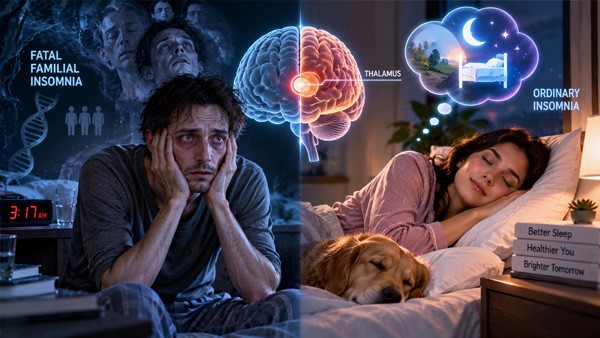

Fatal familial insomnia is one of the rarest diseases known. It has been confirmed in only a few dozen families worldwide. It is also one of the most searched, because it is exactly what a person lying awake at three in the morning, worrying about not sleeping, eventually types into a search bar.
If that is how you arrived here, the most useful thing to say comes first: ordinary insomnia, however severe and however long it has lasted, does not turn into this disease. The two share a word and very little else. Fatal familial insomnia is an inherited brain disease in which sleeplessness is one symptom among many. Chronic insomnia is a disorder of over-alertness in a brain that is fully capable of sleep.
This article explains what the rare disease actually is, how to tell it apart from common insomnia, whether lack of sleep itself can kill, and what genuinely works for the sleeplessness that most people are dealing with.

🧬 What the disease actually is
Fatal familial insomnia belongs to the prion diseases, the same group as Creutzfeldt-Jakob disease. Prions are misfolded versions of a normal protein found in the brain. A misfolded copy causes neighbouring normal copies to misfold too, and the abnormal protein gradually accumulates and destroys nerve cells.
In this disease the damage concentrates in the thalamus, a deep structure that acts as a relay station for the brain and plays a central role in generating sleep. As it degenerates, the brain loses the ability to produce the normal electrical patterns of sleep. The person does not simply lie awake — they drift into a strange state between waking and dreaming, sometimes acting out dream content while apparently awake.
🧬 How it is inherited. The disease is caused by a specific change in the gene that codes for the prion protein. It is inherited in a dominant pattern: each child of an affected parent has a one in two chance of carrying the change, and almost everyone who carries it eventually develops the disease. An even rarer non-inherited form, sporadic fatal insomnia, produces the same picture without the gene change.
The disease is not contagious through ordinary contact, cannot be caught by caring for someone who has it, and is not caused by stress, lifestyle, or years of poor sleep.
📉 How it progresses
Onset is usually in middle age, most often around the fifties, though it ranges widely. Average survival from the first symptoms is around a year and a half, with a range from several months to a few years. The course is often described in stages, although they overlap in practice.
| Stage | What happens |
|---|---|
| Early | Worsening insomnia over months, with panic attacks, unexplained fears and anxiety that do not respond to usual treatment |
| Middle | Hallucinations and dream-like states while awake. The automatic nervous system becomes overactive: heavy sweating, racing heart, raised blood pressure, fever, constricted pupils |
| Advanced | Near-total loss of sleep, marked weight loss, problems with balance, jerking movements, slurred speech and difficulty swallowing |
| Late | Dementia and progressive unresponsiveness, leading to death |
What stands out in that table is how much more is happening than sleeplessness. The disease is a progressive failure of the brain and nervous system. People do not die from the lack of sleep itself, but from the widespread brain damage the prion process causes.
⚖️ Fatal familial insomnia versus ordinary insomnia
This comparison is the heart of the article for most readers.
| Fatal familial insomnia | Chronic insomnia | |
|---|---|---|
| How common | A few dozen families worldwide | Around one adult in ten |
| Family history | Almost always a clear pattern of relatives dying of a progressive neurological illness in middle age | May run in families, but without any fatal illness |
| Ability to sleep | Progressively lost. Sleep does not return with a holiday, a nap, or exhaustion | Present. Sleep is patchy and unreliable but returns, sometimes deeply after several poor nights |
| Course | Steadily worsens over months, never improves | Fluctuates with stress, season, and circumstance |
| Other symptoms | Hallucinations, heavy sweating, fever, fast heart, weight loss, poor balance, jerks, dementia | Tiredness, irritability, poor concentration, worry about sleep |
| Response to treatment | None halts it | Responds well, particularly to structured behavioural therapy |
✅ If you are worried you have it, you almost certainly do not. The disease announces itself with a family history that is hard to miss, with neurological signs that are obvious to others, and with a relentless progression over months. A person with years of bad sleep who is otherwise functioning, whose sleep is better on some nights than others, and who has no relatives with a fatal brain disease in middle age is describing chronic insomnia — which is common, uncomfortable, and treatable.
💤 Can lack of sleep kill you?
This question sits underneath most searches for the disease, and it deserves a straight answer.
Ordinary insomnia does not cause death by sleeplessness. A healthy brain protects itself. As sleep pressure builds, it forces sleep in, including brief microsleeps of a few seconds that a person may not even notice. People with severe insomnia typically sleep considerably more than they believe, which sleep studies show repeatedly. In some, the gap is so large it has its own name: sleep state misperception.
Animal experiments in which rats were kept from sleeping continuously showed that total, enforced deprivation for weeks is fatal. That is not a situation human insomnia reproduces. In humans, the longest documented voluntary sleep deprivation lasted around eleven days and ended without lasting harm.
That does not mean chronic short sleep is harmless. The genuine dangers are slower and more mundane:
- 🚗 Drowsy driving — the most immediate and preventable risk. Impairment after a night without sleep is comparable to driving over the legal alcohol limit
- ❤️ Blood pressure and heart disease — consistently short sleep is associated with higher risk
- 🩸 Blood sugar — reduced insulin sensitivity and a higher risk of type 2 diabetes
- 🧠 Mood — insomnia roughly doubles the risk of developing depression, and treating it reduces that risk
- ⚖️ Weight — short sleep disrupts appetite hormones and increases hunger
These risks are reasons to treat insomnia properly. They are not reasons to lie awake fearing that tonight will be the one that causes harm — a fear that is itself one of the strongest drivers of insomnia.
🔬 How the rare disease is diagnosed
Diagnosis combines several pieces. A detailed family history is usually the strongest clue. Sleep studies show a characteristic loss of normal sleep patterns. Brain scans that measure activity show reduced function in the thalamus early in the disease, while standard MRI may look normal for a long time. Confirmation is by genetic testing of the prion protein gene.
👪 Genetic testing and families
For relatives of someone affected, the question of testing is one of the hardest in medicine. There is no treatment that prevents the disease, so learning one is a carrier offers information but not a remedy.
Testing is therefore offered only with genetic counselling before and after, and many people at risk choose not to be tested. For those planning a family, testing combined with IVF and genetic testing of embryos allows carriers to have children who will not inherit the change.
🔬 Research under way. In Italy, where one of the largest affected families lives, a trial has tested whether long-term doxycycline, an antibiotic that interferes with prion aggregation in the laboratory, can delay onset in carriers. Treatments designed to switch off production of the prion protein itself are in early human trials for prion diseases more broadly. None is yet an established treatment.
📋 What usually causes long-term insomnia
When insomnia persists, it is worth looking for something that is driving it rather than treating the sleep in isolation.
| Cause | Clues |
|---|---|
| Anxiety and depression | Racing thoughts at bedtime; waking early and unable to get back to sleep. Covered in the article on depression prevention |
| Sleep apnoea | Snoring, witnessed pauses in breathing, morning headache, unrefreshing sleep despite enough hours |
| Restless legs | An urge to move the legs in the evening, relieved by moving. Often linked to low iron |
| Pain | Arthritis, back pain and reflux all fragment sleep |
| Medicines | Some antidepressants, steroids, decongestants, some blood pressure medicines, and thyroid medicine at too high a dose |
| Caffeine and alcohol | Caffeine lasts many hours; alcohol helps sleep onset but fragments the second half of the night |
| Menopause | Night sweats and hot flushes |
| Overactive thyroid | Weight loss, tremor, palpitations, heat intolerance |
| Body clock | Shift work, jet lag, or a naturally late sleep pattern |
🛏️ What actually treats insomnia
The most effective treatment for chronic insomnia is not a tablet. It is cognitive behavioural therapy for insomnia, a structured programme usually lasting six to eight weeks, available in person and in validated online formats. It outperforms sleeping pills over the long term and its effect lasts after treatment ends.
Its core techniques sound counter-intuitive, which is part of why they work:
- Sleep restriction — spending less time in bed, initially matched to how much you actually sleep, so that sleep becomes deeper and more consolidated before time in bed is gradually extended
- Stimulus control — the bed is for sleep only. If you are awake and frustrated for a long spell, get up and return only when sleepy
- A fixed wake time — seven days a week, regardless of how the night went. This anchors the body clock more powerfully than bedtime does
- No clock-watching — checking the time feeds the calculation of lost sleep that keeps the brain alert
- Working on the worry about sleep — including the fear that it is dangerous, which this article is partly written to address
💊 Where medicines fit
| Medicine | Honest assessment |
|---|---|
| Melatonin | A modest effect on falling asleep. Best evidence in adults over 55, for jet lag, and for a naturally late body clock. Does not cause dependence or next-day sedation. Timing matters more than dose — for a late body clock it is taken several hours before intended sleep |
| Sedating antihistamines | Widely sold, tolerance develops within days, and they cause next-day grogginess. In older people they are associated with confusion and falls |
| Benzodiazepines and similar hypnotics | Effective briefly, dependence develops within weeks, and falls and memory problems are real risks. Short-term use only. The dependence problem is set out in the article on chlordiazepoxide |
| Low-dose sedating antidepressants | Sometimes used, particularly where depression or anxiety coexists |
| Alcohol | Not a sleep aid. It shortens the time to fall asleep and then fragments the rest of the night |
Melatonin is available in our sleep aids category as Restfine (melatonin 10mg). Many people respond to much smaller doses than 10mg, and starting with part of a tablet is reasonable. It works best as a support to the behavioural steps above, not a replacement for them.
🚑 When to see a doctor
- Insomnia lasting more than three months, or affecting work, driving or mood
- Loud snoring with pauses in breathing, or waking gasping
- Falling asleep while driving, or nearly doing so — stop driving until assessed
- Low mood, hopelessness or thoughts of self-harm — promptly, the same day if thoughts are active
- Sleeplessness together with new confusion, hallucinations, balance problems, jerking movements or weight loss — neurological assessment
- A family history of a progressive fatal brain disease in middle age — ask about genetic counselling
- Relying on sleeping tablets or alcohol most nights
❓ Frequently asked questions
What is fatal familial insomnia?
An inherited prion disease in which misfolded protein destroys the thalamus, a deep brain structure involved in generating sleep. It causes progressive loss of sleep, along with hallucinations, heavy sweating, fast heart rate, weight loss, balance problems and eventually dementia. It has been confirmed in only a few dozen families worldwide.
Can ordinary insomnia turn into fatal familial insomnia?
No. The disease is caused by a specific gene change, or very rarely by a spontaneous prion process. Stress, poor sleep habits and years of chronic insomnia do not cause it. Ordinary insomnia is a disorder of over-alertness in a brain that remains fully able to sleep.
How can I tell if my insomnia is something serious?
The rare disease comes with a clear family history of relatives dying from a progressive brain illness in middle age, relentless worsening over months, and obvious neurological symptoms such as hallucinations, heavy sweating, weight loss, balance problems and jerking movements. Insomnia that fluctuates, improves on some nights and occurs in someone otherwise functioning is chronic insomnia.
Can you die from lack of sleep?
Not from ordinary insomnia. A healthy brain forces sleep in as pressure builds, including brief microsleeps, and people with insomnia usually sleep more than they believe. The real dangers of chronic short sleep are slower: drowsy driving, higher blood pressure, blood sugar problems and a greater risk of depression. Those are reasons to treat it, not to fear each bad night.
How is fatal familial insomnia inherited?
In a dominant pattern. Each child of an affected parent has a one in two chance of carrying the gene change, and almost everyone who carries it eventually develops the disease, usually in middle age. Genetic counselling is offered before any testing, and IVF with embryo testing allows carriers to have unaffected children.
Is there any treatment for fatal familial insomnia?
No treatment halts it at present. Care focuses on comfort and symptom control. Research includes a trial of long-term doxycycline in carriers to see whether it can delay onset, and early human trials of treatments designed to reduce production of the prion protein. None is yet established.
Is it contagious?
Not through ordinary contact, caring for someone with it, or living in the same household. Like other prion diseases, special precautions are taken with surgical instruments used on brain and nerve tissue, but family members and carers are not at risk from contact.
What is the best treatment for chronic insomnia?
Cognitive behavioural therapy for insomnia, usually over six to eight weeks, in person or through validated online programmes. It combines sleep restriction, stimulus control, a fixed wake time and work on worry about sleep. It outperforms sleeping pills over the long term and the benefit lasts after treatment ends.
Does melatonin work for insomnia?
It has a modest effect on falling asleep, with the best evidence in adults over 55, for jet lag and for a naturally late body clock. It does not cause dependence or next-day grogginess. Timing matters more than dose, and many people respond to smaller amounts than are commonly sold.
When should insomnia be checked by a doctor?
When it lasts longer than three months, affects driving, work or mood, or comes with loud snoring and breathing pauses. Urgently if there is falling asleep at the wheel, thoughts of self-harm, or sleeplessness combined with new confusion, hallucinations, balance problems or weight loss.
📑 Sources and editorial
- Clinical and genetic descriptions of fatal familial insomnia and sporadic fatal insomnia
- Reviews of human prion diseases, transmission and infection control
- Neuroimaging and sleep study findings in fatal familial insomnia
- Preventive trial of doxycycline in carriers of the prion protein gene mutation
- Research on sleep deprivation in animals and in humans, and on sleep state misperception
- Guidelines recommending cognitive behavioural therapy as first-line treatment for chronic insomnia
- Evidence reviews on melatonin, antihistamines and hypnotics for insomnia
- Population studies of short sleep, cardiovascular risk, diabetes and depression
- Related reading: benzodiazepines and dependence, depression prevention
- Related products: sleep aids category
- RXshop Editorial Team — reviewed by James Carter, MD, Neurology
Medical Disclaimer: The information in this article is for educational and informational purposes only and is not a substitute for professional medical advice, diagnosis, or treatment. Always seek guidance from a qualified healthcare provider with any questions you may have regarding a medical condition, and before starting, stopping or changing any medication.