REM Sleep: Why the Body Is Paralysed, What Dreams Are For, and When Acting Them Out Is a Warning

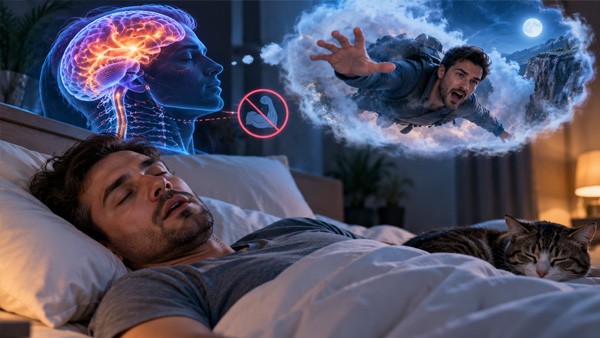
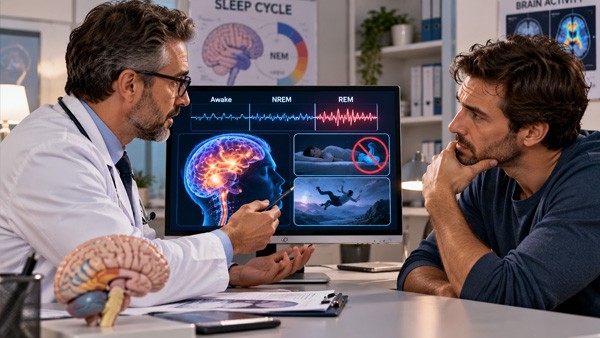
Sleep is not one state. Across the night the brain moves through cycles of about 90 minutes, and the most peculiar stage is REM sleep, named after the rapid eye movements that happen during it. In REM the brain is almost as active as when awake, the eyes dart about, breathing and pulse become irregular, and this is when most vivid dreaming happens.
At the same time the body is switched off. Nerve signals to the muscles are blocked, so the sleeper lies still while the dream plays out. That paralysis is protective, and when it fails, people get hurt.
This guide explains what REM sleep does, what disrupts it, why dreams turn vivid after stopping alcohol or cannabis, and which sleep behaviours need a doctor.
🌙 How the night is built
| Stage | What happens | Share of the night |
|---|---|---|
| Light sleep | Drifting off; easily woken | About half |
| Deep sleep | Physical restoration, growth hormone release; hardest to wake from | About 15 to 25 percent, mostly early in the night |
| REM sleep | Vivid dreams, active brain, paralysed muscles | About 20 to 25 percent, mostly in the second half of the night |
The proportions shift through the night. Deep sleep dominates the first cycles, REM the last ones. That is why cutting sleep short by two hours costs mainly REM, and why people who wake early often remember dreams in fragments.
Newborns spend about half their sleep in REM, which is thought to support brain development. The proportion falls through childhood to adult levels.
🧠 What REM sleep is for
- 📚 Memory — particularly emotional memories and learned skills, which are consolidated during REM
- 💛 Emotional processing — REM appears to soften the emotional charge of difficult experiences while keeping the memory
- 🧩 Problem solving and creativity — the loose associations of dreaming may help connect ideas
- 👶 Brain development in infants
People deprived of REM show a rebound: the next time they sleep undisturbed, they spend far more time in REM than usual, with unusually vivid dreams. The brain treats it as something to make up, which suggests it matters.
🍷 What suppresses REM
Several everyday things reduce REM sleep, and the rebound explains a symptom many people notice when they stop them.
| What | Effect |
|---|---|
| Alcohol | Suppresses REM early in the night; stopping brings vivid dreams for a week or two. See our guide to stopping drinking |
| Cannabis | Suppresses REM; stopping causes intense dreams, as described in our guide to cannabis withdrawal |
| Antidepressants | Many reduce REM; some cause vivid dreams instead |
| Sleep deprivation and shift work | Cut REM disproportionately, because it comes late in the night |
| Untreated sleep apnoea | Repeated arousals fragment REM, which is when breathing pauses are usually worst |
😰 Sleep paralysis
Waking while the REM muscle block is still switched on produces sleep paralysis: full awareness, inability to move or speak for seconds to a couple of minutes, often with a sense of pressure on the chest and sometimes hallucinations of a presence in the room. It is frightening and harmless.
It is more common with irregular sleep, sleep deprivation, jet lag, shift work and sleeping on the back. Frequent episodes with daytime sleepiness can point to narcolepsy, covered in our guide to narcolepsy. Regular sleep and enough of it prevent most episodes.
🛏️ Nightmares, night terrors and something else
| Nightmare | Night terror | REM sleep behaviour disorder | |
|---|---|---|---|
| When | Second half of the night, in REM | First third, in deep sleep | Second half, in REM |
| Who | Any age | Mostly children | Mostly men over 50 |
| Behaviour | Wakes frightened, lies still | Screaming, sitting up, confused, not really awake | Acting out the dream: punching, kicking, shouting, leaping from bed |
| Memory of it | Remembers the dream | No memory next morning | Remembers a dream matching the movements |
⚠️ When the paralysis fails
In REM sleep behaviour disorder, the muscle block does not work, and the sleeper physically acts out dreams, which are often confrontational: being chased or attacked. Partners describe being hit or kicked. People fall out of bed, hit furniture and break bones.
🔴 This is not just an odd habit. In people over 50, REM sleep behaviour disorder is one of the strongest known early warning signs of Parkinson disease and related conditions. A large share of those diagnosed develop one of them over the following ten to fifteen years, often long after the sleep problem started. That is a difficult fact, and also a useful one: it means neurological follow-up can start early. Treatment for Parkinson disease itself is covered in our Parkinson guide.
It can also be triggered by some antidepressants, and untreated sleep apnoea can imitate it closely, so a proper sleep study is part of the assessment.
💊 How it is managed
- Make the bedroom safe first
- This matters more than any tablet: move furniture and sharp objects away, pad the floor beside the bed, put the mattress lower or on the floor, and use window locks. Partners may sleep separately until it is controlled.
- Melatonin
- Often used first because it reduces the movements with a good safety profile, especially in older people. Doses used for this are higher than for jet lag and should be set by a doctor.
- Clonazepam
- Effective and long established, but it is a benzodiazepine, with sedation, falls and dependence to weigh up. It is not in our catalogue.
- Review medicines
- Some antidepressants can trigger or worsen it, and a change may help.
- Treat sleep apnoea
- If present, treating it may resolve the behaviour entirely.
Melatonin is available in our sleep aids category as Restfine (Melatonin). For this condition it should be used under medical supervision, not self-started, because the diagnosis needs confirming first.
🌟 Protecting your REM sleep
- Enough hours — REM is concentrated in the last cycles, so short nights hit it hardest
- A consistent wake time, which anchors the whole cycle
- Alcohol well away from bedtime
- Treat snoring with pauses, because apnoea shreds REM; see our sleep apnoea guide
- Daylight in the morning to keep the body clock steady
📞 When to see a doctor
- Acting out dreams, hitting, kicking or falling out of bed — arrange assessment
- Injury to yourself or a partner during sleep
- Frequent sleep paralysis with daytime sleepiness
- Loud snoring with pauses in breathing
- Nightmares most nights, especially after a traumatic event
- New tremor, stiffness or loss of smell alongside dream-enacting behaviour
❓ Frequently asked questions
What is REM sleep?
The stage where the brain is highly active, the eyes move rapidly and most vivid dreaming happens, while the muscles are temporarily paralysed. It makes up about 20 to 25 percent of the night, mostly in the second half.
Why is the body paralysed during dreams?
Signals to the muscles are blocked so the sleeper does not physically act out the dream. When this block fails, people punch, kick or leap from bed, which is REM sleep behaviour disorder.
How much REM sleep do I need?
Roughly a fifth to a quarter of total sleep. There is no need to track it: sleeping enough hours with a consistent schedule gives the brain the REM it requires.
Why do I have vivid dreams after quitting alcohol or cannabis?
Both suppress REM sleep. When they are stopped, the brain makes up the deficit with a REM rebound, producing unusually vivid or unsettling dreams for one to a few weeks.
What causes sleep paralysis?
Waking while the REM muscle block is still active. It lasts seconds to a couple of minutes and is harmless. Irregular sleep, sleep deprivation, jet lag and sleeping on the back make it more likely.
What is the difference between a nightmare and a night terror?
Nightmares happen in REM in the second half of the night and are remembered. Night terrors happen in deep sleep in the first third, mostly in children, with screaming and confusion, and no memory the next morning.
Is acting out dreams serious?
It causes real injuries and, in people over 50, it is one of the strongest early warning signs of Parkinson disease and related conditions. It should be assessed rather than ignored.
How is REM sleep behaviour disorder treated?
First by making the bedroom safe. Melatonin is often used first because of its safety profile, and clonazepam is an effective alternative with more side effects. Medicines that trigger it are reviewed, and any sleep apnoea treated.
Does alcohol help sleep?
It shortens the time to fall asleep but suppresses REM, fragments the second half of the night and worsens snoring. Overall sleep quality is worse.
Can a smartwatch measure my REM sleep?
Only approximately. Consumer devices estimate stages from movement and heart rate and often disagree with laboratory measurement. Use them for trends, not diagnosis, and do not lose sleep over the numbers.
📑 Sources and editorial
- Reviews of sleep architecture and the functions of REM sleep
- Research on REM rebound after alcohol, cannabis and sleep deprivation
- Clinical practice guidance on the management of REM sleep behaviour disorder, including melatonin and clonazepam
- Longitudinal studies linking REM sleep behaviour disorder with Parkinson disease and Lewy body dementia
- Reviews of sleep paralysis and parasomnias
- Related reading: Parkinson disease treatment, sleep apnoea, narcolepsy
- Related products: Restfine (Melatonin)
- RXshop Editorial Team — reviewed by James Carter, MD, Neurology
Medical Disclaimer: The information in this article is for educational and informational purposes only and is not a substitute for professional medical advice, diagnosis, or treatment. Always seek guidance from a qualified healthcare provider with any questions you may have regarding a medical condition, and before starting, stopping or changing any medication.