Melatonin Explained: Why the Timing Matters More Than the Dose, and What It Will Not Do for You

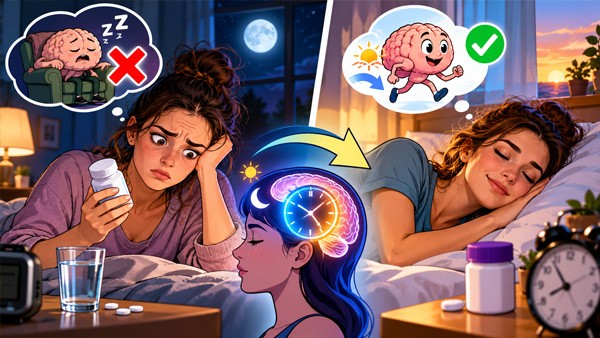

You buy a bottle, it says 10 mg, you take one at bedtime. Some nights it seems to help a bit. Most nights nothing much happens, and after a fortnight you decide melatonin does not work.
What went wrong is almost always the same two things: the time it was taken, and how much. Both are usually wrong in the same direction, and neither is the fault of the person taking it — the instructions on most packets describe a sleeping tablet, which this is not.
💡 Two things that decide whether it works at all.
🔹 It is a clock signal, not a sedative. Melatonin tells the body what time it is. It does not knock you out, and judging it by whether it makes you drowsy misses the point entirely — its main job is moving when sleep wants to happen.
🔹 For shifting the clock, less taken earlier beats more taken at bedtime. Around 0.5 to 1 mg, four to six hours before you currently fall asleep, moves the clock earlier. Ten milligrams at lights-out largely does not. This is the single most common mistake with it.
🕐 What melatonin actually is
Melatonin is a hormone the brain releases when it gets dark. Its message is not "go to sleep" — it is "biological night has started", and every system that runs on a daily cycle reads it: body temperature, alertness, hormone release, digestion.
Your own release begins roughly two hours before you naturally fall asleep, rises through the night and fades towards morning. Someone who naturally sleeps at midnight starts producing it around ten.
That timing is the key to everything below. Taking melatonin is not adding a drug to the system — it is moving the signal the body already sends, and the clock responds to where you put it.
Which also explains why bright light matters as much as the tablet. Light suppresses melatonin, so evening screens and bright rooms push the signal later, while morning daylight pulls it earlier. Light and melatonin are two handles on the same mechanism, and used together they work far better than either alone.
⏰ The timing rule, and why it reverses
This is the part that is almost never explained, and it is the whole game.
The same dose has opposite effects depending on when you take it:
| When taken | What it does to the clock | Used for |
|---|---|---|
|
Late afternoon to early evening several hours before your usual sleep time |
Pulls the clock earlier. You start feeling sleepy sooner and wake earlier | Night owls, delayed sleep phase, eastward travel |
| 30–60 minutes before bed | Mild sedative effect, little clock shift | Trouble falling asleep without a timing problem |
| Morning, after waking | Pushes the clock later. Usually unwanted | Rarely used deliberately; mostly a mistake to avoid |
So the practical instruction for anyone whose problem is falling asleep far too late is not "take it at bedtime". It is take a small dose in the early evening, then get bright light on waking.
💊 How much, honestly
📌 More is not better here, and can be worse.
A large dose keeps melatonin circulating into the following morning. That both blunts the clock-shifting effect you were aiming for and leaves you groggy — which then gets blamed on the condition rather than on the dose.
The doses most widely sold are far above what the body produces. That is a commercial convention, not a clinical one.
| Purpose | Dose | Timing |
|---|---|---|
| Shifting the clock earlier | 0.5–1 mg | 4–6 hours before current sleep onset |
| Falling asleep faster | 1–3 mg | 30–60 minutes before bed |
| Jet lag | 0.5–3 mg | At destination bedtime, covered below |
| Age-related poor sleep | 2 mg prolonged release where available | 1–2 hours before bed |
Both products stocked here are 10 mg tablets, which is above all of these. Where a smaller amount is wanted, a scored tablet can be divided — worth raising with a pharmacist, since prolonged-release forms must never be split.
Practical rule: start at the lowest amount, give it a week, and only then adjust. If a dose leaves you groggy in the morning, the answer is almost always to reduce it rather than to abandon the drug.
📋 What it treats well, and what it does not
| Situation | How well it works | |
|---|---|---|
| ✅ | Delayed sleep phase — cannot sleep before 2 or 3 am, fine if allowed to wake late | Its strongest use. Small evening dose plus morning light |
| ✅ | Jet lag, particularly travelling east | Genuinely effective, and probably the best-evidenced use |
| ✅ | Shift work sleep timing | Helps the sleep period move, though it does not fix night-shift alertness |
| 🟡 | Trouble falling asleep without a timing problem | Modest. Shortens sleep onset by minutes rather than transforming the night |
| 🟡 | Poor sleep over 55 | Modest benefit; own production declines with age |
| ❌ | Waking at 3 am and staying awake | Largely unhelpful. That is a different problem |
| ❌ | Chronic insomnia | Not the answer. Structured behavioural therapy outperforms every drug long-term — see what actually works for insomnia |
| ❌ | Sleep apnoea | Treats nothing here, and tiredness that persists needs that excluded — see sleep apnoea |
✈️ Jet lag, step by step
This is where melatonin earns its reputation, and the direction of travel changes the plan completely.
✅ Going east is the hard direction. You are asking the body to sleep earlier than it wants, and the internal clock resists that far more than it resists staying up late. Which is exactly what melatonin is good at.
Going west is easier, mostly solved by staying up and getting evening light. Melatonin helps less here.
- 🌅 Travelling east — take 0.5 to 3 mg at destination bedtime, starting the first night and continuing for three to five nights. Seek morning light at the destination and avoid bright light in the evening
- 🌇 Travelling west — melatonin is usually unnecessary. Stay awake until local bedtime and get evening light
- 📅 Trips under three days — often better not to adjust at all. Stay on home time where the schedule allows
- 📱 Set your watch to destination time when you board, and eat and sleep by it from that point
- ☕ Caffeine helps alertness, not adjustment, and taken late it works against the whole plan
- 🚗 Do not drive for four to five hours after a dose
🌙 Night owls: the protocol that works
For someone who cannot fall asleep until three in the morning but sleeps perfectly well if left alone until noon, the clock is not broken — it is set late. See our guide to delayed sleep phase syndrome for the condition itself.
Shifting it takes three things together, and leaving any one out is usually why attempts fail:
- 💊 0.5 to 1 mg of melatonin, four to six hours before current sleep onset. If you currently fall asleep at 3 am, that means around 9 to 11 pm — which feels absurdly early and is the point
- ☀️ Bright light within the first half hour of waking, for 20 to 30 minutes. Daylight outdoors beats any lamp; a light box works in winter
- 🕶️ Dim everything in the last two hours before the target bedtime. Evening light is actively pushing the clock the wrong way while you take the tablet trying to pull it the other
Then move in small steps: shift the whole schedule 15 to 30 minutes earlier every few days, not two hours at once. And the wake time has to hold on weekends, because one or two late nights undoes a fortnight of progress.
Expect three to four weeks for a meaningful shift, and expect it to drift back if the light and timing habits stop.
🌆 Shift work
Night shifts are a harder problem, because the goal is usually not a permanent shift but sleeping well at an unnatural time between rotations.
- 🛏️ Melatonin before daytime sleep after a night shift can help the sleep period hold, particularly with blackout blinds and an eye mask
- 🕶️ Dark glasses on the journey home after a night shift, so morning light does not cancel what you are about to do
- ⚠️ It does not keep you awake at night. Melatonin addresses the sleeping half of the problem, not the working half
More on the whole pattern in our guide to shift work sleep disorder.
⚠️ Side effects and what it interacts with
Melatonin is generally well tolerated at sensible doses. What does occur is mostly dose-related.
- 🤕 Headache, the commonest complaint
- 😴 Morning grogginess — nearly always the dose being too high or taken too late
- 😵 Dizziness and mild nausea
- 💭 Vivid or unusually memorable dreams
- 😢 Low mood or irritability in a small number of people
⚠️ Check these before starting.
🔹 Fluvoxamine raises melatonin levels dramatically by blocking its breakdown. The combination needs medical advice
🔹 Warfarin and other anticoagulants — possible increased bleeding risk, so mention it and watch the INR
🔹 Blood pressure medicines — melatonin may interfere with their effect
🔹 Diabetes medication — it can affect glucose handling, so readings are worth watching at first
🔹 Epilepsy — effects on seizure frequency have been reported in both directions. Discuss first
🔹 Autoimmune conditions — melatonin has effects on immune signalling and the evidence here is thin. Caution
🔹 Pregnancy and breastfeeding — avoided, as data are insufficient
🔹 Sedatives and alcohol — combined drowsiness
👶 Children and older adults
In children, melatonin is used mainly for sleep problems linked to neurodevelopmental conditions, and that should happen under specialist guidance rather than from a shop shelf. Long-term data in a developing system are limited, and ordinary childhood bedtime difficulties respond better to routine and boundaries than to a tablet.
Over 55, natural production falls, which is one reason sleep fragments with age. A prolonged-release 2 mg form is licensed in some regions specifically for this group, usually for short courses.
Worth separating out in older adults: much of what looks like poor sleep is actually an advanced clock — falling asleep at eight and waking at four. That is the opposite problem, and melatonin in the evening makes it worse rather than better. Evening light is the fix there.
🛒 Why pharmaceutical quality matters here
One practical point. Melatonin is sold as a food supplement in many countries, which means the content of a tablet is not necessarily what the label says. Independent testing of supplement-grade products has repeatedly found substantial variation between the stated and actual amount, in both directions.
For something where the difference between 0.5 mg and 10 mg changes the effect completely, that matters. A pharmaceutical-grade product with a verified content is worth the preference.
🛏️ What no dose fixes
Melatonin corrects timing. It does not compensate for the things that break sleep regardless of timing:
- ⏰ An irregular wake time. This is the foundation everything else sits on. A fixed wake time, weekends included, does more than any tablet
- ☕ Caffeine after midday, which lingers far longer than most people assume
- 🍷 Alcohol, which shortens sleep onset and then fragments the second half of the night
- 📱 Bright screens late, which suppress your own melatonin while you swallow a replacement
- 😰 Anxiety and a racing mind, which need addressing directly
- 😮💨 Untreated sleep apnoea, where no sleep aid will restore daytime energy
- 🦵 Restless legs, which has its own specific treatment
- 🛏️ Simply not allowing enough hours, which no drug solves
One piece of good news: unlike sleeping tablets, melatonin does not cause dependence or rebound insomnia. Stopping it does not produce a worse night than before, so trying it carries little downside.
📞 When to seek help
⚠️ Tiredness that persists despite adequate sleep needs a cause found, not a stronger sleep aid. Thyroid problems, anaemia, low B12 or iron, depression and sleep apnoea all present this way.
Worth an appointment:
- Melatonin tried for a month with no effect — usually the timing or dose, occasionally the wrong diagnosis
- Falling asleep at 3 am every night and unable to shift it despite trying
- Snoring with breathing pauses or daytime sleepiness, for sleep apnoea assessment
- Falling asleep during the day against your will — see our guide to narcolepsy
- Waking at 3 am and unable to return to sleep, which melatonin will not fix
- Taking warfarin, fluvoxamine, blood pressure or diabetes medication
- Epilepsy or an autoimmune condition
- Pregnancy, or planning one
- Considering it for a child
- Needing something to sleep every night for months, which points to chronic insomnia and a different approach
- Low mood alongside poor sleep, since the two drive each other
❓ Frequently asked questions
When should I take melatonin?
It depends on the goal. To shift the clock earlier, take a small dose four to six hours before your current sleep onset. To fall asleep faster without a timing problem, 30 to 60 minutes before bed.
How much melatonin should I take?
Far less than most packets contain. Around 0.5 to 1 mg for shifting the clock and 1 to 3 mg for sleep onset. Higher doses linger into the morning, blunt the clock shift and cause grogginess.
Is melatonin a sleeping tablet?
No. It is a timing signal telling the body that biological night has started. It has only a mild sedative effect, and judging it by whether it makes you drowsy misses what it actually does.
Does melatonin work for jet lag?
Yes, and this is its best-evidenced use, especially travelling east. Take it at destination bedtime for three to five nights and seek morning light there. Westward travel usually needs light more than melatonin.
Why does melatonin not work for me?
Most often the dose is too high and taken too late, or the problem is not one of timing at all. Waking at 3 am, chronic insomnia and sleep apnoea do not respond to it regardless of dose.
Is melatonin addictive?
No. Unlike sleeping tablets it does not cause dependence or rebound insomnia, and stopping it does not produce a worse night than before starting.
Why am I groggy the morning after?
Almost always because the dose was too large or taken too late, leaving melatonin circulating into the morning. Reducing the amount usually fixes it rather than abandoning the drug.
How do I shift my sleep earlier?
Three things together: a small dose four to six hours before current sleep onset, bright light within half an hour of waking, and dim light in the two hours before the target bedtime. Move in 15 to 30 minute steps.
What interacts with melatonin?
Fluvoxamine raises its levels considerably, and warfarin, blood pressure medicines and diabetes treatments all warrant a check first. Caution applies in epilepsy, autoimmune conditions and pregnancy.
Can children take melatonin?
It is used mainly for sleep problems linked to neurodevelopmental conditions, and under specialist guidance rather than bought off a shelf. Ordinary bedtime difficulties respond better to routine than to a tablet.
📑 Sources and editorial
- Literature on pineal melatonin secretion, dim light melatonin onset and its relationship to habitual sleep timing
- Phase response curve data for exogenous melatonin, describing phase advance with administration before endogenous onset and phase delay with morning administration
- Sleep medicine society clinical practice guidelines on the treatment of intrinsic circadian rhythm sleep-wake disorders, including delayed sleep-wake phase disorder and shift work disorder
- Evidence on combined timed melatonin and timed bright light exposure for circadian phase shifting, and the comparative potency of light as a zeitgeber
- Dose-response literature indicating that low physiological doses are sufficient for phase shifting, and that supraphysiological doses prolong the signal with reduced phase-shifting benefit and increased residual next-day sedation
- Meta-analyses of melatonin for sleep onset latency and total sleep time in primary insomnia, reporting modest effect sizes
- Guidance identifying cognitive behavioural therapy for insomnia as first-line treatment for chronic insomnia
- Trial and review evidence for melatonin in jet lag, including the asymmetry between eastward and westward travel
- Prescribing information for prolonged-release melatonin licensed for insomnia in older adults, and guidance against crushing or splitting prolonged-release formulations
- Guidance on melatonin use in children with neurodevelopmental conditions and the limited long-term safety data in paediatric populations
- Pharmacokinetic literature on melatonin metabolism via cytochrome P450 1A2, including the interaction with fluvoxamine and the effects of caffeine and smoking
- Guidance on melatonin interactions with anticoagulants, antihypertensives and glucose-lowering therapy, and cautions in epilepsy, autoimmune disease, pregnancy and lactation
- Analytical studies of melatonin content variability in supplement-grade products relative to labelled amounts
- Literature on advanced sleep phase in older adults and the role of evening light exposure
- Related reading: delayed sleep phase syndrome, shift work sleep disorder, what works for insomnia, obstructive sleep apnoea, narcolepsy
- Related products: Restfine (Melatonin), Altonil (Melatonin), sleeping aid category
- RXshop Editorial Team — reviewed by James Carter, MD — Neurologist & Sleep Medicine Specialist
Medical Disclaimer: The information in this article is for educational and informational purposes only and is not a substitute for professional medical advice, diagnosis, or treatment. Always seek guidance from a qualified healthcare provider with any questions you may have regarding a medical condition, and before starting, stopping or changing any medication.