Body Clock Disorders: When Sleep Comes at the Wrong Time

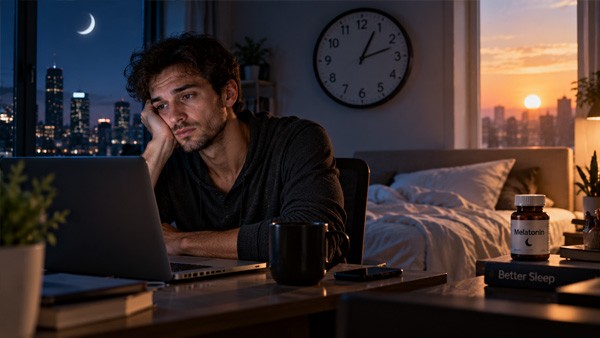
Circadian rhythm disorders are frequently mistaken for insomnia, and the mistake leads to years of the wrong treatment. The distinction is simple and it changes everything that follows.
Someone with insomnia cannot sleep. Someone with a circadian rhythm disorder sleeps perfectly well — at the wrong hours. Left alone, on their own schedule, they fall asleep easily, stay asleep, and wake refreshed. The problem is that their schedule and the world’s do not align.
🕑 Why this distinction decides the treatment. A sleeping tablet addresses an inability to fall asleep. It does nothing whatever to the clock. Sedate someone at eleven at night whose internal clock is set for three in the morning and they will fall unconscious — then wake at the time their body intended, having had drugged sleep at the wrong point in their cycle, feeling worse than if they had simply gone to bed late. These conditions are treated by moving the clock, using light and correctly timed melatonin, not by forcing sleep. Which is why so many people take hypnotics for years without improvement.
🕛 The clock, and what sets it
A cluster of cells in the hypothalamus, no larger than a grain of rice, generates a daily rhythm that governs sleep, alertness, body temperature, hormone release, digestion and blood pressure.
Left entirely without time cues, that clock runs on its own period — in most people slightly longer than twenty-four hours. Left uncorrected it would drift later every day, so it has to be reset daily against the outside world.
Light does the resetting, through a distinct set of cells in the retina that exist for this purpose rather than for vision. They are most responsive to short-wavelength blue light, which is why daylight resets the clock far more powerfully than indoor lighting — the difference between the two is far larger than it looks, since the eye adjusts and the brain does not care how bright it seems.
⚖️ The rule that governs everything
Light does not simply wake you up. Its effect on the clock depends entirely on when it arrives.
There is a pivot point in the daily cycle, occurring at the moment of lowest body temperature — roughly two hours before your habitual waking time.
| Light arriving | Effect on the clock | Practical result |
|---|---|---|
| In the evening and early night, before that low point | Delays the clock | You become sleepy later and wake later |
| In the late night and morning, after that low point | Advances the clock | You become sleepy earlier and wake earlier |
This single rule explains why bright morning light is the standard treatment for someone who cannot get to sleep, and why the same light at midnight makes them considerably worse. It also explains a specific failure: someone with a very delayed clock who gets up at six for bright light exposure may be receiving it before their temperature minimum — and therefore pushing their clock further in the wrong direction.
Melatonin follows the opposite pattern. Taken in the evening it advances the clock; taken in the morning it delays it. Between them, light and melatonin can move a clock in either direction, which is the whole of the treatment.
🌙 The commonest one
Delayed sleep phase disorder affects a substantial share of adolescents and young adults, and it is misread more often than any other sleep condition.
The pattern is consistent. Sleep onset is not possible before roughly two to six in the morning, regardless of how tired the person feels or how early they went to bed. Natural waking is late morning to early afternoon. Sleep quality itself is entirely normal. Given a free schedule — a holiday, a weekend, unemployment — they sleep well and function well.
Forced into conventional hours, they cannot fall asleep at eleven, must rise at seven, and accumulate chronic sleep deprivation. They are exhausted every morning, function poorly before noon, and come alive in the evening.
What they are then called: lazy, unmotivated, undisciplined, depressed. What they are usually treated for: insomnia, with sleeping tablets that do not address the problem.
⚠️ In adolescence, a delayed clock is biological rather than behavioural. At puberty the timing of melatonin release shifts roughly two hours later, so a teenager genuinely cannot fall asleep at the hour they could at eleven years old. Combined with early school starts, this produces an entire population running on chronic sleep restriction by design. Telling a fifteen-year-old to go to bed earlier does not move a clock, and the resulting conflict — nightly, for years — is often more damaging than the sleep loss. Most people grow out of it in their twenties. A minority do not, and that is the disorder.
🌅 And the mirror image
Advanced sleep phase disorder is the same problem in the opposite direction and far less common. Irresistible sleepiness in the early evening, from around six or seven, and waking spontaneously at two or three in the morning unable to return to sleep.
It occurs mainly in older adults and it is frequently mistaken for the early-morning waking of depression, which is a different thing with different treatment. The distinguishing question is what happens in the evening: someone with an advanced clock is falling asleep in front of the television at eight, someone with depression is not.
Treatment reverses the approach — bright light in the evening to push the clock later, and avoiding it in the early morning.
🔄 The clock with nothing to set it
If the internal clock runs slightly longer than twenty-four hours and nothing resets it, sleep drifts later every single day.
That is exactly what happens in people who are totally blind without light perception, in whom the resetting signal never arrives. A substantial proportion of them — more than half by most estimates — have this condition, and it is badly under-recognised.
The pattern is unmistakable once described. For a week or two sleep is normal, because the drifting clock happens to align with the world. Then it drifts out, and for a fortnight they cannot sleep at night and are exhausted by day. Then it comes round again. The cycle repeats indefinitely, and because there are good weeks, the problem gets dismissed as inconsistency.
Since light cannot be used, correctly timed melatonin is the mainstay, and it works.
🌀 No pattern at all
Irregular sleep-wake rhythm means sleep broken into several short periods across the twenty-four hours, with no consolidated night sleep and no sustained daytime alertness. Total sleep may be normal; its organisation is not.
It occurs mainly in dementia, after brain injury, and in some developmental conditions, where the clock itself or the pathways carrying light to it are damaged.
It is one of the commonest reasons families can no longer manage care at home, and it responds better than expected to non-drug measures: bright light during the day, genuine darkness at night, activity and social contact concentrated in daytime hours, and rigid consistency of meal and activity times. Sedatives make it worse and increase falls.
💡 Light as treatment
Light is the more powerful of the two tools and the one people underuse, mostly because they underestimate how much is required.
Intensity. Ordinary indoor lighting sits at a few hundred units of brightness. An overcast day outdoors is around ten thousand; direct sun far more. Sitting by a window is not treatment. Either a purpose-built light box or genuinely going outside is.
Duration. Around thirty minutes for a proper light box, longer for weaker sources.
Timing. The critical variable. For a delayed clock, immediately on waking, and consistently. For an advanced clock, in the evening.
Consistency. Daily. A clock resets by small increments and an inconsistent signal produces no net movement.
Position. The light must reach the eyes, though it is not looked at directly. Reading or eating breakfast in front of it works.
Equally important is what is avoided: bright light in the two or three hours before target bedtime, which pushes the clock the other way and undoes the morning work.
💊 Melatonin, and the mistake everyone makes
Melatonin is not a sleeping tablet, and treating it as one is why it so often disappoints.
It is the hormone the body releases as darkness falls, signalling to the rest of the system that night has begun. Taken from outside, its effect on the clock depends on when it is taken, in the same way light does.
💡 Two corrections that change whether it works.
Timing matters more than dose. To shift a delayed clock earlier, melatonin is taken several hours before the desired sleep time — typically three to five hours before — not at bedtime. Taken at bedtime it produces mild sedation and moves the clock very little, which is exactly what most people do and exactly why they conclude it does not work.
More is not better. For shifting the clock, small doses of around half a milligram to three milligrams are as effective as large ones and in some studies more so, because a large dose remains in the blood long enough to spill into the following morning, where its effect on the clock runs in the opposite direction. Widely sold ten milligram tablets are a hypnotic-style dose. For phase shifting, a quarter or half of one, taken at the right hour, does more than the whole tablet at bedtime.
Melatonin is also the mainstay where light cannot be used — principally in people who are totally blind, in whom it reliably entrains an otherwise free-running clock.
It is not habit-forming, does not cause dependence, and its main side effects at sensible doses are drowsiness if taken at the wrong time and vivid dreams. It interacts with a few medicines, notably some antidepressants that slow its breakdown and anticoagulants, so it is worth mentioning rather than assuming a hormone sold without prescription is inert.
🚫 Why sleeping tablets do not solve this
Worth stating explicitly, since it is the commonest wrong turning.
Hypnotics produce unconsciousness. They do not move a clock. Someone with a delayed phase who takes one at eleven falls asleep and then wakes at their body’s intended hour, with a shorter and pharmacologically altered night behind them. They feel worse, not better.
Over months this adds tolerance, dependence and the difficulty of stopping to a problem that was never about the ability to fall asleep. People spend years in this position, and the way out is recognising that the diagnosis was wrong rather than that the dose was too low.
📱 Screens, honestly
Evening screen use is blamed for a great deal, and the picture is more nuanced than the headlines.
The blue light from a phone or laptop does reach the cells that reset the clock and can delay it — but at typical screen brightness, held at typical distance, the effect is modest compared with a light box or with daylight. Blue-blocking filters produce small effects at best.
The larger problem is what the screen is doing to you rather than what it is emitting. Engaging, stimulating, socially charged content keeps people awake and delays the moment they choose to sleep, and that behavioural effect is considerably bigger than the optical one.
So the useful advice is less about filters and more about what and when: stopping stimulating activity an hour before target sleep, and keeping the evening genuinely dim, which means the room and not only the device.
🔬 Establishing the diagnosis
The single most valuable thing is a sleep diary kept for one to two weeks, recording when you went to bed, when you fell asleep, when you woke, and how you felt — including weekends and any free days, since the free-day pattern reveals the clock’s natural setting.
A wrist monitor recording movement over the same period adds objective data, and specialist settings can measure the evening rise in melatonin directly to locate the clock precisely.
Two things are also worth excluding, because they coexist and complicate: sleep apnoea, which fragments sleep regardless of timing, and depression, which shares the exhaustion and the morning difficulty. Depression and delayed sleep phase occur together frequently and each worsens the other, so finding one is not a reason to stop looking.
📋 Moving a delayed clock
Fix the wake time first and hold it, including weekends. This is the hardest instruction and the most important. Sleeping in on Saturday undoes the week, because the clock reads the late morning as permission to drift further.
Bright light immediately on waking, for around thirty minutes, every day. Outdoors if possible, a light box otherwise.
A small dose of melatonin several hours before target bedtime, at a consistent time, rather than at bedtime.
Dim the evening for two to three hours before target sleep — the room, not only the screens.
Move in small steps. Fifteen to thirty minutes earlier at a time, holding each new schedule for several days before moving again. Attempting a three-hour shift at once fails.
No caffeine after midday, and honest attention to how much there is.
Expect it to relapse after a holiday, an illness or a period of night work, and expect to repeat the process. This is management rather than cure, and the clock returns to its preferred setting whenever the discipline lapses.
Where the schedule can be changed instead of the person — later start times, flexible or remote work, evening study — that is a legitimate and often better solution than a lifetime of fighting one’s own biology.
🩺 When to seek help
- Consistently unable to fall asleep before the early hours, despite tiredness, for months
- Sleeping normally on free days but failing on scheduled ones — the key clue
- Sleep drifting later every day in a repeating cycle, particularly if you are blind
- Falling asleep in the early evening and waking at two or three, unable to return
- Sleeping tablets prescribed for months without improvement
- School or work performance failing because of morning hours specifically
- Snoring with pauses in breathing, which needs excluding whatever the timing
- Falling asleep while driving — urgent
- Low mood alongside, since the two travel together and each worsens the other
- A teenager in nightly conflict over bedtime — the conflict is often more harmful than the schedule
Melatonin is stocked in the sleep aids category as Restfine and Altonil. Both are 10 mg tablets, which is a hypnotic-style dose — for shifting a clock, a fraction of one taken at the right hour is what the evidence supports. Where the problem is shift work or travel rather than an intrinsic clock disorder, the shift work and jet lag articles cover those separately.
❓ Frequently asked questions
How is this different from insomnia?
Someone with insomnia cannot sleep. Someone with a circadian rhythm disorder sleeps perfectly well at the wrong hours — given a free schedule they fall asleep easily, stay asleep and wake refreshed. The problem is alignment with the outside world, not sleep itself. That distinction decides the treatment, because moving a clock and forcing sleep are entirely different interventions.
Why do sleeping tablets not fix it?
They produce unconsciousness without moving the clock. Sedate someone at eleven whose clock is set for three and they fall asleep, then wake at their body's intended hour with a shorter, pharmacologically altered night behind them, feeling worse. Over months this adds tolerance and dependence to a problem that was never about the ability to fall asleep.
When should I take melatonin?
To shift a delayed clock earlier, several hours before your desired sleep time — typically three to five hours before — not at bedtime. Taken at bedtime it produces mild sedation and moves the clock very little, which is what most people do and why they conclude it does not work. Consistency of timing matters more than anything else about it.
Is a bigger dose of melatonin better?
No, and it can be worse. For shifting the clock, small doses of around half a milligram to three milligrams are as effective as large ones and in some studies more so, because a large dose lingers into the following morning where its effect on the clock runs in the opposite direction. Widely sold ten milligram tablets are a hypnotic-style dose; a fraction of one at the right hour does more.
Why does morning light help and evening light hurt?
Because light shifts the clock in opposite directions depending on when it arrives, with the pivot at the moment of lowest body temperature, roughly two hours before habitual waking. Light before that point delays the clock; light after it advances the clock. That is why bright morning light treats a delayed phase and why the same light at midnight makes it considerably worse.
Is sitting by a window enough?
No. Ordinary indoor lighting is a few hundred units of brightness; an overcast day outdoors is around ten thousand, and direct sun far more. The eye adjusts so the difference does not feel that large, and the clock does not care how bright it seems. Either a purpose-built light box for around thirty minutes or genuinely going outside counts as treatment.
Can I catch up on sleep at the weekend?
It is the single most damaging thing you can do while trying to fix this. A fixed wake time held every day, weekends included, is what moves a clock; sleeping in on Saturday reads as permission to drift further and undoes the week. This is the hardest instruction in the whole protocol and the one that determines whether it works.
Is my teenager just being lazy?
At puberty the timing of melatonin release shifts roughly two hours later, so a teenager genuinely cannot fall asleep at the hour they could at eleven years old. Combined with early school starts this produces chronic sleep restriction by design. Telling them to go to bed earlier does not move a clock, and the nightly conflict is often more damaging than the sleep loss itself.
My sleep drifts later every day. What is that?
A free-running clock. Because the internal clock runs slightly longer than twenty-four hours, without daily resetting it drifts later indefinitely. It is common in people who are totally blind without light perception, where the resetting signal never arrives. The pattern is a good fortnight when the clock happens to align, then a bad one, repeating — which is why it gets dismissed as inconsistency.
Do blue light filters on my phone help?
Slightly, and less than the marketing suggests. Screen light does reach the cells that reset the clock, but at typical brightness and distance the effect is modest compared with daylight or a light box, and filters produce small effects at best. The bigger problem is what the screen is doing to you rather than what it emits — engaging content delays the moment you choose to sleep.
📑 Sources and editorial
- International Classification of Sleep Disorders criteria for circadian rhythm sleep-wake disorders
- AASM clinical practice guideline on the treatment of intrinsic circadian rhythm sleep-wake disorders
- Research on the human phase response curve to light and to exogenous melatonin
- Studies of intrinsically photosensitive retinal ganglion cells and short-wavelength light sensitivity
- Literature on pubertal phase delay and school start times
- Evidence on non-24-hour sleep-wake rhythm disorder in totally blind individuals
- Dose-finding studies of melatonin for circadian phase shifting
- Trials of light therapy intensity, duration and timing in delayed sleep phase disorder
- Research on evening screen exposure, blue-blocking interventions and sleep onset
- Related reading: shift work sleep disorder, jet lag, sleep apnoea
- Related products: sleep aids category
- RXshop Editorial Team — reviewed by James Carter, MD, Neurologist and Sleep Medicine Specialist
Medical Disclaimer: The information in this article is for educational and informational purposes only and is not a substitute for professional medical advice, diagnosis, or treatment. Always seek guidance from a qualified healthcare provider with any questions you may have regarding a medical condition, and before starting, stopping or changing any medication.