Prinzmetal Angina: Chest Pain at Rest and at Night, What Triggers the Spasm and Which Medicines Prevent It

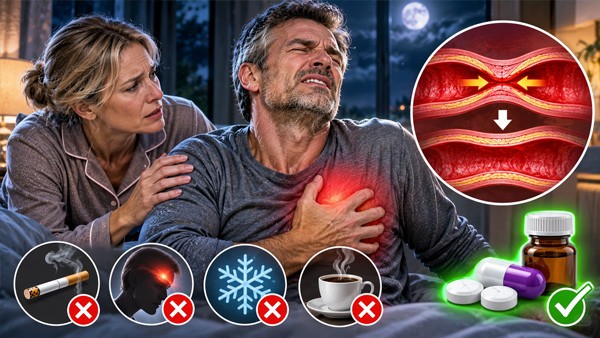

🌙 Most chest pain from the heart shows up when people climb stairs, hurry for a bus or carry heavy bags. Prinzmetal angina breaks that rule. Its typical attack comes at rest, often in the quiet hours between midnight and early morning, and it can wake a person from sleep. 🔍 The cause is not a fixed blockage but a sudden cramp, or spasm, of a coronary artery that squeezes blood flow for a few minutes and then lets go. Doctors also call it variant angina or vasospastic angina. This guide explains what the spasm is, the symptom pattern that gives it away, the triggers that set it off (smoking, cocaine, cold, certain medicines), how doctors confirm it, why calcium channel blockers such as nifedipine and diltiazem are the treatment of choice, how nitrates fit in, and which common drugs can make it worse.
🫀 What makes Prinzmetal angina different
📖 Angina means chest pain caused by the heart muscle not getting enough oxygen. In the common, stable form, a plaque narrows an artery and the pain comes when the heart works harder than the narrowed vessel can supply. In Prinzmetal angina the problem is the muscle in the artery wall, which suddenly contracts too hard and closes the vessel partly or fully, even when the heart is resting and asks for little oxygen. Myron Prinzmetal described this pattern in 1959. 📖 For a general overview of angina types, see angina: types, symptoms, treatment and prevention. This article stays with the spasm form.
🧬 What happens inside the artery
🔬 The lining of a healthy artery releases nitric oxide, which keeps the muscle layer relaxed. When that lining is damaged, for example by smoking, the balance tips toward tightening. A small trigger then makes the smooth muscle clamp down hard, and calcium flowing into the muscle cells drives that contraction. This is why drugs that block calcium entry, and nitrates that replace the missing nitric oxide signal, work so well in this condition.
🎯 The symptom that gives it away: chest pain at rest
🧑⚕️ Nursing and medical exams often ask which symptom a person with Prinzmetal angina will present with. The expected answer is chest pain or pressure that comes on at rest, often at the same time of night or early morning, and usually not from exercise. The pain itself feels like any angina: tightness, squeezing or heaviness behind the breastbone, sometimes spreading to the jaw, neck, shoulder or left arm. What separates it is the timing and the ECG during the attack, which typically shows ST-segment elevation that returns to normal once the spasm eases.
- 📌 Pain at rest or in sleep, often between midnight and morning
- 📌 Episodes that repeat at a similar hour, sometimes in clusters over days or weeks
- 📌 Quick relief with nitroglycerin under the tongue, usually within minutes
- 📌 Normal exercise ability in the afternoon in many patients
- 📌 Possible palpitations, sweating, nausea or faintness during the spasm
🕰️ The night and early morning pattern
🌙 Spasm follows a daily rhythm. The artery wall is most reactive in the late night and early morning, when the nervous system shifts during sleep and waking. Many patients can walk briskly or work out in the afternoon without pain, yet wake at 4 or 5 am with a crushing feeling in the chest. This pattern is one reason doctors often give the main dose of a calcium channel blocker in the evening.
Peak window for attacks
Light effort may still trigger pain
Exercise often tolerated
Common time for the main dose
⏳ How one episode unfolds
⚠️ Some people feel only part of this picture. Silent spasm, without pain, can show up on a 24-hour ECG recording, and in some patients the first sign is fainting or a fast irregular heartbeat rather than chest pain.
⚖️ Prinzmetal angina, stable angina and heart attack compared
🔎 Because the pain feels the same, timing and ECG findings do most of the work in telling these apart. During an attack, variant angina can look exactly like a STEMI heart attack on the ECG, which is why it is always treated as an emergency until proven otherwise.
| 🔍 Feature | 🌀 Prinzmetal angina | 🏃 Stable angina | 🚨 Heart attack |
|---|---|---|---|
| Cause | Temporary spasm of the artery | Fixed narrowing by plaque | Clot blocks the artery |
| When | At rest, at night, early morning | With effort, eases with rest | Any time, at rest too |
| Duration | Usually 5 to 15 minutes | Usually under 5 to 10 minutes | Over 15 to 20 minutes |
| ECG in pain | Short-lived ST elevation | ST depression or normal | ST changes that persist |
| Nitroglycerin | Fast relief | Relief in minutes | Little or no relief |
| Main prevention | Calcium channel blocker | Beta blocker or CCB, aspirin, statin | Emergency reopening of the artery |
👥 Who gets coronary spasm
🧬 Spasm can happen at any adult age, but people with vasospastic angina are on average younger than those with classic angina and often have few of the usual risk factors apart from smoking. It is diagnosed more often in East Asian populations, and some people have a family pattern of overreactive blood vessels.
⚡ Everyday triggers you can control
📝 Not every attack has a clear cause, but many patients learn their own triggers after a few weeks of keeping notes. Removing even one strong trigger can cut the number of attacks noticeably, and some triggers are easy to avoid once known.
🚭 Smoking, cocaine and stimulants
🚬 Tobacco smoke injures the artery lining and lowers nitric oxide, which leaves the vessel ready to spasm. Stopping smoking is the single most effective lifestyle step in vasospastic angina, and some people see attacks fade once they quit, even before medicines are adjusted. Nicotine replacement is generally considered much safer than continued smoking, and prescription aids such as Chantix (Varenicline) or Zyban (Bupropion) can double the chances of quitting when combined with support. 📖 How these aids compare is explained in understanding smoking cessation aids.
❄️ Cocaine causes intense coronary spasm, raises blood pressure and makes blood more likely to clot, so chest pain after cocaine use is treated as a possible heart attack. Amphetamines, methamphetamine and high doses of some stimulant drugs act in a similar way. Anyone with a spasm diagnosis should tell the doctor honestly about recreational drug use, because it changes which emergency medicines are safe.
💊 Medicines that can provoke spasm
🧪 Several ordinary prescriptions narrow arteries or remove a protective effect. Show your diagnosis to every doctor and pharmacist before starting a new medicine, including migraine tablets and cold remedies.
| 🚫 Medicine group | 📝 Why it is a concern |
|---|---|
| Non-selective beta blockers (propranolol) | Leave the tightening signals in the artery unopposed |
| Triptans (sumatriptan and others) | Narrow blood vessels, including coronary arteries |
| Ergot drugs (ergotamine) | Strong vessel constrictors; ergonovine is even used to provoke spasm in tests |
| Decongestants such as pseudoephedrine | Stimulate the same receptors that tighten vessels |
| Some cancer drugs (5-fluorouracil, capecitabine) | Known to cause coronary spasm during treatment |
| High-dose aspirin | May reduce a natural vessel-relaxing substance; low dose is usually fine when needed |
📖 If migraine is part of your history, the safer treatment choices are discussed in migraine with aura and how to tell it from a stroke.
🥶 The link with migraine and Raynaud phenomenon
🧠 Doctors notice that vasospastic angina, migraine and Raynaud phenomenon often appear in the same person, which suggests a general tendency of blood vessels to overreact. This matters for treatment: some migraine drugs are off limits, while calcium channel blockers can help both the heart and cold fingers. 📖 More on cold, white fingers in Raynaud disease.
🩺 How doctors confirm the diagnosis
📈 The challenge is that the spasm comes and goes, so a normal ECG in clinic proves nothing. The strongest evidence is an ECG recorded during pain that shows ST elevation which clears when the pain goes. When that is not available, doctors use longer recordings or a provocation test in the catheter laboratory.
🧭 Spasm on clean arteries or on plaque?
🔹 Many patients have arteries that look nearly normal on angiography; the problem is purely the spasm.
🔹 Others have spasm at the site of a plaque, which narrows the vessel even more and may need the same care as stable coronary disease.
🔹 A third group has spasm in the tiny vessels that angiography cannot see, called microvascular spasm. It is treated in a similar way.
💊 Calcium channel blockers: the treatment of choice
🛡️ Calcium channel blockers relax the muscle in the artery wall by limiting calcium entry. Guidelines name them as first-line prevention for vasospastic angina, and most patients have far fewer attacks once on an adequate dose. Long-acting forms are preferred so the artery stays protected through the night. If one drug at full dose is not enough, cardiologists sometimes combine a dihydropyridine (nifedipine or amlodipine) with diltiazem or verapamil.
📋 Nifedipine in practice
💊 Nifedipine is one of the most studied drugs for coronary spasm. Only extended-release tablets are used for long-term prevention; the old short-acting capsules can drop blood pressure suddenly and speed up the heart, and they are no longer advised for angina. The dose is built up step by step, and the doctor may place it in the evening to cover the night hours.
📋 How it is commonly used
💊 Extended-release, usually 30 to 60 mg once daily, up to 90 mg if needed
🌙 Often taken in the evening when attacks are nocturnal
🚫 Swallow whole; do not crush or chew
🍊 Avoid grapefruit and its juice, which raise blood levels
📊 What patients notice
✅ Fewer night attacks within days to weeks
➖ Flushing, headache in the first weeks
➖ Ankle swelling, more at higher doses
⚠️ Dizziness when standing up quickly
💚 Diltiazem and verapamil
💓 These two belong to a different calcium channel blocker family. They relax the coronary arteries and also slow the heart rate, which suits people who get palpitations or a fast pulse with nifedipine. Diltiazem is often given as a long-acting form at 120 to 360 mg a day; verapamil long-acting forms are usually 240 to 480 mg a day. Both interact with many medicines, including some statins and drugs broken down by the liver enzyme CYP3A4, so a medicine review is important. They are usually not combined with beta blockers because the pulse can drop too low, and they are avoided in people with weak heart pumping or certain conduction problems.
⚡ Nitrates: rescue under the tongue and daily tablets
💨 Nitroglycerin under the tongue or as a spray is the rescue treatment. It works within 1 to 3 minutes because it is absorbed straight into the blood and turns into nitric oxide, the substance the damaged artery is missing. Long-acting nitrates such as Imdur (Isosorbide mononitrate) are added when a calcium channel blocker alone does not control attacks. They need a daily nitrate-free gap of several hours, otherwise the body gets used to them and they stop working.
🧭 What to do during an attack
📱 The usual sublingual dose is 0.3 to 0.4 mg, which can be repeated every 5 minutes up to three doses. Sit, do not stand, when taking it, because it can cause light-headedness and a pounding headache.
🛑 Why beta blockers are a problem here
🔄 In stable angina, beta blockers are a standard choice. In pure vasospastic angina, non-selective beta blockers like propranolol can make spasm worse, because they block the receptors that relax arteries and leave the tightening ones working unopposed. Many cardiologists avoid all beta blockers as the only treatment for spasm. In people who also have fixed plaque or a past heart attack, a cardioselective beta blocker may still be used together with a calcium channel blocker, but that is a specialist decision. If you already take a beta blocker and develop rest pain at night, do not stop it suddenly; ask your doctor to review it.
🧪 Statins, aspirin and other add-ons
📉 Statins lower cholesterol and also seem to improve the function of the artery lining. Some studies have found fewer spasm attacks when a statin is added to a calcium channel blocker, and a statin is clearly indicated when plaque is present. Common choices are Lipitor (Atorvastatin) and Crestor (Rosuvastatin). Aspirin is not routine for pure spasm and high doses are avoided; low-dose aspirin is used when there is coronary plaque or a past heart attack. 📖 Cholesterol targets are covered in high cholesterol and your heart.
Statin, long-acting nitrate, smoking cessation
Low-dose aspirin, magnesium if low
Non-selective beta blockers, high-dose aspirin
💊 Side effects and how they are handled
| 💊 Medicine | ⚠️ Common side effects | 🛠️ What usually helps |
|---|---|---|
| Nifedipine, amlodipine | Ankle swelling, flushing, headache, gum overgrowth (rare) | Dose change, raising the legs, good dental care |
| Diltiazem | Slow pulse, swelling, headache | Pulse checks, dose review |
| Verapamil | Constipation, slow pulse, dizziness | Fibre and fluids, dose review |
| Nitrates | Headache, flushing, light-headedness | Often fades in 1 to 2 weeks; sit when taking a rescue dose |
| Statins | Muscle aches in some people | Report weakness or dark urine at once |
📖 Practical tips for daily life on heart and blood pressure tablets, including what to do on sick days, are in living with blood pressure tablets.
⛔ Never stop treatment suddenly
⚠️ Rebound spasm is a real risk.
🔹 Stopping a calcium channel blocker or nitrate abruptly can bring back attacks that are stronger than before, sometimes within a day or two.
🔹 If side effects are a problem, ask for a slow switch to another drug rather than stopping.
🔹 Before surgery or a long trip, make sure you have enough tablets and that the hospital team knows your diagnosis.
📆 Many people with good control for a year or more ask whether they can come off treatment. Spasm can quiet down over time, especially after stopping smoking, and some cardiologists try a careful, gradual reduction under close watch. This should never be done alone.
✅ A daily checklist for living with spasm
🗿 Myths about Prinzmetal angina
🔮 Outlook and possible complications
🌟 With the right diagnosis, most people with vasospastic angina do well over the long term, especially those who stop smoking and take a calcium channel blocker regularly. The risk is highest in the first months after diagnosis, when doses are still being adjusted, and in people with spasm on top of plaque. Rare but serious complications include heart attack, very slow heart rhythms, ventricular tachycardia and cardiac arrest. Survivors of cardiac arrest caused by spasm may be offered an implanted defibrillator in addition to medicines. 📖 If a heart attack has already happened, the first year of care is described in after a heart attack or stent.
🚨 When to call an ambulance or see a doctor
⛔ Call emergency services now if:
🔹 Chest pain is not clearly better 5 minutes after the first nitroglycerin dose, or lasts more than 15 to 20 minutes.
🔹 Pain comes with fainting, a very fast or irregular heartbeat, severe breathlessness or cold sweat.
🔹 Chest pain follows cocaine or amphetamine use.
🔹 It is your first episode of chest pain at rest and you have no diagnosis yet.
🔹 See your doctor within days if attacks become more frequent, longer, or start appearing during the day or with effort.
❓ Frequently asked questions
What is the main symptom of Prinzmetal angina?
Chest pain or pressure that comes at rest, often at night or in the early morning, lasts several minutes and eases quickly with nitroglycerin.
Is Prinzmetal angina the same as a heart attack?
No. It is a temporary spasm that usually releases, but during an attack the ECG can look like a heart attack, and a long spasm can cause one.
What triggers coronary artery spasm?
Smoking, cocaine and other stimulants, cold exposure, hyperventilation, heavy drinking, stress and some medicines such as triptans and non-selective beta blockers.
What is the best medicine for Prinzmetal angina?
Long-acting calcium channel blockers such as nifedipine, diltiazem, verapamil or amlodipine are first-line, with nitroglycerin for attacks and long-acting nitrates if needed.
Why are beta blockers avoided in variant angina?
Non-selective beta blockers block the signals that relax arteries and leave the tightening signals unopposed, which can make spasm worse.
Why do Prinzmetal angina attacks happen at night?
Artery tone follows a daily rhythm, and the coronary arteries are most prone to spasm between midnight and early morning.
How is vasospastic angina diagnosed?
By an ECG during pain showing temporary ST elevation, a 24 to 48 hour Holter recording, angiography, and sometimes a provocation test in a specialist lab.
Can I take sildenafil if I have Prinzmetal angina?
Not if you use any nitrate, including rescue nitroglycerin. The combination can cause a dangerous fall in blood pressure. Ask your cardiologist first.
Can Prinzmetal angina go away?
Attacks often become rare with treatment and after stopping smoking. Some people can reduce medicines later, but only slowly and under medical supervision.
Is it safe to exercise with vasospastic angina?
Usually yes, since spasm is rarely driven by effort. Warm up, avoid very cold early mornings and follow your cardiologist advice if plaque is present.
📑 Sources and editorial
- 📘 International guidelines on chronic coronary syndromes and vasospastic angina
- 🔬 Consensus criteria for the diagnosis of vasospastic angina, including provocation testing
- 💊 Prescribing information for nifedipine, diltiazem, verapamil, amlodipine and isosorbide mononitrate
- 📊 Cohort studies on outcomes and risk factors in coronary artery spasm
- ⚠️ Reviews of drug-induced coronary vasospasm, including triptans, ergot alkaloids and fluoropyrimidines
- 🚭 Evidence reviews on smoking cessation in coronary disease
- 📖 Related reading: angina types and treatment, after a heart attack or stent, Raynaud disease, migraine with aura, smoking cessation aids
- 🛒 Related products: Adalat (Nifedipine), Cardizem (Diltiazem), Calan (Verapamil), Norvasc (Amlodipine), Imdur (Isosorbide mononitrate), Lipitor (Atorvastatin), Chantix (Varenicline)
- 🩺 RXshop Editorial Team — reviewed by Robert Hayes, MD — Cardiologist
Medical Disclaimer: The information in this article is for educational and informational purposes only and is not a substitute for professional medical advice, diagnosis, or treatment. Always seek guidance from a qualified healthcare provider with any questions you may have regarding a medical condition, and before starting, stopping or changing any medication.