After a Heart Attack or Stent: The First Year, the Five Medicines, and the Chest Pain You Should Never Wait Out
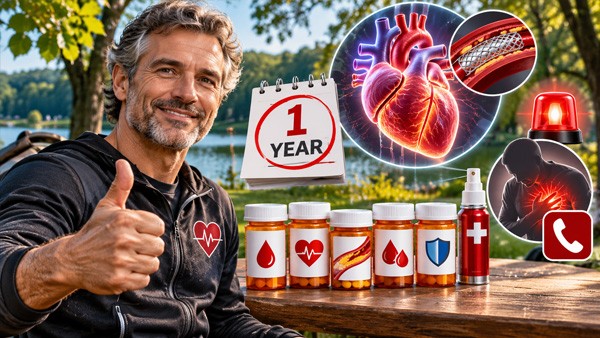

🫀 Leaving hospital after a heart attack or a stent feels like the end of the emergency. In practice it is the start of the year that matters most: the risk of a second event is highest in the first twelve months, and most of that risk is in your hands, not the cardiologist’s. The procedure fixed one narrowed artery. The tablets, the habits and knowing which chest pain to act on protect all the others.
📌 This page is the practical version: what each tablet is for and how long you take it, the one drug you must never stop on your own, the numbers to aim for, what to do when chest pain comes back, and when driving, work, sex and flying are realistic again. For the background on angina itself, the types of angina and how they are treated covers it.
🧩 What actually happened, and why the stent is not the cure
🩺 A heart attack happens when a fatty plaque inside a coronary artery cracks, a clot forms on it and blocks blood flow to part of the heart muscle. A stent opens that one spot. It does nothing for the same disease in the rest of your arteries, where other plaques are sitting, some of them just as likely to crack.
🔎 That is why the treatment afterwards is aimed at the whole artery tree: make the blood less likely to clot, shrink and calm the plaques, and lower the strain on the heart. Each of the five medicine groups below does one of those jobs. None of them replaces another.
| 🏥 Situation | 📝 What it means for the year ahead |
|---|---|
| 🚨 Heart attack treated with a stent | The most common route. Two antiplatelet drugs for usually twelve months, plus the full set of preventive medicines and cardiac rehabilitation |
| 📅 Planned stent for stable angina | No heart attack, but the same artery disease. Second antiplatelet often for about six months, sometimes shorter if bleeding risk is high |
| 💊 Heart attack treated with medicines only | Where a stent was not possible or not needed. The medicines matter even more, because nothing mechanical was fixed |
| 🩺 Bypass surgery | New routes for blood around the blockages. Longer recovery from the operation itself, then the same long-term medicines and habits |
| 📉 Heart muscle weakened by the attack | Shown on the heart scan as a reduced pumping fraction. Beta-blockers and ACE inhibitors become essential rather than optional, and the approach overlaps with long-term heart failure care |
💊 The five medicine groups, and what each one is for
📋 People leave hospital with four to six new tablets and very little idea which does what. Knowing the job of each one is what stops people quietly dropping the “less important” ones — which is how most avoidable second events start.
🩸 1. Antiplatelets — stop clots forming
Aspirin for life, plus a second drug such as Plavix (Clopidogrel) for a fixed period. The most important tablets in the first year.
🧪 2. High-intensity statin — stabilise the plaques
Lipitor (Atorvastatin) 80 mg or Crestor (Rosuvastatin) 20-40 mg, whatever your cholesterol was before. Started in hospital, taken for life.
💓 3. Beta-blocker — slow and protect the heart
Zebeta (Bisoprolol) or Toprol XL (Metoprolol). Essential if the heart muscle was weakened; with a normal pumping fraction, recent trials show less benefit and the length of treatment is reviewed.
🛡️ 4. ACE inhibitor — protect heart and kidneys
Altace (Ramipril) or similar, particularly after a large heart attack, with diabetes or with high blood pressure. A dry cough is the classic side effect, and the usual switch is to a related drug.
⚡ 5. Nitrate spray — for chest pain when it happens
Glyceryl trinitrate spray or tablets under the tongue. Not a preventive, a rescue. The rule for using it has its own section below.
💡 Not everyone gets all five. Some people need a blood thinner for atrial fibrillation as well, which changes the antiplatelet plan entirely — that combination is covered in atrial fibrillation and stroke prevention.
📊 How much each step actually cuts the risk
🔎 The steps add up, and none of them is decoration. The biggest single one is not a tablet at all.
🩸 The one drug you must never stop on your own
🚨 A new stent is bare metal and polymer sitting inside a blood vessel. Until the artery lining grows over it, the stent itself is a place where clots form easily. The two antiplatelet drugs are what stop that happening.
❗ Stopping the second antiplatelet early is the single biggest cause of stent thrombosis — a sudden clot inside the stent. It usually presents as a large heart attack and is fatal in a substantial share of cases. The commonest reason it happens is a dentist, a surgeon or the patient deciding to stop “just for a few days” without asking the cardiology team.
⚠️ Before any dental work, operation or endoscopy
🔹 Tell them you have a stent and take two antiplatelets, before a date is booked, not on the day.
🔹 Most dental work, including extractions, is done without stopping anything. Bleeding is handled locally.
🔹 If anyone suggests stopping, the decision goes back to the cardiologist, who weighs the bleeding risk of the procedure against the clot risk of the stent. In the first months after a stent, planned surgery is often postponed instead.
🔹 Running out of tablets counts as stopping. Order the repeat prescription a week early, every time.
⚠️ Interactions that genuinely matter with these tablets
| 💊 Combination | 📝 What happens, and what to do |
|---|---|
| 🚫 Nitrate spray or Imdur + erectile dysfunction tablets | The dangerous one. Sildenafil, tadalafil and vardenafil together with any nitrate can drop blood pressure to the point of collapse. No nitrate within 24 hours of sildenafil or 48 hours of tadalafil. If you take one and get chest pain, tell the ambulance crew which one and when |
| 💊 Anti-inflammatory painkillers | Ibuprofen, naproxen, diclofenac add bleeding risk on top of two antiplatelets, and raise cardiovascular risk on their own. Paracetamol is the default instead. Which painkiller suits whom is in who should avoid anti-inflammatories |
| 🧪 Clopidogrel + omeprazole or esomeprazole | These two stomach protectors reduce clopidogrel activation in the liver. Pantoprazole is the usual choice instead when stomach protection is needed |
| 🍊 Simvastatin + grapefruit, clarithromycin and some others | Raise simvastatin levels and muscle side effects. Atorvastatin is affected less, rosuvastatin hardly at all |
| 🌿 Herbal supplements | Ginkgo, high-dose fish oil, garlic and ginger capsules add to bleeding risk on antiplatelets. Declare everything, including things bought in a health food shop |
| 🩸 Antiplatelets + a blood thinner | Sometimes necessary, for example with atrial fibrillation. Bleeding risk rises sharply, so this triple combination is kept as short as possible and planned by cardiology. Warfarin specifics are in warfarin, INR and bleeding risk |
⚡ When chest pain comes back: the spray rule
📘 Chest pain after a stent does not automatically mean another heart attack. A significant minority — roughly one in five — get some angina again within a year, from a narrowing elsewhere or, less often, from re-narrowing inside the stent. What matters is telling apart pain that settles from pain that does not, and the spray rule does that for you.
📋 Pain that settles with the spray still needs reporting. Angina that is new, more frequent, triggered by less effort, or waking you at night is called unstable angina, and it is seen within days, not at the next routine appointment. For steady angina that limits you, a long-acting nitrate such as Imdur (Isosorbide Mononitrate) or Norvasc (Amlodipine) is often added. Imdur is taken once in the morning so the body gets a nitrate-free night, which keeps it working.
👩 Warning signs that do not look like chest pain
🔹 Women, people with diabetes and older people more often have a heart attack without classic crushing chest pain.
🔹 Breathlessness out of proportion to effort, pain in the jaw, neck, back or either arm, nausea, sweating, or sudden exhaustion.
🔹 If it is the same feeling you had the first time, treat it as the first time, whatever it looks like.
🎯 The numbers to aim for
📊 Targets after a heart attack are tighter than for someone without heart disease. Most people are not at all of them a year later, and the gap is usually closed by a dose change or an added tablet, not by anything dramatic.
| 🎯 Measure | 📝 Target, and what is done if you are above it |
|---|---|
| 🧪 LDL cholesterol | Below 1.4 mmol/L (55 mg/dL), and at least halved from where you started, in European guidance. If a high-intensity statin does not get there, Zetia (Ezetimibe) is usually the next step. More on the numbers in high cholesterol and what it shapes |
| 🩸 Blood pressure | Under 130/80 for most people, if tolerated without dizziness. The approach is set out in arterial hypertension and what it does over time |
| 💓 Resting heart rate | Often 55-70 beats a minute on a beta-blocker, particularly if angina persists |
| 🍬 Diabetes control | An HbA1c around 53 mmol/mol (7%) for most, with newer diabetes drugs that also protect the heart preferred where possible |
| 🚭 Smoking | Zero, including vaping as a long-term habit. Stop-smoking medicines are safe after a heart attack and roughly double the chance of quitting |
| 🚶 Activity | Around 150 minutes a week of moderate activity, built up gradually through cardiac rehabilitation |
🧪 Statin side effects, and the honest data
💪 Muscle aches are the commonest reason people stop a statin. When tested properly, most of those aches turn out not to be caused by the statin at all. In one trial, people took statin, placebo and nothing in random months without knowing which was which.
🏃 Cardiac rehabilitation, the most skipped treatment
📉 Cardiac rehab is a structured programme of supervised exercise, education and support, usually over six to twelve weeks. It lowers the chance of another heart attack and of being readmitted to hospital, and it is the most reliable way back to normal activity with confidence. It is also the treatment people are least likely to actually receive.
↳ Lower still among women, older people and those living far from a centre.
↳ Usually because nobody referred them, or the referral letter was never followed up.
🚗 Driving, work, sex and flying
📅 These are the questions people want answered and are often too embarrassed or too tired to ask. Rules differ between countries and depend on how the heart attack was treated, so treat the times below as typical, and check your own with the team.
🧠 The part nobody warns you about: mood
😔 About one in five people become clinically depressed after a heart attack, and many more go through weeks of anxiety, poor sleep and fear of every twinge. That is not weakness. It is common, it is treatable, and it matters medically: depression after a heart attack is linked to worse outcomes, partly because people stop taking tablets and stop going to rehab.
Tiredness for several weeks is normal. Persisting low mood beyond that is not
Cardiac rehab is the best treatment for it, because you exercise with monitoring
Sertraline is the one with the most safety data after a heart attack
Often as frightened as the patient, and welcome at rehab sessions
🍽️ Food, alcohol and weight, without the fads
🥗 A Mediterranean-style diet — vegetables, pulses, whole grains, fish, olive oil and nuts — is the pattern with the best evidence after a heart attack. It works alongside the statin, not instead of it. Plant sterol spreads and supplements lower LDL a little but have not been shown to prevent heart attacks.
🍷 Alcohol within low-risk limits, spread through the week and with alcohol-free days. Binge drinking raises blood pressure and triggers rhythm problems. Weight loss helps blood pressure, cholesterol and diabetes, and the aim is steady loss rather than anything rapid.
🗿 Six things people believe that are wrong
| 💭 The belief | ✔️ What is actually the case |
|---|---|
| “The stent fixed it, so I am cured.” | The stent opened one narrowing. The disease is in all the arteries, and the tablets are what protect the rest |
| “My cholesterol was normal, so I do not need a statin.” | After a heart attack the statin is given whatever the starting level. It stabilises plaques as well as lowering the number |
| “I can stop the blood thinners for a dental extraction.” | Almost never needed, and dangerous in the first months. Dentists handle bleeding locally |
| “Chest pain that goes away with the spray is nothing.” | It still needs reporting, and new or worsening angina is seen within days |
| “Exercise could bring on another heart attack.” | Graded exercise through rehab lowers the risk. Inactivity is the riskier choice |
| “Statin aches mean I cannot take statins.” | Most aches come back on a dummy tablet too. A switch or a lower dose usually works |
🚨 When to act, and how fast
🚨 Call an ambulance now
Chest pain not settled ten minutes after two sprays · severe chest pain at rest · pain like the original heart attack · sudden severe breathlessness · fainting or collapse · signs of stroke: face drooping, arm weakness, slurred speech · vomiting blood or black tarry stools on antiplatelets
🟡 Within days
Angina that is new, more frequent or brought on by less effort · needing the spray more often · ankle swelling or breathlessness lying flat · palpitations · nosebleeds or bruising that are getting worse · anyone suggesting you stop an antiplatelet
🟢 At the next review
Your LDL and blood pressure against target · the planned stop date for the second antiplatelet · whether you still need the beta-blocker · rehab referral if it never happened · low mood or anxiety · side effects you have been putting up with · flu and pneumococcal vaccines
❓ Frequently asked questions
How long do I take clopidogrel after a stent?
Usually twelve months after a heart attack and about six months after a planned stent, sometimes shorter if bleeding risk is high. The date is set by cardiology. Never stop it early on your own.
Do I need a statin if my cholesterol was normal?
Yes. After a heart attack a high-intensity statin is given whatever the starting level, because it stabilises plaques and lowers the risk of a second event.
What do I do if chest pain comes back?
Sit down and use one spray under the tongue. If not settled after five minutes, use a second. If still not settled five minutes later, call an ambulance and chew 300 mg aspirin unless allergic.
Can I take erectile dysfunction tablets after a heart attack?
Often yes, once recovered, but never with any nitrate. No nitrate within 24 hours of sildenafil or 48 hours of tadalafil, because blood pressure can fall dangerously.
Can I have dental work on two antiplatelets?
Most dental work, including extractions, is done without stopping anything. Tell the dentist in advance, and send any suggestion to stop back to your cardiologist.
What should my LDL cholesterol be?
Below 1.4 mmol/L, or 55 mg/dL, and at least halved from your starting level, in European guidance. Ezetimibe is usually added if a statin alone does not get there.
Which painkiller is safe after a heart attack?
Paracetamol is the default. Ibuprofen, naproxen and diclofenac add bleeding risk on antiplatelets and raise cardiovascular risk, so they are avoided.
When can I drive again?
For a car, typically one to four weeks depending on the country and how you were treated. Bus and lorry licences have stricter rules and a formal assessment.
Is cardiac rehabilitation worth it?
Yes. It lowers the risk of another heart attack and of readmission, and rebuilds confidence with exercise. Fewer than half of eligible people attend, so ask if you have not been referred.
Is feeling low after a heart attack normal?
Tiredness for some weeks is normal. About one in five develop depression, which is treatable and worth raising, because it affects recovery and adherence to treatment.
📑 Sources and editorial
- 📘 European and American guidelines on the management of acute coronary syndromes and chronic coronary syndromes, including secondary prevention after myocardial infarction and percutaneous coronary intervention
- 🩸 Guidance and trials on the duration of dual antiplatelet therapy after acute coronary syndrome and after elective stenting, including shortened regimens in high bleeding risk patients
- 🚨 Registry and trial data on stent thrombosis, its timing, mortality and the association with premature discontinuation of antiplatelet therapy
- 📊 Registry data on the rate of recurrent cardiovascular events in the first year after myocardial infarction
- 🧪 Cholesterol Treatment Trialists meta-analyses of statin therapy, including risk reduction per 1 mmol/L fall in LDL cholesterol, and guidance on LDL targets and ezetimibe add-on
- 💪 The SAMSON n-of-1 randomised trial of statin, placebo and no-tablet periods in people who had stopped statins because of side effects
- 🩸 Antithrombotic Trialists Collaboration meta-analysis of aspirin in secondary prevention of vascular events
- 💓 Trials of beta-blockers after myocardial infarction with reduced and preserved left ventricular ejection fraction, including recent randomised trials in the reperfusion era
- 🛡️ Evidence for angiotensin-converting enzyme inhibitors after myocardial infarction, particularly with left ventricular dysfunction, diabetes or hypertension
- ⚡ Guidance on sublingual glyceryl trinitrate use and emergency escalation in angina, and on long-acting nitrates including the nitrate-free interval
- 🚫 Prescribing information and guidance on the contraindication of phosphodiesterase-5 inhibitors with nitrates
- 🧪 Evidence on the interaction between clopidogrel and proton pump inhibitors metabolised by CYP2C19
- 💉 The IAMI randomised trial of influenza vaccination after myocardial infarction
- 🚭 Cochrane review of smoking cessation and mortality in patients with coronary heart disease
- 🏃 Cochrane review of exercise-based cardiac rehabilitation, and national audits of cardiac rehabilitation uptake
- 🚗 Licensing authority guidance on driving after acute coronary syndrome and coronary intervention, and aviation guidance on flying after myocardial infarction
- ❤️ Scientific statements on sexual activity and cardiovascular disease
- 🧠 Studies of depression prevalence after myocardial infarction, its association with outcomes, and the safety of sertraline in this population
- 🥗 Evidence on Mediterranean-style diets in secondary prevention of coronary heart disease
- 📖 Related reading: types of angina and how they are treated, high cholesterol and what it shapes, arterial hypertension over time, long-term heart failure care, atrial fibrillation and stroke prevention, leg pain when you walk
- 🛒 Related products: Plavix (Clopidogrel), Lipitor (Atorvastatin), Crestor (Rosuvastatin), Zetia (Ezetimibe), Zebeta (Bisoprolol), Toprol XL (Metoprolol Succinate), Altace (Ramipril), Imdur (Isosorbide Mononitrate), Norvasc (Amlodipine)
- 🩺 RXshop Editorial Team — reviewed by Robert Hayes, MD, FACC — Cardiologist
Medical Disclaimer: The information in this article is for educational and informational purposes only and is not a substitute for professional medical advice, diagnosis, or treatment. Always seek guidance from a qualified healthcare provider with any questions you may have regarding a medical condition, and before starting, stopping or changing any medication.