Jet Lag: How to Reset Your Body Clock Faster


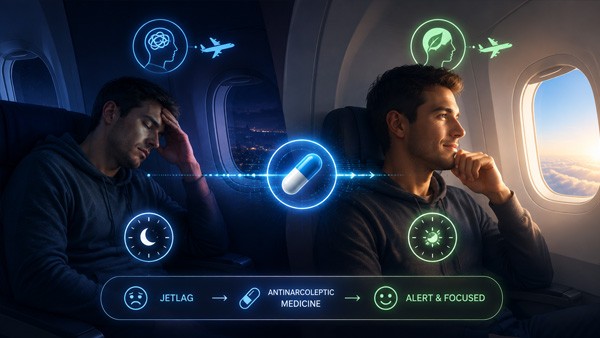
Jet lag is not tiredness from travelling. It is a mismatch between the time on the clock outside and the time on the clock inside, and the two consequences of that are quite different: an internal system running on the wrong schedule, and a person who is exhausted at lunchtime and wide awake at three in the morning.
The distinction matters because it determines what helps. Resting more does not fix a clock that is set wrong. What fixes it is giving the body the signals it uses to reset — and the single most powerful of those, light, moves the clock in opposite directions depending on when you get it. Getting the timing wrong makes jet lag worse, which is why some people arrive, spend the morning in the sun, and feel no better on day four.
🧠 The rule underneath everything below: light in the hours before your body clock reaches its low point pushes the clock later; light after that point pulls it earlier. So the same walk in daylight helps a westward traveller and harms an eastward one, depending purely on when it happens. This is the piece almost every jet lag article leaves out, and it is the piece that determines whether the advice works.
🌍 What is actually misaligned
The body runs on an internal clock housed in a small region of the brain, which governs not just sleep but core temperature, hormone release, digestion, alertness and cognitive performance. It is synchronised to the outside world mainly by light reaching the eyes.
Fly across several time zones and every one of those rhythms is still running on origin time. Melatonin releases hours late, core temperature bottoms out in the afternoon, digestive enzymes arrive at the wrong moment, and alertness peaks in the middle of the night.
The clock does resynchronise, but slowly — roughly one time zone per day, and often less going east. A six-hour trip therefore takes the better part of a week to resolve on its own, which is longer than most trips.
Symptoms follow from the misalignment rather than from the flight: difficulty sleeping at destination night, sleepiness during the day, reduced concentration and reaction time, irritability and low mood, digestive upset and constipation, and a general sense of being unwell that has no other explanation.
↔️ Why east is harder than west
Everyone who travels regularly notices this, and there is a specific reason for it.
Left with no external cues, the human body clock runs slightly longer than twenty-four hours — typically a little over. Every day it is nudged back into line by morning light. That built-in tendency means the clock finds it easier to be pushed later than pulled earlier.
Flying west requires a delay: staying up later and waking later. That is the direction the clock naturally drifts, so it happens comparatively easily. Most people manage roughly one and a half to two zones a day.
Flying east requires an advance: going to sleep earlier and waking earlier when the body is not ready for either. That works against the natural drift, and adjustment is slower — often around one zone per day or less.
There is a further complication going east across many zones. If the shift required is large enough, the body can sometimes resynchronise by going the long way round, delaying instead of advancing, which produces an unpredictable and prolonged adjustment. This is why eight-hour eastward trips feel disproportionately worse than the arithmetic suggests.
🛫 Jet lag is not travel fatigue
These get conflated and they behave differently.
| Travel fatigue | Jet lag | |
|---|---|---|
| Cause | Long journey, cramped seating, dehydration, disrupted routine, cabin conditions | Body clock misaligned with local time |
| Requires crossing time zones | No — occurs on long north-south flights too | Yes |
| Recovery | One good night of sleep | Roughly one day per time zone |
| What helps | Rest, hydration, moving about | Light timing, sleep scheduling, melatonin |
Someone flying north to south for twelve hours arrives exhausted and has no jet lag at all. Someone flying four hours east across four zones may feel physically fine and still be waking at four in the morning for the next few days.
☀️ Light, and getting the direction right
Light is by far the strongest signal available, and it works in both directions depending on timing relative to one specific point in the body cycle.
That point is the low point of core body temperature, which falls roughly two to three hours before your usual wake time. Before it, light delays the clock. After it, light advances the clock. That single fact generates all the practical advice.
| Direction | You need to | Seek light | Avoid light |
|---|---|---|---|
| Westward | Delay the clock | Late afternoon and evening at destination | Early morning at destination |
| Eastward, up to about 6 zones | Advance the clock | Morning at destination | Late evening at destination |
| Eastward, more than about 8 zones | Advance the clock, carefully | Late morning and midday for the first days, moving earlier each day | Early morning for the first days — it can push you the wrong way |
That third row is the counterintuitive one and it is worth understanding. After a very long eastward trip, local sunrise may arrive before your body has reached its temperature low point. Light at that moment delays rather than advances, sending you further from where you want to be. Wearing sunglasses in the destination early morning for the first day or two, and getting bright light later in the morning instead, avoids that.
Practically: outdoor daylight is far brighter than any indoor lighting and is the tool of choice. Where daylight is not available at the right time, a light box designed for circadian use works. Sunglasses are the tool for the avoidance half, which people consistently forget is equally important.
💊 Melatonin
Melatonin is a signal rather than a sedative. Taken at the right time it tells the clock that night has arrived, and it shifts the clock in the direction of that signal. Taken at the wrong time it shifts the clock the wrong way.
For eastward travel, which is where the evidence is strongest, it is taken at the destination bedtime on arrival and for the first few nights. Some protocols begin it a day or two before departure, at a time corresponding to the destination evening.
For westward travel it is less useful, since the main task is staying awake later and light does most of the work.
Two practical points are consistently mishandled. The dose is small — the evidence supports doses well below what is commonly sold, and larger amounts do not shift the clock better while making people groggy. And timing matters more than dose, because the effect is directional.
Availability differs by country: prescription-only in many, sold as a supplement in others, where quality and actual content vary considerably between brands.
📅 Adjusting before you leave
Shifting the clock partially before departure reduces the gap on arrival, and it is the most effective thing available for anyone who can plan.
Going east, move bedtime and wake time earlier by an hour a day for the three days before travel, with bright light immediately on waking and dim light in the evening.
Going west, move both later by an hour a day, with light in the evening and darkness protected in the morning.
Even a partial shift helps disproportionately, since it reduces the number of zones the body has to cover after arrival. For a short trip — two or three days — the opposite strategy is often better: stay on home time entirely, schedule what matters for the hours when you are naturally alert, and avoid trying to adapt to a clock you are about to leave.
🛏️ On the plane and on arrival
Set your watch to destination time when you board, and start thinking in it. This sounds trivial and it structures every subsequent decision.
Sleep on the plane only if it is night at your destination. Sleeping because you are tired, when it is the destination afternoon, entrenches the misalignment. If it is destination night, use an eye mask and earplugs and try. If it is not, stay awake.
Drink water and go easy on alcohol. Cabin air is very dry, and alcohol fragments sleep badly and worsens the following day.
On arrival, adopt local time immediately — meals, activity, bedtime. Eating at destination mealtimes contributes a modest additional signal to the peripheral clocks in the liver and gut.
Nap carefully or not at all. If you must, keep it short and early in the destination afternoon, so it does not reduce the sleep pressure you need for that night.
Get outside. Daylight at the correct time, as set out above, is the intervention that actually moves the clock.
☕ Caffeine, used deliberately
Caffeine is genuinely useful for jet lag and is frequently used badly.
It improves alertness and performance during the destination day, which helps you stay awake and get the light exposure that does the real work. What it does not do is shift the clock, and taken late it prevents the sleep that consolidates the shift.
Its half-life is around five hours, longer in some people, so an afternoon coffee is still measurably present at bedtime. A reasonable rule when adjusting is to stop by early afternoon destination time.
Worth noting that the older article this replaces described armodafinil as superior to caffeine because of fewer contraindications. That has it backwards: caffeine has far fewer contraindications than any prescription wakefulness drug, which is a controlled substance with a specific list of cautions. Caffeine has other limitations, but that is not one of them.
💊 Where wakefulness medication fits
Modafinil and armodafinil are used for jet lag, and being accurate about their role is more useful than being enthusiastic.
What they are licensed for is excessive sleepiness in narcolepsy, in shift work sleep disorder, and as an addition where sleepiness persists despite treated sleep apnoea. Jet lag is not among them, so this is off-label use.
What they do is suppress sleepiness and improve alertness and sustained attention for the day — and the benefit is largest in people who are sleep-deprived, which describes almost every long-haul traveller.
What they do not do is realign the body clock. The internal schedule remains exactly where it was; the person simply does not feel the consequence for a while. Jet lag will resolve at the same rate whether or not the tablet is taken.
That defines the sensible use case: someone who has to function on day one or two — a presentation, a negotiation, a competition, driving — and cannot wait out the adjustment. It is a bridge across a specific gap, not a treatment.
⚠️ Half-life is the deciding factor for travel. The task in jet lag is to be alert during the destination day and asleep during the destination night, and a drug still working at bedtime defeats the second half. Modafinil, with a half-life around twelve hours, suits this better than armodafinil at around fifteen. Whichever is used, it belongs early in the destination morning — taken at midday it will still be working when you need to sleep, which entrenches the misalignment it was meant to help you tolerate.
The usual cautions apply and are not trivial: it is a prescription controlled substance in most countries; it reduces the effectiveness of hormonal contraception during use and for a month afterwards; any rash requires stopping and medical assessment; and it is avoided in significant cardiac disease, in pregnancy, and with caution in anxiety or bipolar disorder. Anyone taking it for the first time should not do so on the day of an important event.
🛌 Sleeping at the destination
The other half of the problem is falling asleep when the body thinks it is the middle of the afternoon.
Everything that normally supports sleep matters more than usual here: a dark, cool, quiet room, no screens in the hour beforehand, and a consistent destination bedtime even when it feels absurd. Protecting the sleep environment on the first two nights does more than most people expect, because it is the first consolidated destination-night sleep that anchors the shift.
Short-term sleep medication is sometimes used for the first nights, and it has real drawbacks: next-day impairment, an association with confusion at altitude and in unfamiliar settings, and no effect on the underlying misalignment. Where it is used it should be short-acting and short-lived, and never combined with alcohol.
Alcohol as a sleep aid is the common self-prescribed version and is the worst option available, because it produces early sleep and then fragments the second half of the night when the body clock is already fighting you.
⚠️ Who should take more care
Jet lag is an inconvenience for most people and a genuine risk for some.
- Epilepsy — sleep deprivation lowers the seizure threshold, and long-haul travel with disrupted sleep and missed medication timing is a recognised trigger
- Bipolar disorder — circadian disruption and sleep loss can precipitate episodes, particularly mania; eastward travel is the more commonly implicated direction
- Diabetes on insulin — dose timing across time zones needs planning in advance rather than improvisation
- Anyone on time-critical medication — including contraception, anticoagulants and transplant medicines
- Heart and lung disease — the flight itself carries considerations independent of jet lag
- Anyone driving on arrival — reaction time after a long eastward flight is measurably impaired, and this is the most underestimated risk in the whole subject
❌ What does not work
Elaborate jet lag diets, including feast and fast protocols, have little supporting evidence. Meal timing contributes a modest signal to peripheral clocks; it is not a substitute for light.
Simply toughing it out without adjusting light exposure means the clock resets at its natural rate of about a day per zone, and nothing has been gained.
Sleeping as much as possible on arrival feels sensible and reliably prolongs the problem, because it removes the daylight exposure that does the resetting.
Homeopathic jet lag remedies have no evidence behind them.
Blue-light-blocking glasses worn indiscriminately are not a strategy. Blocking light matters at specific times and in a specific direction, and worn at the wrong moment they prevent the exposure that would have helped.
✅ If you only do three things: shift your sleep an hour a day toward destination time for the two or three days before you fly; on arrival get outdoor daylight at the right time for your direction and actively avoid it at the wrong time; and hold the destination bedtime from the first night even when it feels ridiculous. Those three account for most of the achievable benefit, and none of them costs anything.
Where alertness on a specific day genuinely cannot wait, wakefulness medication is stocked in the wakefulness category, with Modalert (modafinil) being the better-suited option for travel because its shorter duration interferes less with sleeping at the destination that night. It requires a prescription and does not replace the measures above.
❓ Frequently asked questions
How long does jet lag last?
Roughly one day per time zone crossed, and often slower going east. A six-hour difference therefore takes the better part of a week to resolve on its own, which is longer than many trips. Adjusting sleep before departure and managing light exposure correctly on arrival shortens it substantially; doing nothing means waiting out the natural rate.
Why is flying east worse than flying west?
Because the body clock left to itself runs slightly longer than twenty-four hours, so it finds being pushed later much easier than being pulled earlier. Westward travel requires a delay, which matches the natural drift. Eastward requires an advance, which works against it. Across many zones eastward the clock can also resynchronise the long way round, delaying instead of advancing, which prolongs adjustment unpredictably.
When should I get daylight after arriving?
It depends on direction. Travelling west, seek light in the late afternoon and evening and avoid it in the early morning. Travelling east up to about six zones, seek morning light and avoid late evening light. Travelling east across more than about eight zones, avoid early morning light for the first days and get bright light in the late morning instead, moving earlier each day.
Why can morning light make eastward jet lag worse?
Because the clock responds to light differently either side of the low point in core body temperature, which sits roughly two to three hours before your usual wake time. Light before that point pushes the clock later; light after it pulls it earlier. After a very long eastward flight, local sunrise may fall before your body has reached that point, so early daylight delays you further from where you want to be.
Does melatonin work for jet lag?
It helps, mainly for eastward travel, taken at the destination bedtime on arrival and for the first few nights. It is a timing signal rather than a sedative, so it shifts the clock in the direction of the signal — which means the wrong timing shifts it the wrong way. The effective dose is small, well below what is commonly sold, and larger amounts do not shift the clock better while causing grogginess.
Should I sleep on the plane?
Only if it is night at your destination. Sleeping simply because you are tired, when it is the destination afternoon, entrenches the misalignment you are trying to correct. Set your watch to destination time when you board and decide from that. If it is destination night, use an eye mask and earplugs; if it is not, stay awake even though it is unpleasant.
Does modafinil cure jet lag?
No. It suppresses sleepiness and improves alertness for the day, which is genuinely useful, but it does not move the body clock at all. Jet lag resolves at the same rate whether or not it is taken. Its sensible use is as a bridge for someone who must function on day one or two — a presentation, a competition, driving — rather than as a treatment for the underlying misalignment.
Modafinil or armodafinil for travel?
Modafinil generally suits travel better. The task is to be alert during the destination day and asleep during the destination night, and armodafinil half-life of around fifteen hours is more likely to still be working at bedtime than modafinil at around twelve. Either way it belongs early in the destination morning — taken at midday it will interfere with the night sleep that anchors the adjustment.
What is the difference between jet lag and travel fatigue?
Travel fatigue comes from the journey itself — cramped seating, dehydration, cabin conditions, disrupted routine — and resolves after one good night of sleep. It happens on long north-south flights with no time zones crossed. Jet lag is misalignment of the body clock with local time, requires crossing zones, and takes roughly a day per zone to resolve regardless of how much you rest.
Should I adjust before a short trip?
Usually not. For two or three days, staying on home time is often the better strategy: schedule what matters for the hours when you are naturally alert, keep your sleep window as close to home time as circumstances allow, and avoid partially adapting to a clock you are about to leave. Adjusting is worth the effort for longer stays, where the investment pays back.
Who needs to be particularly careful?
People with epilepsy, since sleep deprivation lowers the seizure threshold. People with bipolar disorder, where circadian disruption can precipitate episodes, particularly after eastward travel. Anyone on insulin or other time-critical medication, where dosing across time zones needs planning in advance. And anyone driving on arrival, since reaction time after a long eastward flight is measurably impaired.
Do jet lag diets work?
Not meaningfully. Feast and fast protocols and similar schemes have little supporting evidence. Meal timing does contribute a modest signal to the peripheral clocks in the liver and gut, so eating at destination mealtimes is worth doing, but it is a supporting measure rather than a substitute for light exposure, which is by far the strongest signal available.
📑 Sources and editorial
- American Academy of Sleep Medicine practice parameters for the clinical evaluation and treatment of circadian rhythm sleep disorders, including jet lag disorder
- Cochrane review of melatonin for the prevention and treatment of jet lag
- Research on the human phase response curve to light and the relationship to core body temperature minimum
- Literature on the free-running period of the human circadian clock and directional asymmetry in re-entrainment
- Evidence reviews on modafinil and armodafinil for circadian rhythm sleep disorders
- FDA prescribing information for modafinil and armodafinil
- Related products: wakefulness category
- RXshop Editorial Team — reviewed by James Carter, MD, Neurology and Sleep Medicine
Medical Disclaimer: The information in this article is for educational and informational purposes only and is not a substitute for professional medical advice, diagnosis, or treatment. Always seek guidance from a qualified healthcare provider with any questions you may have regarding a medical condition, and before starting, stopping or changing any medication.