Asthma Cough or Bronchitis: Cough-Variant Asthma, the Night Cough, Why Antibiotics Fail and How Inhaled Steroids Help


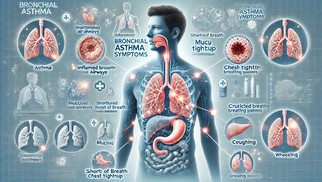
😷 A dry cough that keeps coming back after every cold, wakes you at 3 a.m. and flares on cold air or a dusty room is often called “bronchitis again”. In a large share of adults with this pattern the real cause is asthma, sometimes asthma that never makes the chest wheeze at all. Doctors call that form cough-variant asthma. 🔍 It matters because the treatment is completely different: bronchitis usually settles on its own, while an asthma cough needs an anti-inflammatory inhaler and does not respond to antibiotics or cough syrup. This guide explains how to tell the two apart, why the cough is worst at night, which tests confirm asthma when the lungs sound normal, how a trial of an inhaled steroid works, where a combination inhaler such as Advair Diskus fits, and which signs mean the cough has a different cause.
🌬️ What an asthma cough is
🧬 Asthma is a long-term inflammation of the airways that makes them oversensitive. When the lining meets a trigger, the muscle around the tubes tightens, the lining swells and extra mucus forms. In many people the first and loudest sign of this is a cough, not breathlessness. The cough is usually dry or brings up only a little clear or white phlegm, comes in fits, and is set off by things that would not bother healthy lungs: laughing, cold air, exercise, perfume, smoke or a change of room temperature. 📖 For a general overview of asthma and how a long-term plan is built, see asthma: breathing can be easy again, but it needs a plan. This article stays with one question: is the cough asthma or something else, and how is it treated.
🔇 Cough-variant asthma: asthma without the wheeze
🔊 Classic asthma comes with wheeze, a tight chest and shortness of breath. Cough-variant asthma has the same airway sensitivity, but the cough is the only symptom, or almost the only one. The doctor listens to the chest and hears nothing unusual, the chest X-ray is normal, and the person is often told it is a lingering virus. Cough-variant asthma is one of the most common causes of chronic cough in adults who do not smoke, and it also affects children. A part of adults with it later develop wheeze and typical asthma, especially if the inflammation is never treated.
🧪 A close relative is non-asthmatic eosinophilic bronchitis: the same type of inflammation with eosinophil cells in the phlegm, but without the twitchy airway muscle. Breathing tests are normal in this condition, yet it also responds well to an inhaled steroid. For the person with the cough the practical message is the same: an inflammatory cough needs an anti-inflammatory treatment.
🌙 Why the cough is worse at night and early morning
🕒 Night cough is one of the strongest clues to asthma. Airway width follows a daily rhythm, and in asthma the narrowest point falls in the early hours of the morning, roughly between 3 and 5 a.m. Several things add up while you sleep, which is why the same person may feel almost fine in the afternoon.
💡 Waking with a cough more than once a week is not a small detail. Doctors treat any night waking from asthma as a sign that the condition is not controlled, even if daytime is quiet.
⚖️ Asthma cough or acute bronchitis: the clues
🧐 Acute bronchitis is an infection of the large airways, almost always caused by a virus. It starts with a cold, the cough becomes productive, and it fades over about two to three weeks. The pattern over time is often more telling than the cough itself.
🟡 Yellow or green phlegm does not prove a bacterial infection. The colour comes from white blood cells and appears in viral bronchitis and in asthma flare-ups alike. On its own it is not a reason for antibiotics.
🗂️ Asthma, bronchitis, COPD, reflux and nasal drip side by side
| 🔎 Cause | 📋 Typical cough | 🧪 What confirms it | 💊 Main treatment |
|---|---|---|---|
| Asthma, cough-variant asthma | Dry, night and morning, trigger-driven | Spirometry with reversibility, peak flow diary, FeNO, challenge test | Inhaled steroid, reliever as needed |
| Acute bronchitis | Wet, after a cold, fades in 2 to 3 weeks | History and examination | Fluids, rest, time |
| Chronic bronchitis, COPD | Wet, every morning, smokers | Spirometry that does not fully reverse | Stopping smoking, long-acting inhalers |
| Reflux cough | After meals, lying down, hoarse voice | Response to reflux treatment | Diet, raising the bed head, acid reducers |
| Nasal drip (upper airway cough) | Throat clearing, mucus in the throat | Nose and sinus examination | Nasal steroid spray, antihistamine |
| ACE inhibitor cough | Dry, tickly, starts weeks after a new tablet | Medicine review | Switching the blood pressure tablet |
📖 If you smoke or used to smoke and cough up phlegm most mornings, the long-term bronchitis picture is covered in chronic bronchitis: the cough that does not quit.
🔁 The “bronchitis every winter” story
📆 Many adults with undiagnosed asthma tell a very similar story. The repeat is the clue: healthy airways recover after a virus, asthmatic airways stay inflamed and keep coughing for weeks.
🚫 Why antibiotics do not help an asthma cough
🦠 Antibiotics kill bacteria. An asthma cough is driven by inflammation from the immune system, and acute bronchitis is driven by viruses, so in both cases the tablets have nothing to act on. Large reviews of acute bronchitis in otherwise healthy adults show that antibiotics shorten the cough by a day at most, while causing diarrhoea, rash and thrush in some people and adding to antibiotic resistance. The cough often seems to improve after the course simply because time has passed.
- 📌 Antibiotics are considered when there are signs of pneumonia: high fever, fast breathing, chest pain on breathing, low oxygen
- 📌 Whooping cough, confirmed or suspected, is also treated with antibiotics
- 📌 In COPD flare-ups with more and darker phlegm, doctors sometimes use them
- 📌 For an asthma cough alone, the treatment that works is an inhaled steroid
📖 How a doctor decides whether a chest infection is pneumonia: pneumonia or bronchitis, the severity score and when to go in.
⏳ How long is too long
Acute: usually a cold or bronchitis
Subacute: often post-viral, asthma possible
Chronic: needs a proper search for the cause
Blood, weight loss, breathlessness: see a doctor now
🤔 A cough lasting three to eight weeks after a cold is most often post-viral and fades by itself; this is covered in cough after a cold that will not go away. When the same cough returns with every cold, wakes you at night or appears with exercise, asthma moves to the top of the list.
🩺 Tests that confirm asthma when the chest sounds normal
🔬 Asthma is diagnosed from the story plus objective proof that the airways narrow and open again. With cough-variant asthma the first breathing test is often normal, so the doctor may need a second step. A full walk-through of each test is in how asthma is diagnosed and what the tests show.
| 🧪 Test | 📋 What it shows | 💡 In a cough-only patient |
|---|---|---|
| Spirometry with reliever | Airflow before and after albuterol; a clear rise points to asthma | Often normal between flare-ups |
| Peak flow diary | Swings between morning and evening readings over 2 weeks | Variability above about 10% a day supports asthma |
| FeNO (exhaled nitric oxide) | Level of allergic type inflammation in the airways | A high level predicts a good response to inhaled steroid |
| Methacholine or mannitol challenge | How easily the airways narrow when provoked | A negative test makes asthma unlikely as the cause |
| Blood eosinophils | Allergic type white cells | Raised levels support an inflammatory cough |
| Chest X-ray | Rules out pneumonia, tumour, scarring | Normal in asthma; needed if red flags exist |
📊 A peak flow diary for a cough
📝 A peak flow meter is a cheap plastic tube that measures how fast you can blow air out. Two weeks of readings often show the morning dips that a single clinic visit misses.
🧪 The treatment trial: an inhaled steroid for a few weeks
💊 When the story fits and tests are not available or not conclusive, doctors often use the treatment as a test. A regular inhaled steroid is given for a fixed period, and a clear fall in cough supports the diagnosis. Many people notice a change within one to two weeks, though a fair trial lasts longer. If nothing changes after a proper trial with good technique, asthma becomes much less likely and the search moves to reflux, the nose or other causes.
🛡️ Inhaled steroids that treat the cough
🍃 Inhaled corticosteroids calm the inflammation at its source. They are preventers: they work only when used every day, and the effect builds over weeks. The dose that reaches the blood is small, which is why they are safe for long-term use at usual doses. For cough-variant asthma a low to medium dose is usually enough.
💡 Ciclesonide is worth knowing about for people with an asthma cough who also get a hoarse voice from other inhalers. A hoarse, irritated throat can itself keep a cough going, and a drug that is switched on mainly in the lung leaves less active steroid in the mouth and throat.
💜 When a combination inhaler like Advair is the next step
➕ If the cough and night waking continue on a regular inhaled steroid taken correctly, the usual next step is to add a long-acting bronchodilator in the same device. Advair Diskus combines fluticasone with salmeterol, a long-acting reliever that keeps the airway muscle relaxed for about 12 hours. It is taken as one inhalation twice a day, morning and evening, in strengths of 100/50, 250/50 or 500/50 micrograms; the second number is the salmeterol dose and stays the same, while the steroid dose changes.
🧭 Three facts to keep in mind with Advair Diskus:
🔹 It is a controller. It is not for sudden symptoms; a quick reliever is still needed in the pocket.
🔹 Salmeterol is never used for asthma without an inhaled steroid, which is why the combination device exists.
🔹 Once the cough has been quiet for about three months, the dose is often stepped down rather than kept high for years.
🛒 Options include Advair Diskus (Fluticasone + Salmeterol). 📖 Why salmeterol is always paired with a steroid, and how doses are stepped down, is covered in detail in salmeterol and combination inhalers for asthma. Current international asthma guidance also favours an inhaler that combines a steroid with formoterol as the reliever for many adults, so ask the doctor which scheme fits you.
⚡ The reliever: albuterol for symptoms, not for the cough every day
💨 Albuterol (salbutamol) opens the airways within minutes and lasts about four to six hours. A cough that stops after two puffs of albuterol is a useful clue that it is asthma. The usual adult dose is one to two puffs when needed. But a reliever does nothing for the inflammation underneath, and using it alone, day after day, hides a problem that keeps growing.
🛒 Reliever options include Ventolin (Albuterol), Proventil (Albuterol) and Asthalin (Albuterol). A shaky hand and a fast heartbeat after a few puffs are common and pass quickly.
💊 Montelukast as an add-on
🌙 Montelukast is a tablet that blocks leukotrienes, chemical signals that tighten and inflame the airways. It is taken as 10 mg once a day in the evening by adults and is mainly used as an add-on to an inhaled steroid, or for people who also have hay fever or exercise-related symptoms. Some studies in cough-variant asthma show that it eases the cough, and it suits people who struggle with inhalers. It is less effective than an inhaled steroid on its own.
⚠️ Mood and sleep warning: montelukast carries a boxed warning about mood changes, vivid dreams, sleep problems, agitation and, rarely, suicidal thoughts. Stop it and talk to a doctor if any of these appear, and tell the prescriber about past depression before starting.
🛒 Options include Singulair (Montelukast). 📖 When the cough and wheeze come mostly in pollen season, see pollen season asthma.
🌫️ Nebulised treatment when an inhaler is hard to use
👴 Some people cannot coordinate a puffer: older adults with weak hands, people with arthritis or during a bad flare. A nebuliser turns liquid medicine into a mist that is breathed in through a mask or mouthpiece over several minutes, with no technique to learn. Budesonide respules can be combined with a reliever in one nebulised dose. Nebulisers are not stronger than a spacer used well, but they are easier when breathing is hard.
🛒 One example is Budesal Respules (Budesonide + Levosalbutamol), used as prescribed by a doctor. The face should be washed after a mask is used, to keep steroid off the skin around the mouth and eyes.
🦠 Asthmatic bronchitis: when a chest infection lands on asthma
🤕 “Asthmatic bronchitis” is not a formal diagnosis, but it describes something real. A virus is the most common trigger of asthma flare-ups, so a person with asthma who catches a cold often gets a longer, harder cough with wheeze and breathlessness. The treatment is aimed at the asthma, not the virus.
💊 When a short course of steroid tablets is needed
📉 During a real flare-up, inhaled treatment may not be enough. Doctors then prescribe a short course of prednisolone or prednisone, usually for about five to seven days, which can be stopped without tapering after a short course. It works within a day or two. Common short-term effects are a big appetite, trouble sleeping, mood swings and higher blood sugar in people with diabetes. Needing steroid tablets more than once or twice a year is a sign that the daily treatment should be stepped up.
🎯 Inhaler technique that matters for a cough
🤔 A preventer that lands in the mouth instead of the lungs cannot calm the cough, and the leftover powder in the throat can make it worse. Poor technique is one of the most common reasons a correct treatment seems to fail. 📖 Device by device instructions are in asthma inhalers: preventer, reliever and technique.
🗣️ Side effects of inhaled steroids and how to avoid them
| ⚠️ Side effect | 📝 Why it happens | ✅ What helps |
|---|---|---|
| Hoarse voice | Steroid settles on the vocal cords | Spacer, rinse, a lower dose or ciclesonide |
| Oral thrush | Yeast grows where steroid is left in the mouth | Rinse and spit after each dose; antifungal if it appears |
| Throat irritation and cough after the puff | Powder or propellant irritates the throat | Different device type, slower breath with a spacer |
| Easy bruising, eye changes at high doses | More steroid reaches the blood over years | Lowest dose that controls symptoms, regular review |
| Salmeterol in Advair: tremor, palpitations, headache | Effect on muscles and heart | Usually mild; report a racing or irregular heartbeat |
💊 Fluticasone, the steroid in Flovent and Advair, is broken down by the liver enzyme CYP3A4. Strong blockers of this enzyme, such as ritonavir and some antifungal tablets, can raise its level in the blood and cause steroid side effects, so every doctor should know about all your medicines.
🏠 Triggers that keep the cough going
🧹 Medicine calms the airways, but a trigger met every day keeps restarting the inflammation. The biggest single one in adults is tobacco smoke, including second-hand smoke and vaping.
🔎 Other causes that look like an asthma cough
🧩 A chronic cough often has more than one cause at once. If the inhaler helps only partly, the doctor usually checks the nose, the stomach and the medicine list next.
🔮 Does cough-variant asthma turn into ordinary asthma
📈 In follow-up studies, a substantial minority of adults with cough-variant asthma go on to develop wheeze and classic asthma over the following years. Early treatment with an inhaled steroid appears to lower that risk, and a high FeNO level or raised blood eosinophils point to a higher chance. Others find the cough settles and treatment can be reduced to the lowest dose, or used only through the winter and after colds, under medical guidance.
Treated early, non-smoker, cough settles within weeks
High FeNO, allergies, cough back with every cold
Smoking, untreated for years, repeated steroid tablets
🗿 Myths about the asthma cough
🚨 When to see a doctor
⛔ Get urgent help if:
🔹 You are too breathless to speak in full sentences, your lips look blue or grey, or the reliever does not help.
🔹 You cough up blood, have chest pain, a high fever or fast breathing.
⛔ Book a visit soon if:
🔹 The cough has lasted more than 3 weeks with no sign of fading, or more than 8 weeks in total.
🔹 It wakes you at night, comes back with every cold, or comes with weight loss, night sweats or a hoarse voice that lasts.
🔹 You smoke or used to smoke and the cough has changed.
💡 Bring a list of your medicines, any peak flow readings and a note of when the cough started and what sets it off. This makes the first visit far more useful.
❓ Frequently asked questions
How do I know if my cough is asthma or bronchitis?
An asthma cough is usually dry, worse at night and early morning, set off by cold air, exercise or smoke, and returns with every cold. Bronchitis follows a cold, brings up phlegm and fades within about three weeks.
What is cough-variant asthma?
It is a form of asthma where a dry, persistent cough is the main or only symptom, without obvious wheeze or breathlessness. It is treated like asthma, with an inhaled steroid.
Why is my asthma cough worse at night?
Airways are narrowest in the early morning hours because of the body clock, and dust mites, lying flat with reflux and nasal drip add to it. Night waking means asthma is not controlled.
Do antibiotics help an asthma cough?
No. An asthma cough comes from inflammation, not bacteria. Antibiotics are needed only for confirmed bacterial infections such as pneumonia or whooping cough.
How long does an inhaled steroid take to stop an asthma cough?
Many people notice less coughing within one to two weeks, but a fair trial lasts several weeks, often up to eight, with daily use and good technique.
Can Advair Diskus be used for an asthma cough?
Yes, when a regular inhaled steroid alone has not controlled the cough. It is taken as one inhalation twice daily and is not a reliever for sudden symptoms.
Can asthma be diagnosed if my breathing test is normal?
Yes. A peak flow diary, an exhaled nitric oxide test or a challenge test can show asthma when spirometry is normal, which is common in cough-variant asthma.
Is montelukast good for an asthma cough?
It can help, mainly as an add-on to an inhaled steroid or when hay fever is present. It carries a warning about mood and sleep changes, so report any such effects.
What is asthmatic bronchitis?
It is an informal name for a chest infection, usually viral, that triggers an asthma flare-up with cough, wheeze and breathlessness. Treatment focuses on the asthma.
When should a cough be checked by a doctor?
Straight away if there is blood, chest pain, high fever or severe breathlessness. Otherwise if it lasts beyond three weeks without fading, wakes you at night or keeps coming back.
📑 Sources and editorial
- 📘 International asthma strategy reports on diagnosis, control and stepwise treatment
- 📗 Respiratory society guidelines on the assessment and management of chronic cough in adults
- 🔬 Clinical reviews of cough-variant asthma and non-asthmatic eosinophilic bronchitis
- 🦠 Systematic reviews of antibiotics for acute bronchitis in adults
- 💊 Prescribing information for fluticasone, fluticasone with salmeterol, budesonide, ciclesonide, albuterol and montelukast
- ⚠️ Regulatory safety communication on neuropsychiatric effects of montelukast
- 📖 Related reading: asthma: building a plan, how asthma is diagnosed, asthma inhalers and technique, cough after a cold, chronic bronchitis
- 🛒 Related products: Advair Diskus (Fluticasone + Salmeterol), Flovent (Fluticasone), Pulmicort (Budesonide), Ciclohale (Ciclesonide), Ventolin (Albuterol), Singulair (Montelukast)
- 🩺 RXshop Editorial Team — reviewed by Emily Chen, MD — Internal Medicine
Medical Disclaimer: The information in this article is for educational and informational purposes only and is not a substitute for professional medical advice, diagnosis, or treatment. Always seek guidance from a qualified healthcare provider with any questions you may have regarding a medical condition, and before starting, stopping or changing any medication.