Cellulitis and Skin Infections: What Needs an Antibiotic, What Needs Draining, and What Is Not Infected

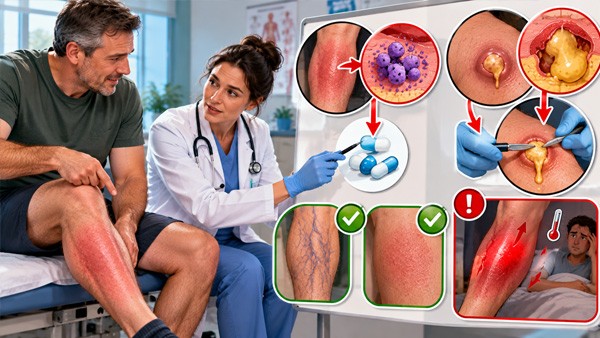

A red, hot, swollen area of skin gets one of three completely different answers: tablets, a scalpel, or nothing at all. Getting that wrong is common in both directions — people take antibiotics for skin that is not infected, and people take antibiotics for pus that needed opening.
🩹 Five things that decide what happens.
🔹 There is no test for cellulitis. It is diagnosed by looking at it, which is exactly why it is over-diagnosed. Studies of patients admitted with cellulitis find that roughly a third had something else.
🔹 Both legs red at the same time is almost never cellulitis. Cellulitis is one-sided. Symmetrical redness is venous eczema, chronic venous change or swelling from the heart or kidneys.
🔹 A boil or an abscess needs draining. Pus is a closed space with no blood supply reaching the middle, so antibiotics cannot finish it. Drainage is the treatment and the antibiotic is an extra.
🔹 Small, surface infections are treated on the skin, not swallowed. Impetigo and a single infected follicle do not need tablets.
🔹 Pain far worse than the skin looks, spreading by the hour, is a surgical emergency. That is the one pattern on this page that must not be waited on.
🗺️ The map: same redness, different depth
Skin infections are separated by how deep they sit, and the depth decides the treatment far more than the name does.
| Condition | Depth and look | What it needs |
|---|---|---|
| Impetigo | Surface only. Golden-crusted patches, often around the nose and mouth, in children | Topical antibiotic. Tablets only if widespread |
| Folliculitis | Individual hair follicles. Small pustules each centred on a hair | Usually resolves. Antiseptic wash; topical if persistent |
| Furuncle (boil) | One follicle gone deep. A tender lump that comes to a head | Warm compress, then drainage. Antibiotics often unnecessary |
| Carbuncle | Several boils joined, usually neck or back. Multiple draining points | Drainage plus antibiotics |
| Abscess | A walled pocket of pus. Fluctuant — it gives under a finger | Incision and drainage. Antibiotics alone fail |
| Erysipelas | Upper dermis. Bright red with a sharply raised border you can feel, often the face or shin, with fever early | Antibiotics. Responds well |
| Cellulitis | Deeper dermis and fat. Ill-defined border that fades into normal skin, warm, tender, spreading | Antibiotics, elevation, and finding the entry point |
| Infected bite wound | Punctures that look small and go deep | A different antibiotic from everything above |
| Necrotising infection | Fascia beneath the fat. Pain out of all proportion, firm swelling past the redness | Surgery immediately. Antibiotics do not save it alone |
🦿 What cellulitis actually looks like
- 🔹 One side only. Almost always a lower leg, sometimes an arm or the face
- 🔹 Warm to the touch, tender, and spreading over hours to a day or two
- 🔹 The border is vague, fading into normal skin rather than stopping at a line
- 🔹 There is usually an entry point, and it is often tiny — a crack between the toes, a scratch, an insect bite, an ulcer, a shaving nick, a patch of eczema
- 🔹 Fever occurs in a minority, so being afebrile does not argue against it
- 🔹 Red streaks running up towards the groin or armpit, with a tender swollen node there, mean the lymphatics are involved. It looks alarming and it responds to the same treatment
- 🔹 Blisters on the surface can occur in more severe cellulitis and are not automatically a sign of necrotising infection, though they raise the threshold for a proper look
🦶 The single most useful thing on this page: look between the toes.
🔹 Fungal infection of the toe webs is the commonest doorway for leg cellulitis. The split, soggy skin between the fourth and fifth toes lets bacteria through, and the leg above it becomes infected.
🔹 The antibiotic clears the cellulitis and leaves the doorway open, which is a large part of why it comes back.
🔹 Treating the fungus is prevention, not cosmetics. Lamisil (Terbinafine) and the rest of the antifungal range exist for this, and in recurrent cellulitis treating the feet matters as much as the antibiotic did.
🔹 Dry between the toes properly, change socks daily, and do not share towels. Unglamorous and effective.
🚨 The pattern that goes to surgery, not to a pharmacy
🚨 Necrotising soft tissue infection destroys tissue along the fascia faster than antibiotics can reach it. Hospital immediately if:
🔹 The pain is far worse than the skin looks. This is the earliest and most reliable sign, and it appears before the skin changes do
🔹 It is spreading over hours, not days, and you can see the change between one look and the next
🔹 The swelling is firm and extends beyond the red area, feeling wooden rather than puffy
🔹 The skin turns dusky, grey or purple, blisters, or goes numb. Numb skin in a painful area is especially serious
🔹 Crackling under the skin when pressed
🔹 The person is far more unwell than the skin explains — confusion, racing pulse, vomiting, low blood pressure
🔹 It is getting worse despite antibiotics that should be working
Higher risk: diabetes, immunosuppression, injecting drug use, recent surgery, liver disease, and chickenpox in children. The treatment is surgical removal of dead tissue, and every hour of delay matters.
🧐 The red leg that is not infected
This is where most unnecessary antibiotics go. If redness has been present for weeks, is on both legs, itches rather than hurts, or has a border matching the shape of something that touched it, think again.
| What it really is | What gives it away |
|---|---|
| Venous eczema (stasis dermatitis) | Both legs, itchy rather than painful, scaly and brownish, chronic, worse by evening. The commonest thing mistaken for cellulitis. Needs moisturiser, a steroid cream and compression — the opposite of antibiotics |
| Lipodermatosclerosis | Chronic tight woody skin above the ankle, the leg narrowing into an inverted champagne bottle shape. Can flare and look acutely inflamed |
| Deep vein thrombosis | Swelling with calf pain and tightness, often with little redness and no fever. Must be excluded rather than assumed — see the symptoms that need hospital today |
| Contact dermatitis | Itchy, with a border matching whatever touched it — a plaster, a boot, a cream. Covered in contact dermatitis, causes and testing |
| Gout | Centred on a joint, exquisitely tender, often the big toe, with redness spreading over the foot. See gout and the uric acid target |
| Shingles | A band on one side that stops at the midline, with burning pain before any rash. See shingles and the 72-hour window |
| Insect bite reaction | Itchy, appeared within hours, and stops enlarging after a day or two. A bite that keeps spreading on day three is a different matter |
| Chronic lymphoedema | Long-standing heavy swelling with thickened skin. It both imitates cellulitis and genuinely predisposes to it |
| Ruptured calf muscle or Achilles | Sudden onset during activity, bruising tracking down to the ankle |
| Erythema migrans | An expanding ring with central clearing after a tick bite, usually not painful |
💡 A practical rule. Cellulitis of both legs at once is so rare that a diagnosis of bilateral cellulitis should be treated as probably wrong until proven otherwise. The same goes for redness that has sat unchanged for a month.
🔪 Boils and abscesses: why tablets are the side dish
The principle here is the same one that governs a dental abscess, and it is worth stating plainly: an antibiotic carried in the blood cannot reach the middle of a pocket of pus, because that space has no circulation. Explained at length in what antibiotics can and cannot do for a tooth infection.
- 🌡️ A warm compress several times a day helps a developing boil come to a head and often lets it drain on its own
- ✂️ Incision and drainage is the definitive treatment for a fluctuant abscess. Relief is usually immediate, because the pain was pressure
- 💊 Antibiotics are added when there is surrounding cellulitis, when it is large or on the face, when the person is systemically unwell, immunosuppressed or diabetic, or when drainage was incomplete
- 🚫 Never squeeze a boil on the central face — the area from the bridge of the nose to the corners of the mouth drains towards veins inside the skull. Squeezing there is the one place this advice is more than cosmetic
- 🔄 Boils that keep returning usually mean Staphylococcus aureus living in the nose. A short course of Bactroban (Mupirocin) in the nostrils plus an antiseptic wash is how that cycle is broken, and it is far more effective than another course of tablets
- 🧴 Keep towels, razors and flannels personal while boils are active, since it spreads within households easily
- ⚠️ Recurrent boils in the armpits or groin with scarring and tunnels are probably not boils at all but hidradenitis suppurativa, which is treated completely differently
💊 Which antibiotic, and why not the others
| Situation | What is used |
|---|---|
| Cellulitis or erysipelas, straightforward | Keflex (Cephalexin) or Cephadex DT. Covers both Streptococcus and ordinary Staphylococcus aureus, which is exactly what is needed |
| Impetigo, small and localised | Bactroban (Mupirocin) ointment applied to the lesions. Tablets are not needed unless it is extensive |
| Penicillin or cephalosporin allergy | Cleocin (Clindamycin), which covers both organisms well, or a macrolide such as Zithromax (Azithromycin) where resistance is low |
| Abscess, or suspected resistant Staphylococcus | Bactrim, Doxycycline or clindamycin. Cephalexin does not cover MRSA, which matters after a drained abscess, with a previous MRSA result, or with injecting drug use |
| Animal or human bite | Augmentin or Amoxyheal CV. This is the one situation where amoxicillin with clavulanate is first choice, because bites carry Pasteurella from animals and Eikenella from humans, and cephalexin and clindamycin both miss them |
| Diabetic foot infection | Assessed and prescribed in person, never self-treated. Depth, bone involvement and circulation all change the choice |
| Ciprofloxacin, levofloxacin, moxifloxacin | The wrong class for skin. Weak against Streptococcus, and carrying tendon, nerve and aortic warnings. Widely bought for skin infection and a poor fit |
| Topical neomycin or fusidic acid | Neomycin is a frequent cause of contact allergy, so a worsening rash on it may be the cream. Fusidic acid resistance has risen sharply where it is used casually |
⏱️ How long, and what getting better looks like
Expectations here are wrong in a specific and predictable way, and it leads to unnecessary changes of antibiotic.
- 📅 Five to six days is enough for most uncomplicated cellulitis. The old ten to fourteen day habit has gone, and longer courses do not lower recurrence
- ⚠️ The redness often expands for the first 24 to 48 hours while the treatment is working. What should improve first is fever, pain and how unwell the person feels. Judging success by the red area in the first two days leads to switching a drug that was fine
- 🖊️ Draw round the edge with a pen and write the time. It turns a vague impression into a measurement, and it is the easiest thing anyone can do at home
- 🦵 Elevate the leg above the level of the hip whenever sitting. This is the single most underused measure in leg cellulitis and it does more for the swelling than any tablet. Walking around all day with the leg down slows recovery considerably
- 🟤 The colour fades last, over two to four weeks, and a brownish stain can persist for months. That is healing, not continuing infection
- 🚩 No improvement in fever and pain by 48 to 72 hours means a rethink: an undrained abscess, a resistant organism, a deeper infection, or the diagnosis being wrong in the first place
- 🍄 Antibiotics have costs — diarrhoea, thrush and resistance. New watery diarrhoea during or after a course needs attention rather than an anti-diarrhoeal; thrush afterwards is common and treatable, as in vaginal candidiasis and the fluconazole dose
🔁 Why it comes back, and how to stop that
Around one in three people who have had cellulitis of the leg has another episode within three years, and each attack damages lymphatic drainage a little more, which makes the next one easier. Prevention is therefore not optional extra advice.
- 🦶 Treat the toe webs and the toenails. The commonest doorway, and the commonest thing left untreated
- 🧴 Moisturise daily and treat eczema properly. Dry cracked skin is an entry point, and an itch-scratch cycle keeps opening it — see breaking the itch-scratch cycle
- 🧦 Compression for leg swelling, once the acute episode has settled. Reducing the oedema reduces recurrence substantially, and it is the measure most often skipped
- 🩹 Care for any ulcer or wound rather than leaving it open and uncovered
- 🧪 Control diabetes. High glucose impairs the immune response and slows healing — see choosing the first drug in type 2 diabetes
- ⚖️ Weight and venous disease both feed the swelling that feeds the infection
- 💊 Long-term preventive penicillin is offered after repeated attacks. It works while it is taken and the benefit fades after stopping, so it is a decision about years rather than weeks
🐾 Bites, which follow different rules
- 🐱 Cat bites are the worst of the common ones. Needle-thin teeth drive bacteria deep and the surface seals over it, so a tiny puncture on a hand becomes a deep infection. A large share become infected
- 🐶 Dog bites crush more and infect less, though a deep one still needs looking at
- 👊 A cut over the knuckles from hitting a mouth is the highest-risk bite there is. The joint opens when the fist clenches and seals when it relaxes, trapping bacteria inside the joint. It always needs assessment, however small it looks
- 🚫 Bite wounds are generally not stitched closed, because sealing bacteria inside is the problem. Facial wounds are handled differently by a specialist
- 💉 Tetanus cover is checked every time, and rabies risk is assessed for any animal bite depending on the animal and the region
- 🚰 Irrigate immediately and generously with running water. What happens in the first minutes matters more than what is prescribed afterwards
- 🧫 Hands, feet, joints and faces are all higher risk than the same bite on a thigh
🦶 The diabetic foot is a separate problem
⚠️ Any break in the skin of a diabetic foot is assessed in person, not managed at home.
🔹 Pain is an unreliable guide, because neuropathy removes it. A serious infection can be painless, and people walk on it for days.
🔹 If something can be probed to bone, assume the bone is involved. That changes treatment from days to weeks and may need surgery.
🔹 Circulation decides healing. An antibiotic cannot reach tissue that has no blood supply, which is why the arteries are assessed too — see leg pain when you walk.
🔹 Check feet daily, including between the toes and the soles, with a mirror if needed. This is the whole of prevention, and it is boring and it works.
🍄 When it is fungal and the cream makes it worse
Fungal infection imitates bacterial infection often enough to matter, and the two are treated in opposite directions.
- 🔹 Ringworm on the body — an expanding ring with a scaly active edge and clearer centre, itchy rather than painful
- 🔹 Between the toes — split, white, soggy skin, which is both an infection and the doorway discussed above
- 🔹 In skin folds — under the breasts, in the groin, under an abdominal fold. Red, moist, often with small satellite spots just beyond the main patch, which is the clue to yeast
- ⚠️ A steroid cream on a fungal rash makes it spread while making it look better for a few days. The itch settles, the fungus grows, and the pattern becomes unrecognisable. If a rash improves on steroid and then returns worse and wider, suspect this
- 💊 Treatment is antifungal — topical for small areas, and oral such as Lamisil (Terbinafine) or Diflucan (Fluconazole) for nails, scalp or extensive skin, chosen by site and organism
- ⏳ Courses are long. Skin takes weeks, toenails take months, and stopping early is the usual reason it returns
🧴 What to put on a wound, and what not to
- ✅ Clean running water and mild soap. That is the evidence-based answer and it beats everything in the cupboard
- ❌ Not hydrogen peroxide, not neat alcohol, not iodine poured into open tissue. They damage the cells doing the healing and do not reduce infection in a simple wound
- 💧 Cover it and keep it slightly moist. Wounds heal faster covered than scabbed dry in the open air, which is the opposite of the usual instinct
- 🧷 Change the dressing when it is wet or dirty, not on a fixed schedule for its own sake
- 🔎 Normal healing means redness confined to a few millimetres at the edge, decreasing day by day, with clear or slightly yellow fluid early on
- 🚩 Infection means redness spreading outwards, increasing pain after day two or three, thick pus, a bad smell, or fever
- 💊 Antibiotic ointment is for an infected wound, not for every graze. Routine use is how resistance to topical antibiotics developed
👶 Children, and the two that need urgency
- 🔹 Impetigo is the commonest — golden crusts around the nose and mouth, highly contagious, treated topically. Children can return to school once lesions are crusted or dry, or after 48 hours of treatment
- 🔹 Redness and swelling around an eye is an emergency, because infection behind the eye socket threatens vision. Pain on moving the eye, a bulging eye or double vision means hospital the same hour
- 🔹 Chickenpox with a rapidly worsening painful area is the classic setting for necrotising infection in a child. Anti-inflammatory medicines are avoided during chickenpox for this reason
- 🔹 Widespread blistering and peeling in a baby or toddler with fever needs assessment the same day
- 🔹 Folliculitis after a hot tub is common, usually resolves without antibiotics, and is caused by a different organism from ordinary folliculitis
- 🔹 Not every pustule is infection. Acne is inflammation of the follicle rather than a treatable infection — see how retinoids and isotretinoin clear acne
📞 When to seek help, and how fast
🚨 Emergency, now: pain far worse than the skin looks; spreading visibly over hours; firm swelling beyond the redness; skin dusky, blistered or numb; crackling under the skin; high fever with chills, confusion or faintness; redness and swelling around an eye; a hand bite over the knuckles; a rapidly worsening painful area during chickenpox.
Same day:
- Redness spreading on a leg, arm or face, especially with fever
- Any infection in a diabetic foot, however small and however painless
- A cat bite, a human bite, or any bite on a hand, foot, joint or face
- A fluctuant lump that needs draining
- No improvement in fever and pain after 48 to 72 hours of antibiotics
- Infection with a weakened immune system — chemotherapy, long-term steroids, transplant medication
Arrange a review if:
- You have had cellulitis twice or more — the prevention plan matters more than the next course of antibiotics
- Both legs are red and you have been given antibiotics for cellulitis
- Redness has been present unchanged for weeks
- Boils keep returning, which usually means nasal carriage rather than bad luck
- A rash improves on steroid cream and then comes back worse and wider
- Your legs swell and you have had one episode of cellulitis
❓ Frequently asked questions
How long do antibiotics take to work for cellulitis?
Fever and pain should improve within 48 to 72 hours. The redness often expands for the first day or two while the treatment is working, so colour is a poor early guide.
Can both legs have cellulitis at the same time?
Almost never. Symmetrical redness is usually venous eczema, chronic venous change or swelling from the heart or kidneys, and those need creams and compression rather than antibiotics.
Do I need antibiotics for a boil?
Often not. A boil needs warm compresses and then drainage. Antibiotics are added if there is spreading redness around it, if it is on the face, or if you are unwell or diabetic.
What antibiotic is used for a skin infection?
Cephalexin for straightforward cellulitis, mupirocin ointment for small impetigo, clindamycin in penicillin allergy, and amoxicillin with clavulanate for bites.
How do I know if a skin infection is serious?
Pain far worse than the skin looks, spreading over hours, firm swelling beyond the redness, dusky or numb skin, or feeling very unwell. Those mean hospital immediately.
Why does my cellulitis keep coming back?
Usually an untreated entry point, most often fungal infection between the toes, plus leg swelling. Treating the feet and using compression prevents more recurrences than antibiotics do.
Is my red leg a blood clot or an infection?
A clot usually causes swelling and calf tightness with little redness and no fever. Cellulitis is warm, tender and spreading. The two overlap enough that a clot must be excluded.
Should I put hydrogen peroxide on a wound?
No. It damages the cells that heal the wound and does not reduce infection in a simple one. Clean running water and mild soap, then cover it and keep it slightly moist.
Why did my rash get worse after using a steroid cream?
The rash may be fungal. Steroid settles the itch while the fungus spreads, so it improves briefly and returns wider. An antifungal is needed instead.
Is a cat bite worse than a dog bite?
Yes. Thin teeth drive bacteria deep and the surface seals over, so a small puncture on a hand can become a deep infection. Cat bites and hand bites both need assessment.
📑 Sources and editorial
- Infectious disease society guidance on the diagnosis and management of skin and soft tissue infections, including the classification by depth, indications for incision and drainage, and antibiotic selection by presentation
- Clinical guidance on cellulitis and erysipelas, including the absence of a confirmatory diagnostic test, the typically unilateral presentation, and treatment duration of five to six days in uncomplicated disease
- Studies of diagnostic accuracy in cellulitis, including the proportion of patients admitted with a cellulitis diagnosis who were found to have an alternative condition, and the conditions most commonly responsible
- Literature on pseudocellulitis, including stasis dermatitis, lipodermatosclerosis, contact dermatitis, gout, deep vein thrombosis, lymphoedema and ruptured calf muscle as mimics
- Guidance on necrotising soft tissue infection, including pain disproportionate to examination findings as the earliest sign, the associated systemic features, risk groups, and the requirement for urgent surgical debridement rather than antimicrobial therapy alone
- Guidance on the management of cutaneous abscess, including the primacy of drainage and the defined circumstances in which adjunctive antibiotics add benefit
- Evidence on tinea pedis and interdigital maceration as a portal of entry for lower limb cellulitis, and on treatment of the feet as a preventive measure
- Evidence on recurrence rates after an episode of lower limb cellulitis and on the role of oedema reduction, compression therapy and skin care in prevention
- Trial evidence on long-term antibiotic prophylaxis for recurrent cellulitis, including the loss of benefit after discontinuation
- Guidance on Staphylococcus aureus decolonisation with intranasal mupirocin and antiseptic washing for recurrent furunculosis
- Guidance on impetigo, including topical antibiotic therapy for localised disease, oral therapy for extensive disease, and return-to-school criteria
- Prescribing information for cephalexin, clindamycin, trimethoprim with sulfamethoxazole, doxycycline, azithromycin, amoxicillin with clavulanate and topical mupirocin
- Guidance on methicillin-resistant Staphylococcus aureus in skin infection, including risk factors and the absence of MRSA coverage with first-generation cephalosporins
- Guidance on the management of mammalian bite wounds, including the microbiology of cat, dog and human bites, the avoidance of primary closure, clenched-fist injuries over the metacarpophalangeal joints, and tetanus and rabies assessment
- Guidance on diabetic foot infection, including probe-to-bone assessment for osteomyelitis, the effect of neuropathy on pain as a guide, vascular assessment, and daily foot inspection
- Guidance on fluoroquinolone safety restrictions and their limited activity against streptococci in skin infection
- Literature on contact sensitisation to topical neomycin and on rising fusidic acid resistance associated with widespread topical use
- Guidance on superficial fungal infection of the skin, nails and skin folds, including the effect of topical corticosteroid on presentation and course, and treatment durations by site
- Evidence on wound cleansing, including the absence of benefit and the cytotoxicity of hydrogen peroxide and alcohol in open wounds, and the advantage of moist wound healing
- Guidance on periorbital and orbital cellulitis in children, and on the association between varicella infection, non-steroidal anti-inflammatory use and invasive streptococcal infection
- Related reading: what antibiotics can and cannot do for a tooth infection, thrombosis and embolism warning signs, shingles and the 72-hour window, contact dermatitis, breaking the itch-scratch cycle, leg pain when you walk, acne and how retinoids clear it
- Related products: Keflex (Cephalexin), Bactroban (Mupirocin), Cleocin (Clindamycin), Bactrim, Doxycycline, Augmentin, Lamisil (Terbinafine), antifungal range
- RXshop Editorial Team — reviewed by Emily Chen, MD, MPH — Internal Medicine Specialist
Medical Disclaimer: The information in this article is for educational and informational purposes only and is not a substitute for professional medical advice, diagnosis, or treatment. Always seek guidance from a qualified healthcare provider with any questions you may have regarding a medical condition, and before starting, stopping or changing any medication.