Ear Pain in Adults: The Causes That Are Not an Ear Infection, and the One Sign That Needs a Specialist

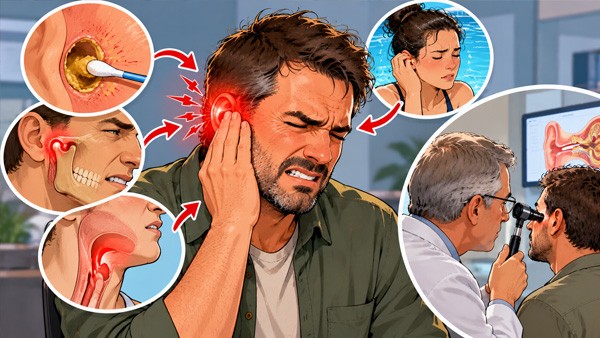

An adult with earache usually assumes it is an ear infection and often gets handed an antibiotic. In a good share of cases both the assumption and the antibiotic are wrong, and the reason is worth understanding: in adults, the ear is frequently not where the problem is.
Children get middle ear infections because their drainage tubes are short, soft and horizontal. Adult tubes are longer and steeper, so middle ear infection becomes much less common. What takes its place is a different list.
💡 Three things that sort out most adult earache before you see anyone.
🔹 Pull your outer ear, and press the small flap in front of the canal opening. If that reproduces the pain sharply, the problem is in the ear canal — the outer ear. That one movement separates the commonest adult cause from everything else.
🔹 Now press just in front of the ear and open and close your jaw. Pain, clicking or grinding there points at the jaw joint, not the ear at all.
🔹 And if neither does anything, the ear may be entirely healthy and the pain referred from the throat, teeth or neck. Which is the group that most often ends up on an antibiotic it does not need.
👍 Outer ear: the commonest one
Infection of the ear canal skin, called otitis externa and widely known as swimmer ear, is the leading cause of ear pain in adults. The canal is a warm, narrow, dead-ended tube lined with thin skin, and once that skin is damaged or waterlogged, bacteria do well there.
| Feature | What you notice |
|---|---|
| How it starts | Itching first, usually for a day or two, then soreness |
| The giveaway | Pain on touching, pulling or pressing the ear. Middle ear infection does not do this |
| Hearing | Muffled, because the canal swells shut. It returns as the swelling settles |
| Discharge | Often scant and watery rather than thick |
| Chewing | Can hurt, because the jaw joint sits against the canal |
What sets it off is reliably one of a short list: water that stays in after swimming or showering, cotton buds, in-ear headphones worn for hours, hearing aids, hot humid weather, and skin conditions like eczema or psoriasis affecting the canal.
📌 This is a drops condition, and tablets mostly do not work for it.
Oral antibiotics reach the skin of the ear canal poorly. Topical treatment put directly into the canal is the standard approach — usually an antibiotic combined with a steroid to settle the swelling, for around a week.
Two reasons it fails when it fails: the canal was too full of debris for drops to reach the skin, which needs clearing by a professional before anything works, and the ear did not stay dry. Drops cannot outrun a daily swim.
Oral antibiotics come in only when the infection spreads out of the canal onto the surrounding skin, or in the serious form below.
Keeping it dry matters more than most people expect. No swimming while it is active, and in the shower a plug of cotton wool with a smear of petroleum jelly on the outer surface keeps water out better than cotton wool alone.
🍄 When it is fungus instead
Worth knowing because the treatment is the opposite of what people reach for. Repeated or prolonged courses of antibiotic ear drops clear the normal bacteria and let fungus take over the canal.
- 🚨 Itching out of proportion to the pain is the signature — often maddening rather than sore
- 🔍 Debris that looks like wet paper, cotton wool or black specks
- ❌ More antibiotic drops make it worse. It needs an antifungal and thorough cleaning
- 📅 It is slower to clear than the bacterial kind and often needs the canal cleaned more than once
If a canal infection has not responded to two courses of antibiotic drops, this is the first thing to ask about rather than trying a third.
⚠️ The drops that must not go in a perforated eardrum.
Some older ear drops contain gentamicin or neomycin, which can damage the inner ear if they reach it through a hole in the eardrum. They are avoided when the drum is perforated or might be.
Which is why putting leftover drops from a previous episode into a discharging ear is a bad idea: discharge can mean the drum has perforated, and that changes which drops are safe. Worth having the ear looked at rather than guessing.
🚨 The serious form, mostly in diabetes
Rare, and the reason severe canal infection in an older adult is taken seriously rather than treated by text message.
Necrotising otitis externa is infection that spreads from the canal into the bone at the base of the skull. It occurs almost entirely in people with diabetes, especially poorly controlled, and in those with weakened immunity.
| Warning sign | Why it stands out |
|---|---|
| Deep, boring pain, worst at night | Out of proportion to how the canal looks, and not relieved by ordinary painkillers |
| No response to drops | Two or three weeks of treatment with no improvement |
| Granulation tissue in the canal | Lumpy red tissue at the floor of the canal, which a clinician looks for specifically |
| Facial weakness | Involvement of the facial nerve, which is an emergency |
| Treatment | Prolonged systemic ciprofloxacin, often for six weeks or more, with imaging and specialist supervision |
This is the one situation where an oral antibiotic is the centre of treating an outer ear infection, and Cipro (Ciprofloxacin) is the usual choice because of the organism involved. It is a hospital-supervised course, not a prescription to self-manage.
🦻 Middle ear infection in an adult
Less common than in children, and it tends to follow a cold, a bout of allergic rhinitis, or nasal blockage. The pattern differs from canal infection: pain is deep and throbbing, touching the ear does not make it worse, hearing is dulled, and there may be fever.
When it is genuinely bacterial, this is where an antibiotic earns its place.
| Situation | Usual choice |
|---|---|
| First line | Amoxil (Amoxicillin) — still the standard, and still effective |
| Recent antibiotic course, or no improvement after 48 to 72 hours | Augmentin (Amoxicillin + Clavulanate), which covers organisms that produce the enzyme breaking down plain amoxicillin |
| Mild penicillin sensitivity | A cephalosporin such as Ceftin (Cefuroxime) |
| True penicillin allergy | A macrolide such as Biaxin (Clarithromycin) or Zithromax (Azithromycin) |
Children are a different calculation, with watchful waiting playing a much larger role — covered in our guide to ear infection in children and which antibiotic is used. For ears that keep going wrong, or fluid that will not clear, see chronic ear infection, glue ear and grommets.
🦷 When the ear is fine and the pain is real
A large share of adults with earache have an ear that looks completely normal on examination. The pain is genuine; it is arriving from somewhere else along shared nerves.
- 🦷 The jaw joint. Probably the single commonest cause of earache with a normal ear. Pain in front of the ear, worse when chewing or first thing in the morning, often with clicking and with tooth grinding at night. The joint sits directly against the ear canal
- 🦷 Teeth, especially lower back molars and wisdom teeth. A dying tooth can present as pure earache with no tooth pain at all
- 🗣️ Throat and tonsils. Tonsillitis refers to the ear through a shared nerve. Sore throat plus one-sided ear pain plus difficulty opening the mouth suggests an abscess beside the tonsil, which needs same-day assessment — see tonsillitis and how it is treated
- 💇 The neck. Upper cervical spine problems and muscle tension refer upward into the ear
- ⚡ Nerve pain. Brief electric-shock pains lasting seconds, triggered by swallowing or touching a spot, suggest neuralgia rather than infection
- 💧 Eustachian tube trouble. After a cold or a flight: blocked, full, popping, muffled hearing, more pressure than pain. An antibiotic does nothing for this. If it keeps recurring, allergy may be the driver — see allergic rhinitis
- ✈️ Barotrauma from flying or diving, worst on descent, settling over days
- 🧹 Wax. Rarely painful on its own, but impacted wax that gets wet swells and can press against the drum
🚨 The sign that changes everything
🚨 Persistent one-sided ear pain, or a persistently blocked ear, in an adult whose ear examination is normal, needs an ENT assessment.
The reason is specific. A growth at the back of the nose, or in the tonsil, throat or base of the tongue, can block the Eustachian tube on one side or refer pain into the ear while the ear itself looks perfectly healthy. The ear is the symptom; the problem is elsewhere, out of sight without a scope.
Fluid behind the eardrum on one side only, in an adult, with no cold to explain it, is a recognised red flag and a reason to examine the back of the nose.
🔹 Take it more seriously with: a lump in the neck; hoarseness lasting over three weeks; difficulty or pain on swallowing; unexplained weight loss; blood-stained nasal discharge or repeated nosebleeds on one side; hearing loss in one ear; a history of smoking or heavy alcohol use; age over 40.
Most of these turn out to be nothing. The point is that it is checked rather than treated as earache for six months, because by far the biggest factor in the outcome is how early it is looked at.
🦠 Shingles in the ear, and the 72-hour window
Easy to miss early and worth recognising, because the timing of treatment decides the result.
The chickenpox virus can reactivate in the nerve supplying the ear. This produces severe one-sided ear pain, often before any rash appears, followed by blisters in the ear canal, on the outer ear or in the mouth on that side.
- 😠 Pain first, sometimes for a day or two with nothing to see — which is when it gets called an ear infection
- 🫤 Weakness of one side of the face, so that side does not smile or close its eye properly
- 🌀 Vertigo, ringing or hearing loss on the same side
- ⏱️ Antiviral treatment started within 72 hours gives the best chance of full facial recovery, usually with a steroid. Started late, recovery is less complete
A painful ear with blisters, or with any facial weakness, is a same-day problem. Valtrex (Valacyclovir) is among the antivirals used, and shingles and how it is treated covers the wider picture.
💊 Does it need an antibiotic?
Collected in one place, because this is the decision that most often goes wrong.
| Cause | Antibiotic? |
|---|---|
| Ear canal infection, mild to moderate | Drops, not tablets. Oral adds side effects without adding benefit |
| Canal infection spreading onto surrounding skin | Yes, oral, alongside the drops |
| Necrotising otitis externa | Yes — prolonged systemic ciprofloxacin, under specialist care |
| Fungal canal infection | No. Antifungal and cleaning. More antibiotic makes it worse |
| Bacterial middle ear infection in an adult | Yes — amoxicillin first line |
| Eustachian tube blockage after a cold or flight | No. Time, decongestion, and treating any allergy |
| Jaw joint, dental or neck referred pain | No. Treat the actual source |
| Throat infection referring to the ear | Depends entirely on the throat, not on the ear |
| Impacted wax | No |
| Shingles of the ear | No — antiviral, and urgently |
❌ What to stop doing
- 🚫 Cotton buds. They push wax inward, scratch the canal skin and strip the protective layer that keeps infection out. The canal clears itself outward — wax migrates out on its own, and nothing needs inserting to help it
- 🕯️ Ear candling. No drainage occurs, the residue in the cone is candle wax rather than ear wax, and it has caused burns and canal blockage
- 🚬 Olive oil or peroxide into a painful ear of unknown cause. Fine for softening wax in a healthy ear, unhelpful or harmful if the drum is perforated
- 🎧 Earbuds for hours in heat. They trap moisture and warmth in a closed tube, which is the exact condition canal infection needs. Give the ears dry air between uses
- 🏊 Swimming through an active canal infection, which is the commonest reason treatment fails
- 💊 A third course of the same drops without the ear being looked at again
- 🛏️ Sleeping on the painful side, which makes it worse overnight
For pain itself, paracetamol and ibuprofen work well and work better together than either alone, which covers most people while the cause is sorted out. A warm compress held against the ear helps, and takes nothing away from treatment.
📞 When to seek help
🚨 Same day: weakness of one side of the face; blisters in or around the ear; severe pain with swelling or redness spreading behind the ear; a stiff neck, severe headache, confusion or high fever with ear pain; sudden hearing loss in one ear; severe vertigo with vomiting; or ear pain with difficulty opening the mouth and a sore throat.
Book an appointment if:
- One-sided ear pain or blockage lasting more than a few weeks with a normal-looking ear — the item from the red flag section, and the reason to not simply wait it out
- Canal infection that has not improved after a week of drops, which usually means the canal needs clearing or the organism is fungal
- You have diabetes and severe ear pain, particularly deep pain at night — this is assessed differently
- Discharge from the ear, which may mean a perforation and changes which drops are safe
- Hearing has not returned once the pain settled
- Repeated episodes of canal infection, since the trigger is usually identifiable and removable
- Earache that is clearly worse on chewing, with jaw clicking — a dental or jaw assessment rather than an ear one
- A blocked ear every time you fly, which is manageable with preparation
- You wear hearing aids and the canal is sore, since fit and cleaning are usually the cause
- Ringing in one ear that persists, particularly with hearing loss on that side
- You have been given antibiotics twice for the same ear with no improvement, which means the diagnosis should be revisited rather than the prescription repeated
❓ Frequently asked questions
How do I tell an outer ear infection from a middle ear one?
Pull the outer ear or press the flap in front of the canal. Sharp pain means the outer canal. Middle ear infection is deep and throbbing, and touching the ear does not change it.
Why did my earache get antibiotics that did nothing?
Most likely the cause was not a bacterial middle ear infection. Canal infections need drops, and jaw, dental, throat and Eustachian tube causes do not respond to antibiotics at all.
What causes swimmer ear if I do not swim?
Cotton buds, in-ear headphones worn for long periods, hearing aids, shower water left in the canal, humid weather, and eczema or psoriasis affecting the canal skin.
My ear is intensely itchy rather than sore. What does that suggest?
Itching far exceeding the pain, often with debris resembling wet paper or black specks, suggests fungal overgrowth, usually after repeated antibiotic drops. It needs an antifungal, not more antibiotic.
Why does my ear hurt when I chew?
The jaw joint sits directly against the ear canal. Pain on chewing with clicking or morning tightness points to the joint rather than the ear, and is a common cause of earache with a normal ear.
When should ear pain be checked by a specialist?
Persistent one-sided pain or blockage in an adult with a normal-looking ear, especially with a neck lump, hoarseness, swallowing trouble, one-sided hearing loss, or a smoking history.
Are cotton buds bad for your ears?
Yes. They push wax deeper, scratch the canal skin and remove the layer that resists infection. The canal moves wax outward by itself and needs nothing inserted.
Which antibiotic is used for an adult middle ear infection?
Amoxicillin first line. Amoxicillin with clavulanate if there was a recent course or no improvement in two to three days, and a cephalosporin or macrolide for penicillin allergy.
Why is ear pain more serious in diabetes?
Canal infection can spread into the skull base, a condition called necrotising otitis externa. Deep pain worst at night and no response to drops in someone with diabetes needs specialist assessment.
What does ear pain with facial weakness mean?
Possible shingles affecting the nerve to the ear. Antiviral treatment started within 72 hours gives the best chance of full facial recovery, so it is a same-day problem.
📑 Sources and editorial
- Clinical guidance on the assessment and management of otitis externa in adults, including topical antibiotic and corticosteroid treatment, aural toilet, water precautions and indications for systemic therapy
- Evidence on the limited penetration of oral antibiotics into ear canal skin and the resulting preference for topical treatment in uncomplicated otitis externa
- Guidance on otomycosis, including its association with prior topical antibiotic use, presenting features and antifungal management
- Guidance on the ototoxic potential of aminoglycoside-containing ear preparations and their avoidance in suspected tympanic membrane perforation
- Clinical guidance on necrotising otitis externa, including association with diabetes mellitus and immunosuppression, presenting features, facial nerve involvement, imaging, and prolonged systemic antipseudomonal therapy
- Guidance on antibiotic selection for acute otitis media, including amoxicillin as first-line therapy, amoxicillin with clavulanate for recent antibiotic exposure or treatment failure, and cephalosporin or macrolide alternatives in penicillin allergy
- Literature on the anatomical differences in Eustachian tube orientation between children and adults and the resulting difference in incidence of acute otitis media
- Literature on referred otalgia, including temporomandibular joint dysfunction, dental sources, oropharyngeal and tonsillar causes via the glossopharyngeal nerve, cervical spine causes, and neuralgias
- Referral guidance on persistent unilateral otalgia or unilateral middle ear effusion in adults with a normal otoscopic examination, and the requirement for nasopharyngeal assessment
- Head and neck cancer referral criteria, including unilateral otalgia, unilateral hearing loss, neck lump, persistent hoarseness, dysphagia, unexplained weight loss and unilateral epistaxis
- Guidance on Ramsay Hunt syndrome, including pain preceding vesicles, facial nerve palsy, vestibulocochlear involvement, and the effect of antiviral initiation within 72 hours on facial nerve recovery
- Evidence on combined paracetamol and ibuprofen for acute pain compared with either agent alone
- Position statements on ear candling, including absence of demonstrable benefit and documented harms, and guidance against cotton bud use for ear cleaning
- Guidance on Eustachian tube dysfunction, barotrauma and impacted cerumen, and the absence of a role for antibiotics in these conditions
- Related reading: ear infection in children and which antibiotic is used, chronic ear infection, glue ear and grommets, tonsillitis, allergic rhinitis, bacterial sinusitis, shingles
- Related products: Amoxil (Amoxicillin), Augmentin (Amoxicillin + Clavulanate), Cipro (Ciprofloxacin), Ceftin (Cefuroxime), Valtrex (Valacyclovir), antibiotics category
- RXshop Editorial Team — reviewed by Emily Chen, MD, MPH — Internal Medicine Specialist
Medical Disclaimer: The information in this article is for educational and informational purposes only and is not a substitute for professional medical advice, diagnosis, or treatment. Always seek guidance from a qualified healthcare provider with any questions you may have regarding a medical condition, and before starting, stopping or changing any medication.