Living on Immunosuppressants: The Blood Tests You Cannot Skip, the Infections That Matter, and the Vaccine Rules


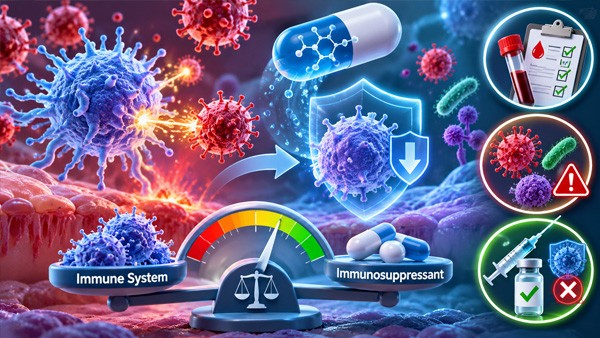
🔁 Immunosuppressants are a straight trade. You get a quieter immune system — a kidney that is not attacked, a bowel that stays in remission, joints that stop eroding — and in exchange you take on a monitoring schedule and a short list of things that are now genuinely dangerous. The drugs work. Almost everything that goes wrong afterwards goes wrong because one item on that list was never explained.
📌 Four numbers, four different lessons, and all four are in this article. What follows is the practical version: which blood tests and how often, which infections behave differently now, the live-vaccine rule that catches people out at a travel clinic, the sun rule, and the interactions that matter more than any dietary advice you will be given.
🧩 Who ends up on these, and what they are holding back
📘 The word immunosuppressant covers a wide span of drugs and an even wider span of how suppressed you actually are. Someone on a small dose of azathioprine for ulcerative colitis and someone three months out from a kidney transplant are both immunosuppressed, and almost nothing else about their precautions is the same.
| 🩺 Why it is prescribed | 📝 What the drug is doing |
|---|---|
| 🫀 After a kidney or other organ transplant | Preventing rejection, indefinitely. Usually three drugs together, at their highest intensity in the first year. There is no stopping point — the organ depends on the medication continuing |
| 🌀 Ulcerative colitis and Crohn disease | Keeping remission without repeated steroid courses. Started when someone needs steroids more than once a year. The Crohn version of that decision is in how Crohn disease behaves and what controls it |
| 🦴 Rheumatoid arthritis and related conditions | Stopping joint erosion, which is permanent once it has happened. Why the first twelve weeks matter so much is set out in early rheumatoid arthritis and the first twelve weeks |
| 🦋 Lupus and vasculitis | Protecting kidneys, lungs and nerves from ongoing inflammatory damage. Often a steroid to gain control, then a steroid-sparing drug to hold it |
| 🫁 Autoimmune hepatitis and myasthenia gravis | Two conditions where azathioprine does most of the long-term work, with the steroid tapered off once it has taken effect |
| 👁️ Severe uveitis, severe eczema, severe psoriasis | Where topical treatment has failed and the alternative is permanent damage or an unlivable condition |
🎚️ How suppressed are you, actually
🔎 This matters because every precaution on this page is scaled to it. The question to get answered explicitly is: am I on low-level or significant immunosuppression. It determines vaccine rules, infection prophylaxis, and how urgently a fever needs looking at.
💡 The rough dividing line, in practical terms.
🔹 Low-level: hydroxychloroquine, sulfasalazine, mesalamine, low-dose methotrexate, azathioprine at a standard dose, or a short steroid course. Live vaccines may still be possible, and ordinary illnesses behave much as before.
🔹 Significant: prednisolone at 20 mg a day or more for two weeks or longer, higher-dose azathioprine, any combination of two or more agents, biologics, or a transplant regimen. No live vaccines, and a fever gets assessed rather than waited out.
🔹 Profound and long-lasting: rituximab and similar, where the effect on vaccine response and infection risk persists for six to twelve months after the last dose. People forget this one because the drug was given months ago.
🧬 The one test to do before azathioprine, not after
❗ Azathioprine is broken down by an enzyme, and a small number of people have almost none of it. Give them a standard dose and their bone marrow shuts down within weeks. A blood test beforehand identifies them, and where it is available it is done routinely.
↳ Standard dose and standard monitoring.
↳ A reduced dose from the start, plus closer blood counts.
↳ Azathioprine is avoided entirely. A standard dose causes marrow failure.
🩸 The blood tests, and why the first two months are different
📅 Monitoring is front-loaded because the two things being watched for — marrow suppression and liver inflammation — almost always appear early. After that it settles into a routine that continues for as long as the drug does.
⏳ How long before any of it works
📉 Mismatched expectations end more treatments than side effects do. Steroids work in days, which is why they are used to gain control. Azathioprine takes two to three months, which is why it is started while the steroids are still tapering.
🦠 Which infections genuinely behave differently now
📋 Ordinary colds remain ordinary colds. A short, specific list changes, and knowing it is worth more than any general advice about being careful.
| 🦠 Infection | 📝 What changes, and what to do |
|---|---|
| 🌡️ Shingles | Risk roughly two to three times higher, and the episodes are more severe and more likely to leave lasting nerve pain. A painful band of blisters on one side needs Valtrex (Valacyclovir) or Zovirax (Acyclovir) started within 72 hours. The non-live shingles vaccine is safe here and worth asking about |
| 🫁 Pneumocystis pneumonia | A fungal pneumonia that essentially only occurs in the immunosuppressed. Risk rises with prednisolone at 20 mg or more for a month or more, and with transplant regimens. Prevented with low-dose Bactrim (Sulfamethoxazole + Trimethoprim) a few days a week. Presents as breathlessness on exertion with a dry cough and a normal-looking chest |
| 🧫 Cytomegalovirus | Mainly a transplant problem, concentrated in the first year. Fever with falling blood counts, or bowel or eye symptoms. Monitored by blood test in transplant programmes rather than waited for |
| 🫁 Tuberculosis reactivation | Old, dormant infection waking up. Screened for before biologics and before prolonged high-dose steroids. If you have ever lived in or travelled extensively through a high-prevalence country, say so |
| 🧀 Listeria | From unpasteurised dairy, soft cheeses, cold deli meats, pre-prepared salads and smoked fish. Causes a severe illness in the immunosuppressed and is almost entirely preventable by avoiding those foods |
| 🍄 Candida and other fungi | Oral or oesophageal thrush with steroids, particularly inhaled ones. Rinse the mouth after inhaler use. Deeper fungal infection belongs to profound immunosuppression |
| 👶 Chickenpox and measles contact | If you are not immune and are significantly immunosuppressed, contact with either is an urgent call, not a wait-and-see. Preventive treatment exists and is time-limited. Why chickenpox hits adults harder is covered in chickenpox in adults |
| 🧫 Skin and soft tissue infection | Spreads faster and the usual warning signs are blunted by steroids. A lower threshold for antibiotics, and which skin infections need one is worth reading before you need it |
🌡️ The fever rule, which is the single most important paragraph here.
🔹 Steroids suppress fever and mask pain. So an infection that would have produced a temperature of 39 and obvious tenderness may produce almost nothing. Feeling unwell without a clear reason is itself the symptom.
🔹 On significant immunosuppression, a fever gets assessed the same day, not watched for 48 hours.
🔹 Fever plus a known low neutrophil count is an emergency, and it is treated as one before any organism is identified.
🔹 Say the word immunosuppressed at the start of every medical contact, including out-of-hours and at the pharmacy counter. It changes the assessment, and nobody will guess it from your notes in time.
💉 Vaccines: the one rule that catches everyone out
📌 This is where the preventable disasters happen, usually at a travel clinic, and the rule itself is simple. Vaccines made from killed or manufactured material are safe and recommended. Vaccines containing a live weakened organism can cause the actual disease in someone significantly immunosuppressed.
✅ Safe, and actively recommended
💉 Influenza, every single year. The injected vaccine contains no live virus
💉 Pneumococcal, which is the one most often missed
💉 COVID vaccines, on the schedule for immunosuppressed people
💉 The recombinant shingles vaccine — the modern non-live one. Important given the raised shingles risk
💉 Hepatitis B, tetanus, HPV, inactivated polio
💡 Household members can have their normal vaccines, which reassures a lot of families unnecessarily worried about it
🚫 Live — avoided on significant immunosuppression
🚫 MMR, measles mumps and rubella
🚫 Chickenpox, and the older live shingles vaccine
🚫 Yellow fever — the classic travel-clinic problem, since some countries require proof of it
🚫 Oral typhoid, BCG, oral polio, rotavirus
🚫 The nasal spray flu vaccine, which children are offered. The injection is the one to have
☀️ Skin cancer, and the habit worth building now
🔎 Long-term immunosuppression raises the risk of skin cancer, mostly the squamous type, and in transplant recipients the increase is very large indeed. It is also one of the most preventable things on this entire page.
📊 On other cancers, the honest version: there is a small increase in lymphoma risk with long-term thiopurine treatment, on the order of doubling a risk that was low to begin with — a few extra cases per ten thousand people per year. That is a real consideration and it is much smaller than the risk of leaving severe inflammation untreated. It is a conversation to have, not a reason to stop.
🚫 The interactions that genuinely matter
⚠️ Most interaction warnings are theoretical. These are not. The first one on this list has killed people, and it happens because two different clinicians each prescribed something reasonable.
| ⚠️ Combination | 📝 Why, and what happens |
|---|---|
| 🚨 Azathioprine + allopurinol or febuxostat | The most dangerous interaction in this whole area. Allopurinol blocks the pathway that disposes of azathioprine, so the dose you are taking behaves like several times that dose. Result: severe, sometimes fatal bone marrow failure. The combination is either avoided or the azathioprine is cut to roughly a quarter with intensive monitoring. If anyone offers you a gout tablet, say you take azathioprine before you leave the room |
| 🍊 Grapefruit with sirolimus | Not a folk warning. Grapefruit substantially raises blood levels of sirolimus and related drugs, which means toxicity from an unchanged dose. Avoided completely, juice included |
| 💊 Live vaccines | Covered above, and worth repeating because it is a travel clinic that usually administers them, not the team who know your medication |
| 💊 Anti-inflammatory painkillers with transplant drugs | Ibuprofen and similar reduce kidney blood flow, which a transplanted kidney tolerates poorly. Paracetamol is the default instead |
| 💊 Clarithromycin, some antifungals, some epilepsy drugs | Push sirolimus and tacrolimus levels dramatically up or down through the same liver pathway. Any new prescription is checked against the transplant medication, not assumed to be fine |
| 🌿 St John wort and herbal supplements | St John wort lowers transplant drug levels enough to cause rejection. Herbal does not mean inert. Everything gets declared, including things bought in a health food shop |
| 💊 Co-trimoxazole with methotrexate | Both affect folate handling, and together they can suppress the marrow. Relevant because co-trimoxazole is also the drug used for pneumonia prophylaxis |
🧪 Sirolimus, and what is specific to it
📘 Worth being straightforward: sirolimus is not a first-line transplant drug in most modern programmes. The usual combination is a calcineurin inhibitor with an antiproliferative and a steroid. Rapacan (Sirolimus) is used in specific situations — where a calcineurin inhibitor is damaging the kidney, where skin cancers are recurring, or in certain rare conditions outside transplant altogether.
Common, dose-related, and the usual reason people cannot tolerate it
It impairs healing, so it is usually paused around planned surgery. Tell any surgeon before a date is set
Rise in most people. Checked, and often treated
Monitored, and sometimes the reason it is stopped
Measured regularly. The window between too little and too much is not wide
🦴 Steroids: the part of the bill paid later
📉 Deltasone (Prednisolone) and Predniheal (Prednisolone) do a job nothing else does as quickly. The whole reason for the drugs in the rest of this article is to get off them, or down to a small dose.
| 🦴 What long courses cost | 📝 What is done about it |
|---|---|
| 🦴 Bone loss | Begins early and is silent. Calcium and vitamin D for anyone on a prolonged course, a bone density scan, and a bone-protecting drug where the risk is high |
| 🍬 Raised blood sugar | Can tip someone into diabetes, or unbalance existing diabetes within days of starting. Glucose is checked, not assumed |
| 👁️ Cataracts and raised eye pressure | Both develop quietly over months. An eye check on long-term treatment, which almost nobody is offered unprompted |
| 🧴 Thin skin, easy bruising, poor healing | Cosmetic and also practical: small injuries become infected more readily |
| 😫 Mood, sleep and appetite | Agitation, insomnia and weight gain are dose-related and usually improve as the dose comes down. Worth saying out loud rather than enduring |
| 🚨 Adrenal suppression | The dangerous one. After more than about three weeks, your own adrenal glands have stopped producing cortisol. See the box below |
🚨 Never stop a steroid abruptly after more than about three weeks.
🔹 Your adrenal glands have switched off, and they take weeks to months to restart. Stopping suddenly means no cortisol at all, which produces vomiting, collapse and dangerously low blood pressure. This is adrenal crisis, and it is a medical emergency.
🔹 Carry a steroid card or alert, always. It tells anyone treating an unconscious patient something they cannot otherwise know.
🔹 During a feverish illness, vomiting, or before surgery, the steroid dose may need temporarily increasing rather than skipping. Get those sick-day rules written down in advance, while you are well.
🔹 If you cannot keep tablets down because of vomiting, that is a call now, not a day of waiting to see if it settles. An injectable form exists for exactly this.
🤰 Pregnancy, and the decision made in the wrong order
👶 The instinct is to stop everything before trying to conceive. For most of these drugs that is the wrong move, and in several conditions active disease is considerably more dangerous to a pregnancy than the medication is.
📋 In practice: azathioprine has more pregnancy safety data behind it than almost any other immunosuppressant and is generally continued. Mycophenolate and methotrexate are a different matter entirely — both cause serious harm to a developing baby and both must be stopped well in advance, with reliable contraception until then. Sirolimus has limited data and is usually switched. The plan is made with the specialist team before conception, which is the part that goes wrong: it gets raised at eight weeks instead of eight months.
📉 Adherence, which outranks every other factor
🔎 This is not a lecture, it is arithmetic. Roughly a third of kidney transplants lost late are lost because the medication was not taken consistently, and in autoimmune disease missed maintenance doses are the commonest single cause of a flare.
↳ Side effects nobody mentioned, cost, a complicated schedule, feeling completely well, and the belief that two missed days cannot matter.
↳ Chronic rejection, recurrence of the original disease, infection, and other causes.
✈️ Travel, dentists and surgeons
🗿 Six things people are told that are wrong
| 💭 The belief | ✔️ What is actually the case |
|---|---|
| "I am immunosuppressed, so I should avoid all vaccines." | The opposite. Inactivated vaccines are more important than ever. Only the live ones are the problem, and that is a short, specific list |
| "I feel well, so I can skip the blood tests." | A falling neutrophil count and rising liver enzymes produce no symptoms at all until something goes badly wrong. That is precisely why the tests exist |
| "Herbal supplements are safe because they are natural." | St John wort can lower transplant drug levels enough to cause rejection. Grapefruit raises sirolimus levels into toxicity. Both are natural |
| "A cold is now a serious emergency." | Ordinary viruses stay ordinary for most people on low-level treatment. It is unexplained fever, breathlessness and shingles that change, and the point is knowing which is which |
| "I should stop everything to get pregnant." | Azathioprine is usually continued. Mycophenolate and methotrexate must be stopped well in advance. The two situations could not be more different |
| "Missing a couple of days will not matter." | Around a third of late transplant losses are attributed to exactly those couple of days, repeated. In autoimmune disease it is the leading cause of a flare |
🚨 When to act, and how fast
🚨 Same day, and say you are immunosuppressed first
Any fever, or feeling significantly unwell with no clear cause · breathlessness on exertion with a dry cough · a painful blistering rash in a band on one side · spreading redness of the skin · vomiting so you cannot keep tablets down, if you take steroids · mouth ulcers with a sore throat and feeling generally ill, which can mean the marrow is suppressed · unusual bruising or bleeding · contact with chickenpox or measles if you are not immune · for transplant: a drop in urine output, or a tender swollen graft
🟡 This week
A new prescription from anyone who did not check it against your list · anyone offering you a gout tablet while you take azathioprine · a new, growing, crusting or bleeding skin lesion · persistent mouth ulcers on sirolimus · no blood test in over three months · planning a pregnancy, or being pregnant · a travel vaccination appointment coming up · planned surgery or dental work · side effects you have started quietly taking less because of
🟢 At the next routine review, raise these
Whether you have had the pneumococcal and the non-live shingles vaccine · whether the enzyme test was done before azathioprine was started · whether you need pneumonia prophylaxis at your current steroid dose · bone protection and an eye check if you have been on steroids for months · your sick-day steroid rules, written down · annual skin check · and whether the steroid dose can come down any further
❓ Frequently asked questions
How often do I need blood tests on azathioprine?
Weekly for the first four weeks, fortnightly to about week eight, then every one to three months indefinitely. The schedule restarts from weekly after any dose increase.
Which vaccines can I not have?
Live ones: MMR, chickenpox, the older live shingles vaccine, yellow fever, oral typhoid, BCG, oral polio and the nasal spray flu vaccine. Inactivated vaccines are all safe.
Can I take allopurinol with azathioprine?
Not at normal doses. Allopurinol blocks the pathway that clears azathioprine and can cause fatal bone marrow failure. The combination is avoided or the dose cut to about a quarter.
How long does azathioprine take to work?
Eight to twelve weeks before any effect, and up to six months for the full benefit. That lag is why it is started while steroids are still being tapered.
What should I do if I get a fever?
On significant immunosuppression, get assessed the same day and say you are immunosuppressed first. Steroids mask fever and pain, so feeling unwell without a cause is itself the warning.
Do these drugs raise my cancer risk?
Skin cancer clearly, which is why daily sunscreen and annual skin checks matter. Lymphoma risk roughly doubles from a low baseline, which is far smaller than the risk of untreated disease.
Can I stop prednisolone when I feel better?
Not after about three weeks of treatment. Your adrenal glands have stopped producing cortisol and stopping abruptly risks adrenal crisis. It has to be tapered.
Which foods should I avoid?
Unpasteurised dairy, soft cheeses, cold deli meats, smoked fish and pre-prepared salads, because of listeria. Grapefruit entirely if you take sirolimus or tacrolimus.
Can I get pregnant on immunosuppressants?
Often yes. Azathioprine is usually continued. Mycophenolate and methotrexate cause serious harm and must be stopped well in advance. Plan it with the specialist before conceiving.
Why is shingles more of a problem now?
Risk is two to three times higher and the episodes are more severe, with more lasting nerve pain. Start an antiviral within 72 hours, and ask about the non-live shingles vaccine.
📑 Sources and editorial
- 📘 Clinical guidelines on immunosuppressive therapy in solid organ transplantation, including standard maintenance regimens and the place of mTOR inhibitors such as sirolimus as alternative rather than first-line agents
- 📘 Guidelines on immunosuppressive and steroid-sparing therapy in inflammatory bowel disease, rheumatoid arthritis, lupus, vasculitis, autoimmune hepatitis and myasthenia gravis
- 🎚️ Published definitions of low-level versus significant immunosuppression, including corticosteroid dose and duration thresholds, and the prolonged immunological effects of B-cell depleting therapy
- 🧬 Pharmacogenomic guidance on thiopurine methyltransferase and NUDT15 testing before thiopurine therapy, including population frequencies of intermediate and absent enzyme activity and the associated risk of severe myelosuppression
- 🩸 Monitoring schedules for azathioprine and mercaptopurine, including full blood count and liver function test frequency during initiation, after dose changes and during long-term maintenance
- ⏳ Evidence on time to clinical response with thiopurines, corticosteroids and mTOR inhibitors
- 🚨 Prescribing and safety literature on the azathioprine and allopurinol or febuxostat interaction, including the mechanism of xanthine oxidase inhibition, reported cases of fatal myelosuppression and recommended dose reduction
- 🍊 Pharmacokinetic studies of grapefruit juice and other cytochrome P450 3A4 inhibitors and inducers on sirolimus and tacrolimus exposure, and on St John wort causing subtherapeutic levels and rejection
- 🦠 Reviews of opportunistic infection in immunosuppressed patients, including herpes zoster incidence and severity, Pneumocystis jirovecii pneumonia risk thresholds and co-trimoxazole prophylaxis, cytomegalovirus surveillance after transplantation, tuberculosis reactivation screening, and listeriosis and food safety guidance
- 🌡️ Guidance on the assessment of fever in the immunosuppressed patient, the blunting of inflammatory signs by corticosteroids, and the management of febrile neutropenia
- 💉 National and international immunisation guidance for immunosuppressed adults, including the contraindication of live attenuated vaccines, recommended inactivated vaccines, the timing of live vaccines relative to starting and stopping therapy, vaccination of household contacts, and the safety of recombinant zoster vaccine
- 📊 Studies of reduced vaccine immunogenicity under immunosuppression, including influenza and pneumococcal seroconversion rates
- ☀️ Epidemiological studies of cutaneous squamous cell carcinoma and basal cell carcinoma incidence in organ transplant recipients and in patients on long-term thiopurines, azathioprine-associated ultraviolet A photosensitivity, and guidance on photoprotection and skin surveillance
- 🧫 Cohort studies and meta-analyses of lymphoma risk with thiopurine therapy in inflammatory bowel disease, and of post-transplant lymphoproliferative disorder
- 🧪 Prescribing information for sirolimus, including stomatitis, impaired wound healing and perioperative management, dyslipidaemia, proteinuria, pneumonitis and therapeutic drug monitoring
- 🦴 Guidance on the adverse effects of long-term systemic corticosteroids, including glucocorticoid-induced osteoporosis prevention and bone density assessment, hyperglycaemia, cataract and glaucoma screening, and skin fragility
- 🚨 Guidance on tertiary adrenal insufficiency following corticosteroid therapy, including tapering requirements, steroid emergency cards, sick-day dose adjustment rules and the recognition and treatment of adrenal crisis
- 🤰 Reproductive safety data and guidance for azathioprine, mycophenolate, methotrexate and mTOR inhibitors in pregnancy and in men planning conception, and evidence comparing the risks of active disease with those of continued therapy
- 📉 Studies quantifying the contribution of medication non-adherence to late kidney allograft loss, and on interventions that improve adherence
- ✈️ Travel medicine guidance for immunosuppressed travellers, including yellow fever certificate requirements and waivers, food and water precautions and medication carriage
- 📖 Related reading: how Crohn disease behaves and what controls it, early rheumatoid arthritis and the first twelve weeks, chickenpox in adults and when antivirals help, which skin infections need an antibiotic, diabetic kidney disease and the numbers that matter
- 🛒 Related products: Imuran (Azathioprine), Rapacan (Sirolimus), Deltasone (Prednisolone), Predniheal (Prednisolone), Bactrim (Sulfamethoxazole + Trimethoprim), Valtrex (Valacyclovir), Zovirax (Acyclovir), Asacol (Mesalamine), immune and transplant range
- 👩⚕️ RXshop Editorial Team — reviewed by Emily Chen, MD, MPH — Internal Medicine Specialist
Medical Disclaimer: The information in this article is for educational and informational purposes only and is not a substitute for professional medical advice, diagnosis, or treatment. Always seek guidance from a qualified healthcare provider with any questions you may have regarding a medical condition, and before starting, stopping or changing any medication.